Correction in Real Time
Compound evidence detail2 SCRs / 5 parts
- Documentedthe Baumrind authoritative-parenting literature in human child development
- Documentedthe canine correlational evidence linking dog-directed caregiving styles to attachment, attention, sociability, and problem-solving outcomes (van Herwijnen 2018/2020, Brubaker and Udell 2023)
- Heuristicthe JB inference that one specific caregiving style experimentally produces the best long-term developmental outcomes in dogs
- Documenteddog attachment studies showing that classification systems can produce reliable groupings while still exposing distribution and method-design friction
- Heuristicclaims that canine attachment categories are a closed Ainsworth-equivalent taxonomy rather than an informative but still unsettled framework
In the JB methodology, indirect correction is communication, not punishment. Heuristic The categorical distinction (correction is a signal carried inside a relationship; punishment is suffering imposed on a subject) is JB's operating position; the underlying mechanics can be described in operant terms, and JB acknowledges that. What changes outcomes is the relational context the correction is delivered inside: a regulated handler, a calm floor, a dog whose attachment system reads the handler as a secure base, and a signal channel that mirrors what dogs use with each other. The operational micro-behaviors are body blocking, spatial pressure, calm vocal markers, and quiet disengagement. The dog reads them, the family means them, and the cumulative effect is the dog who needs less correction over time because the channel itself is doing the work prevention started.
For Families
The framework's preference is always prevention. Correction is what happens when prevention has not worked, and the methodology entry on correction explains how to do it without breaking the relationship.
Real-time correction has three properties. It happens immediately, while the behavior is still happening or just finishing. It is brief - a moment of information, not a campaign. It is calm - the human stays regulated, the social bond resumes within seconds. None of the corrective tools the framework uses involve fear, pain, or escalating emotional intensity.
What this looks like in practice is small social signals. Stepping into a puppy's path. Turning away from a rude solicitation. A brief calm sound. Quiet disengagement. The interaction is over before the puppy has time to interpret it as a major event. The puppy registered the information; the relationship is intact; the household tone has not changed.
What It Means
An indirect correction is a communication act with three properties. First, the signal is non-threatening: it does not increase the dog's arousal, it does not invoke fear, and it does not produce an avoidance response that would generalize beyond the moment. Second, the signal is precise: it is delivered to the specific micro-behavior the family is communicating about, at the moment the behavior is occurring, with no surplus emotional content the dog has to disentangle. Documented Third, the signal is delivered inside a regulated relational channel: the handler's state, the household calm floor, and the dog's reading of the handler as secure base are what the dog is actually responding to, more than the surface behavior of the correction itself.
The four operational micro-behaviors. Body blocking is the use of the handler's body to occupy the spatial position the dog was about to move into. The communication is "this space is not available right now" and the dog reads it as a structural fact about the environment, not as a threat to the dog. Spatial pressure is the use of forward-leaning, sideways stepping, or directional posture to communicate that the dog should redirect. The communication is directional, not punitive. Calm vocal markers are short, low, level-toned vocalizations (a brief "ah," a quiet "no," a low neutral sound) used to mark the moment the behavior occurs. The marker carries no surplus arousal, no escalation, and no emotional charge beyond the moment. Quiet disengagement is the deliberate withdrawal of the handler's attention, eye contact, or proximity in response to a behavior the family is not encouraging. The communication is "I am not engaging with that" and the dog reads it as the loss of the relational channel for the moment, not as abandonment.
The categorical distinction is operationally critical even though it is mechanistically debated. Heuristic The behavioral-science literature can describe the mechanics of an indirect correction in operant terms: a body block in the moment of a counter-jump can be described as positive punishment of the jump behavior. JB's position is that the operant description is mechanically true at one level of analysis and operationally inadequate at the level the family actually operates inside. What the dog is doing is reading the handler's state, the relational signal, and the household's chronic regulatory channel; what the family is doing is delivering a precise communicative signal inside a relationship the dog is securely attached to. The label "positive punishment" is correct under one framing and misses what the operation actually is. JB carries the categorical claim at heuristic confidence and the relational-context claim as the operationally load-bearing position.
The signal channel is dog-native. Conspecific canine communication uses body posture, spatial movement, brief vocalizations, and disengagement as primary signals. Observed-JB The intraspecific canine ethology literature documents these channels in dog-dog social interaction (Bradshaw, Bekoff, and the broader canid ethology tradition); the JB-specific application to the handler-as-signal-source is JB's operational synthesis. The dog raised in a household where the family deploys these signals is a dog who is reading a channel the dog is biologically prepared to read. The dog raised in a household where the family deploys non-native channels (verbal commands without body context, treat-marker chains, aversive devices) is a dog who is reading a channel the dog has to learn from scratch. Signal precision improves when the signal channel is native.
The handler state is the carrier wave. The Sundman et al. (2019) long-term cortisol synchrony finding (SCR-105) and the Koskela et al. (2024) heart-rate-variability coupling finding (SCR-106) establish that the dog is reading the handler's physiology in real time and across months. Documented The Parr-Cortes et al. (2024) finding that stressed-human odor impairs canine cognition (SCR-107) and the Wilson et al. (2022) olfactory stress-detection finding (SCR-058) establish that the chemical channel is operating during the correction moment too. A correction delivered by a regulated handler transmits one signal to the dog; the same correction delivered by a dysregulated handler transmits something different, because the carrier wave is different. The behavioral surface (the body block, the vocal marker, the disengagement) is the same; the relational signal the dog is reading is not. This is part of why the methodology positions handler regulation as upstream of correction technique.
The Bouton extinction asymmetry is what makes correction-as-communication structurally different from correction-as-extinction. Bouton's documented work on extinction (carried at SCR-008 and confirmed in canine populations by Gazit et al. 2005) establishes that extinguished behaviors are not erased; they are inhibited, with the original learning preserved beneath the inhibition. The behavior recurs under context renewal, spontaneous recovery, and reinstatement. Correction as extinction inherits the asymmetry: every behavior corrected via extinction leaves residue, and the residue is recoverable. Correction as communication does not target the behavior for extinction at all. The communicative signal redirects the dog inside the relational channel; the behavior is resolved at the moment, the dog reads the signal, and the underlying motivation is addressed through the structural arrangement of the household (prevention, mentorship, calm floor) rather than through repeated extinction trials. This is part of the mechanistic case for why correction-as-communication produces dogs who need less correction over time.
Why It Matters for Your Dog
The practical starting position is that the family's first correction operation is the operation on the family. A regulated handler producing a precise signal inside a calm relational channel is the operation that the four micro-behaviors are actually delivering. A dysregulated handler producing the same micro-behaviors with elevated arousal, surplus emotional charge, or escalating intensity is delivering a different signal entirely. The methodology's preference is that the family practices the four micro-behaviors first in non-correction contexts (a body block when the dog has not done anything; a spatial pressure cue during play; a calm vocal marker during a neutral moment; a quiet disengagement when the dog is calm) so that the family's body is fluent in the channel before the family deploys it under correction conditions.
The signal-precision principle applies here exactly. The communication is to the specific micro-behavior, at the moment of the behavior, with no surplus content. A vocal marker that lasts two seconds when the marker should have lasted half a second is teaching the dog something the family did not intend. A body block delivered with elevated breathing is transmitting a chemical signal alongside the spatial signal. A disengagement that becomes a stare is no longer disengagement. The precision is operationally what makes the signal a signal rather than a flood; the communication channel is preserved because the family is not flooding it.
The escalation question. The methodology's preference is that escalation is the wrong direction. If the four micro-behaviors deployed inside a regulated relational channel are not producing the communication, the operational answer is rarely to increase the intensity of the micro-behaviors; the operational answer is usually that the dog is over a regulatory threshold the household has not yet noticed, or that the structural arrangement of the household is producing the behavior at a frequency the correction channel cannot keep up with. The first move is to look at prevention, the calm floor, the rest budget, the rhythm, and the handler's own state. The correction is the moment-to-moment surface; the structural arrangement is what changes the rate.
The mistakes-feel-natural problem. Most families come into the methodology with a corrective vocabulary inherited from the broader pet-dog culture: loud "no," repeated commands, sustained eye contact, leash pops, time-outs as punishment, raised voices. Each of these is a high-arousal, low-precision signal delivered with surplus emotional content. Heuristic The methodology's observation is that families adopting the four indirect-correction micro-behaviors find the early period uncomfortable because the corrections feel insufficient: they are quieter, smaller, and less satisfying to the human's own emotional response than the inherited corrective vocabulary. The methodology's position is that the discomfort is the family unlearning its inherited expectation that a correction has to feel like something to the human in order to work for the dog. The dog is reading the channel either way; the question is which channel.
Correction in real time is the operational form of the Indirect Correction pillar. The pillar names the principle (subtle, non-threatening signals; mirrors natural canine communication; categorically distinct from punishment); the entry names the operational micro-behaviors a family deploys (body blocking, spatial pressure, calm vocal markers, quiet disengagement). The pillar acknowledges that the mechanics can be described in operant terms; the entry carries the relational-context claim as the load-bearing position. Both insist on the same operational priority: the handler\u0027s regulated state is the carrier wave the correction is delivered through, and the household\u0027s chronic relational channel is the medium the dog is actually responding to.
The most common indirect-correction failure modes are specific. First, surplus emotional content: the marker is correct, the body block is correct, but the handler's elevated arousal is transmitting an additional signal the dog is reading. Second, signal flooding: the correction becomes constant, the channel saturates, and the signals lose their precision. Third, escalation: the family encounters the early discomfort of the smaller signals and resolves it by amplifying the signals back toward the inherited corrective vocabulary. Fourth, correction without prevention: the family is using the correction channel to manage behaviors the structural arrangement of the household is producing at a rate the channel cannot keep up with. Fifth, correction without relational regulation: the family is delivering correct micro-behaviors inside a chronically dysregulated household, and the carrier wave is undermining the signal.
A note on the limit of the inference. The documented evidence supports handler-state coupling at multiple timescales (Sundman 2019; Koskela 2024; SCR-105, SCR-106), olfactory chemical signaling between handler and dog (Wilson 2022; Parr-Cortes 2024; SCR-058, SCR-107), the Bouton extinction asymmetry and canine renewal (SCR-008; Gazit et al. 2005), Hebbian circuit-level plasticity (SCR-022), and owner-managed variables as behavioral-outcome predictors (SCR-485; SCR-486). The categorical claim that indirect correction is communication and not punishment is JB's heuristic synthesis: mechanically describable in operant terms, operationally distinct because the relational context, signal channel, and handler-state carrier wave are not what an operant punishment paradigm controls. The specific four-micro-behavior intervention has not been tested in a controlled canine cohort against alternative correction protocols. The methodology's confidence rests on the convergent documented channels and the cohort-scale observation.
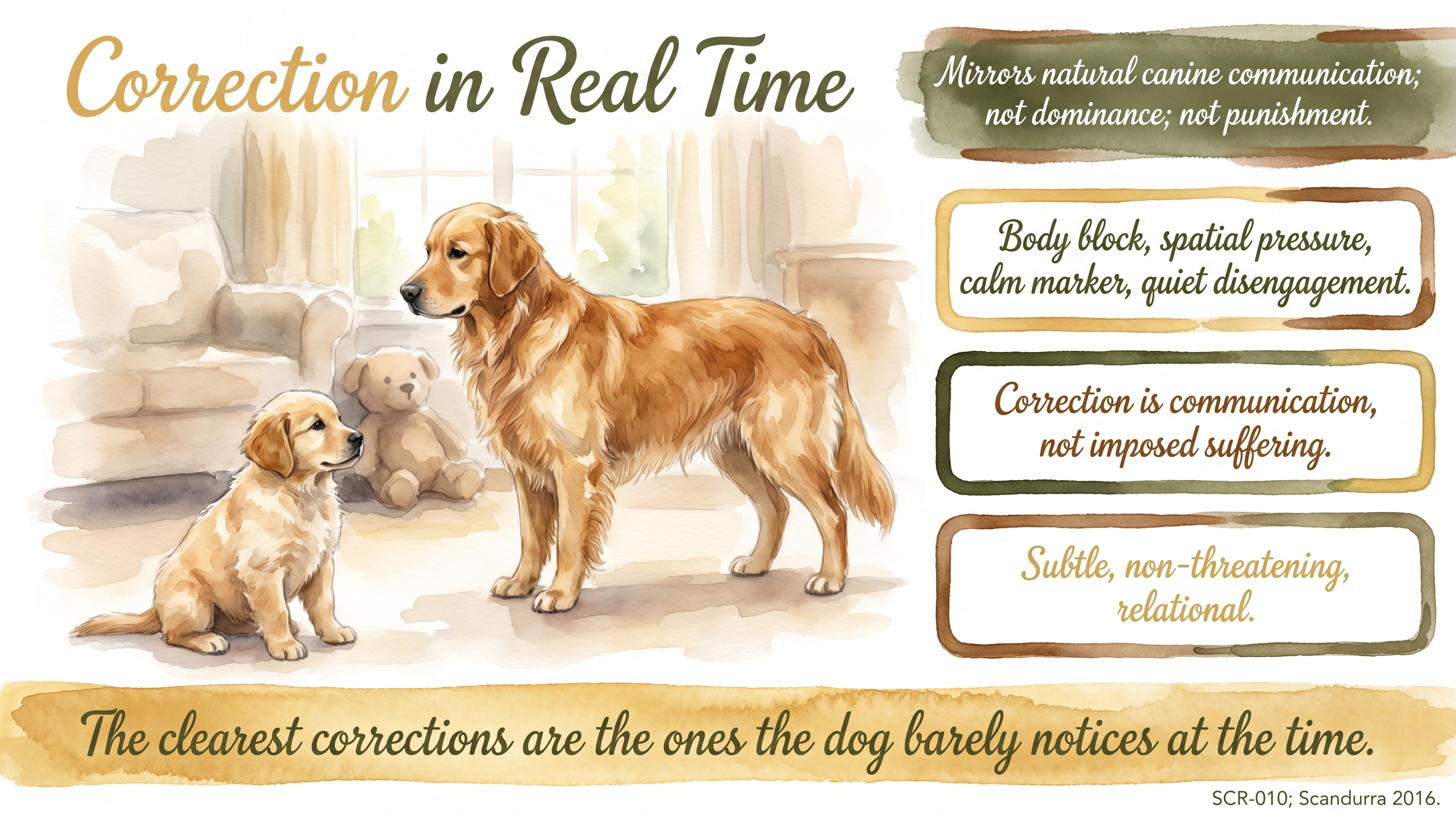
Correction is a sentence the dog already speaks.
Key Takeaways
- Indirect correction is communication, not punishment. The categorical distinction is heuristic and operationally load-bearing; the mechanics can be described in operant terms but the relational context, signal channel, and handler-state carrier wave are not what an operant punishment paradigm controls.
- The four operational micro-behaviors are body blocking (occupying the spatial position the dog was moving into), spatial pressure (directional posture and stepping), calm vocal markers (short, low, level-toned), and quiet disengagement (withdrawal of attention, eye contact, or proximity).
- The handler's regulated state is the carrier wave the correction is delivered through. Sundman 2019 cortisol synchrony, Koskela 2024 HRV coupling, and Parr-Cortes 2024 olfactory chemosignaling establish that the dog is reading the handler's physiology in real time. The same micro-behavior delivered by a regulated handler vs a dysregulated handler is not the same signal.
- Correction-as-communication is structurally different from correction-as-extinction. Bouton extinction asymmetry (SCR-008; Gazit 2005 in dogs) establishes that extinguished behaviors leave recoverable residue; communicative signals redirect the dog inside the relational channel and do not target the behavior for extinction at all. Less correction is needed over time because the channel itself is doing the work prevention started.
The Evidence
- Sundman, A.-S. et al. (2019), Scientific Reportsdomestic dogs (N=58 dog-owner dyads)
Long-term hair-cortisol concentrations synchronized between dogs and their owners across months. Owner profile drove the dog's cortisol more strongly than the reverse. The chronic carrier wave the dog's correction-channel reading is delivered inside is the household's long-term regulatory state. - Koskela, A. et al. (2024), Scientific Reportsdomestic dogs and their owners
Heart-rate-variability coupling is dyad-specific. The real-time coupling is the moment-to-moment expression of the relational channel; a correction delivered by a regulated handler transmits a different signal than the same correction delivered by a dysregulated handler, because the carrier wave is different.
- Parr-Cortes, Z. et al. (2024), Scientific Reportsdomestic dogs
Exposure to stressed-human body-odor samples impaired canine performance on a cognitive bias test. Stressed-human chemosignals are detectable by dogs and produce measurable cognitive shifts. Surplus arousal in the handler during correction is being transmitted through the olfactory channel in addition to the visible behavioral channel. - Wilson, C. et al. (2022), PLOS ONEdomestic dogs (alert-trained)
Dogs trained to discriminate human stress-related odor performed at well-above-chance accuracy. The olfactory stress-detection capacity is intact in dogs at relevant ecological levels. The chemical channel is one of the channels indirect correction is being delivered through.
- Bouton, M. E. (2002, 2004); Bouton, M. E., & Moody, E. W. (2004)foundational learning theory (rat, human, cross-species); confirmed in dogs by Gazit et al. (2005)
Extinction does not erase the original learning; it inhibits it through a context-dependent secondary process. Extinguished behaviors recur under context renewal, spontaneous recovery, and reinstatement. Correction-as-extinction inherits the asymmetry: residue is preserved beneath the inhibition. Correction-as-communication does not target the behavior for extinction; it redirects the dog inside the relational channel and addresses underlying motivation through the structural arrangement of the household. - Gazit, I., Goldblatt, A., & Terkel, J. (2005), Animal Cognitiondomestic dogs (working detection dogs)
Canine renewal effect documented directly in dogs: behaviors extinguished in one context recovered when the dog was tested in a different context. The extinction asymmetry is canine-confirmed.
- Hebb, D. O. (1949); Bliss & Lømo (1973); Bi & Poo (1998)foundational neuroscience principle (rabbit, rat); cross-species
Neurons that fire together wire together. Application to the correction channel is conserved-mechanism inference: each precise micro-behavior delivered inside a regulated channel is repeating the channel itself, and the dog's reading of the channel becomes increasingly fluent. The channel is being built through repetition of correct deliveries; the deliveries are not just resolving the moment, they are shaping the dog's future read of the same channel.
- JB cohort observationfamily-raised Golden Retrievers
JB cohort observation across families raising Golden Retrievers using the four indirect-correction micro-behaviors inside a regulated relational channel is that the rate of correction required declines over the first year and continues to decline through adulthood, even as the dog encounters new contexts. The pattern is consistent with the Hebbian channel-wiring claim and the Bouton communication-not-extinction claim. The observation has not been tested in a controlled canine cohort against alternative correction protocols. Reported at observed confidence.
- Smith, B. P. et al. (2025), Preventive Veterinary Medicinedomestic dogs (N=3,044 Golden Retrievers, Golden Retriever Lifetime Study)
Household management variables identified as significant predictors of behavioral trajectory across the first three years of life. Correction methodology is one of the variables in the household-management cluster; the cohort finding does not partition correction-channel type at the precision the methodology operates inside. - Dodman, N. H. et al. (2018); Bouma, E. M. C. et al. (2024)domestic dogs (multiple cohorts)
Owner personality and parenting-style variables are associated with canine behavior outcomes. Authoritative caregiving (high responsiveness, high consistency) is associated with the most regulated outcomes; permissive and authoritarian profiles are associated with worse outcomes. The four-micro-behavior correction channel is operationally consistent with the authoritative profile.
- JB Methodology synthesisfamily-raised Golden Retrievers
The categorical claim that indirect correction is communication and not punishment, that the mechanics can be described in operant terms but the relational context is the operationally load-bearing variable, and that the four-micro-behavior channel mirrors native canine communication is JB's heuristic synthesis of handler-state coupling, olfactory chemosignaling, Bouton extinction asymmetry, Hebbian plasticity, and owner-managed variables. Each component is documented; the categorical claim and the specific intervention rest on the convergent channels rather than on a direct controlled-cohort test.
No controlled canine cohort study has tested the four-micro-behavior indirect-correction channel against alternative correction protocols (force-free reinforcement-only, balanced-method aversive, traditional verbal command) on matched outcomes.
The categorical distinction between correction-as-communication and correction-as-punishment is mechanistically debated; no published study has operationalized the relational-context variable in a way that would partition outcomes by it.
Intraspecific canine signal-channel mapping to interspecific handler-signal channels is JB synthesis; the conspecific-signal literature does not directly establish that handler delivery of conspecific-pattern signals is read as the same channel by the dog.
The interaction between correction-channel discipline and downstream measures (signal-precision tolerance, attachment-classification stability, long-term cortisol profile) has not been partitioned in a published canine cohort.
SCR References
Sources
Bekoff, M. (1995). Play signals as punctuation: The structure of social play in canids. Behaviour, 132(5-6), 419-429.
Bi, G.-Q., \u0026 Poo, M.-M. (1998). Synaptic modifications in cultured hippocampal neurons: Dependence on spike timing, synaptic strength, and postsynaptic cell type. Journal of Neuroscience, 18(24), 10464-10472.
Bliss, T. V. P., \u0026 Lømo, T. (1973). Long-lasting potentiation of synaptic transmission in the dentate area of the anaesthetized rabbit following stimulation of the perforant path. Journal of Physiology, 232(2), 331-356.
Bouma, E. M. C., Reijgwart, M. L., \u0026 Dijkstra, A. (2024). Dog-directed parenting styles and intergenerational patterns in dog-owner dyads. Animals, 14(3).
Bouton, M. E. (2002). Context, ambiguity, and unlearning: Sources of relapse after behavioral extinction. Biological Psychiatry, 52(10), 976-986.
Bouton, M. E. (2004). Context and behavioral processes in extinction. Learning \u0026 Memory, 11(5), 485-494.
Bouton, M. E., \u0026 Moody, E. W. (2004). Memory processes in classical conditioning. Neuroscience \u0026 Biobehavioral Reviews, 28(7), 663-674.
Bradshaw, J. W. S., Pullen, A. J., \u0026 Rooney, N. J. (2015). Why do adult dogs "play"? Behavioural Processes, 110, 82-87.
Brubaker, L., \u0026 Udell, M. A. R. (2023). The effects of human attachment style on dog social behavior. Animal Cognition, 26(2), 627-640.
Dodman, N. H., Brown, D. C., \u0026 Serpell, J. A. (2018). Associations between owner personality and psychological status and the prevalence of canine behavior problems. PLOS ONE, 13(2), e0192846.
Gazit, I., Goldblatt, A., \u0026 Terkel, J. (2005). The role of context specificity in learning: The effects of training context on explosives detection in dogs. Animal Cognition, 8(3), 143-150.
Hebb, D. O. (1949). The Organization of Behavior: A Neuropsychological Theory. New York: Wiley.
Koskela, A., Kareinen, I., Somppi, S., Törnqvist, H., Vainio, O., Kujala, M. V. (2024). Heart rate variability coupling in dog-human dyads. Scientific Reports, 14, 8213.
Mech, L. D. (1999). Alpha status, dominance, and division of labor in wolf packs. Canadian Journal of Zoology, 77(8), 1196-1203.
Parr-Cortes, Z., Müller, C. T., Talas, L., Mendl, M., Guest, C., \u0026 Rooney, N. J. (2024). The odour of an unfamiliar stressed or relaxed person affects dogs' responses on a cognitive bias test. Scientific Reports, 14, 15843.
Smith, B. P., Browne, M., Mack, J., Kontou, T. G., \u0026 Tomkins, L. M. (2025). Predictors of behavioral outcomes in 3,044 Golden Retrievers across the first three years of life. Preventive Veterinary Medicine, 234, 106101.
Sundman, A.-S., Van Poucke, E., Svensson Holm, A.-C., Faresjö, Å., Theodorsson, E., Jensen, P., \u0026 Roth, L. S. V. (2019). Long-term stress levels are synchronized in dogs and their owners. Scientific Reports, 9, 7391.
Wilson, C., Campbell, K., Petzel, Z., \u0026 Reeve, C. (2022). Dogs can discriminate between human baseline and psychological stress condition odours. PLOS ONE, 17(9), e0274143.