Indirect Correction
Compound evidence detail2 SCRs / 4 parts
- Observed-JBthe ethological evidence that adult dogs deploy specific social signals with situational selectivity and brief contextual deployment (Abrantes, Bekoff, Mech) together with the Bray, MacLean et al. 2021 retriever puppy demonstration that canine attention to human gestural cues is biologically pre-loaded
- Heuristicthe JB application generalizing the dog signal-precision pattern into a universal social-signaling principle and the corollary claim that high-frequency human verbal praise categorically degrades communicative information in household contexts
- Documentedcanine welfare evidence on aversive training methods (Vieira de Castro 2020, Ziv 2017, Hiby 2004) and attachment-mediated stress modulation evidence (Schoberl 2015, Asher 2020, Brubaker and Udell 2023)
- HeuristicJB claim that secure attachment context measurably alters how dogs experience mechanically operant-identical correction procedures, RF-flagged in the SCR and formally untested in controlled canine studies
Indirect Correction is the fifth pillar of Just Behaving: subtle, non-threatening signals intended to communicate disapproval without escalation. It includes body blocking, spatial pressure, calm vocal markers, quiet disengagement, and gentle physical redirection when needed. The aim is to preserve communication inside an established relationship, but whether that aim is reliably achieved depends on relational context, attachment security, timing, intensity, and the dog's individual sensitivity. Mixed Evidence The ethological backdrop is meaningful. The full JB package is still partly observed and partly heuristic.
The most evidence-sensitive claim in this pillar, that relational context can change the developmental meaning of mechanically similar corrective interventions, is documented in detail at The Relational Modulation Claim. That entry states the current evidence ceiling explicitly and should be read alongside this page by anyone evaluating the pillar's scientific status. For the broader learning-theory counterargument, read The Operant Question. See JB and Standard Learning Theory for the full mapping of every JB construct to its mainstream learning-theory equivalent, and Aggression and Hard Cases for the boundary between JB raising and clinical referral. The relational-modulation claim remains Heuristic and RF-Flagged in SCR-005; it has not been directly tested in a within-design canine comparison. The aversive-training welfare evidence remains Documented and continues to constrain any claim that a corrective procedure is welfare-neutral. Heuristic
For Families
Indirect Correction is what Just Behaving does when prevention is not enough. The first thing to know is what it is not. It is not punishment. It is not yelling. It is not physical discipline. It is not the prong collar or the e-collar or the alpha roll.
What it is, instead, is the small social signals that adult dogs already use with puppies. Stepping into a puppy's path. Turning away from a rude solicitation. A brief calm sound that means "not that." Quiet disengagement when the puppy gets pushy. The interaction is brief, calm, and over.
The point is communication, not suffering. A correction is a moment of information, not a campaign. Within a few seconds the social bond resumes. If a correction takes more than a few seconds, or escalates emotionally, or makes the puppy fearful, it stopped being a correction. The framework asks families to hold that line carefully - the technique is only coherent inside its limits.
What It Means
JB argues that the dog world often collapses too much of the middle ground. Observed-JB Human influence gets reduced to a false binary: reward on one side and punishment on the other. Indirect Correction is JB's refusal of that collapse. It says a social species has always had more than two channels available.
The center of the pillar is not force. It is communication.
When an adult quietly steps into a puppy's path, turns away from rude solicitation, or gives a brief social signal that says "not that," the point is not prolonged suffering. Mixed Evidence The point is clarity. The interaction is brief, proportionate, and over. The relationship continues.
That is the standard JB is trying to preserve. A correction is not a campaign. It is a moment of information. It says, "that is not what we do," and then the social bond resumes. No theatrics. No emotional flooding. No pressure that drags on long after the puppy has already received the message. Mixed Evidence
The approved techniques are:
- body blocking
- spatial pressure
- calm vocal markers
- quiet disengagement
- gentle physical redirection when needed
What unites them is not the body part used. It is the delivery standard:
- brief
- calm
- proportional
- non-threatening
- immediately over
The pillar also demands honesty. JB does not deny that some of these mechanics can be described in operant language. A brief interruptive signal may still be classifiable as positive punishment at the behavioral level. Heuristic The JB claim is narrower: behavioral classification alone does not capture relational context, secure attachment, timing, tone, or the developmental meaning of a signal delivered inside an ongoing bond.
That distinction matters because the documented literature on aversive methods is not subtle. Harsh or fear-based interventions are associated with higher stress, poorer welfare, and more behavioral fallout. Indirect Correction is only coherent if it stays outside that territory. The pillar is therefore inseparable from its own guardrails.
Those guardrails are hard limits:
- seconds, not minutes
- if fear appears, stop immediately
- if the human is dysregulated, correction is off the table
- if three calm corrections do not work, reassess the environment instead of escalating
Without those limits, "indirect correction" becomes a euphemism for whatever a frustrated person wanted to do anyway.
Why It Matters for Your Dog
No prevention system is perfect. Puppies are living organisms, not software. Boundaries will be tested. Excitement will spill over. Access will be attempted. The real question is not whether interruption will ever be necessary. The real question is what kind of interruption preserves development instead of damaging it.
If correction is harsh, prolonged, or emotionally charged, it can fracture trust and teach the puppy that the human is a source of stress. If correction is brief, calm, and relationally grounded, JB argues it can preserve the conversation while still holding the line. Heuristic
Indirect Correction is JB's answer to the question, "What happens when prevention is not enough?" The answer is not fear, force, or emotional escalation. It is a readable signal that protects the relationship while still holding the boundary.
In practice, that means stepping into a puppy's path instead of grabbing, creating space instead of cornering, using one flat vocal marker instead of a lecture, and ending pushy interactions quietly instead of turning them into drama.
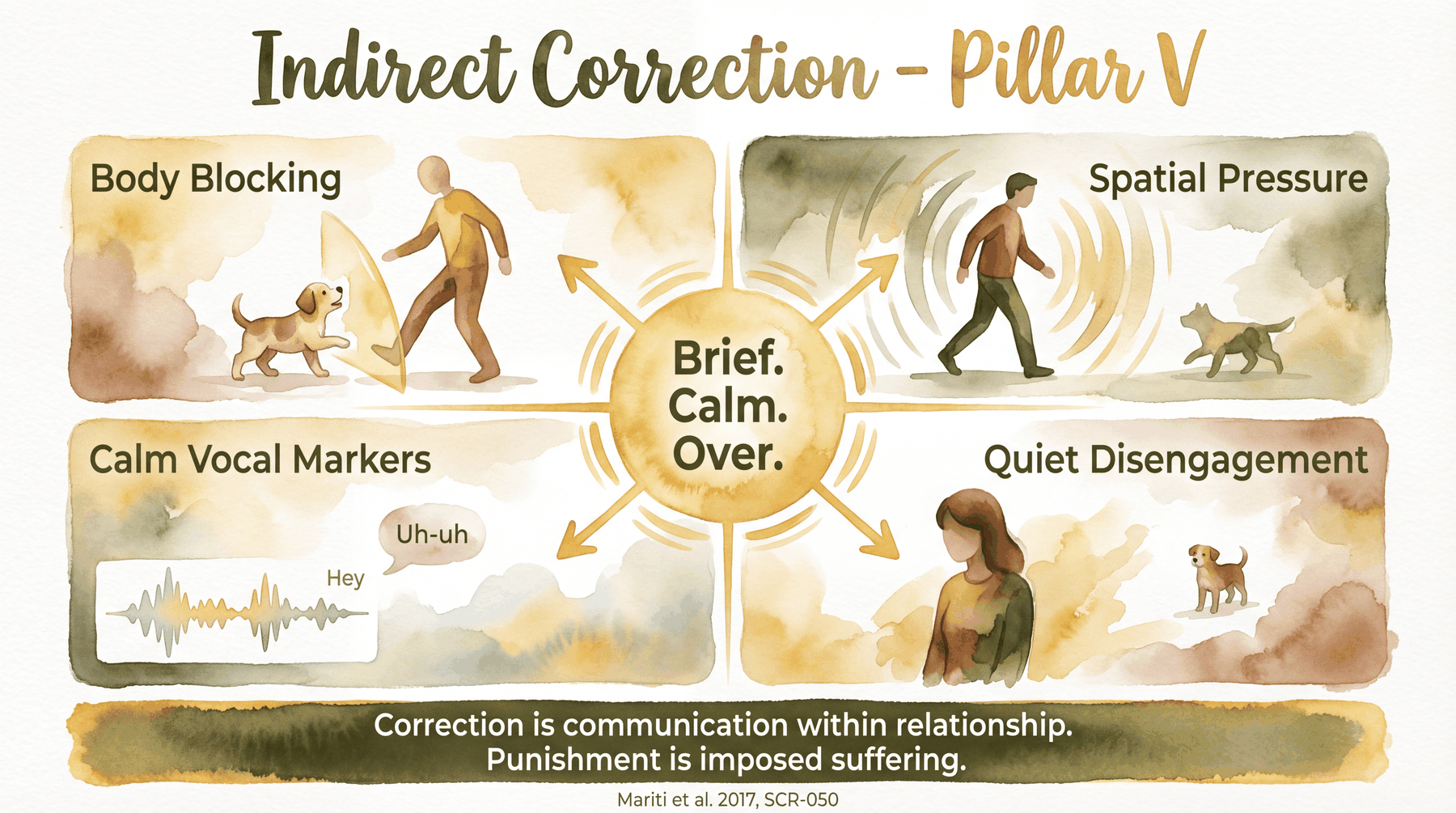
Four tools, one principle - correction is communication within relationship, not imposed suffering.
Key Takeaways
- Indirect Correction is intended to be a tightly bounded communication model, not a euphemism for punishment or escalation.
- The documented science supports the canine communication backdrop and the welfare cost of aversives.
- The JB relational-modulation claim remains Heuristic and RF-Flagged; the exact JB package is observed practice, not a published standardized protocol.
- The pillar only stays coherent when its guardrails are honored: brief, calm, proportional, and immediately over.
The Evidence
This entry uses mixed-evidence claim-level tags beyond the dedicated EvidenceBlocks below. These tags mark claims that combine documented findings with observed practice, heuristic application, or unresolved gaps.
- Mariti, C. et al. (2017)domestic dogs
Pilot data support calming and de-escalatory signals as real dog social behavior, giving documented footing to the idea that brief social signals can reduce rather than intensify conflict. - Canine communication literature summarized in SCR-110domestic dogs
Approach angle, body orientation, and spatial positioning function as meaningful social signals, supporting the ethological backdrop for body blocking and spatial pressure. - Vieira de Castro, A. C. et al. (2020)domestic dogs
Dogs trained with aversive methods showed higher cortisol, more stress behavior, and more pessimistic judgment bias than dogs from reward-based schools. - Ziv (2017) and Hiby et al. (2004)domestic dogs
Converging literature supports welfare concerns around aversive methods and does not show a superior efficacy case that would justify those risks.
- Golden Retrievers in program practice
The specific JB package of body blocking, spatial pressure, flat vocal markers, quiet disengagement, and tightly bounded redirection is observed program practice rather than a formally tested intervention protocol.
- domestic dogs and JB synthesis
JB's strongest claim is that identical mechanical interruptions can land differently depending on relational context. That claim is biologically plausible and partly supported indirectly, but it remains heuristic rather than directly tested.
No published study directly tests the specific claims or protocols described in this entry within a controlled canine trial.
SCR References
Sources
- Hiby, E. F., Rooney, N. J., & Bradshaw, J. W. S. (2004). Dog training methods: Their use, effectiveness and interaction with behaviour and welfare. Animal Welfare, 13(1), 63-69.
- Mariti, C., et al. (2017). Analysis of the intraspecific visual communication in the domestic dog. Journal of Veterinary Behavior, 18, 49-57.
- Vieira de Castro, A. C., Fuchs, D., Morello, G. M., Pastur, S., de Sousa, L., & Olsson, I. A. S. (2020). Does training method matter? Evidence for the negative impact of aversive-based methods on companion dog welfare. PLoS ONE, 15(12), e0225023.
- Canine communication literature summarized in SCR-110. Supports canine spatial and social-signal communication as ethological background. The indirect-correction technique-level claim remains [Heuristic] (anchors: SCR-110, SCR-005 RF-flagged).
- Ziv, G. (2017). The effects of using aversive training methods in dogs: A review. Journal of Veterinary Behavior, 19, 50-60.