Prevention
Proactive structuring of environment and interactions to prevent undesirable behaviors from forming. We never intentionally request, initiate, or encourage behaviors that we would later need to correct. Mixed Evidence Prevention avoids the permanent residue that extinction leaves behind and reduces the intensity of intervention later required.
For Families
Prevention is the single most useful idea you will get from Just Behaving. The short version: most behavior problems in adult dogs are not problems we fixed once. They are problems we never gave the dog a chance to start.
What that looks like in practice is unglamorous. Mealtime is calm before the puppy has a chance to learn that mealtime is exciting. The first thirty seconds at the front door are calm before the puppy practices excited greeting forty times. The puppy never learns to nip during play because no one - child, adult, or visitor - initiates mouth play in the first place. The behaviors that families spend years trying to extinguish in adult dogs are behaviors that, in a Just Behaving home, were simply never built.
This is not the same as being permissive. It is also not the same as being strict. It is the difference between teaching a dog "do not jump on people" and never letting jumping on people become something the dog practices in the first place. The first requires correction. The second does not need correction at all.
The rest of this page explains the neuroscience behind why prevention works and why extinction - the standard "correct it later" approach - leaves a residue that returns under stress. The science is real and the citations are below. But if you remember nothing else from this entry, remember that the cleanest behavior to fix is the one that never started.
What It Means
The dog training industry is built on a cycle: a behavior forms, the owner seeks help, the professional provides a correction protocol, the owner manages the behavior, the behavior recurs, the owner returns for more help. The method creates the need for the method.
Prevention breaks that cycle at the beginning. If a behavior never forms, there is nothing to correct, nothing to extinguish, nothing to manage. Documented This is not a theoretical preference - it is grounded in what we know about how neural pathways work.
Consider the most common example: mouthing and nipping. A widely cited but source-unverified estimate suggests approximately 80% of new puppy owners struggle with mouthing and nipping [Ambiguous - SCR-006: source verification pending]. Ambiguous The original source for this figure has not been located, so the number should be read as an industry-circulating estimate rather than a measured prevalence. The important point for this entry is not the exact percentage. It is that mouthing is commonly treated as a normal problem to correct after it appears.
Across the Just Behaving breeder environment, meaning the period when puppies are raised in the program before family placement, JB has not observed a mouthing or nipping problem. Observed-JB This is a bounded program observation about puppies during the breeder-raised period only. It does not claim zero post-placement mouthing in family homes, and it does not extend to dogs raised by families with JB coaching after pickup. No controlled comparison against a correction-based program exists.
That narrower observation still matters because it asks a different question: what happens when no human initiates mouth play and early mouthing is interrupted before it becomes rehearsed? JB's answer is Prevention: no human asks for the behavior, no human rewards it with excitement, and the first sign is handled as a calm boundary rather than as a game.
Why It Matters for Your Dog
Prevention is grounded in three converging lines of neuroscience:
Hebbian learning. Neurons that fire together wire together. Every repetition of a behavior strengthens the neural pathway that produces it. Documented A behavior is not just an action - it is a physical connection in the brain that grows stronger with use (SCR-022).
Extinction does not erase. Bouton (2002, 2004) demonstrated that extinction does not erase original learning. The original conditioned response persists. What the organism learns during extinction is a new, context-dependent response layered on top of the original. Remove the context, and the original returns through spontaneous recovery, renewal, reinstatement, or rapid reacquisition. (SCR-008)
This means: a behavior that has been "corrected" through extinction is always lurking. A behavior that was never learned has no pathway to reactivate. Prevention is not just easier than correction. It is fundamentally more effective.
Habit formation. Graybiel's research demonstrates that habitual behaviors transfer to basal ganglia control, becoming resistant to conscious modification. Documented The canine application of this mechanism is assumed to be conserved given shared mammalian neurobiology but has not been directly tested. The practical implication: behaviors allowed to become habitual are neurologically harder to modify than behaviors caught early or never allowed to form (SCR-023).
Punishment predicts downstream problems. Dale et al. (2024) provides prospective evidence that the use of punishment predicts the later development of separation-related behaviors. Documented This strengthens the Prevention case from a different angle: not only does Prevention avoid the formation of unwanted pathways, it avoids the corrective approaches that themselves produce downstream behavioral problems (SCR-036).
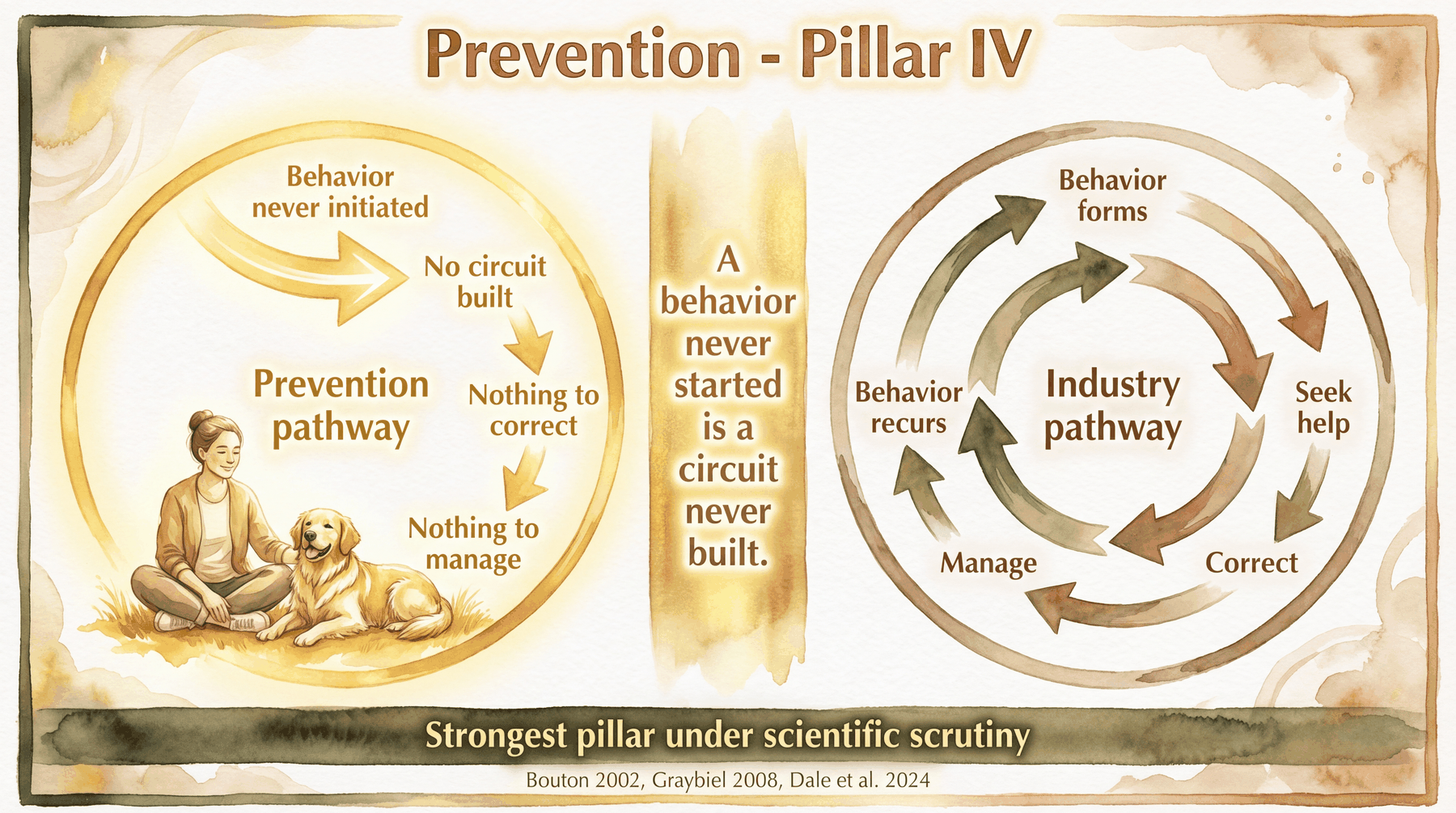
A behavior never initiated is a circuit never built. Among the five pillars, prevention is the one with the strongest direct support in the extinction and developmental neuroscience literature.
Key Takeaways
- Behaviors are neural pathways that strengthen with every repetition - a behavior never started never builds a circuit.
- Extinction does not erase learned behaviors; it creates a competing memory that can return through spontaneous recovery, renewal in new contexts, or reinstatement from a single slip.
- Prevention is more effective than correction because it avoids the permanent residue that extinction leaves behind.
- JB has not observed a mouthing or nipping problem during the breeder-raised period before family placement. That supports the prevention model as bounded program observation, not as a post-placement outcome guarantee.
The Evidence
This entry uses ambiguous claim-level tags beyond the dedicated EvidenceBlocks below. These tags mark claims where the literature remains unsettled or multiple interpretations coexist.
This entry uses mixed-evidence claim-level tags beyond the dedicated EvidenceBlocks below. These tags mark claims that combine documented findings with observed practice, heuristic application, or unresolved gaps.
- Hebb, D. O. (1949)neuroscience - multi-species
The Organization of Behavior. Established the foundational 'neurons that fire together wire together' principle - behaviors are neural pathways that strengthen with repetition. - Bouton, M. E. (2002, 2004)rats, multiple species
Extinction does not erase original learning. The original conditioned response persists and is recoverable through spontaneous recovery, renewal, reinstatement, and rapid reacquisition. - Gazit, I. & Terkel, J. (2005)domestic dogs
Direct canine demonstration of context-dependent extinction - renewal of conditioned responses when context changed. - Dale, A. R. et al. (2024)domestic dogs
Animal Welfare - prospective longitudinal evidence that use of punishment predicts later development of separation-related behaviors.
The JB inference that behaviors never initiated are 'circuits never built' is consistent with Hebbian plasticity and synaptic pruning mechanisms but has not been directly tested as a behavioral intervention strategy in dogs.
Graybiel's habit formation research is documented in rodent and primate models. Canine application is assumed from conserved mammalian neurobiology but remains untested.
- Just Behaving program dataGolden Retrievers
JB has not observed a mouthing or nipping problem during the breeder-raised period before family placement, limited to puppies while they are being raised inside the program. This is a bounded program observation, not a post-placement family-home outcome claim. Tested against three independent professional reviewers (DACVB, CPDT-KA, developmental psychologist) - none dismissed the outcome.
No published study directly compares a prevention-based raising program against a correction-based training program in a randomized trial with long-term follow-up. This absence applies bilaterally - it constrains claims for and against both approaches equally (SCR-167).
SCR References
Sources
- Hebb, D. O. (1949). The Organization of Behavior: A Neuropsychological Theory. Wiley. Supports the foundational neuroscience principle. Prevention-as-circuit application in dog raising remains [Heuristic] (anchor: SCR-167); not a tested prevention intervention in this literature.
- Just Behaving program data: bounded observation, not controlled comparative evidence.
- Bouton, M. E. (2002). Context, ambiguity, and unlearning: Sources of relapse after behavioral extinction. Biological Psychiatry, 52(10), 976-986.
- Bouton, M. E. (2004). Context and behavioral processes in extinction. Learning & Memory, 11(5), 485-494. Supports the foundational neuroscience principle. Prevention-as-circuit application in dog raising remains [Heuristic] (anchor: SCR-167); not a tested prevention intervention in this literature.
- Dale, F. C., Burn, C. C., Murray, J. K., and Casey, R. A. (2024). Canine separation-related behaviour at six months of age: Dog, owner and early-life risk factors identified using the Generation Pup longitudinal study. Animal Welfare, 33, e60. DOI: 10.1017/awf.2024.56.
- Gazit, I., Goldblatt, A., and Terkel, J. (2005). The role of context specificity in learning: The effects of training context on explosives detection in dogs. Animal Cognition, 8(3), 143-150. DOI: 10.1007/s10071-004-0236-9.