OFA Certification
OFA certification is one of the most familiar phrases in purebred-dog health screening, but families often know the name more than the substance. That gap matters. "OFA tested" can mean a real multi-domain screening architecture, or it can be used as vague shorthand by people who assume the registry label itself is the guarantee. It is not. OFA is a tool, a database, and a framework for standardized interpretation. It is useful precisely because it helps reduce guesswork. It is limited because no registry result can guarantee lifelong normality in a dog or in that dog's offspring. Documented
What It Means
What OFA Is
The Orthopedic Foundation for Animals is a North American health-screening registry that compiles results across several canine screening domains. It is best known publicly for hips and elbows, but the larger OFA ecosystem also interfaces with cardiac screening; eye certification through the OFA Eye Certification Registry; thyroid screening; patellas and other structural evaluations; and DNA-result recording in some contexts.
Its practical value lies in standardization and public verifiability. A family does not have to rely only on a breeder saying "our dogs are clear." Documented In many cases, they can verify results directly.
The Most Familiar Program: Hips
For hips, OFA uses the extended-hip radiographic view and assigns one of seven grades Excellent; Good; Fair; Borderline; Mild dysplasia; Moderate dysplasia; and Severe dysplasia. Documented
The passing grades are Excellent, Good, and Fair. Borderline means equivocal, not normal. Mild through Severe are dysplastic.
This is a widely recognized language, which is one reason OFA remains central in breeder and buyer conversation.
Elbows
Elbow certification is simpler in structure but not less important. OFA elbow grading revolves around whether degenerative or dysplastic change is visible radiographically. Documented
The practical breeder standard is usually Grade 0 or Normal is acceptable; and Grades I through III represent increasing severity of elbow dysplasia. Observed-JB
The simplicity of the grading system can make people underestimate the disease. They should not. Elbow pathology can be life-shaping for individual dogs even when it is less publicly discussed than hips.
Preliminary Versus Final Certification
OFA also distinguishes between preliminary and final evaluations.
Preliminary evaluations can be performed earlier. Final certification for hips and elbows generally requires the dog to be at least twenty-four months old. That distinction matters because families sometimes hear that a dog was "OFAed" without understanding whether the result was a final adult clearance or an earlier preliminary screen.
Early information can be useful. It is just not the same thing as final certification.
Why OFA Still Matters Even With Its Limits
OFA remains valuable for several reasons large public database; standardized interpretation language; breeder accountability through public records; broad acceptance across clubs and buyers; and integration with multi-domain health planning.
The system also supports CHIC-style breeder workflows, where the emphasis is not only on one test but on whether the breed-relevant screening set has actually been completed.
Why It Matters for Your Dog
The Limits of OFA
The most important limit is methodological. For hips, the standard extended view does not measure passive laxity as directly as distraction-based methods such as PennHIP. The SCR already supports that stress or distraction radiography is the stronger predictor of later osteoarthritis risk. Documented
That does not make OFA useless. It means OFA and PennHIP are not identical tools asking the same question.
Other limits include voluntary submission can bias apparent prevalence, passing parents can still produce affected offspring, results capture the dog at the time of screening, not every future disease state, and OFA listings do not replace interpretation of pedigree, family history, and later-life outcomes.
OFA Beyond Hips and Elbows
Families often forget that OFA is not only about orthopedic radiographs.
The same larger screening logic touches cardiac certification, where the quality of the underlying exam matters enormously; eye registry documentation, where annual ophthalmologic reevaluation matters; and thyroid screening, where autoimmune change can develop later.
That means the letters "OFA" are only as strong as the actual test behind them. A cardiac entry based on a casual primary-care auscultation is not equivalent to advanced specialist echocardiography, even if both live in an OFA-adjacent ecosystem.
What Families Should Ask
Good OFA questions include was the result preliminary or final, what age was the dog at evaluation, which domains were actually screened, who performed the underlying specialty exam where relevant, and can I verify the record publicly.
That last question matters because the registry is most useful when it makes vague marketing unnecessary.
Why This Page Matters for Just Behaving
The Just Behaving position is not anti-registry and not pro-registry as an abstract ideology. It is pro-clarity.
OFA is one of the places where families can move from vague breeder reassurance to verifiable data. The mistake is treating the registry label itself as the full answer. The real answer is always a combination of the method used; the age of screening; the domains covered; and the family history behind the dog.
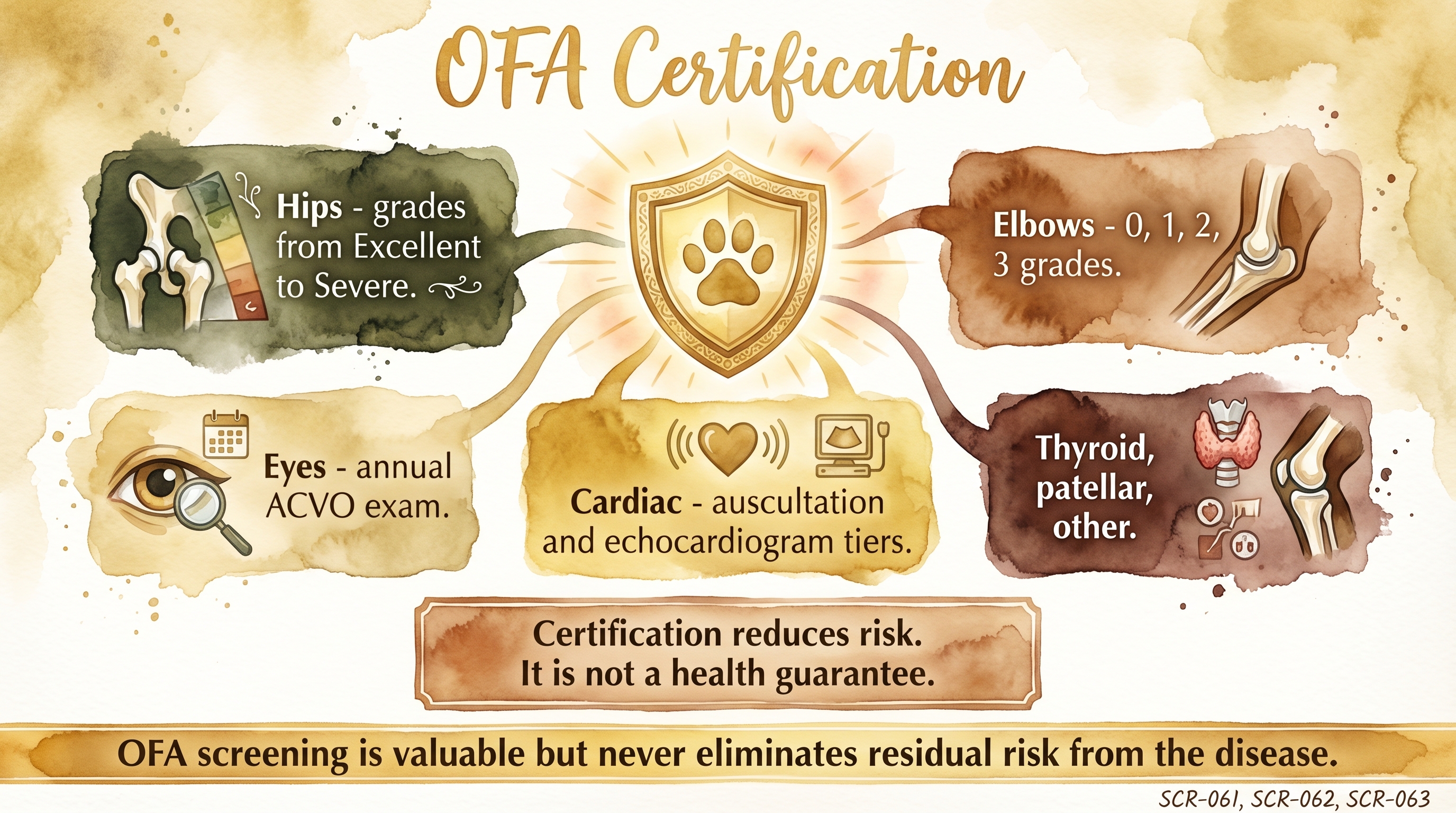
OFA screening is valuable but never eliminates residual risk from the disease.
Key Takeaways
- OFA certification is a useful screening and registry framework, not a blanket health guarantee.
- The most familiar OFA programs are hips and elbows, but the larger screening ecosystem also touches eyes, heart, thyroid, and other domains.
- For hips especially, OFA and PennHIP are not redundant because they measure different things and carry different strengths.
- Families should verify whether a result was final, what age the dog was screened, and what method actually sat underneath the registry entry.
The Evidence
This entry uses observed claim-level tags beyond the dedicated EvidenceBlocks below. These tags mark JB program observation or practice-derived claims that need dedicated EvidenceBlock coverage in a later content pass.
- SCR-063 supportdogs
The standard OFA-style extended hip view does not measure passive laxity as directly as distraction or stress radiography, which better predicts later osteoarthritis risk. - SCR-061 supportdogs
Registry language around cardiac clearance is only as good as the underlying method, and auscultation alone is not a defensible substitute for specialist echocardiography in SAS screening. - SCR-062 supportGolden Retrievers
Eye risk in Goldens is not exhausted by DNA panels, which is why ophthalmologic registry participation still matters.
- OFA protocol materialsdogs
OFA creates standardized categories and public verifiability, but the registry does not convert probabilistic screening into a guarantee. - Orthopedic literaturedogs
Passing parents can still produce affected offspring in polygenic diseases, so registry screening is risk reduction rather than certainty.
- domestic dogs
No published study directly defines the single best testing interval, threshold, or decision rule for ofa certification across all Golden Retriever households and breeding programs.
SCR References
Sources
- Orthopedic Foundation for Animals. (n.d.). Hip dysplasia. https://ofa.org/diseases/hip-dysplasia/
- Orthopedic Foundation for Animals. (n.d.). Cardiac disease. https://ofa.org/diseases/other-diseases/cardiac-disease/
- Orthopedic Foundation for Animals. (n.d.). Eye certification. https://ofa.org/diseases/eye-disease/
- Orthopedic Foundation for Animals. (n.d.). CHIC program. https://ofa.org/chic-programs/
- Smith, G. K., Biery, D. N., & Gregor, T. P. (1990). New concepts of coxofemoral joint stability and the development of a clinical stress-radiographic method for quantitating hip joint laxity in the dog. Journal of the American Veterinary Medical Association, 196(1), 59-70. PMID: 2295555.
- Smith, G. K., Mayhew, P. D., Kapatkin, A. S., McKelvie, P. J., Shofer, F. S., & Gregor, T. P. (2001). Evaluation of risk factors for degenerative joint disease associated with hip dysplasia in German Shepherd Dogs, Golden Retrievers, Labrador Retrievers, and Rottweilers. Journal of the American Veterinary Medical Association, 219(12), 1719-1724. https://doi.org/10.2460/javma.2001.219.1719
- Ontiveros, E. S., Fousse, S. L., Crofton, A. E., Hodge, T. E., Gunther-Harrington, C. T., Visser, L. C., & Stern, J. A. (2019). Congenital cardiac outflow tract abnormalities in dogs: Prevalence and pattern of inheritance from 2008 to 2017. Frontiers in Veterinary Science, 6, 52. https://doi.org/10.3389/fvets.2019.00052
- van Staveren, M. D. B., & Szatmari, V. (2020). Detecting and recording cardiac murmurs in clinically healthy puppies in first opinion veterinary practice at the first health check. Acta Veterinaria Scandinavica, 62, 57. https://doi.org/10.1186/s13028-020-00535-1
- Downs, L. M., Wallin-Hakansson, B., Boursnell, M., Marklund, S., Hedhammar, A., Truve, K., Hubinette, L., Lindblad-Toh, K., Bergstrom, T., & Mellersh, C. S. (2011). A frameshift mutation in Golden Retriever dogs with progressive retinal atrophy endorses SLC4A3 as a candidate gene for human retinal degenerations. PLOS ONE, 6(6), e21452. https://doi.org/10.1371/journal.pone.0021452
- Townsend, W. M., Huey, J. A., McCool, E., King, A., & Diehl, K. A. (2020). Golden Retriever pigmentary uveitis: Challenges of diagnosis and treatment. Veterinary Ophthalmology, 23(5), 774-784. https://doi.org/10.1111/vop.12796