Elbow Dysplasia in Golden Retrievers
Compound evidence detail1 SCR / 3 parts
- Documentedthe canine elbow-dysplasia lesion cluster including fragmented medial coronoid process, OCD of the medial humeral condyle, ununited anconeal process, and elbow incongruity, with FCP as the most prevalent component in retriever breeds
- Documentedthe multi-breed surgical-comparison evidence that computed tomography exceeds plain radiography in early-FCP detection sensitivity, with Golden Retrievers represented in the cited cohorts
- Documentedthe Lavrijsen 2012 Dutch registry estimates of approximately 5 percent radiographic FCP prevalence and approximately 0.24 heritability in Golden Retrievers, presented as Dutch registry-population figures rather than as universal breed constants
Elbow dysplasia in Golden Retrievers is best understood as an umbrella label, not as one single lesion. It refers to a family of developmental elbow problems that create incongruity, cartilage damage, pain, and later osteoarthritis in a joint that already tolerates large forces during normal movement. For many dogs, the first sign is simply a young Golden with forelimb lameness that should have resolved and does not. Documented
What It Means
When people say "elbow dysplasia," they are usually referring to one or more of four classic lesion patterns fragmented medial coronoid process; osteochondrosis or osteochondritis of the medial humeral condyle; ununited anconeal process; and elbow incongruity. Observed-JB
In practice, fragmented medial coronoid process is the lesion families and clinicians hear about most often in Goldens. Observed-JB But the broader point is that the elbow is a three-bone joint that depends on very precise developmental alignment. When that precision is lost, abnormal loading follows. Once abnormal loading becomes chronic, arthritis is hard to avoid.
Why It Deserves More Attention
Hip dysplasia gets more public attention, but elbow disease can be at least as consequential for daily comfort.
There are a few reasons.
First, dogs carry more body weight on the forelimbs than on the hind limbs. A painful elbow can therefore have a major effect on willingness to move, sit, rise, turn, and play.
Second, elbow lesions often begin during development, so the first clinical story may appear while a dog is still young. Observed-JB A family can misread that as a strain, growing awkwardness, or temporary overexertion.
Third, standard radiographs can understate pathology in some elbows. That does not mean radiography is useless. It means that elbow pain, especially when persistent, deserves more seriousness than a quick normal-looking film sometimes encourages.
How Common Is It
In OFA-style discussion, Golden Retriever elbow dysplasia is often quoted in roughly the 10 to 12 percent range. Estimated As with hips, those numbers come from a submitted population, not from a perfect random sample of all Goldens. So they are useful but not final.
The key practical point is simpler: elbow dysplasia is common enough in Goldens that breeders should not treat elbow clearances as optional or secondary to hip work.
Diagnosis and Screening
The diagnostic path usually begins with history and examination. Young dog. Forelimb lameness. Worse after activity. Reduced range of motion. Pain with elbow flexion or extension. Sometimes the dog turns the foot slightly outward to unload the joint.
From there, radiographs are the normal first step. Registry-style screening and grading systems help structure breeder decision-making, but clinical workups sometimes need more than a single screening film. Advanced imaging, especially CT, can detect lesions that plain radiographs miss or blur.
This is one reason elbow dysplasia is often more frustrating than families expect. A dog can be clinically lame before the full structural picture is easy to see.
Why It Matters for Your Dog
The Breeding Question
The responsible breeding standard is not complicated: elbows should be screened along with hips.
The more nuanced point is that elbow disease reminds us why "health tested" is not a magic phrase. Clearances matter. Family history matters. Offspring outcomes matter. And screening reduces risk rather than abolishing it.
Because the elbow is such an unforgiving joint, even mild structural abnormality can have outsized downstream consequences. That makes breeder transparency especially important. If a line produces repeated early forelimb lameness, arthroscopy, or elbow arthritis, that pattern matters even when individual paperwork looks superficially acceptable.
What Families Can Do
Families cannot screen the genetic risk out of a puppy after the fact, but they can avoid pushing a vulnerable joint harder than it needs to be pushed. Documented
The same broad growth-management principles that matter for orthopedic development elsewhere matter here keep the puppy lean; avoid repetitive impact on immature joints; use appropriate large-breed nutrition; and take persistent forelimb lameness seriously.
It is especially important not to dismiss repeated "off and on" front-leg lameness in a growing Golden as nothing. Some puppies do have transient soft-tissue soreness. But elbow disease is exactly the kind of problem that gets labeled "probably just overdid it" one time too many.
When to See a Veterinarian
Veterinary evaluation is appropriate for forelimb lameness lasting more than a few days; repeated episodes of the same front-leg lameness; stiffness after exercise or after rest; reluctance to sit squarely, jump, or turn tightly; and pain when the elbow is handled or flexed.
Same-day evaluation is warranted if the dog is acutely non-weight-bearing, clearly painful, or the joint looks swollen.
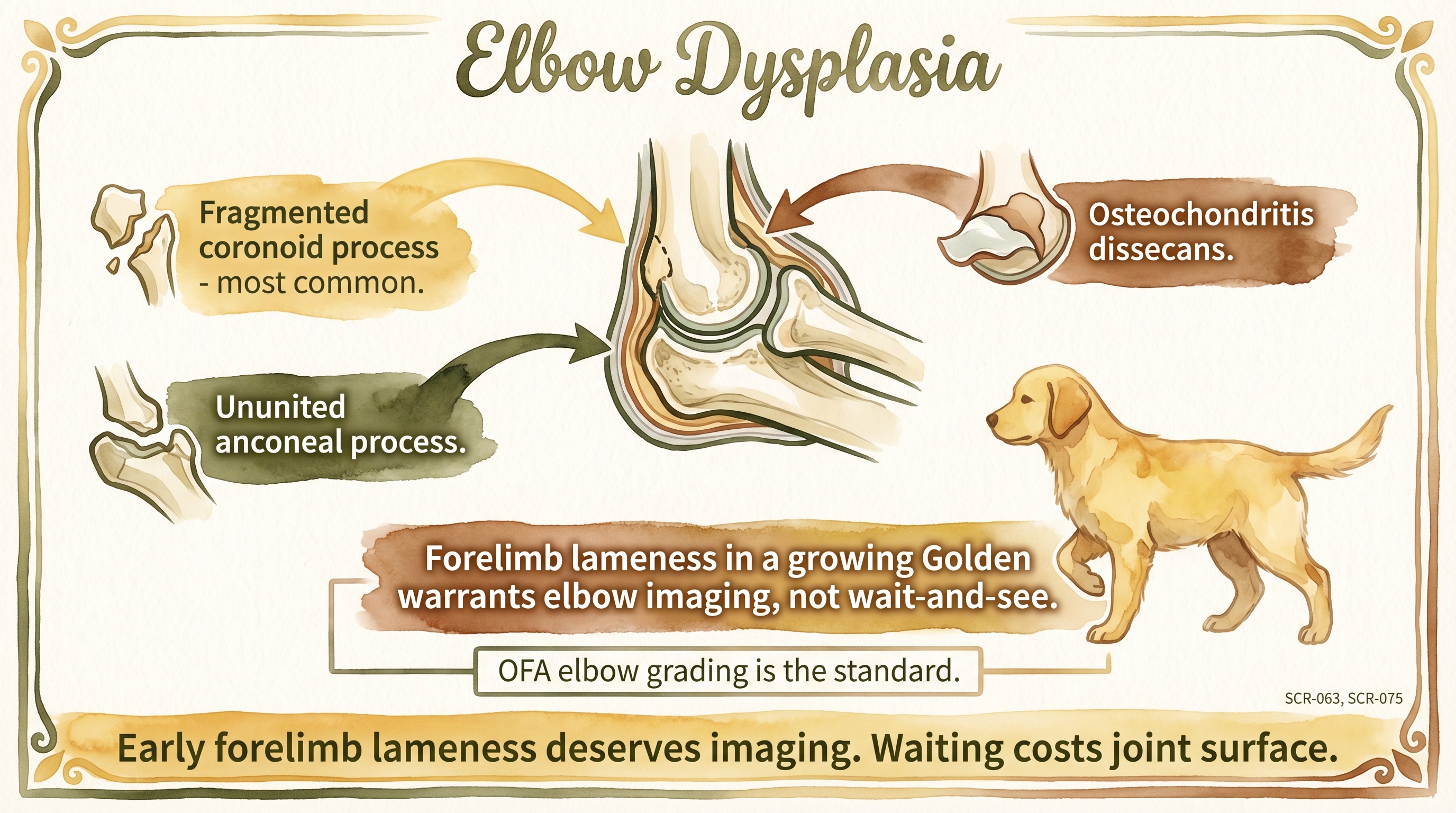
Early forelimb lameness deserves imaging - waiting costs joint surface.
Key Takeaways
- Elbow dysplasia is a cluster of developmental elbow lesions, not one single pathology.
- In Goldens, early forelimb lameness is important and should not be waved away if it persists or recurs.
- Elbow screening should be treated as co-equal with hip screening in responsible breeding programs.
- Lean growth, sensible exercise, and early workup of lameness help reduce the functional cost of elbow disease even though they do not remove the inherited risk.
The Evidence
This entry uses observed claim-level tags beyond the dedicated EvidenceBlocks below. These tags mark JB program observation or practice-derived claims that need dedicated EvidenceBlock coverage in a later content pass.
This entry uses estimated claim-level tags beyond the dedicated EvidenceBlocks below. These tags mark approximate ranges or timing claims that should remain bounded by the cited sources.
- Hip-elbow screening science synthesisdogs
Elbow dysplasia is a developmental orthopedic disease cluster, not a single lesion, and Goldens are one of the breeds in which screening remains clinically meaningful. - Common puppy health musculoskeletal literaturelarge-breed dogs
Large-breed skeletal immaturity extends well into adolescence, which is why persistent juvenile lameness deserves workup rather than casual dismissal. - Large-breed growth literaturedogs
Lean body condition and sensible impact management matter for orthopedic expression in growing dogs.
- Lavrijsen et al. 2012Golden Retrievers
In a Dutch Golden Retriever screening dataset, radiographic fragmented medial coronoid process prevalence was approximately 5 percent and heritability was estimated at approximately 0.24, supporting feasibility of selection against FCP in the breed. These figures are dataset-bound to the Dutch registry population and should not be quoted as universal breed rates. - Carpenter et al. 1993dogs, multi-breed with Golden inclusion
Computed tomography demonstrated higher sensitivity than plain radiography for detection of fragmented medial coronoid process when both were compared against surgical findings, which is why a radiographically normal elbow does not categorically exclude clinically relevant medial coronoid pathology. - Huck et al. 2009dogs, Kealy lifetime cohort continuity
Lifetime lean body condition reduced elbow osteoarthritis expression in a longitudinal study, establishing body condition as a documented, modifiable phenotypic modifier of elbow disease burden.
- domestic dogs
No published study directly compares the most effective long-term management paths for elbow dysplasia in golden retrievers in dogs across breeds and ordinary home settings.
SCR References
Sources
- Carpenter, L. G., Schwarz, P. D., Lowry, J. E., Park, R. D., & Steyn, P. F. (1993). Comparison of radiologic imaging techniques for diagnosis of fragmented medial coronoid process of the cubital joint in dogs. Journal of the American Veterinary Medical Association, 203(1), 78-83. PMID: 8407465.
- Lavrijsen, I. C. M., Heuven, H. C. M., Voorhout, G., Meij, B. P., Theyse, L. F. H., Leegwater, P. A. J., & Hazewinkel, H. A. W. (2012). Phenotypic and genetic evaluation of elbow dysplasia in Dutch Labrador Retrievers, Golden Retrievers, and Bernese Mountain Dogs. The Veterinary Journal, 193(2), 486-492. https://doi.org/10.1016/j.tvjl.2012.01.001
- Huck, J. L., Biery, D. N., Lawler, D. F., Gregor, T. P., Runge, J. J., Evans, R. H., Kealy, R. D., & Smith, G. K. (2009). A longitudinal study of the influence of lifetime food restriction on development of osteoarthritis in the canine elbow. Veterinary Surgery, 38(2), 192-198. https://doi.org/10.1111/j.1532-950X.2008.00487.x
- Kealy, R. D., Olsson, S. E., Monti, K. L., Lawler, D. F., Biery, D. N., Helms, R. W., Lust, G., & Smith, G. K. (1992). Effects of limited food consumption on the incidence of hip dysplasia in growing dogs. Journal of the American Veterinary Medical Association, 201(6), 857-863. PMID: 1399793.
- Schoenmakers, I., Hazewinkel, H. A. W., Voorhout, G., Carlson, C. S., & Richardson, D. (2000). Effect of diets with different calcium and phosphorus contents on the skeletal development and blood chemistry of growing Great Danes. Veterinary Record, 147(23), 652-660. PMID: 11131552.
- Hedhammar, A., Wu, F. M., Krook, L., Schryver, H. F., de Lahunta, A., Whalen, J. P., Kallfelz, F. A., Nunez, E. A., Hintz, H. F., Sheffy, B. E., & Ryan, G. D. (1974). Overnutrition and skeletal disease: An experimental study in growing Great Dane dogs. Cornell Veterinarian, 64(Suppl. 5), 1-160. PMID: 4826273.