Thyroid Screening in Breeding Stock
Compound evidence detail1 SCR / 2 parts
- Documentedthe OFA Thyroid Evaluation protocol combining total T4, free T4 by equilibrium dialysis, TSH, and thyroglobulin autoantibody testing through approved laboratories; the rationale for TgAA-positive exclusion from breeding stock; and the elevated Golden Retriever prevalence in OFA registry analyses that justifies breed-specific screening
- Heuristicthe typical two-year serial-rescreening interval - reflective of breeding-program consensus rather than a cadence outcome-validated by published cohort data, chosen because autoimmune thyroiditis can develop after an initially negative screen
Thyroid screening in breeding stock exists because the most breeding-relevant thyroid problem is not just low hormone at one moment. It is autoimmune thyroiditis, a heritable immune-mediated process that can be brewing before a dog looks obviously hypothyroid on a simple screening panel. That is why responsible thyroid screening is broader than checking one total T4 value and moving on. Mixed Evidence
What It Means
What the Screening Is Trying to Detect
The main breeding-stock target is autoimmune thyroiditis, one of the important causes of primary hypothyroidism in dogs. In this process, the immune system targets thyroid tissue and can create a long preclinical phase before classic signs become obvious.
That distinction matters because breeding programs are not only trying to diagnose clinical disease. They are trying to screen for heritable risk architecture before affected dogs have already contributed broadly to the next generation.
What the Typical Panel Includes
The OFA thyroid protocol is more meaningful than a single screening hormone because it combines several pieces of information total T4; free T4; TSH; and TgAA, or thyroglobulin autoantibody.
The TgAA result matters especially because it can identify autoimmune activity that fits the heritable thyroiditis story more directly than hormone levels alone. Mixed Evidence
Why One Number Is Not Enough
Families often learn about thyroid disease through the idea of a "low T4." Observed-JB That is understandable but incomplete.
A single low total T4 can occur for reasons that do not mean primary hypothyroidism, including non-thyroid illness; medication effects; systemic inflammatory states; and physiologic variation.
That is why breeder thyroid screening and clinical thyroid diagnosis both work best as multi-parameter interpretation rather than one-lab overconfidence.
Why TgAA Is So Important
TgAA is useful because it points more directly toward autoimmune thyroiditis rather than only showing the downstream hormone consequences after more damage has accumulated.
In breeding terms, this matters because autoimmune thyroiditis is the heritable concern; a dog can be earlier in the disease process; and later disease can emerge after a previously normal screen. Documented
This is also why rescreening matters. A one-time normal result does not mean a dog is permanently outside the thyroid-risk conversation.
Why It Matters for Your Dog
Why Annual or Periodic Rescreening Matters
Thyroid disease is not a static trait like a known genotype result. It is a biologic process that can develop later.
That means a breeding dog may screen normal at one age; develop autoimmune markers later; and develop clinical hypothyroidism later still.
The practical lesson is the same one families already see in eye screening: a late-onset disease architecture requires repeated evaluation if the dog remains in a breeding program. Documented
Golden Retriever Relevance
Goldens are not the only breed where thyroid disease matters, but they are common enough participants in the hypothyroidism conversation that thyroid screening belongs in a serious health-testing protocol.
The correct way to speak about that is with proportion. Thyroid screening is important. It does not carry the same breed-defining public weight as cancer or hips. But it is meaningful enough that ignoring it would leave a preventable gap in breeder diligence.
The Limits of Thyroid Screening
Good thyroid screening still has limits.
Important ones include not every future case is visible on one exam, antibody status and hormone status do not always move in lockstep, non-thyroid illness can distort interpretation, and a screening panel does not replace full clinical workup when a dog is actually symptomatic.
This is why the page should be read as a screening guide, not as a promise that one clean thyroid entry settles the matter forever.
What Families Should Ask
Useful questions include what thyroid panel was actually run, was TgAA included, how recent was the test, has the dog been rescreened during breeding life, and if a dog or close relative later developed thyroid disease, how did that affect breeding decisions. Documented
Those questions are much better than a vague "Are the parents thyroid tested?"
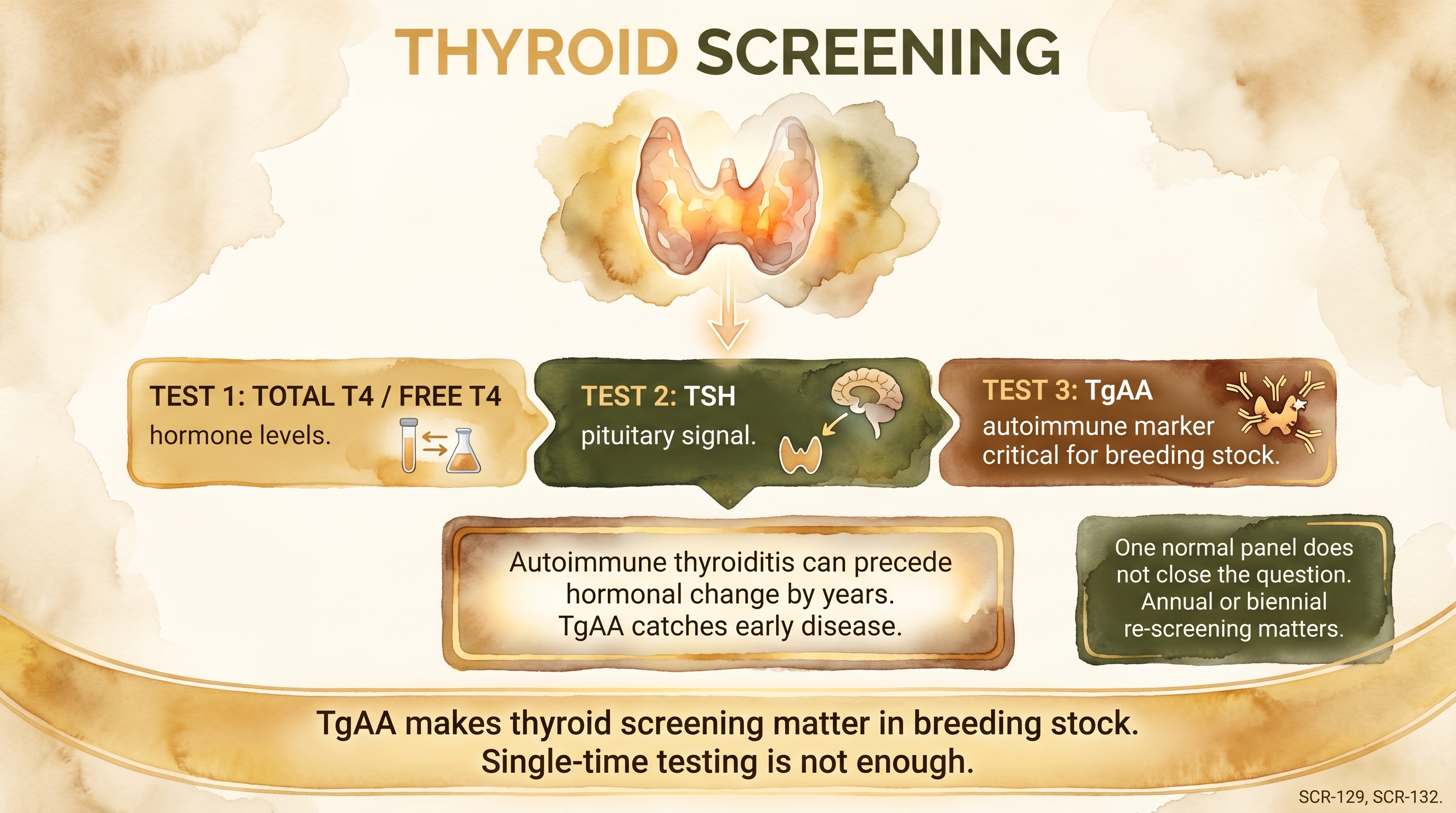
TgAA makes thyroid screening matter in breeding stock - single-time testing is not enough.
Key Takeaways
- Breeding-stock thyroid screening is trying to identify autoimmune thyroiditis risk, not just one low hormone value.
- A useful panel includes total T4, free T4, TSH, and TgAA because one isolated number is too easy to misread.
- TgAA matters because it points toward the immune-mediated, heritable side of the thyroid problem.
- A normal result today is helpful but not permanent, which is why periodic rescreening remains important in active breeding dogs.
The Evidence
This entry uses documented claim-level tags beyond the dedicated EvidenceBlocks below. These claims should remain tied to the entry Sources and SCR references during the next evidence-chain authoring pass.
This entry uses observed claim-level tags beyond the dedicated EvidenceBlocks below. These tags mark JB program observation or practice-derived claims that need dedicated EvidenceBlock coverage in a later content pass.
- OFA thyroid protocoldogs
Breeding-stock thyroid screening is built around panel interpretation, including total T4, free T4, TSH, and TgAA rather than one isolated hormone value. - Canine endocrinology consensusdogs
TgAA is especially relevant because it helps identify autoimmune thyroiditis, the breeding-relevant immune-mediated form of disease. - Clinical-screening logicdogs
Periodic rescreening is warranted because autoimmune thyroiditis can emerge later than the last normal clearance.
- Endocrine-diagnosis literaturedogs
Total T4 alone is a poor stand-alone basis for confident diagnosis because non-thyroid illness and other factors can suppress values secondarily. - Golden-specific source synthesisGolden Retrievers
The breed carries enough hypothyroidism relevance that thyroid screening belongs in a serious breeding protocol, but the rhetoric should stay proportionate and avoid treating thyroid disease as the dominant Golden health story.
- domestic dogs
No published study directly defines the single best testing interval, threshold, or decision rule for thyroid screening in breeding stock across all Golden Retriever households and breeding programs.
SCR References
Sources
- American Animal Hospital Association. (2023). 2023 AAHA selected endocrinopathies of dogs and cats guidelines. Journal of the American Animal Hospital Association, 59(3), 113-135. https://doi.org/10.5326/JAAHA-MS-7368
- Orthopedic Foundation for Animals. (n.d.). Thyroid database. https://ofa.org/diseases/other-diseases/thyroid/
- Bugbee, A., Rucinsky, R., Cazabon, S., Kvitko-White, H., Lathan, P., Nichelason, A., & Rudolph, L. (2023). 2023 AAHA selected endocrinopathies of dogs and cats guidelines. Journal of the American Animal Hospital Association, 59(3), 113-135. https://doi.org/10.5326/JAAHA-MS-7368