DNA Testing Panels for Dogs
Compound evidence detail1 SCR / 2 parts
- Documentedthe absence of any commercially validated, peer-reviewed DNA screening test for juvenile renal dysplasia or ectopic ureters in Golden Retrievers as of April 2026; downstream citations must carry an explicit date qualifier
- Observed-JBongoing GRCA, University of Cambridge, and Broad Institute research efforts soliciting samples and investigating inheritance patterns - presented as active research rather than as imminent test availability
DNA testing panels are one of the most useful and most misunderstood tools in modern dog breeding. At their best, they prevent avoidable recessive disease, verify parentage, and help breeders manage carrier status without panic. At their worst, they are marketed as if a cheek swab can summarize the whole future health of a Golden Retriever. It cannot. The most important thing a family should learn from this page is not that DNA testing is unimportant. It is that DNA testing is powerful inside a specific lane and weak outside it. Documented
What It Means
What a DNA Panel Actually Tests
A canine DNA panel looks for known genetic variants. That word "known" does a lot of work.
These panels can be excellent for validated monogenic diseases; carrier identification; parentage confirmation; identity matching; and some genomic diversity and coefficient-of-inbreeding tools. Documented
They are much weaker for polygenic disease prediction; late-onset complex disease forecasting; and any condition whose causal variant has not been found.
This is why the right question is never "Did you run a DNA panel?" The right question is "Which conditions does the panel test, how well validated are those tests, and what important breed risks remain outside panel reach?"
The Golden Retriever Use Case
In Golden Retrievers, DNA testing is highly useful for a subset of known inherited disorders. That includes conditions like ichthyosis and several PRA variants, where the genetic architecture is well enough characterized that breeders can make rational pairing decisions. Documented
The SCR already supports two load-bearing conclusions here.
First, carrier-to-clear breeding avoids affected puppies while preserving diversity. That matters because it means responsible breeding is not the same as purging every carrier from the population.
Second, DNA panels do not exhaust ocular risk in Goldens. Even a dog that is genetically clear on known eye-related variants can still face late-onset or genetically unresolved ocular disease.
The PRA Example Shows the Whole Logic
Progressive retinal atrophy is a good example because it demonstrates both the strength and the limit of panel testing.
The strength is clear: known Golden PRA variants can be tested directly.
The limit is just as important: PRA in Golden Retrievers is genetically heterogeneous. The SCR now codifies that at least three different genes are relevant in the breed. A dog clear on one PRA test is not therefore "PRA-clear" in the broadest possible sense unless the full relevant test set has actually been run.
This is why smart breeders think in terms of condition architecture rather than one marketing label.
Why Carrier Status Should Not Cause Panic
Families often hear the word "carrier" and assume something is wrong with the dog. For most autosomal recessive conditions, that is not the correct interpretation.
A carrier is typically clinically normal; can still be an outstanding breeding dog; and becomes a risk only if paired to another carrier of the same mutation.
That is why the SCR backs carrier-to-clear breeding as the responsible genetic-management strategy in many cases. It prevents affected puppies while protecting the breeding population from unnecessary narrowing.
This is one of the places where simplistic "clear only" language can actually work against long-term breed health.
What Panels Cannot Predict Well
Most of the diseases families worry about most in Golden Retrievers are not simple single-gene disorders with one strong commercial test.
That includes much of the real Golden burden cancer; hip dysplasia; elbow dysplasia; subvalvular aortic stenosis; and many allergy and immune-mediated patterns. Documented
These conditions are polygenic, multifactorial, incompletely mapped, or all three at once. A direct-to-consumer panel may imply more predictive power than the science currently supports. Families should read those claims skeptically.
Why It Matters for Your Dog
Diversity and Genomic Tools
Some DNA platforms now offer genomic diversity metrics or internal coefficient-of-inbreeding estimates. Those tools can be genuinely useful because pedigree alone can miss a lot of real homozygosity.
Still, they are not magic either. The value comes from integrating them into mating decisions, not from treating a single diversity score as the entire answer to breed stewardship.
In other words, genomic tools add clarity. They do not eliminate judgment.
The Important Test Gaps
Another reason families should resist panel absolutism is that some clinically important conditions still lack validated DNA tests altogether.
The current SCR explicitly states that, as of March 2026, no validated DNA test existed for juvenile renal dysplasia or ectopic ureters in Golden Retrievers. That fact matters because it shows the limit of the technology in a very concrete way.
Some disease areas remain clinical-screening problems rather than DNA-panel problems.
Why Panels Do Still Matter
The right response to those limits is not cynicism. It is correct tool placement.
DNA panels remain highly valuable for recessive disease prevention; preserving carriers without producing affected puppies; confirming ancestry and parentage; and adding another layer to responsible breeder transparency. Documented
They become misleading only when used as a substitute for eye exams; heart screening; orthopedic screening; family-history tracking; and honest discussion of population-level risk. Documented
How Families Should Read a Breeder's Results
Good questions include which lab ran the testing, which Golden-specific variants were included, are any results carrier findings rather than affected findings, how were carrier results managed in pairings, and what important conditions are not DNA-testable in this breed.
Those questions create much better conversations than simply asking whether a breeder has "done the genetics."
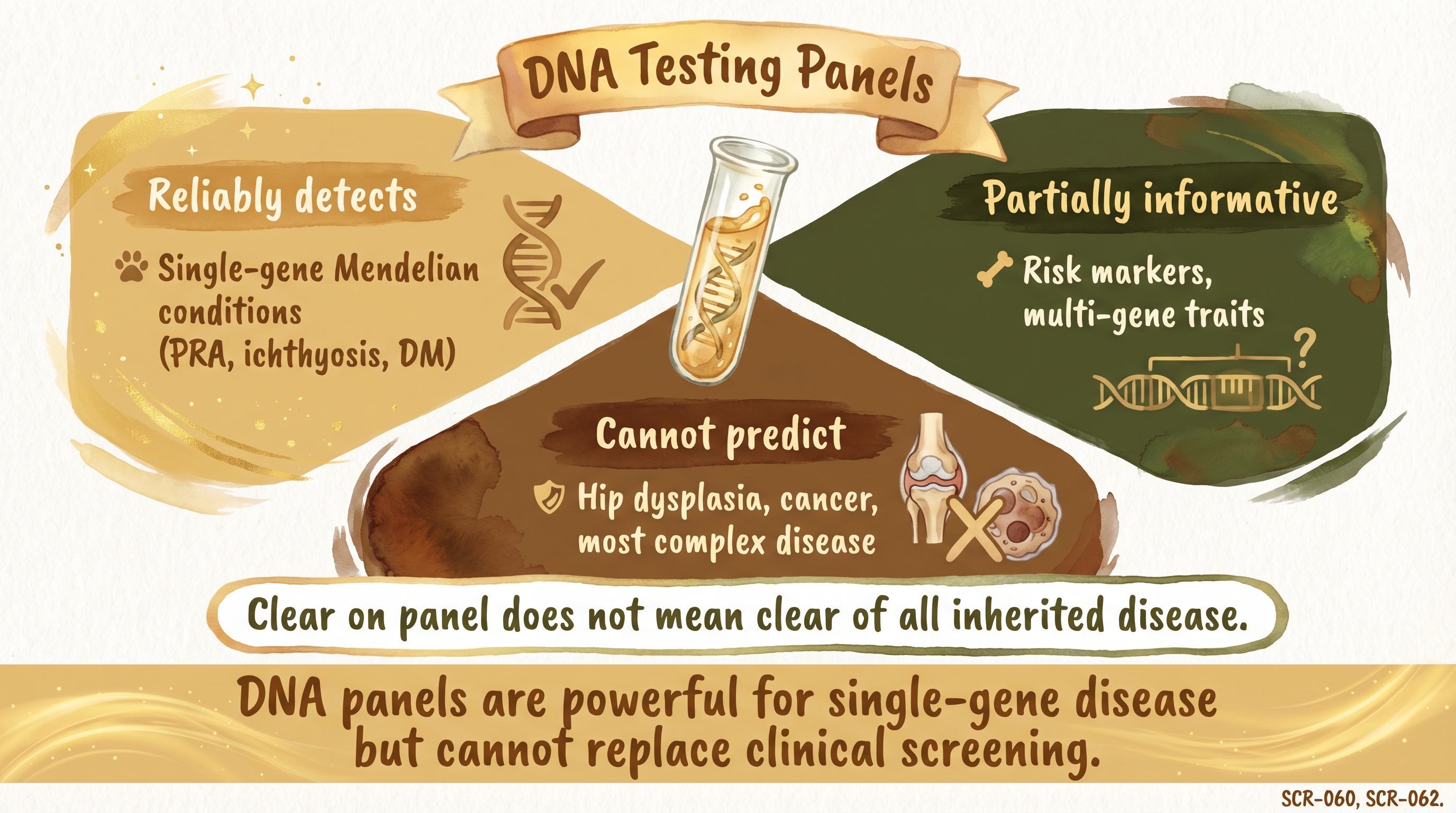
DNA panels are powerful for single-gene disease but cannot replace clinical screening.
Key Takeaways
- DNA panels are highly useful for validated monogenic diseases, carrier management, and parentage verification, but they do not summarize total future health.
- In Goldens, carrier-to-clear breeding is often the responsible path because it prevents affected puppies without needlessly shrinking diversity.
- A clear DNA panel does not rule out many major Golden risks, including polygenic disease and late-onset clinical conditions that require other screening methods.
- Families should ask what the panel tested, what it did not test, and how the breeder used the results in actual mating decisions.
The Evidence
- SCR-066 supportdogs
Carrier-to-clear breeding prevents affected puppies for recessive disease while preserving breeding-population diversity. - SCR-062 supportGolden Retrievers
Current DNA panels do not exhaust Golden Retriever ocular risk, so panel results cannot replace annual clinical eye screening. - SCR-113 supportGolden Retrievers
PRA in Goldens is genetically heterogeneous, so being clear on one PRA variant is not equivalent to comprehensive PRA clearance. - SCR-134 supportGolden Retrievers
As of March 2026, no validated DNA test existed for juvenile renal dysplasia or ectopic ureters in Golden Retrievers.
- Canine genetics literaturedogs
Commercial panels are strongest where a validated variant and disease relationship are well established and much weaker for polygenic outcome prediction. - Breeding-program logicdogs
DNA screening should be integrated with phenotype, family history, and diversity management rather than being treated as a stand-alone promise of health.
- domestic dogs
No published study directly defines the single best testing interval, threshold, or decision rule for dna testing panels for dogs across all Golden Retriever households and breeding programs.
SCR References
Sources
- Orthopedic Foundation for Animals. (n.d.). CHIC program. https://ofa.org/chic-programs/
- Orthopedic Foundation for Animals. (n.d.). DNA based disease tests. https://ofa.org/diseases/dna-tested-diseases/
- Grall, A., Guaguere, E., Planchais, S., Grond, S., Bourrat, E., Hausser, I., Hitte, C., Le Gallo, M., Derbois, C., Kim, G. J., Lagoutte, L., Degorce-Rubiales, F., Radner, F. P. W., Thomas, A., Kury, S., Bensignor, E., Fontaine, J., Pin, D., Zimmermann, R., ... Fischer, J. (2012). PNPLA1 mutations cause autosomal recessive congenital ichthyosis in Golden Retriever dogs and humans. Nature Genetics, 44(2), 140-147. https://doi.org/10.1038/ng.1056
- Downs, L. M., Wallin-Hakansson, B., Boursnell, M., Marklund, S., Hedhammar, A., Truve, K., Hubinette, L., Lindblad-Toh, K., Bergstrom, T., & Mellersh, C. S. (2011). A frameshift mutation in golden retriever dogs with progressive retinal atrophy endorses SLC4A3 as a candidate gene for human retinal degenerations. PLOS ONE, 6(6), e21452. https://doi.org/10.1371/journal.pone.0021452
- Downs, L. M., Wallin-Hakansson, B., Bergstrom, T., & Mellersh, C. S. (2014). A novel mutation in TTC8 is associated with progressive retinal atrophy in the golden retriever. Canine Genetics and Epidemiology, 1, 4. https://doi.org/10.1186/2052-6687-1-4
- Boundary approved by Queue1-DecisionTree: carrier-to-clear breeding and Golden Retriever PRA panel-limit claims are now covered by verified SCR-062, SCR-066, and SCR-113 source chains. The renal dysplasia / ectopic-ureter DNA-test component remains a monitored boundary: current GRCA and UC Davis materials describe active Golden Retriever ectopic-ureter genetics research, not a validated clinical DNA test for renal dysplasia or ectopic ureters in Golden Retrievers.