Ophthalmologic Screening for Breeding Stock
Compound evidence detail1 SCR / 2 parts
- Documentedthe rationale for board-certified veterinary ophthalmology examination as the breeding-stock ocular clearance standard - GRPU is late-onset (mean presentation around 8 to 8.6 years), has no available DNA test, and clinical examination remains the only practical screening pathway; DNA testing and clinical ophthalmoscopy serve complementary rather than substitutable roles
- Heuristicthe specific annual examination cadence as breeding-program consensus rather than a cadence whose precise interval has been validated by published controlled-trial outcome data - chosen because late-onset disease can develop after earlier clear examinations and shorter intervals are consensus-recommended
Ophthalmologic screening for breeding stock matters because some of the most important Golden Retriever eye risks are clinical problems, not panel problems. A dog can look normal to the family, be genetically clear on a set of known variants, and still carry late-onset ocular risk that only a board-certified veterinary ophthalmologist is positioned to evaluate. This is why annual eye screening remains a core part of serious Golden Retriever breeding programs. Documented
What It Means
What the Exam Is
The standard breeding-stock eye screen is a full ophthalmologic examination performed by a board-certified veterinary ophthalmologist, usually within the ACVO and OFA Eye Certification Registry framework.
The exam typically includes pupil dilation, slit-lamp biomicroscopy, indirect ophthalmoscopy, and evaluation of lens, retina, and anterior segment structures. Observed-JB
In some Golden-specific contexts, gonioscopy also matters because it can improve early assessment of pigmentary uveitis risk signals and related drainage-angle questions. Documented
Why This Is Not Redundant With DNA Testing
Families sometimes assume a DNA panel makes annual eye exams optional. The SCR says otherwise.
Current DNA panels do not exhaust Golden ocular risk, and PRA in Goldens is genetically heterogeneous even within the panel-testable portion of the problem. That means two separate things are true at once DNA testing is genuinely useful for known variants; and clinical eye screening is still indispensable.
Those are not competing ideas. They are complementary layers of the same screening architecture.
The Main Conditions Screening Tries to Catch
The practical screening target in Goldens includes several kinds of disease hereditary cataracts; progressive retinal atrophy patterns; distichiasis and eyelid abnormalities; entropion and related structural problems; and Golden Retriever Pigmentary Uveitis. Documented
Some of these are partly genotype questions. Some are clinical exam questions. Some are strongly late-onset questions. That is exactly why the annual screen matters.
Why Annual Recertification Matters
Hip certification is usually discussed as a one-time adult clearance. Eye certification is different.
The reason is simple: some important ocular diseases are progressive and adult-onset. A dog that passes an exam at age two has not therefore solved the question for life. Documented This is especially true for Golden Retriever Pigmentary Uveitis, which can emerge later and worsen over time.
So the practical breeder standard is not "the dog passed once." The real standard is "the dog is being reevaluated regularly through breeding life."
Why It Matters for Your Dog
Golden Retriever Pigmentary Uveitis Is the Best Example
GRPU is one of the clearest reasons this page exists. It is clinically important, breed-relevant, adult-onset, and not reducible to a current commercial DNA test.
That creates a very specific screening lesson annual ophthalmology matters more than one historic normal result; late-onset disease can change the breeding picture after early adulthood; and families should not confuse DNA clarity with full ocular clearance.
This is one of the places where a vague breeder phrase like "eyes are clear" is not enough without knowing when the exam was done and by whom.
What the Registry Adds
The OFA Eye Certification Registry adds public structure to the screening process. That is useful because it creates standard documentation; date-specific results; public verification in many cases; and better transparency for buyers.
Still, as with all registries, the value depends on the method under the entry. The real asset is the ophthalmologist-performed exam, not the existence of a registry line by itself.
Limits of the Exam
Eye screening is powerful, but it is not omniscient.
Important limits include it captures the dog at the time of exam, not every future state, some disease processes begin subtly, normal findings do not eliminate all later-life risk, and the exam does not replace DNA testing for known monogenic conditions.
This is why the best breeder practice is layered screening rather than one-tool confidence.
What Families Should Ask
Useful questions include was the exam performed by a board-certified ophthalmologist, when was the most recent exam, is the dog being recertified annually, were any findings monitored over time, and what DNA tests were also run for known retinal conditions. Documented
Those questions move the conversation out of marketing and into actual screening competence.
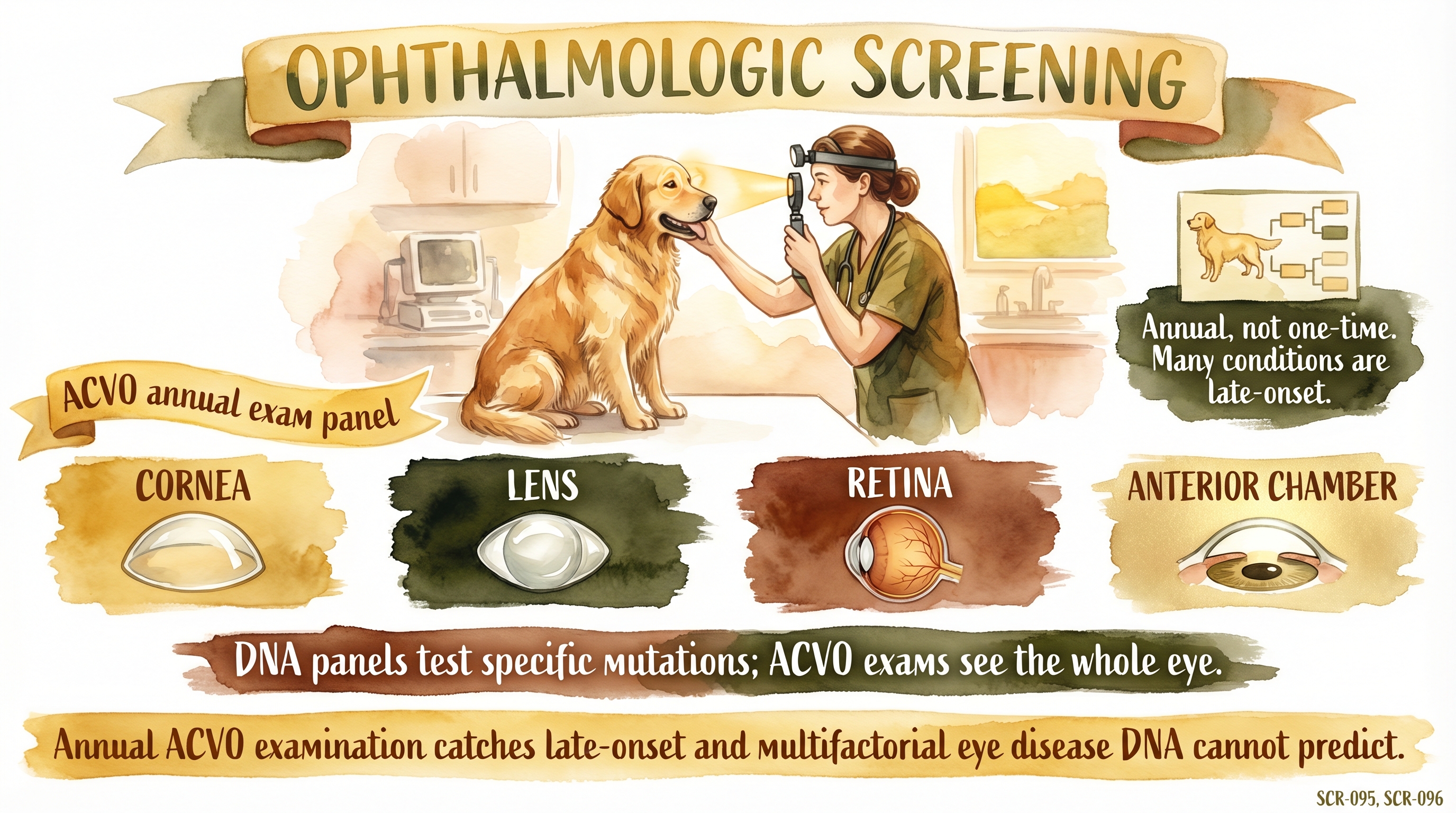
Annual ACVO examination catches late-onset and multifactorial eye disease DNA cannot predict.
Key Takeaways
- Annual ophthalmologic screening remains essential in Goldens because important ocular risks are clinical and late-onset, not fully DNA-testable.
- DNA testing and ophthalmology are complementary, not interchangeable, especially for PRA architecture and GRPU risk.
- A historic normal eye exam is not enough for breeding stock because adult-onset disease can emerge later.
- Families should ask who performed the exam, when it was done, and whether the dog is being recertified annually.
The Evidence
This entry uses observed claim-level tags beyond the dedicated EvidenceBlocks below. These tags mark JB program observation or practice-derived claims that need dedicated EvidenceBlock coverage in a later content pass.
- SCR-062 supportGolden Retrievers
DNA panels do not exhaust Golden Retriever ocular risk, which is why ophthalmologic examination remains necessary. - SCR-113 supportGolden Retrievers
PRA in Goldens is genetically heterogeneous, so being negative on one tested variant is not equivalent to comprehensive retinal clearance. - Clinical ophthalmology protocolsdogs
Dilated specialist eye exams remain the core clinical tool for identifying late-onset and non-panel-detectable ocular disease in breeding stock.
- Golden ocular source synthesisGolden Retrievers
GRPU creates a uniquely strong case for recurring specialist screening because it is breed-relevant, progressive, and not reducible to current panel testing. - Registry-practice logicdogs
Annual recertification is not bureaucratic excess. It reflects the biology of late-onset eye disease and the limits of one-time clearance.
- domestic dogs
No published study directly defines the single best testing interval, threshold, or decision rule for ophthalmologic screening for breeding stock across all Golden Retriever households and breeding programs.
SCR References
Sources
- Orthopedic Foundation for Animals. (n.d.). Eye certification registry. https://ofa.org/diseases/eye-certification/
- Townsend, W. M., & Gornik, K. R. (2013). Prevalence of uveal cysts and pigmentary uveitis in Golden Retrievers in three Midwestern states. Journal of the American Veterinary Medical Association, 243(9), 1298-1301. https://doi.org/10.2460/javma.243.9.1298
- Townsend, W. M., Huey, J. A., McCool, E., King, A., & Diehl, K. A. (2020). Golden Retriever pigmentary uveitis: Challenges of diagnosis and treatment. Veterinary Ophthalmology, 23(5), 774-784. https://doi.org/10.1111/vop.12796
- Downs, L. M., Wallin-Hakansson, B., Bergstrom, T., & Mellersh, C. S. (2014). A novel mutation in TTC8 is associated with progressive retinal atrophy in the Golden Retriever. Canine Genetics and Epidemiology, 1, 4. https://doi.org/10.1186/2052-6687-1-4
- Sapienza, J. S., Simo, F. J., & Prades-Sapienza, A. (2000). Golden Retriever uveitis: 75 cases (1994-1999). Veterinary Ophthalmology, 3(4), 241-246. https://doi.org/10.1046/j.1463-5224.2000.00151.x