PennHIP
PennHIP is one of the most important screening systems in canine orthopedics because it asks a more predictive question than the traditional extended-hip view: how loose is the joint when you actually test its passive laxity? That question matters because hip dysplasia begins with laxity, not with the later arthritis visible on a mature radiograph. Families do not need to become orthopedic specialists to use this page. They do need to understand that PennHIP and OFA are not redundant labels for the same information. Documented
What It Means
What PennHIP Is
PennHIP is a radiographic screening method developed to quantify passive hip laxity. It uses a standardized technique and reports a numerical value called the distraction index, often shortened to DI. Observed-JB
The lower the DI, the tighter the hip. The higher the DI, the greater the passive laxity and the greater the later dysplasia or osteoarthritis concern.
The Three Views
PennHIP uses three radiographic views an extended view; a compression view; and a distraction view.
The distraction view is the central innovation because it reveals how much the femoral head can be displaced when the masking effect of the traditional extended position is removed.
Why This Matters More Than Families Realize
The SCR already supports the key claim: passive laxity on stress or distraction radiography predicts later osteoarthritis risk more strongly than the standard extended view alone. Documented
That means PennHIP is not only "another hip test." It is a different kind of hip test that focuses more directly on the underlying biomechanical risk factor.
What the Distraction Index Means
The DI is a number between zero and one in practical discussion, with lower values representing tighter hips and higher values representing greater laxity. Breeders often compare a dogs value with the breed median or percentile context.
The family-friendly way to think about it is lower DI means less passive looseness; higher DI means more passive looseness; and more looseness usually means more later risk.
This does not turn the measurement into destiny. It turns it into a more direct risk estimate.
Why It Matters for Your Dog
PennHIP Versus OFA
This is the comparison families ask about most.
OFA uses the extended view and categorical grades. PennHIP uses a different three-view method and a numerical distraction index.
OFA is more widely recognized publicly; more deeply integrated into registry culture; and broader in casual breeder familiarity.
PennHIP is more quantitative; more centered on passive laxity; usable earlier in life; and stronger as a predictive orthopedic tool.
Those differences are why some serious breeders use both rather than treating them as alternatives where only one can possibly matter.
Age and Practical Use
One major advantage of PennHIP is that it can be performed earlier than final OFA certification. That early information does not replace adult orthopedic judgment, but it gives breeders a clearer risk signal long before traditional final certification age. Documented
This makes PennHIP especially valuable in breeding programs trying to avoid investing heavily in a young dog only to discover later that its hip risk profile was weaker than expected. Documented
Limits
PennHIP is strong, but not magical.
Important limits include it focuses on hips, not elbows, the test still predicts risk rather than guaranteeing outcome, environmental management still matters, and the method requires trained providers and standardized technique.
A low-risk PennHIP result does not mean a dog can be overfed, overconditioned, or managed carelessly through growth. Documented Prevention still matters after screening.
Why Buyers Should Care
Buyers often hear "our dogs have good hips" without learning how that conclusion was reached. PennHIP helps sharpen that conversation. It allows a breeder to talk about laxity in more specific terms instead of only broad passing or failing language.
The goal is not to force every buyer to prefer one system. The goal is to help buyers ask smarter questions did you use OFA, PennHIP, or both; what did the result actually measure; what age was the dog at testing; and how do you interpret the result in the context of family history.
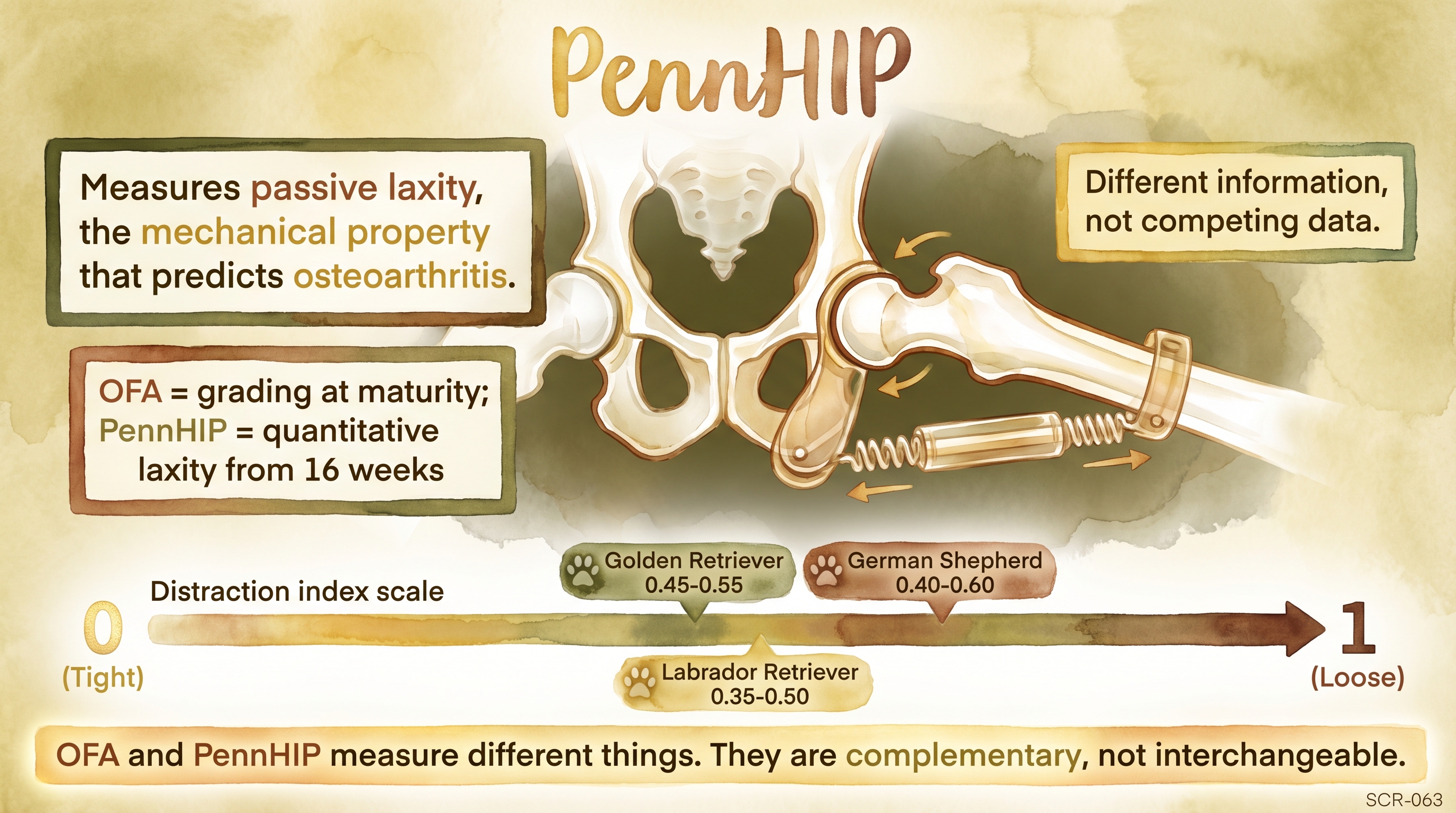
OFA and PennHIP measure different things - they are complementary, not interchangeable.
Key Takeaways
- PennHIP is a quantitative hip-screening system built around passive laxity and distraction index, not just later visible arthritis.
- Its central strength is predictive value: it asks a more direct biomechanical question than the standard extended view alone.
- PennHIP and OFA are not redundant because they measure different things and serve different screening roles.
- A strong PennHIP result improves risk assessment but never turns hip health into a guarantee.
The Evidence
This entry uses observed claim-level tags beyond the dedicated EvidenceBlocks below. These tags mark JB program observation or practice-derived claims that need dedicated EvidenceBlock coverage in a later content pass.
- SCR-063 supportdogs
Passive laxity measured on distraction or stress radiography is a stronger predictor of later osteoarthritis risk than the standard hip-extended view alone. - PennHIP methodology literaturedogs
The distraction index gives a quantitative estimate of passive hip laxity rather than waiting for secondary degenerative change to appear. - Comparative orthopedic literaturedogs
The method is especially useful because it targets the mechanical variable most central to dysplasia risk.
- Comparative screening logicdogs
PennHIP and OFA are complementary tools rather than interchangeable labels because they emphasize different parts of the orthopedic story. - Orthopedic prevention literaturedogs
Even a favorable screening result does not eliminate the importance of lean body condition and sensible growth management.
- domestic dogs
No published study directly defines the single best testing interval, threshold, or decision rule for pennhip across all Golden Retriever households and breeding programs.
SCR References
Sources
- Smith, G. K., Biery, D. N., & Gregor, T. P. (1990). New concepts of coxofemoral joint stability and the development of a clinical stress-radiographic method for quantitating hip joint laxity in the dog. Journal of the American Veterinary Medical Association, 196(1), 59-70. PMID: 2295555.
- Smith, G. K., Mayhew, P. D., Kapatkin, A. S., McKelvie, P. J., Shofer, F. S., & Gregor, T. P. (2001). Evaluation of risk factors for degenerative joint disease associated with hip dysplasia in German Shepherd Dogs, Golden Retrievers, Labrador Retrievers, and Rottweilers. Journal of the American Veterinary Medical Association, 219(12), 1719-1724. https://doi.org/10.2460/javma.2001.219.1719
- Runge, J. J., Kelly, S. P., Gregor, T. P., Kotwal, S., & Smith, G. K. (2010). Distraction index as a risk factor for osteoarthritis associated with hip dysplasia in four large dog breeds. Journal of Small Animal Practice, 51(5), 264-269. https://doi.org/10.1111/j.1748-5827.2010.00937.x
- Culp, W. T. N., Kapatkin, A. S., Gregor, T. P., Powers, M. Y., McKelvie, P. J., Smith, G. K., & Biery, D. N. (2006). Evaluation of the Norberg angle threshold: A comparison of hip joint laxity and osteoarthritis in dogs. Veterinary Surgery, 35(5), 453-459. https://doi.org/10.1111/j.1532-950X.2006.00174.x
- Lust, G., Williams, A. J., Burton-Wurster, N., Pijanowski, G. J., Beck, K. A., Rubin, G., Smith, G. K., & Farese, J. P. (2001). Joint laxity and its association with hip dysplasia in Labrador Retrievers. Journal of the American Veterinary Medical Association, 219(9), 1242-1246. https://doi.org/10.2460/javma.2001.219.1242
- Orthopedic Foundation for Animals. (n.d.). Hip dysplasia. https://ofa.org/diseases/hip-dysplasia/