Golden Retriever Lifespan and Longevity
Golden Retriever longevity is one of the most emotionally loaded subjects in the breed. Families want a number. The breed community often offers a story instead: Goldens used to live sixteen or seventeen years, and modern breeding ruined them. The problem is that the story is stronger than the evidence. Modern data does support a serious cancer burden and a lifespan that usually lands around ten to twelve years. What it does not yet firmly support is the nostalgic claim that an earlier Golden era routinely produced sixteen-year dogs as the norm. Mixed Evidence
What It Means
The Best-Supported Modern Range
Across modern surveys, veterinary datasets, and cohort-style reporting, Golden Retrievers generally cluster around a lifespan in the low teens, most often quoted in the ten-to-twelve-year range. Some populations land a little above that, some below. The exact figure depends on how deaths were recorded, which region was sampled, and whether the denominator included only formally diagnosed animals, insured animals, or owner-reported deaths.
This is why honest lifespan discussion should avoid fake precision. "Exactly 11.6 years" sounds scientific, but it often hides major dataset differences. The sturdier statement is simpler: in current data, Goldens are not generally a fourteen-to-seventeen-year breed. They are usually a low-teens breed carrying a meaningful risk of earlier loss from cancer and other disease.
Why the Old Longer-Lived Golden Story Persists
The folklore persists for understandable reasons.
People remember exceptional dogs vividly. Breed elders often compare the healthiest dogs they knew in one era to the average dog they see in another. Older dogs were also less likely to receive sophisticated cancer diagnostics, which complicates cross-era comparisons of cause of death and age at death.
The SCR boundary here matters. The claim that Goldens commonly used to live sixteen or seventeen years remains unverified. That does not mean no Goldens reached those ages. Of course some did. The issue is whether those ages represented a normal population expectation. At the moment, the evidence is not strong enough to say they did.
What Pulls Lifespan Down
Cancer
Cancer is the biggest single force in Golden Retriever mortality discussion. Hemangiosarcoma, lymphoma, mast cell tumors, and osteosarcoma all shape the breed's average lifespan because they are common enough, serious enough, and often age-limiting enough to move the whole curve.
Population structure
Golden longevity cannot be separated from breed genetics. A narrowed gene pool, repeated use of influential sires, and concentration of risk alleles create a background against which complex disease unfolds. This does not reduce longevity to one genetic number, but it does make diversity management relevant. Documented
Body condition
One of the most actionable longevity factors in dogs generally is body condition. The SCR already supports the claim that maintaining dogs lean extends lifespan and delays chronic disease expression. Documented That point matters in Goldens because the breed is affectionate, food-motivated, and often allowed to drift overweight as adulthood progresses.
Orthopedic and mobility burden
Hip disease, elbow disease, and chronic pain may not always be the official recorded cause of death, but they shape healthy lifespan. Documented A dog whose joints fail early does not experience the same quality or length of vigorous life as a dog who stays mobile into old age.
Longevity Versus Healthy Longevity
Families often mean two different things when they say "lifespan."
One is total years alive.
The other is how long the dog remains comfortable, mobile, engaged, continent, and able to participate in normal family life. A Golden who lives to twelve with good mobility, stable appetite, and preserved joy has experienced a different longevity story than a Golden who also reaches twelve but spends the last three years in steady decline.
That distinction matters because responsible breeding is not only about adding months. It is about shifting the timing and severity of disease so more of life stays usable and good.
Why It Matters for Your Dog
What Responsible Breeding Can Influence
Breeding cannot guarantee lifespan. It can influence the odds.
A responsible breeder can track age and cause of death across generations; prefer lines with documented later-life durability; manage diversity rather than narrowing the pool further; screen for orthopedic, cardiac, and ocular disease; and avoid language that treats one young passing dog as proof of a long-lived line. Documented
A responsible breeder cannot promise that two long-lived parents will produce a long-lived puppy; erase complex cancer risk with a single mating; and turn old stories about legendary lifespan into evidence.
The key shift is from sales rhetoric to surveillance logic. Breeders who know how their dogs die, at what ages, and in what line patterns are in a much better position than breeders who only know who passed health tests at age two.
What Families Can Influence
Families also matter, though within limits.
Keep the dog lean
This is the clearest modifiable factor available. A consistently lean body condition reduces orthopedic burden, improves metabolic health, and is associated with longer canine lifespan. Documented In practical terms, this usually means resisting the cultural pressure to normalize heaviness in adult Goldens.
Stay ahead of health changes
Twice-yearly senior wellness checks, early evaluation of lumps, and attention to changes in gait, appetite, drinking, or stamina do not guarantee longer life, but they improve the chance that treatable problems are identified earlier.
Protect mobility
Conditioning, traction, weight management, appropriate exercise, and early orthopedic evaluation all support healthy aging.
Accept probability honestly
Good choices improve odds. They do not create immunity. A family can do many things right and still lose a Golden to cancer. That tragedy does not mean the choices did not matter. It means biology still outruns control.
Why This Entry Matters for Just Behaving
Golden Retriever longevity is not a side issue to a breeding program. It is a credibility issue.
A breeder who says little about lifespan is avoiding the central emotional question families actually carry. A breeder who pretends the answer is simple is replacing honesty with reassurance. The better path is this one: explain the modern range, acknowledge the cancer burden, reject unverified nostalgia as data, and emphasize the things that genuinely shift probability.
That is the standard a serious Golden program should meet.
When to See a Veterinarian
Veterinary evaluation is appropriate for the signs that most often shorten healthy lifespan, including unexplained weight loss; new lump formation; reduced stamina; chronic stiffness or limping; drinking or urinating more than usual; recurrent vomiting or diarrhea; and persistent cough or exercise intolerance.
For older Goldens, changes that seem small often deserve attention sooner rather than later because many major diseases begin subtly.
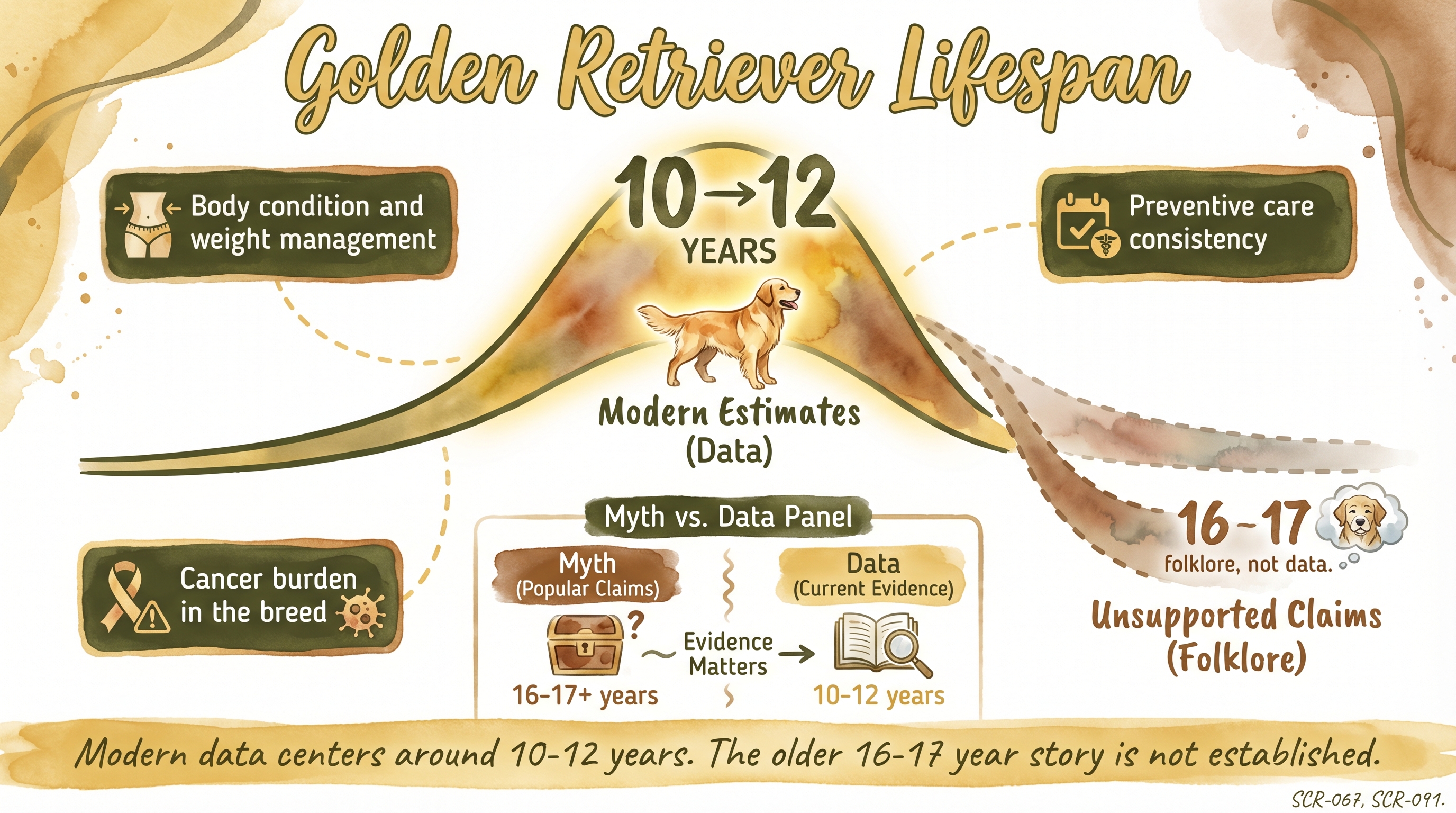
Modern data centers around 10-12 years - the older 16-17 year story is not established.
Key Takeaways
- Modern Golden Retriever lifespan is best described as low-teens rather than legendary mid-teen folklore.
- Cancer is the biggest force shaping longevity in the breed, but mobility, body condition, and population genetics matter too.
- The old story that Goldens routinely lived sixteen or seventeen years remains unverified and should not be presented as settled fact.
- Breeders and families can shift the odds through surveillance, diversity management, screening, and lean body condition, but none of those measures creates certainty.
The Evidence
This entry uses mixed-evidence claim-level tags beyond the dedicated EvidenceBlocks below. These tags mark claims that combine documented findings with observed practice, heuristic application, or unresolved gaps.
- Modern Golden lifespan datasetsGolden Retrievers
Recent surveys and cohort-style sources place Golden Retriever lifespan in the low teens, usually around ten to twelve years. - SCR-075 supportdogs
Lean body condition extends lifespan and delays chronic disease expression, making weight control one of the clearest modifiable longevity factors. - Golden mortality sourcesGolden Retrievers
Cancer remains the dominant age-limiting burden in the breed.
- SCR-068 boundaryGolden Retrievers
The claim that Goldens broadly used to live sixteen or seventeen years has not been adequately established by matched population-level evidence. - Historical comparison problemgeneral
Cross-era longevity comparisons are distorted by diagnostic change, referral change, and survivor-memory bias.
No direct canine research located for this specific topic. Current understanding relies on related research, clinical observation, and cross-species inference.
SCR References
Sources
- Fleming, J. M., Creevy, K. E., & Promislow, D. E. L. (2011). Mortality in North American dogs from 1984 to 2004: An investigation into age-, size-, and breed-related causes of death. Journal of Veterinary Internal Medicine, 25(2), 187-198. https://doi.org/10.1111/j.1939-1676.2011.0695.x
- Guy, M. K., Page, R. L., Jensen, W. A., et al. (2015). The Golden Retriever Lifetime Study: Establishing an observational cohort study with translational relevance for human health. Philosophical Transactions of the Royal Society B, 370(1673), 20140230. https://doi.org/10.1098/rstb.2014.0230
- Simpson, M., Searfoss, E., Albright, S., Brown, D. E., Wolfe, B., Clark, N. K., McCann, S. E., Haworth, D., Guy, M., & Page, R. (2017). Population characteristics of Golden Retriever Lifetime Study enrollees. Canine Genetics and Epidemiology, 4, 14. https://doi.org/10.1186/s40575-017-0053-5
- Labadie, J. D., Elser, B. A., Brown, D. C., Searfoss, E. E., & Page, R. L. (2022). Cohort profile: The Golden Retriever Lifetime Study (GRLS). PLoS ONE, 17(6), e0269425. https://doi.org/10.1371/journal.pone.0269425
- Kealy, R. D., Lawler, D. F., Ballam, J. M., Mantz, S. L., Biery, D. N., Greeley, E. H., Lust, G., Segre, M., Smith, G. K., & Stowe, H. D. (2002). Effects of diet restriction on life span and age-related changes in dogs. Journal of the American Veterinary Medical Association, 220(9), 1315-1320. https://doi.org/10.2460/javma.2002.220.1315
- O'Neill, D. G., Church, D. B., McGreevy, P. D., Thomson, P. C., & Brodbelt, D. C. (2013). Longevity and mortality of owned dogs in England. The Veterinary Journal, 198(3), 638-643. https://doi.org/10.1016/j.tvjl.2013.09.020
- Teng, K. T. Y., Brodbelt, D. C., Pegram, C., Church, D. B., & O'Neill, D. G. (2022). Life tables of annual life expectancy and mortality for companion dogs in the United Kingdom. Scientific Reports, 12, 6415. https://doi.org/10.1038/s41598-022-10341-6