Senior Exercise and Daily Life
Senior dogs still need movement. That is the first sentence because many families lose confidence precisely here. They worry that activity will worsen aging, so they begin protecting the dog by shrinking the dog's world too far. JB pushes back on that. The older Golden usually needs less intensity, less duration, and more recovery than before. It does not need life to collapse into bed rest and hallway wandering. Observed-JB
Good senior daily life is movement scaled to capacity, not movement abandoned.
What It Means
Why Movement Still Matters
Older dogs benefit from continued activity because movement supports muscle maintenance, joint mobility, appetite regulation, bowel regularity, mental orientation, and emotional steadiness.
Inactivity has costs. Dogs that move too little often get stiffer, weaker, and less confident. Observed-JB Then the family reads the resulting decline as proof the dog needed even less activity, and the loop tightens.
The Pace Has to Change
The senior dog does not need its adult routine copied forward unchanged. Observed-JB That is where families most often go wrong.
The better pattern is usually shorter walks more often, softer footing when possible, less repetitive impact, more warm-up before the dog is asked for a real pace, and more rest after meaningful outings.
The walk still matters because it is still relationship, exploration, circulation, and emotional orientation all at once. It just happens on older legs now.
Let the Dog Tell the Truth
Senior exercise should be guided less by the old plan and more by the dog's present body.
Useful signals include morning stiffness after the previous day, slowing on hills or turns, reluctance at the beginning of activity, shorter self-selected distance, heavier panting than expected, and longer recovery after normal exertion.
These signals do not always mean stop. They often mean adjust. The dog may want the same life with a different scale.
Enrichment Without Excess
Senior daily life also benefits from lower-cost forms of enrichment: calm sniff walks, familiar visits to easy places, brief retrieving if the dog still enjoys it and recovers well, gentle social inclusion, and scent games that do not require jumping or frantic searching.
This is where families can be especially creative in a good way. The senior dog does not need novelty fireworks. It needs ways of staying mentally inside life that do not demand a younger body.
Weather and Surface Matter More Now
Older dogs often show their age most clearly in cold weather, slippery surfaces, and abrupt changes in terrain. Observed-JB Families help their senior dogs greatly by taking those variables seriously. A walk that is comfortable on dry grass may be difficult on ice. A temperature that once felt irrelevant may now mean the first ten minutes are spent trying to loosen the body rather than enjoying the outing.
This is not coddling. It is reading the real conditions under which the older body has to operate.
Pain Is Often Quieter Than Families Expect
One reason senior exercise is hard to calibrate is that dogs often mask discomfort well. The dog may still go out happily and still be sore afterward. That is why post-activity behavior matters as much as enthusiasm at the door.
Families should not try to solve significant pain questions philosophically. Those belong with the veterinarian. JB's role is simpler: notice what the dog is showing and do not assume willingness means comfort.
The senior dog does not need to prove spirit by overriding the body. The family honors the dog best by making movement small enough, warm enough, and calm enough that it still feels good to do.
What This Is Not
This page is not saying senior dogs should be pushed through daily quotas, every slowing dog only needs a better walk plan, or pain management can be replaced by nicer surfaces. It is saying the senior dog still needs a daily life with movement in it, and that movement should be adapted rather than erased.
Why It Matters for Your Dog
Senior exercise is one of the clearest places where families can either preserve dignity or accidentally remove it. A dog who is no longer taken anywhere, no longer walked, and no longer invited into simple family movement often loses more than muscle. The dog loses orientation and part of its ordinary belonging.
Scaled movement protects against that. It tells the dog that life has changed, but life is still life. The family is still here. The walk is still for us. The world is still available, just in a gentler size.
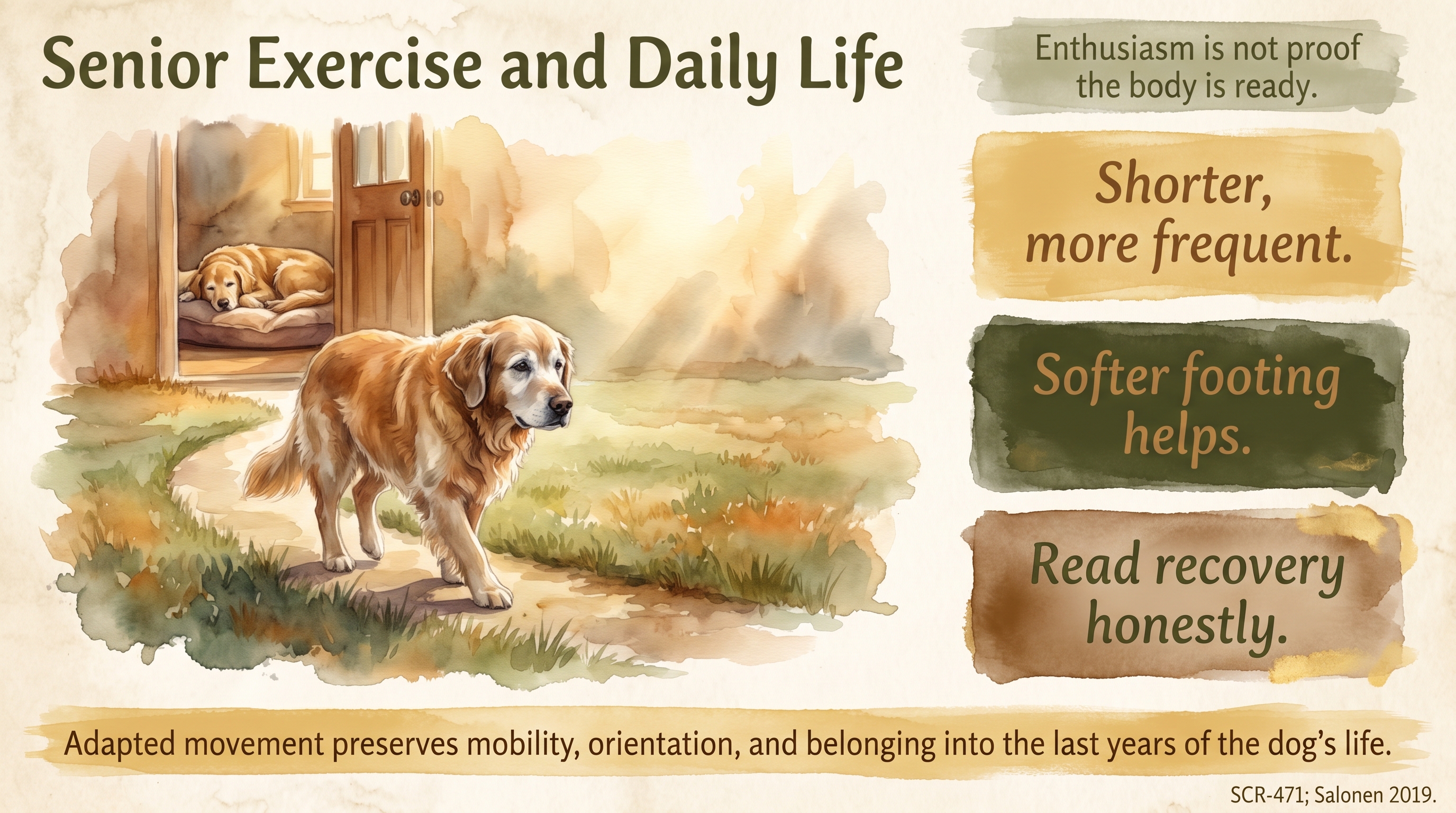
Adapted movement preserves mobility, orientation, and belonging into the last years of the dog's life.
Key Takeaways
- Senior dogs still need movement, but the scale and recovery pattern usually need to change.
- Shorter frequent outings, softer footing, and closer attention to recovery often work better than copying the old adult plan.
- A dog's enthusiasm to go out is not the same thing as proof that the body is comfortable afterward.
- Adapted movement helps preserve not only mobility but also orientation and belonging in daily life.
The Evidence
- orthopedic and senior-care literaturedogs
Older dogs benefit from appropriately scaled movement because mobility, conditioning, and body condition interact with comfort and function in later life. - Golden orthopedic contextGolden Retrievers
Breed-level joint and mobility concerns make later-life exercise choices especially relevant in Goldens.
- JB breeder and family observationGolden Retrievers
Senior dogs usually do best with shorter, more frequent, calmer movement rather than either old-adult intensity or near-complete inactivity. - JB household practiceolder family dogs
Preserving walks and inclusion at a gentler scale often supports both mood and mobility better than overprotection.
No published study directly tests the practical implications of senior exercise and daily life for domestic dog raising programs. The application to household dog raising remains an interpretive synthesis rather than a directly tested intervention finding.
SCR References
Sources
- American Animal Hospital Association. (2023). 2023 AAHA senior care guidelines for dogs and cats. Journal of the American Animal Hospital Association, 59(1), 1-21. https://doi.org/10.5326/JAAHA-MS-7343
- Creevy, K. E., Grady, J., Little, S. E., Moore, G. E., Strickler, B. G., Thompson, S., & Webb, J. A. (2019). 2019 AAHA canine life stage guidelines. Journal of the American Animal Hospital Association, 55(6), 267-290. https://doi.org/10.5326/JAAHA-MS-6999
- Kealy, R. D., Lawler, D. F., Ballam, J. M., Mantz, S. L., Biery, D. N., Greeley, E. H., Lust, G., Segre, M., Smith, G. K., & Stowe, H. D. (2002). Effects of diet restriction on life span and age-related changes in dogs. Journal of the American Veterinary Medical Association, 220(9), 1315-1320. https://doi.org/10.2460/javma.2002.220.1315
- Smith, G. K., Paster, E. R., Powers, M. Y., Lawler, D. F., Biery, D. N., Shofer, F. S., McKelvie, P. J., & Kealy, R. D. (2006). Lifelong diet restriction and radiographic evidence of osteoarthritis of the hip joint in dogs. Journal of the American Veterinary Medical Association, 229(5), 690-693. https://doi.org/10.2460/javma.229.5.690
- Just Behaving program observation disclosure. (2026). Boundary: this internal observation is limited to JB-raised Golden Retrievers whose families continued the JB framework after placement; cohort size, time window, and counting rule are deferred in this revision. Treat as program observation supporting senior exercise and daily-life adjustment patterns, not as published external evidence.