Longevity as a Heritable Trait in Dogs
Longevity is heritable enough to matter in breeding, but not heritable enough to become destiny. That sentence captures the whole subject in a way that is worth holding onto before any of the detail arrives, because most of the confusion in lifespan conversations comes from treating heritability as either nothing or everything when the actual reality sits in between. Across dog populations, lifespan shows a measurable genetic component, usually described in the low-to-moderate range, while still remaining heavily shaped by disease burden, body size, environment, nutrition, reproductive decisions, and simple luck. In Golden Retrievers, the conversation becomes even more specific because cancer dominates the breed-level mortality picture, and any honest longevity discussion in the breed has to confront cancer as the central variable rather than treating it as a separate topic. Documented
What It Means
Longevity as a statistical population trait
When longevity is described as a heritable trait, the claim is not that there is one lifespan gene waiting to be selected cleanly, and the claim is not that breeders can engineer longer life by identifying and pursuing that gene. The claim is that populations differ in ways that make longer or shorter life statistically more likely, and that those differences have a genetic component that responds, at least partially, to the selection choices breeders make over generations. Some populations of dogs reliably live longer than others, some lines within a breed produce dogs that reach advanced age more often than their herdmates, and those patterns are stable enough that they cannot be fully attributed to environment or chance.
That heritable component can reflect several overlapping mechanisms rather than one single pathway, and understanding the mechanisms helps explain why longevity behaves the way it does in real breeding populations. Inherited cancer susceptibility contributes significantly in breeds like Goldens where cancer is the dominant cause of death, because lines with higher cancer burden will on average produce dogs with shorter lives even when nothing else about their biology is unusual. Inherited structural soundness or fragility matters because dogs whose joints, spines, and cardiovascular systems age well can remain functional longer than dogs whose structural problems force early euthanasia or complicate other conditions. Background genomic diversity matters because dogs from more diverse genetic backgrounds seem to age better on average than dogs from heavily inbred lines, likely through a combination of reduced recessive disease expression and general biological resilience that is hard to attribute to any one locus. Fertility and general biological robustness are often correlated with longevity, and lines with fertility problems frequently also show other signs of biological compromise that affect lifespan. And specific loci associated with survival differences in defined populations have been identified in research studies, though these associations are usually modest in effect size and population-specific in their applicability.
The Golden Retriever lifespan picture
Golden Retrievers illustrate the complexity of lifespan discussion well because the breed has become a subject of significant research and cultural attention around its longevity, and the data that has accumulated deserves careful interpretation rather than either acceptance of folklore or dismissal of legitimate concern. Documented The breed-average lifespan is often described in the rough 10 to 12 year range in modern datasets, which places Goldens at the lower end of what would be expected for a mid-to-large breed dog. But the exact number depends strongly on what kind of dataset is being used, and the differences between dataset types are large enough that any single lifespan claim must stay tied to the population studied.
Referral necropsy populations, meaning dogs whose deaths were examined at referral veterinary centers, tend to produce different lifespan estimates than caregiver surveys, because the dogs who end up at referral centers are often those whose deaths involved enough complexity to warrant that level of investigation. Caregiver surveys capture a broader population but depend on caregiver memory and honesty about causes of death. Insured-dog data reflects a population that has both the resources and inclination to insure, which may not represent the full breed population. Each of these methodologies captures something real about Golden Retriever longevity, but none of them captures the full picture, and breeders or families who cite lifespan numbers should understand where those numbers came from before treating them as authoritative.
The 16-to-17-year historical narrative
One of the most persistent cultural claims in the Golden Retriever world is that the breed used to live 16 to 17 years in earlier decades and now routinely lives only 10 to 12 years, with the shortened lifespan attributed variously to commercial breeding practices, reduced genetic diversity, environmental toxins, vaccination schedules, or modern feeding practices depending on who is telling the story. Estimated This narrative is culturally powerful because it taps into real grief over dogs lost too soon and real concerns about the direction the breed has taken, and dismissing it outright would miss the emotional truth that many long-time Golden enthusiasts genuinely feel they are losing dogs earlier than they used to.
But the source layer treats a modern breed-wide lifespan decline claim as unresolved rather than settled, and responsible communication has to respect that distinction. The evidence that would be needed to rigorously compare lifespan distributions across decades is thin, because systematic lifespan data from earlier eras is largely unavailable and the comparisons that have been made often rely on selective memory, small samples, or non-representative populations. Individual dogs reaching 16 or 17 have always been rare in any breed of Golden Retriever size, and whether the average has genuinely shifted or whether the perception reflects something else is a question the peer-reviewed record has not yet answered with confidence.
What is better established, and what breeders and families can work with more reliably, is the structural picture of the current breed. Golden Retrievers carry a heavy cancer burden relative to many other dog populations, and that burden is a real feature of the breed rather than a perception. Inbreeding and diversity loss have measurable biological costs within the breed, with documented consequences for fertility, immune function, and overall resilience. Within-breed genetic differences can be associated with survival variation, meaning that lines within the breed do differ in how their dogs age. This is enough to make longevity a legitimate breeding target even if it is never a simple one and even if the historical narrative remains contested.
Why longevity responds slowly to selection
Longevity is one of the harder traits to select for directly because the feedback loop is long. A breeder who wants to select for hip conformation can screen a two-year-old dog and make breeding decisions promptly. A breeder who wants to select for longevity has to wait until that dog has lived its full life before knowing how long that was, and by the time the information arrives, the dog has typically been gone for years and the breeding opportunities have passed. This asymmetry between the trait's expression and the breeder's decision timeline makes direct longevity selection genuinely difficult to operationalize in any program.
Practical longevity selection therefore works more through ancestral tracking than through direct measurement of breeding candidates. A breeder evaluates the lifespan and cause of death of the breeding candidate's parents, grandparents, siblings, and extended relatives, and uses that population history as an approximation of the candidate's own genetic longevity potential. Documented This approach is slower and less precise than direct measurement would be, but it is the tool the biology leaves available, and breeders who track ancestral information carefully are doing the real work of longevity selection even when they cannot name it in those terms.
Why It Matters for Your Dog
Families should care about longevity because it changes how a breeder thinks, and the mindset difference between breeders who treat longevity seriously and breeders who treat it as an afterthought is visible in many other parts of the program as well.
A breeder who treats longevity as real will track age at death across relatives with enough specificity to know when each major ancestor died and why. They will track cause of death when known, distinguishing cancer from cardiac disease from orthopedic-related euthanasia from natural old age because the causes carry different breeding implications. Documented They will track cancer clustering in families, noting when particular lines produce multiple cancer cases at younger-than-average ages even when individual diagnoses could be explained away. And they will pay attention to whether close inbreeding is accumulating hidden biological cost across generations, using pedigree analysis and modern tools like genomic inbreeding coefficients where available to catch problems before they become visible as fertility decline or shortened lifespan.
That mindset is different from relying only on screening snapshots taken at breeding age, and it requires a longer time horizon and more active record-keeping than many breeding programs maintain. Breeders who do this work are not necessarily producing dogs with guaranteed longer lives, but they are producing dogs from populations where the longevity odds have been thoughtfully managed, and over generations the difference between managed and unmanaged populations can become substantial.
For JB, longevity matters because it pulls several other topics together into a single integrated concern. Diversity preservation matters partly because recent inbreeding has documented costs inside the breed, and a program that ignores diversity is indirectly accepting a longevity cost even if it never frames the decision in those terms. Cancer monitoring matters because cancer is the central mortality burden in Goldens, and any longevity strategy that does not attend to cancer patterns is missing the largest single contributor to the breed's lifespan picture. And breeder honesty matters because a lifespan discussion without dataset limits quickly turns into folklore, and folklore-level claims do not help families make the informed decisions they deserve to make.
The right long-arc goal is not "produce immortal dogs," which would be dishonest as an aspiration and impossible as an outcome. It is "select away from the population structure that makes shorter, more disease-limited life more likely," and that goal is achievable in principle even if its results are measured over generations rather than within any single litter. A program committed to that goal is doing the real work of longevity breeding whether or not the individual dogs it produces ever become the 16-year-old outliers families sometimes hope for.
What This Cannot Predict
Longevity is the opposite of a single-puppy guarantee, and the temptation to treat it that way should be resisted actively because the consequences of overclaiming are particularly painful for families.
It cannot tell a family that one puppy from a long-lived pedigree will definitely reach advanced age, because the individual outcome distribution remains wide even within the best lines and because the factors contributing to early death include components that are not reducible to the pedigree.
It cannot reduce lifespan to one marker, one ancestor, or one line label, because the polygenic and multifactorial nature of longevity means that no single point of information captures enough of the relevant variation to dominate the prediction.
And it cannot erase the reality that accidents, environment, infection, endocrine disease, orthopedic decline, and especially cancer can interrupt even a genetically promising life in ways that no amount of careful breeding can fully prevent. Documented A Golden Retriever from a line that has produced many long-lived dogs can still develop lymphoma at age six, and that outcome is not evidence that the breeder failed or that the line's longevity record was false. It is evidence that probabilistic traits produce probabilistic outcomes even when the underlying probabilities are favorable.
The safe interpretation is population-level only. Selection can shift odds over time, breeders can work toward lines where longer-lived dogs are more common, and families can reasonably prefer breeders whose longevity track record is better documented. But none of this translates into an individual promise, and communication that treats it that way is setting families up for disappointment that is not fair to anyone involved.
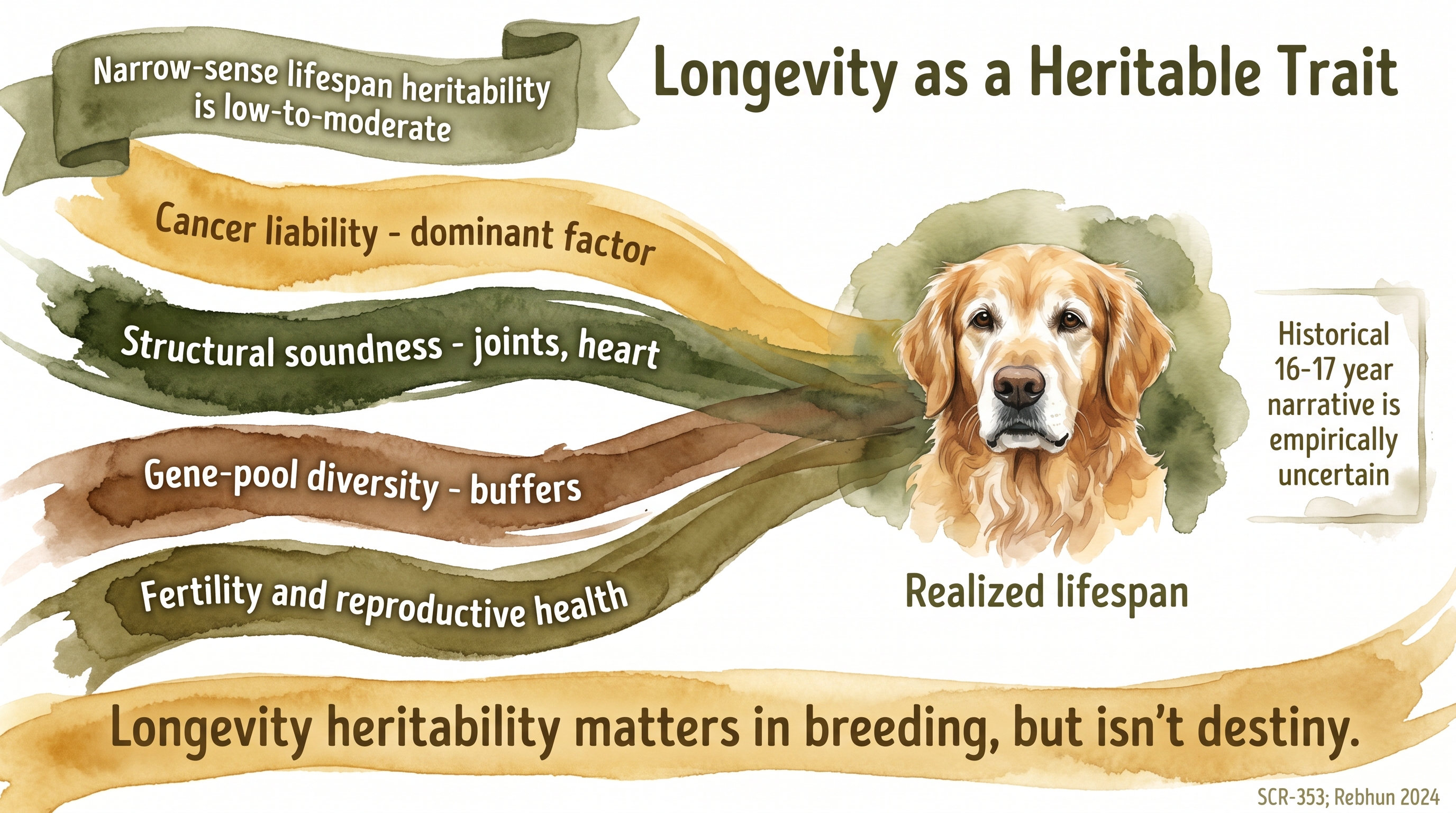
Longevity is heritable enough to matter in breeding but not heritable enough to become destiny.
Key Takeaways
- Longevity has a real heritable component in dogs, but it remains a probabilistic population trait rather than an individual guarantee.
- In Golden Retrievers, lifespan discussion cannot be separated from cancer burden and population structure.
- Specific longevity-associated loci can be informative without becoming deterministic predictors.
- The most responsible breeding approach treats diversity preservation, cause-of-death tracking, and cancer pattern monitoring as part of longevity selection.
- Claims that breed-average lifespan has collapsed from a historical norm of 16 to 17 years remain unresolved in the peer-reviewed record and should not be presented as settled fact.
The Evidence
This entry uses estimated claim-level tags beyond the dedicated EvidenceBlocks below. These tags mark approximate ranges or timing claims that should remain bounded by the cited sources.
- Canine longevity genetics and epidemiology literaturedogs
Overall lifespan shows low-to-moderate heritability in studied dog populations, supporting the view that longevity can respond to selection without becoming individually predictable. - Golden Retriever longevity GWAS literatureGolden Retrievers
Within-breed association work has identified ERBB4-related haplotypes associated with survival differences in Golden Retrievers, while still stopping short of a deterministic longevity model.
- Golden Retriever longevity and cancer source synthesisGolden Retrievers
Golden lifespan estimates vary by dataset, but cancer is the dominant mortality story in the breed and must be treated as central to any breeding discussion about longevity. - Golden Retriever population-health studiesGolden Retrievers
Recent inbreeding and reduced diversity are associated with measurable biological costs inside the breed, making diversity preservation part of longevity strategy.
- Golden Retriever longevity boundaryGolden Retrievers
The popular claim that breed-average lifespan has definitively collapsed from a much older historical norm remains unresolved in the peer-reviewed record and should not be stated as settled fact.
No prospective longitudinal study has directly tracked whether breeders' ancestral longevity rankings predict actual offspring longevity better than baseline population rates, controlling for other breeding selections.
SCR References
Sources
- McMillan K.M., Bielby J., Williams C.L., Upjohn M.M., Casey R.A., & Christley R.M. (2024). Longevity of companion dog breeds: those at risk from early death. Scientific Reports, 14, 531. doi:10.1038/s41598-023-50458-w
- Teng K.T., Brodbelt D.C., Pegram C., Church D.B., & O'Neill D.G. (2022). Life tables of annual life expectancy and mortality for companion dogs in the United Kingdom. Scientific Reports, 12(1), 6415. doi:10.1038/s41598-022-10341-6
- O'Neill D.G., Church D.B., McGreevy P.D., Thomson P.C., & Brodbelt D.C. (2013). Longevity and mortality of owned dogs in England. The Veterinary Journal, 198(3), 638-643. doi:10.1016/j.tvjl.2013.09.020
- Urfer S.R., Wang M., Yang M., Lund E.M., & Lefebvre S.L. (2020). Risk factors associated with lifespan in pet dogs evaluated in primary care veterinary hospitals. Journal of the American Animal Hospital Association, 56(3), 130-137. doi:10.5326/JAAHA-MS-6973
- Bonnett B.N., Egenvall A., Hedhammar Ã…., & Olson P. (2005). Mortality in over 350,000 insured Swedish dogs from 1995-2000: I. Breed-, gender-, age- and cause-specific rates. Acta Veterinaria Scandinavica, 46(3), 105-120. doi:10.1186/1751-0147-46-105
- Kent M.S., Burton J.H., Dank G., Bannasch D.L., & Rebhun R.B. (2018). Association of cancer-related mortality, age and gonadectomy in golden retriever dogs at a veterinary academic center (1989-2016). PLOS ONE, 13(2), e0192578. doi:10.1371/journal.pone.0192578
- Guy M.K., Page R.L., Jensen W.A., Olson P.N., Haworth J.D., Searfoss E.E., & Brown D.E. (2015). The Golden Retriever Lifetime Study: establishing an observational cohort study with translational relevance for human health. Philosophical Transactions of the Royal Society B, 370(1673), 20140230. doi:10.1098/rstb.2014.0230
- Labadie J., Swafford B., DePena M., Tietje K., Page R., & Patterson-Kane J. (2022). Cohort profile: The Golden Retriever Lifetime Study (GRLS). PLOS ONE, 17(6), e0269425. doi:10.1371/journal.pone.0269425