The Five Pillars as Shared Language Between Breeder and Family
Families sometimes meet the Five Pillars as if they were five separate things to remember. That is understandable, but it misses their practical power in the transition. The pillars are not a checklist of techniques. They are a shared language. They describe the way the breeder lives with the puppies and the way the family is being invited to continue living with the dog once it comes home. That shared-language framing is a JB formulation rather than a peer-reviewed intervention model, which is why it remains heuristic. But it is one of the clearest ways to understand how the philosophy actually functions in daily life. Heuristic
What It Means
Each pillar names a part of the same communication system.
Mentorship means the puppy has calm adults to orient toward.
Calmness means the whole household organizes around a lower arousal baseline.
Structured Leadership means the adults hold direction, timing, and boundaries.
Prevention means the family avoids writing problems it would later need to fight.
Indirect Correction means the family still has a real boundary vocabulary without crossing into punishment.
These are not independent modules.
They reinforce each other constantly.
How the Pillars Fit Together
Calmness is the floor.
Without it, the rest gets noisy fast.
Mentorship and Structured Leadership are the scaffolding. They tell the puppy who to read and how the household organizes itself. Heuristic
Prevention is the architectural principle. It shapes what the family chooses not to initiate.
Indirect Correction is the fine-grained language that protects boundaries after the relationship is already organized around calm.
Once families see the pillars this way, the transition becomes much easier to understand.
What JB Does Not Recommend
JB does not recommend treating the pillars like: five hacks, five commands, five compliance tasks, and five independent training tools. Heuristic
That framing turns a living philosophy into a technique stack.
The family then starts asking: which pillar do I use for this.
instead of asking: what kind of relationship is the puppy living inside right now.
That is the more important question.
Why Shared Language Matters
The shared-language framing matters because breeder and family can then mean the same thing by the same words. Heuristic When JB says calmness, it does not mean lethargy. When it says correction, it does not mean fear. When it says leadership, it does not mean domination. In other words, correction is communication, while punishment is imposed suffering.
That reduces confusion.
It also gives the family a stable interpretive frame when life gets harder: if the puppy is escalating, check calmness, if the puppy has no adult to orient to, check mentorship, if the home keeps writing problems, check prevention, and if the family feels it has no boundary language, check indirect correction. Heuristic
Why It Matters for Your Dog
This page matters because the transition is where the pillars stop being theory. They become the actual air the puppy breathes in the home.
The Five Pillars are not five unrelated dog techniques. They are one relational language. Calmness is the floor, mentorship and leadership organize the relationship, prevention shapes what gets written, and indirect correction protects boundaries without turning the relationship punitive.
When the family understands that, it becomes much harder to drift back into the industry habit of solving each new problem with a new method. The pillars already give the family one coherent way to think.
That coherence is part of what steadies the puppy.
It is also part of what steadies the humans.
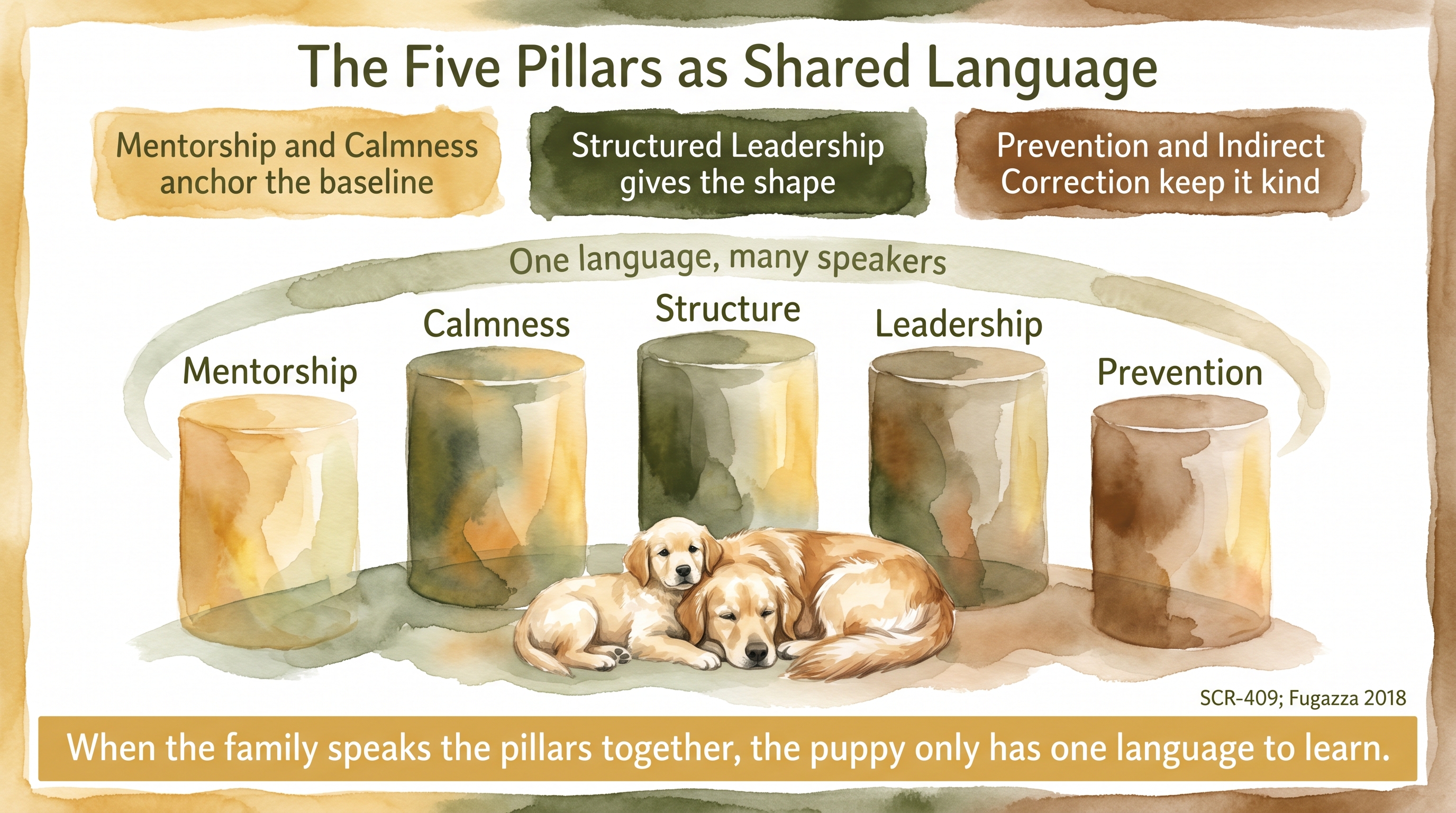
When the family speaks the pillars together, the puppy only has one language to learn.
Key Takeaways
- The Five Pillars work best when families understand them as one language rather than five separate techniques.
- Calmness is the floor, mentorship and leadership organize the relationship, prevention reduces later cleanup, and indirect correction protects boundaries without punishment.
- Treating the pillars like a technique stack weakens the philosophy by separating what is meant to work together.
- The shared-language framing helps breeder and family keep meaning consistent across the transition.
The Evidence
- Brubaker & Udell (2023); van Herwijnen et al. (2018, 2020); de Assis et al. (2025)domestic dogs
Canine outcomes are shaped by owner consistency, guidance style, stability, and relational patterns rather than by isolated events alone. - Topal et al. (1998); Horn et al. (2013); Dale et al. (2024); Thielke & Udell (2019)domestic dogs
Secure social orientation, contextual consistency, and predictable handling all support more stable early adjustment.
- JB philosophical synthesisapplied puppy raising
The Five Pillars as one interlocking shared language is a JB explanatory framework consistent with multiple evidence streams, but it is not itself a directly trialed five-part intervention package.
No published study directly tests the specific Just Behaving guidance on the pillars as shared language. This entry relies on broader canine evidence, breeder observation, and practical synthesis.
SCR References
Sources
- Brubaker, L., & Udell, M. A. R. (2023). Does pet parenting style predict the social and problem-solving behavior of pet dogs (Canis lupus familiaris)? Animal Cognition, 26(1), 345-356. https://doi.org/10.1007/s10071-022-01694-6
- van Herwijnen, I. R., van der Borg, J. A. M., Naguib, M., & Beerda, B. (2018). The existence of parenting styles in the owner-dog relationship. PLOS ONE, 13(2), e0193471. https://doi.org/10.1371/journal.pone.0193471
- van Herwijnen, I. R., van der Borg, J. A. M., Naguib, M., & Beerda, B. (2020). Dog-directed parenting styles predict verbal and leash guidance in dog owners and owner-directed attention in dogs. Applied Animal Behaviour Science, 232, 105131. https://doi.org/10.1016/j.applanim.2020.105131
- de Assis, L. S., Georgetti, B., Burman, O. H. P., Pike, T. W., & Mills, D. S. (2025). Development of a dog owner caregiving style scale (Lincoln Owner Caregiving Questionnaire, LOCQ) and its relationship with behaviour problems in dogs. Applied Animal Behaviour Science, 287, 106628. https://doi.org/10.1016/j.applanim.2025.106628
- Topal, J., Miklosi, A., Csanyi, V., and Doka, A. (1998). Attachment behavior in dogs: A new application of Ainsworth's Strange Situation Test. Journal of Comparative Psychology, 112(3), 219-229. https://doi.org/10.1037/0735-7036.112.3.219
- Horn, L., Huber, L., and Range, F. (2013). The importance of the secure base effect for domestic dogs. PLoS ONE, 8(1), e65296. https://doi.org/10.1371/journal.pone.0065296
- Dale, F. C., Burn, C. C., Murray, J., & Casey, R. (2024). Canine separation-related behaviour at six months of age: Dog, owner and early-life risk factors identified using the 'Generation Pup' longitudinal study. Animal Welfare, 33, e60, 1-16. https://doi.org/10.1017/awf.2024.56
- Thielke, L. E., & Udell, M. A. R. (2019). Evaluating cognitive and behavioral outcomes in conjunction with the secure base effect for dogs in shelter and foster environments. Animals, 9(11), 932. https://doi.org/10.3390/ani9110932