Authoritative Caregiving and Outcomes
Compound evidence detail1 SCR / 3 parts
- Documentedthe Baumrind authoritative-parenting literature in human child development
- Documentedthe canine correlational evidence linking dog-directed caregiving styles to attachment, attention, sociability, and problem-solving outcomes (van Herwijnen 2018/2020, Brubaker and Udell 2023)
- Heuristicthe JB inference that one specific caregiving style experimentally produces the best long-term developmental outcomes in dogs
Authoritative caregiving refers to the combination of warmth and structure. In human developmental psychology, it is the parenting style most consistently associated with strong developmental outcomes. Dog research has increasingly adapted this framework to caregiver-dog relationships, and the current evidence supports a careful conclusion: authoritative-like caregiver styles are measurable in dogs and are associated with better attachment-related and behavioral outcomes, but the full causal transfer from human parenting science remains more limited than the shorthand sometimes suggests. Documented
What It Means
The Human Origin of the Framework
Baumrind's typology is the standard starting point. The familiar quadrants are: authoritative (high warmth, high structure), authoritarian (low warmth, high control), permissive (high warmth, low structure), and uninvolved (low warmth, low structure).
In human children, the authoritative pattern is the strongest overall predictor of healthy developmental functioning across many domains. That part of the literature is settled enough to be treated as textbook developmental science.
The question for dog science is narrower. Can caregiver behavior be meaningfully described using analogous style dimensions, and if so, do those dimensions predict measurable outcomes in dogs?
What the Dog Literature Shows
The answer is increasingly yes.
van Herwijnen and colleagues showed that dog-directed parenting styles can be measured as stable caregiver-report patterns. In later observational work, those styles predicted concrete caregiver behavior: praise, verbal correction, leash tension, and how much the dog oriented back to the caregiver in a distraction context. Documented
Brubaker and Udell then took the question a step further by linking caregiving style to attachment-related and performance outcomes. Dogs of caregivers with authoritative styles showed the highest secure-attachment rates along with stronger sociability and better persistence in a solvable task. Documented Bouma and colleagues extended the literature further, showing that parenting-style variables in dog-human relationships are associated with attachment security, sensitivity to social context, and related outcomes.
These findings matter because they move the topic beyond analogy. The caregiver-style variable is not just borrowed language from parenting books. It is now a measurable canine research variable. Documented
Why Warmth and Structure Travel Together
One reason the authoritative pattern is so interesting is that it integrates two things that are often falsely opposed: responsiveness and boundaries.
Too little responsiveness weakens the relationship's regulatory function. Too little structure weakens predictability and legibility. Attachment science and controllability science both suggest that organisms do best when the caregiving environment is usable: warm enough to be safe, structured enough to be understandable. Documented
In the dog literature, authoritative-like styles appear to capture that same balance better than purely corrective or purely permissive patterns do. Documented That is why the outcome signal keeps recurring across attachment, sociability, and persistence measures.
Why It Matters for Your Dog
The Causality Boundary
This is the most important limit.
The human framework is causal and deeply replicated. The dog framework is promising, direct, and increasingly robust, but much of it is still correlational. Studies show that caregiver style and dog outcomes move together. They do not yet prove the full developmental mechanism with the same strength the human literature can claim.
That means the scientifically disciplined phrasing is: dog-directed parenting styles exist, authoritative-like caregiving is associated with better outcomes, and the stronger claim that authoritative caregiving has been experimentally established as the singular cause of those outcomes in dogs is still too strong.
No published study has directly tested whether JB-style authoritative caregiving produces measurably better outcomes than other authoritative-style approaches or other parenting styles in a breeder-to-family comparison.
This matters because the literature is already strong enough without being oversold.
The pillar entry interprets these findings as support for a parental rather than dominance-based framework. This page stays closer to the evidence: authoritative-like caregiver style is a documented canine variable, and its outcome associations are meaningful, but the full causal framework remains more bounded than in human developmental research.
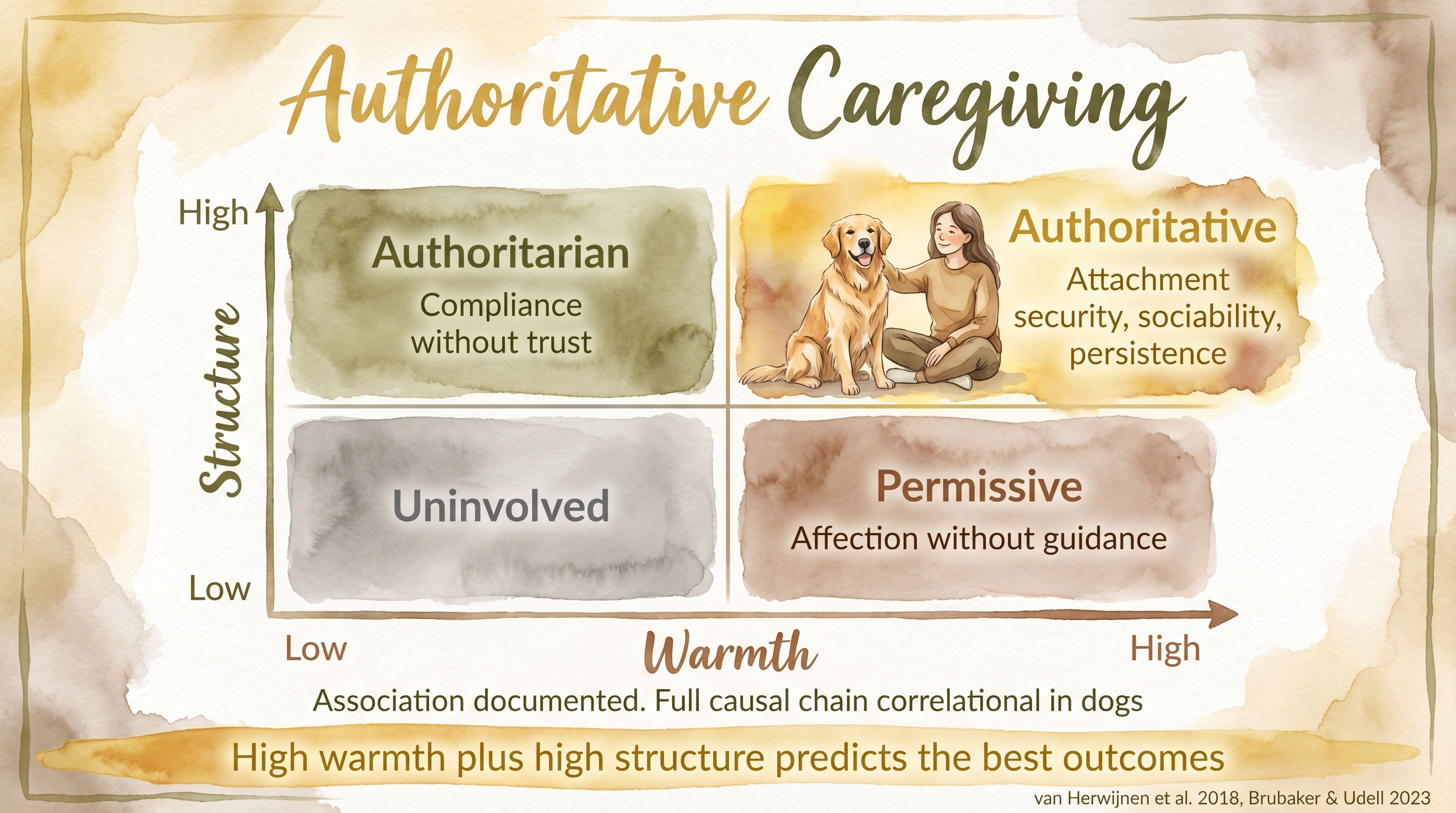
Authoritative caregiving combines warmth with consistent structure - producing better outcomes than permissive or authoritarian approaches.
Key Takeaways
- Authoritative caregiving combines warmth with clear and stable structure.
- Dog-directed parenting styles are now measurable variables, not just borrowed metaphors.
- Authoritative-like caregiver styles are associated with stronger attachment-related and behavioral outcomes in dogs.
- Those associations are meaningful, but they should not be overstated as fully settled canine causality.
The Evidence
- van Herwijnen, I. R. et al. (2018)domestic dogs and humans
Recovered dog-directed parenting-style dimensions in owners using dog-adapted parenting-style items. - van Herwijnen, I. R. et al. (2020)domestic dogs and humans
Parenting-style scores predicted praise, corrections, leash guidance, and dog owner-directed attention in observed contexts. - Brubaker, L., & Udell, M. A. R. (2023)domestic dogs
Authoritative owners had dogs with higher secure-attachment rates and better social and problem-solving outcomes. - Bouma, E. M. C. et al. (2024)domestic dogs and humans
Parenting-style transmission into dog care was associated with differences in attachment security, sociability, and context use.
- Baumrind, D. (1966, 1991)humans
Authoritative parenting is the warmth-plus-structure pattern most consistently associated with stronger developmental outcomes in children.
- SCR-019 boundarydomestic dogs and humans
The authoritative framework is strongly documented in humans. Dog evidence now supports direct association, but the full causal transfer remains more limited and partly analogical.
SCR References
Sources
- Baumrind, D. (1966). Effects of authoritative parental control on child behavior. Child Development, 37(4), 887-907.
- Baumrind, D. (1991). The influence of parenting style on adolescent competence and substance use. Journal of Early Adolescence, 11(1), 56-95.
- Bouma, E. M. C., Vingerhoets, A. J. J. M., & van der Veld, W. M. (2024). Parenting styles and intergenerational transmission in human-dog relationships. Anthrozoos / Animals, 14(7), 1038.
- Brubaker, L., & Udell, M. A. R. (2023). Does pet parenting style predict the social and problem-solving behavior of pet dogs? Animal Cognition, 26(1), 345-356.
- van Herwijnen, I. R., van der Borg, J. A. M., Naguib, M., & Beerda, B. (2018). The existence of parenting styles in the owner-dog relationship. PLOS ONE, 13(2), e0193471.
- van Herwijnen, I. R., van der Borg, J. A. M., Naguib, M., & Beerda, B. (2020). Dog-directed parenting styles predict verbal and leash guidance in dog owners and owner-directed attention in dogs. Applied Animal Behaviour Science, 232, 105131. https://doi.org/10.1016/j.applanim.2020.105131