Thresholds, Doorbell, and Visitor Arrivals
Compound evidence detail1 SCR / 3 parts
- Documentedthe Baumrind authoritative-parenting literature in human child development
- Documentedthe canine correlational evidence linking dog-directed caregiving styles to attachment, attention, sociability, and problem-solving outcomes (van Herwijnen 2018/2020, Brubaker and Udell 2023)
- Heuristicthe JB inference that one specific caregiving style experimentally produces the best long-term developmental outcomes in dogs
In the JB methodology, the doorbell is not a behavior problem. It is a classical-conditioning cue that most households have accidentally spent hundreds of repetitions teaching the dog to experience as a ritualized arousal event. Heuristic The dog that goes berserk at the doorbell has not developed a pathology. The dog has learned, with considerable accuracy, what the doorbell predicts in that specific household: an incoming trigger, a change in the human state, and a ritualized sequence of greeting behaviors that the family has rehearsed without intending to. The methodology's first answer is not a counter-conditioning protocol. It is a prevention stance taken early enough that the doorbell circuit is never built in the way most households build it. The threshold itself, the physical doorway between inside and outside, is a teachable structural moment, and the methodology treats it as one.
For Families
The doorbell is one of the most reliable triggers in the household. Most pet dogs explode at it - barking, racing, jumping - because the doorbell has been paired thousands of times with a high-arousal event the dog cares about.
The Just Behaving approach is to never let that pairing build in the first place. From early puppyhood, the doorbell is a normal sound that does not predict chaos. Visitors enter calmly. The household tone stays steady. The puppy is not encouraged to celebrate arrivals, and the puppy is not given the opportunity to practice forty repetitions of excited greeting before someone notices.
What this looks like at the front door is straightforward. The household stays calm. Visitors greet the dog only after the dog has settled. The first thirty seconds of every arrival are taught as calm, not as a celebration. A dog raised this way meets visitors as part of the household instead of as the household's primary event.
What It Means
The operating position is that the doorbell and the doorway are Pavlovian events. The doorbell is a stimulus; what it predicts is a conditional pairing the family has set up through repetition. In a household where the doorbell reliably predicts the entry of an exciting person, a burst of human vocalization at elevated pitch and volume, and a sequence of greeting behaviors in which the dog is first corrected for approaching and then rewarded for approaching differently, the doorbell becomes a conditioned stimulus for that entire behavioral sequence. The dog's escalating response at the sound of the doorbell is not a failure of obedience. It is the Pavlovian output the pairing has produced.
The structural vulnerability of extinction-based remediation is documented. Once the doorbell-arousal circuit has been conditioned across hundreds of household repetitions, extinction-based protocols (ignoring the doorbell; desensitizing to the doorbell; counter-conditioning the doorbell to a calm outcome) will produce behavioral improvements that remain vulnerable to Bouton's four return-of-behavior phenomena: spontaneous recovery with time, renewal with context change, reinstatement with a single high-arousal trigger re-exposure, and rapid reacquisition if the original pairing recurs (SCR-008). Documented Gazit, Goldblatt, and Terkel (2005) demonstrated the renewal effect directly in domestic dogs. The extinguished doorbell response has not been erased; it has been overlaid with a context-dependent inhibitory circuit that suppresses but does not replace the original. The methodology's preference for prevention over remediation is specifically grounded in this structural asymmetry.
The Hebbian frame makes the repetition count visible. Each doorbell ring that predicts a ritualized arousal sequence is a repetition that strengthens the circuit (SCR-022). The family that has lived with a dog for two years and has had the doorbell ring approximately twice a week has had approximately two hundred pairings. The dog's response is the output of two hundred repetitions of the specific conditional structure the family has set up, delivered with roughly the same emotional choreography each time. The methodology's operational question for a family raising a Golden Retriever puppy is not what to do when the doorbell rings. It is what the family wants the doorbell to predict in the dog's learning history, and then the choreography of the doorbell event is arranged to produce that prediction.
The threshold as spatial variable. The doorway is the specific physical location at which an environmental shift occurs: inside to outside, private space to public space, household ambient state to environmental stimulus state. The methodology's position is that thresholds are teachable structural moments. The dog that has learned, through repetition, that doorways are crossed calmly, with the handler leading and the dog following, and that there is a consistent pause-and-proceed pattern at thresholds, has learned a spatial grammar that propagates through every subsequent threshold the dog encounters. The dog that has learned, through repetition, that doorways are events to be rushed through ahead of the handler, or events at which the handler lunges to retrieve the dog, has learned a different grammar. Both are learned; only one is teaching what the family intends.
The handler-state channels apply here too. A doorbell rings and the handler's autonomic state shifts; the HRV channel (Koskela 2024; SCR-106), the cortisol channel (Sundman 2019; SCR-105), and the olfactory channel (Wilson 2022; SCR-058; Parr-Cortes 2024; SCR-107) transmit the shift to the dog before the visitor has entered the house. Documented The dog that reads a handler stiffening, scanning, or pre-bracing at the doorbell is receiving physiological information that anticipates the event. The family that approaches the doorbell from a regulated handler state is transmitting different information through the same channels. The doorbell event begins before the door opens.
Overimitation at arrivals. The visitor themselves is a model. Huber et al. (2018, 2020, 2022) established that dogs preferentially copy demonstrated actions from caregivers and that relationship quality modulates what is copied (SCR-010). Documented The visitor is not a caregiver, but the visitor's arrival behavior is a demonstration the dog witnesses: whether the visitor enters calmly or with escalating vocal greeting, whether the visitor makes direct approach to the dog or allows the dog to orient first, whether the visitor ritualizes the greeting or moves past it. Over repetition, the pattern of visitor arrival is one of the structural variables shaping how the dog processes incoming people. The family's authority to set the arrival choreography is not optional politeness. It is part of the structural architecture.
Why It Matters for Your Dog
The practical starting position for a family raising a Golden Retriever puppy is to treat the doorbell and the doorway in the early weeks and months as architectural opportunities rather than behavioral challenges. The eight-to-twelve-week puppy has not yet built a doorbell circuit. The ten-to-sixteen-week puppy is actively building one from whatever the household does in the presence of the ringing doorbell. The family that maintains a low-key doorbell response (ringing is neutral, door-opening is calm, visitor entry is unceremonious) across the first several months produces a puppy for whom the doorbell predicts a calm sequence. The family that runs ritualized greeting sequences in the first several months produces a puppy for whom the doorbell predicts arousal.
The practical grammar of the threshold. The methodology's preference is that the dog learns to wait briefly at a threshold before crossing, not through an obedience command deployed at the moment of crossing but through repetition of a calm choreography: the handler approaches the door at a normal pace, the dog follows without crowding, the handler opens the door, the handler crosses, the dog crosses. The sequence is the same whether the destination is a walk, a visitor welcome, or the back-yard trash run. The consistency of the pattern is the teaching. The dog does not need to be cued into waiting; the dog has seen the sequence two hundred times and the sequence is the grammar.
The practical grammar of the doorbell. The methodology's preference for households raising a Golden Retriever puppy is that the doorbell is rehearsed deliberately in low-arousal conditions. A family member rings the doorbell from outside without anything else happening; the dog notes the sound, the household remains in its ambient state, nothing occurs. The doorbell rings, a family member enters normally, the ambient state persists, the visitor (family member) proceeds past the dog without ritualized greeting. Over repetition, the doorbell is paired with ambient-state continuation rather than with arousal. The conditioning is prevention-oriented rather than remediation-oriented, and it is precisely the kind of conditioning that is not vulnerable to the Bouton return-of-behavior phenomena, because the circuit being built is the calm-outcome circuit from the first pairing forward.
Thresholds, doorbell, and visitor arrivals is a Prevention operation in the most precise sense. The Bouton extinction asymmetry (SCR-008) establishes that once a doorbell-arousal circuit has been built, extinction overlays a context-dependent inhibitory circuit onto the original but does not erase it. The methodology's strongest intervention is to never build the arousal circuit in the first place. The family that has a ten-week-old puppy and two-to-three potential doorbell events per week has a narrow window in which the puppy's doorbell history is being written for the adult dog's lifetime. The Prevention pillar's operating guidance "never intentionally request, initiate, or encourage a behavior we would later correct" maps directly onto the doorbell question. The doorbell is a low-cost, high-repetition event; the grammar the family sets for it in the first months is the grammar the adult dog will carry.
The most common doorbell and threshold failure modes are specific. First, the ritualized human greeting: the family, on hearing the doorbell, produces an escalated vocal greeting to the arriving person, often with elevated pitch, faster pace, and physical movement toward the door. The dog reads the ritualized greeting as the conditioned-stimulus sequence and adds its own response to it. Second, the correction-primary door: the puppy approaches the door and is corrected off, approaches again and is corrected off, and over repetition the door becomes a high-arousal location at which the puppy is continuously negotiated with. The correction-primary door produces the attention-and-arousal pattern the correction was meant to prevent. Third, the visitor-primary framing: every visitor is greeted with the same escalated attention sequence the household reserves for arrivals, and the dog has seen two hundred demonstrations of how humans greet arriving people. The dog copies what has been modeled. Fourth, the gate-without-grammar: the family blocks the dog from the door with a physical gate and treats the gate as the solution, but no positive grammar for the threshold is being built; the gate prevents the unwanted behavior but does not build the settled behavior. The methodology's preference is gate-plus-grammar, using the physical barrier while also building the positive choreography.
A boundary worth naming. The claim that doorbell and threshold patterns are heavily shaped by repeated pairings in the household is consistent with documented classical-conditioning mechanics, documented caregiver-modulated overimitation (SCR-010), documented handler-state transmission (SCR-058, SCR-105, SCR-106, SCR-107), and documented canine Hebbian plasticity (SCR-022). Documented The specific numerical claim (hundreds of pairings; specific prevention windows) is estimated from general conditioning principles and cohort observations rather than from a direct intervention trial measuring doorbell-response trajectories under varying early household architectures.
A note on adult dogs. Families adopting a Golden Retriever with an already-established doorbell-arousal history are not out of options. The methodology's preference is to combine prevention architecture (doorbell events are re-rehearsed in low-arousal conditions; the handler-state channel is regulated at the doorbell; visitor choreography is controlled) with honest acknowledgment that the extinction-based components of the remediation will remain vulnerable to Bouton's return-of-behavior phenomena. The improvement is real and durable under maintenance; the circuit has not been erased.
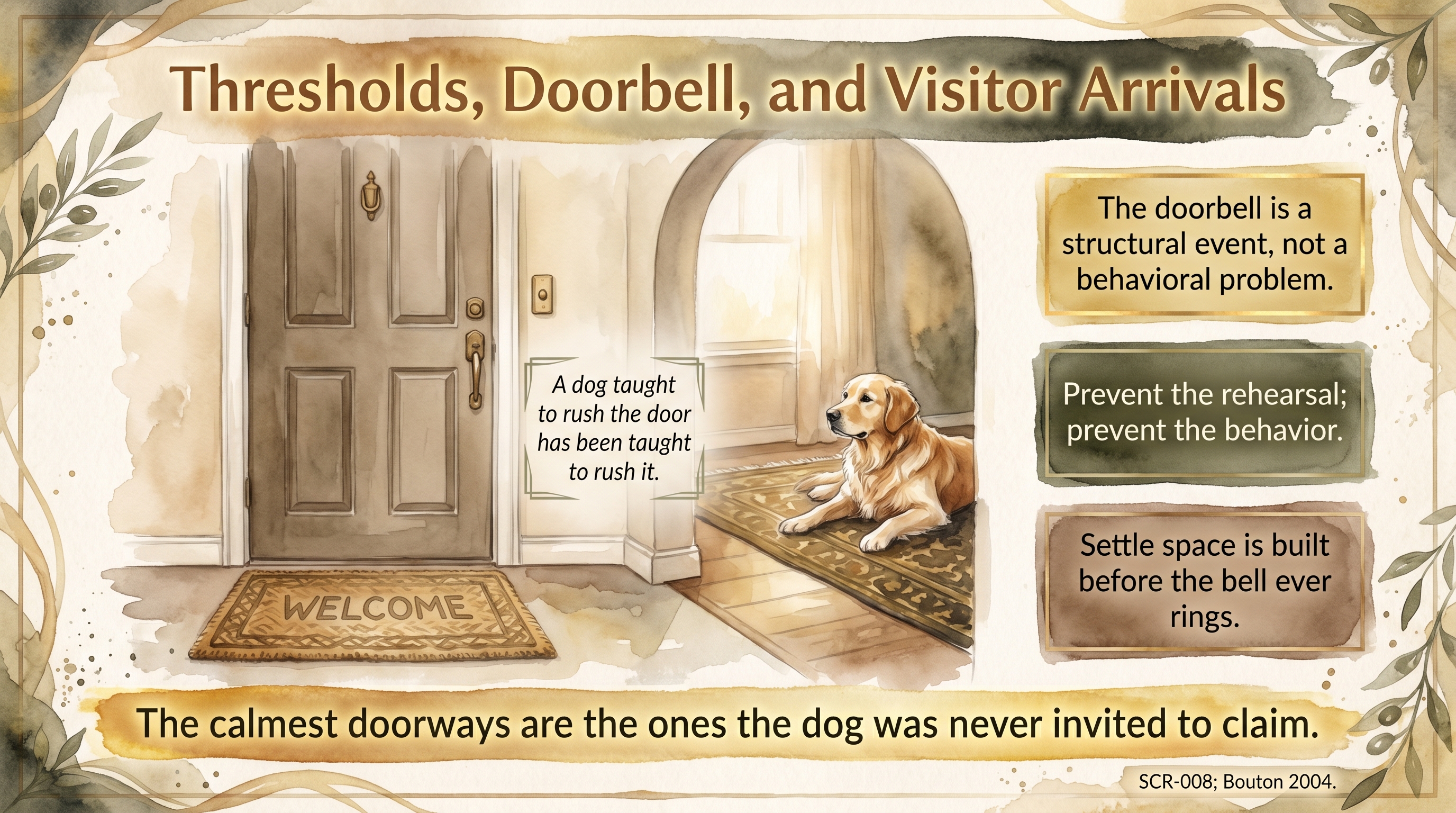
The dog the doorbell meets is the dog the foundation produced.
Key Takeaways
- The doorbell is a classical-conditioning cue, not a behavior problem. What it predicts is a conditional pairing the household has set up through repetition. The dog's response is the Pavlovian output of the pairing, and the family authors the pairing by choreographing what happens after the doorbell rings.
- The threshold is a teachable structural moment. Doorways teach a spatial grammar through repetition (handler leads, dog follows, calm crossing) that propagates through every subsequent threshold. The pattern itself is the teaching; specific doorway cues are secondary.
- Prevention is structurally stronger than extinction-based remediation. Once the arousal circuit has been conditioned, extinction overlays a context-dependent inhibitory circuit but does not erase the original (Bouton; SCR-008, canine renewal demonstrated by Gazit et al. 2005). The methodology's strongest intervention is not building the circuit in the first place.
- Handler state transmits through the doorbell event before the door opens. The HRV (Koskela 2024; SCR-106), cortisol (Sundman 2019; SCR-105), and olfactory-chemosignal (Wilson 2022; SCR-058; Parr-Cortes 2024; SCR-107) channels are open; the handler's pre-bracing at the doorbell is information the dog receives. The visitor's own arrival behavior is a demonstration the dog copies over repetition (Huber et al.; SCR-010).
The Evidence
- Bouton, M. E. (2002, 2004); Bouton, Winterbauer, & Todd (2012)rats (primary experimental work)
Extinction generates a context-dependent inhibitory circuit that suppresses but does not erase the original conditioned response. Any remediation protocol applied to an established doorbell-arousal circuit will exhibit spontaneous recovery with time, renewal with context change, reinstatement with a single trigger re-exposure, and rapid reacquisition. The prevention architecture avoids this asymmetry by not building the original circuit in the first place. - Gazit, I., Goldblatt, A., & Terkel, J. (2005), Animal Cognitiondomestic dogs
Direct canine demonstration of the renewal effect. Confirms that the Bouton framework operates in domestic dogs; an extinguished doorbell response can rebound sharply with context change.
- Sundman, A.-S. et al. (2019), Scientific Reports; Koskela, A. et al. (2024), Scientific Reportsdomestic dogs and their owners
Long-term dog-owner cortisol synchrony (Sundman 2019) and dyad-specific heart-rate-variability coupling (Koskela 2024) are documented canine findings. The doorbell is a daily event at which the handler's autonomic state shifts; the shift transmits through the coupling channels. - Wilson, C. et al. (2022), PLOS ONE; Parr-Cortes, Z., Rooney, N. J., & Mills, D. S. (2024), Scientific Reportsdomestic dogs
Dogs discriminate human stress odor (Wilson 2022) and show cognitive-bias impairment from stressed-human chemosignal (Parr-Cortes 2024). The handler's state at the doorbell is chemically available to the dog before the visitor enters.
- Huber, L. et al. (2018, 2020, 2022); Mackie & Huber (2023)domestic dogs
Dogs preferentially copy demonstrated actions from caregivers; caregiver relationship quality modulates what is copied. Over repetition, the family's arrival-greeting patterns and the visitor's arrival behaviors are demonstrations the dog observes. The family's authority to set arrival choreography is part of the structural architecture, not optional courtesy. - Brubaker, L. & Udell, M. A. R. (2023), Animal Cognitiondomestic dogs (N=48 dog-owner dyads)
Authoritative dog-directed caregiving (high warmth + structure) associated with best canine outcomes. The doorbell event is a specific case in which warmth and structure are both on display: the family remains warm in its ambient state and structurally clear about the threshold choreography.
- Hebb, D. O. (1949); Bliss & Lømo (1973); Bi & Poo (1998)foundational neuroscience principle (rabbit, rat); cross-species
Neurons that fire together wire together. The cross-species mechanism is documented; application to canine doorbell-circuit learning is conserved-mechanism inference. A household with two doorbell rings per week has approximately two hundred pairings across the first two years; the dog's response is the output of those pairings.
- Panksepp, J. (1998), Affective Neuroscience; canine extensions (Bhave et al. 2024; Cetintav et al. 2025)multiple mammals (primarily rats); domestic dog (canine classification extensions)
The SEEKING system is activated by anticipation of a predicted event, not by the event itself. The doorbell functions as an anticipatory cue that predicts the arrival sequence; the dog's elevated state at the ring is the anticipation output. Prevention-oriented doorbell rehearsal pairs the ring with ambient-state continuation rather than with arrival ritual.
- SCR-047 methodological guardraildomestic dogs
The canine arousal literature does not support a blanket anti-arousal framing. The doorbell claim is narrower: the doorbell that has been conditioned to predict a ritualized high-arousal sequence produces a ritualized high-arousal response; the doorbell that has been conditioned to predict ambient-state continuation does not. The claim is about the specific pairing and its predicted outcome, not about heart rate in isolation.
- JB Methodology synthesisfamily-raised Golden Retrievers
The convergent claim that the doorbell and threshold events are among the highest-repetition, lowest-cost opportunities for prevention-oriented architecture (because the events occur regularly, the stakes at each individual event are low, and the cumulative repetition count is large) is JB's synthesis of the classical-conditioning, Hebbian, handler-state, and overimitation findings. Each component is documented in dogs. The specific prevention-versus-remediation intervention comparison has not been directly tested.
No controlled trial has directly compared prevention-oriented doorbell architecture in puppyhood against remediation-oriented protocols applied to established doorbell-arousal patterns in adult dogs.
Specific repetition-count estimates (two hundred pairings across two years) are reasoned from household observation and typical household doorbell frequency rather than measured in a canine cohort study.
The interaction between doorbell architecture and equipment choices (gate, crate, leash tether at arrival) has not been systematically compared in a prevention framework.
Cross-breed comparisons of doorbell-circuit plasticity are not yet available in the published canine literature.
SCR References
Sources
Bhave, S. et al. (2024). Machine-learning classification of canine emotional states using Panksepp's seven affective categories. Applied Animal Behaviour Science. (preprint/early-access; canine application of Panksepp framework)
Bi, G.-Q., \u0026 Poo, M.-M. (1998). Synaptic modifications in cultured hippocampal neurons: Dependence on spike timing, synaptic strength, and postsynaptic cell type. Journal of Neuroscience, 18(24), 10464-10472.
Bliss, T. V. P., \u0026 Lømo, T. (1973). Long-lasting potentiation of synaptic transmission in the dentate area of the anaesthetized rabbit following stimulation of the perforant path. Journal of Physiology, 232(2), 331-356.
Bouton, M. E. (2002). Context, ambiguity, and unlearning: Sources of relapse after behavioral extinction. Biological Psychiatry, 52(10), 976-986.
Bouton, M. E. (2004). Context and behavioral processes in extinction. Learning \u0026 Memory, 11(5), 485-494.
Bouton, M. E., Winterbauer, N. E., \u0026 Todd, T. P. (2012). Relapse processes after the extinction of instrumental learning: Renewal, resurgence, and reacquisition. Behavioural Processes, 90(1), 130-141.
Brubaker, L., \u0026 Udell, M. A. R. (2023). The effects of dog-directed parenting style on dog cognition and behavior. Animal Cognition, 26(2), 363-377.
Cetintav, B. et al. (2025). Canine emotional state classification using Panksepp's framework. Applied Animal Behaviour Science. (extension of Bhave et al. 2024 dataset)
Gazit, I., Goldblatt, A., \u0026 Terkel, J. (2005). The role of context specificity in learning: The effects of training context on explosives detection in dogs. Animal Cognition, 8(3), 143-150.
Hebb, D. O. (1949). The Organization of Behavior: A Neuropsychological Theory. New York: Wiley.
Huber, L., Popovová, N., Riener, S., Salobir, K., \u0026 Cimarelli, G. (2018). Would dogs copy irrelevant actions from their human caregiver? Learning and Behavior, 46(4), 387-397.
Huber, L., Salobir, K., Mundry, R., \u0026 Cimarelli, G. (2020). Selective overimitation in dogs. Learning \u0026 Behavior, 48, 113-123.
Huber, L., Kubala, D., \u0026 Cimarelli, G. (2022). Overimitation in dogs: Is there a link to the quality of the relationship with the caregiver? Animals, 12(3), 326.
Kis, A., Szakadát, S., Gácsi, M., Kovács, E., Simor, P., Török, C., Gombos, F., Bódizs, R., \u0026 Topál, J. (2017). The interrelated effect of sleep and learning in dogs (Canis familiaris); an EEG and behavioural study. Scientific Reports, 7, 41873.
Koskela, A., Kareinen, I., Somppi, S., Törnqvist, H., Vainio, O., Kujala, M. V. (2024). Heart rate variability coupling in dog-human dyads. Scientific Reports, 14, 8213.
Mackie, J., \u0026 Huber, L. (2023). Socially priming dogs in an overimitation task. Animal Cognition, 26, 1473-1486.
Panksepp, J. (1998). Affective Neuroscience: The Foundations of Human and Animal Emotions. New York: Oxford University Press.
Parr-Cortes, Z., Rooney, N. J., \u0026 Mills, D. S. (2024). The odour of an unfamiliar stressed or relaxed person affects dogs' responses on a cognitive bias test. Scientific Reports, 14, 15843.
Sundman, A.-S., Van Poucke, E., Svensson Holm, A.-C., Faresjö, Å., Theodorsson, E., Jensen, P., \u0026 Roth, L. S. V. (2019). Long-term stress levels are synchronized in dogs and their owners. Scientific Reports, 9, 7391.
Wilson, C., Campbell, K., Petzel, Z., \u0026 Reeve, C. (2022). Dogs can