Prevention Over Extinction
Compound evidence detail1 SCR / 2 parts
- Documentedcanine neuroimaging evidence that structured training is associated with measurable brain-network connectivity differences
- Documentedrodent evidence supporting activity-shaped myelination as a mechanism for experience-dependent neural wiring
In JB, Prevention Over Extinction is the operating principle that treats prevention and extinction as categorically different rather than as two timing-equivalent options. The principle works from the position that a behavior never initiated is a circuit never built, while a behavior allowed to form and later suppressed leaves a residue the family will be managing for the life of the dog. Heuristic The component neuroscience of circuit-building, extinction asymmetry, and habit automation is documented across mammals; the convergent argument that the family should structure the puppy's first months around what the dog never gets to practice is JB's synthesis of that science, well-supported mechanistically but not directly proven by a controlled comparative trial in dogs.
For Families
The Prevention pillar explains the principle. This methodology entry explains the mechanism. The short version: when a household tries to extinguish a behavior the dog has already practiced - through ignoring, redirecting, or correcting - the original behavior is not erased. It is layered with a competing memory. Under stress, fatigue, or novel context, the original behavior returns.
The neuroscience term is renewal. The behavior researcher Mark Bouton spent decades documenting it across species. Extinction creates a second memory; the first does not go away. That is why a dog who once jumped on visitors and was retrained to sit will sometimes jump on a visitor years later under the right combination of stress and excitement.
Prevention bypasses the problem entirely. A behavior that was never built has no memory to return to. The cleanest behavior to fix is the one that never started.
What It Means
What prevention means in the JB methodology is not vigilance against problems as they appear. It is environmental and relational design that does not give the developing dog the opportunity to practice behaviors the family does not want to live with later. The argument for treating this as the load-bearing principle of the first developmental months rests on three independently documented neuroscience findings, plus one direct canine demonstration that ties them to dogs.
The first finding is Hebbian circuit-building. Hebb's foundational 1949 work established that neurons that fire together wire together (SCR-022). Documented Bliss and Lømo (1973) demonstrated long-term potentiation directly. Bi and Poo (1998) added spike-timing dependent plasticity. The mechanism is foundational neuroscience and is universally accepted. Documented The behavioral application to specific canine developmental contexts, that a puppy practicing a behavior repeatedly is physically strengthening the underlying neural pathway, is interpretive but rests on a conserved mammalian mechanism. The point JB takes from Hebbian plasticity is structural, not metaphorical: practice is not a soft word for repetition, it is the physical process by which the dog's nervous system is being shaped.
The second finding is the physical substrate of that shaping. Gross and colleagues (2010) used longitudinal MRI and histology in 17 dogs from one to thirty-six weeks of age to document progressive postnatal myelination, with the brain reaching a mostly adult-like appearance by approximately sixteen weeks and continued white-matter maturation extending well beyond (SCR-040). Documented What is being insulated by myelin during this period plausibly includes whatever circuits the puppy is most actively engaging, though the link between repetition of a specific behavior and insulation of its specific underlying circuit has not been mapped directly in dogs. Working dog studies have shown that structured training produces measurable changes in canine brain functional connectivity that correlate with behavioral performance (SCR-115); the activity-dependent myelination mechanism that explains why is documented in rodents and applied to dogs as conserved-mechanism inference. Mixed Evidence The combined picture is that the developmental window during which JB families receive a puppy is also the window in which the puppy's most-practiced behaviors are being physically wired into faster, more efficient, more resistant-to-modification circuitry.
The third finding is what happens when that circuitry is later asked to stop. Bouton (2002, 2004) and Bouton, Winterbauer, and Todd (2012) established in extensive rodent work that extinction does not erase the original conditioned response (SCR-008). Documented Extinction generates a new, context-dependent inhibitory circuit that sits on top of the original one, temporarily suppressing it under conditions resembling the extinction training context. The original pathway remains structurally present and reappears under spontaneous recovery (with time), renewal (with context change), reinstatement (with re-exposure to the trigger), and rapid reacquisition (with fresh training). Gazit, Goldblatt, and Terkel (2005) demonstrated the renewal effect directly in domestic dogs. Explosives detection dogs whose responses had been extinguished on one search path showed detection accuracy rebound from 52.46% to 95.83% when tested in a novel context. Documented Bouton states the asymmetry plainly: "Although extinction is relatively context-specific, conditioning is usually less so." Original learning generalizes across contexts more effectively than extinction does. That asymmetry is the neurological argument for prevention's superiority.
The fourth finding maps the long-term fate of well-rehearsed behavior. Jog and colleagues (1999), Barnes and colleagues (2005), and Graybiel (2008) documented in rats and macaques that habitual behaviors transfer from goal-directed control in the dorsomedial striatum to automatic control in the dorsolateral striatum, becoming chunked sequences with characteristic start-and-end neural firing patterns and reduced reliance on conscious deliberation (SCR-023). Documented Once chunked, behaviors fire in response to environmental triggers without active prefrontal evaluation and resist modification. The mammalian basal ganglia architecture is highly conserved, but the specific striatal shift and action-chunking mechanism have not been demonstrated directly in domestic dogs; the canine application is interpretive. Heuristic What this adds to the prevention argument is a temporal dimension. The longer a behavior practices itself, the more deeply it transfers from a state in which the dog could choose otherwise to a state in which the behavior runs automatically.
The convergence of these findings, that circuits build with repetition, that what is practiced gets physically insulated, that extinction does not erase, and that rehearsed behaviors automate beyond conscious modification, is what JB calls the prevention argument. Heuristic Each component is independently documented in its source species. The convergent application to canine household raising is well-supported mechanistic inference rather than a directly demonstrated canine finding. Direct canine neurobiology comparing "prevented" against "extinguished" behavioral end states does not exist (per the SCR-008 evidence boundary). The argument is compelling, and compelling arguments have a habit of expanding past what their evidence can sustain. JB holds the boundary explicitly.
The corollary mechanism is synaptic pruning. Unused neural connections are eliminated during development (SCR-024). Documented The pruning machinery is confirmed in the developing canine brain (Seppälä et al. 2011 documented its functional necessity), though dog-specific pruning timelines are not established. Documented The JB application, that behaviors never initiated are not only never wired but are subsequently pruned away, is best read as logical synthesis grounded in a verified mechanism rather than as a directly tested canine intervention. The framing JB uses in family-facing communication, "what isn't practiced is what isn't there to manage later," sits at this same level: confident in the underlying biology, careful about the specific behavioral mapping.
Why It Matters for Your Dog
The implication for a JB family is operational and somewhat counterintuitive. The most consequential prevention work is not what the family does in response to a behavior. It is what the family arranges so the behavior does not get the chance to start. The arithmetic is asymmetric. Prevention costs structure in the first months. Extinction costs structure for years, with the original pathway still present and surfacing under any of the four canine-relevant return-of-behavior conditions Bouton mapped.
What this looks like in practice is unglamorous. Mealtime is structured before a food-begging circuit forms, not after. Thresholds are kept calm before a threshold-explosion circuit develops. The first thirty seconds at the front door is taught as calm before the puppy has had the chance to practice excited greeting forty times. Resource locations (the dog's bed, the dog's crate, the family table, the dog's feeding spot) are anchored as predictable before the dog has the chance to practice resource conflict. None of this is dramatic. It is environmental design, repeated long enough that the dog's nervous system writes calm rather than reactivity into the developing circuit.
The principle is not perfectionism. The family will not prevent every behavior in every situation. The hierarchy of response in the JB methodology, mentorship and indirect correction, exists precisely because prevention sometimes fails, and the family needs language for what to do when it does. The principle is about recognizing that prevention and correction are not interchangeable, that the cost of addressing a behavior goes up every time the dog gets to practice it, and that the family's most efficient developmental work happens upstream of the moment the unwanted behavior appears.
Prevention Over Extinction is the operating-principle expression of the Prevention pillar. The pillar names the rule. The principle names the architecture: environmental design, household structure, and developmental timing arranged so that the dog's most-practiced circuits are the ones the family wants to keep. The other four pillars carry the day-to-day work of mentorship, calm, structured leadership, and indirect correction. Prevention organizes the developmental sequence those four operate inside.
For Golden Retrievers in the JB program, the principle is leveraged by breed history and program design. Across the entire Just Behaving breeding program, spanning years of raising Golden Retrievers, the program has not produced a single puppy or adult with a mouthing or nipping problem (SCR-007). Observed-JB That zero-incidence observation is internal program data, tested against three independent professional reviewers (DACVB, CPDT-KA, developmental psychologist), none of whom dismissed the outcome. It must not be generalized to a universal prevention claim without the formal comparative study identified in RF-013. No controlled trial has compared the JB prevention-only protocol against graduated bite-inhibition or other industry-standard approaches, and JB names that gap openly. What the program offers the family is not proof of method supremacy. It is a puppy whose developmental window has been organized around prevention, transitioning to a household whose first months are the family's opportunity to continue that organization rather than reverse it.
There is one additional piece of the practical picture worth naming. Prevention is unglamorous because it produces an absence: the absence of jumping, the absence of counter-surfing, the absence of door-bolting, the absence of the resource-guarding incident the family's friends warn them about. The methodology asks the family to do consistent, low-drama work during a developmental window in exchange for an outcome that, by design, will look uneventful. That trade is harder to feel good about than visible training would be. It is also, on the available neuroscience, where the leverage actually lives.
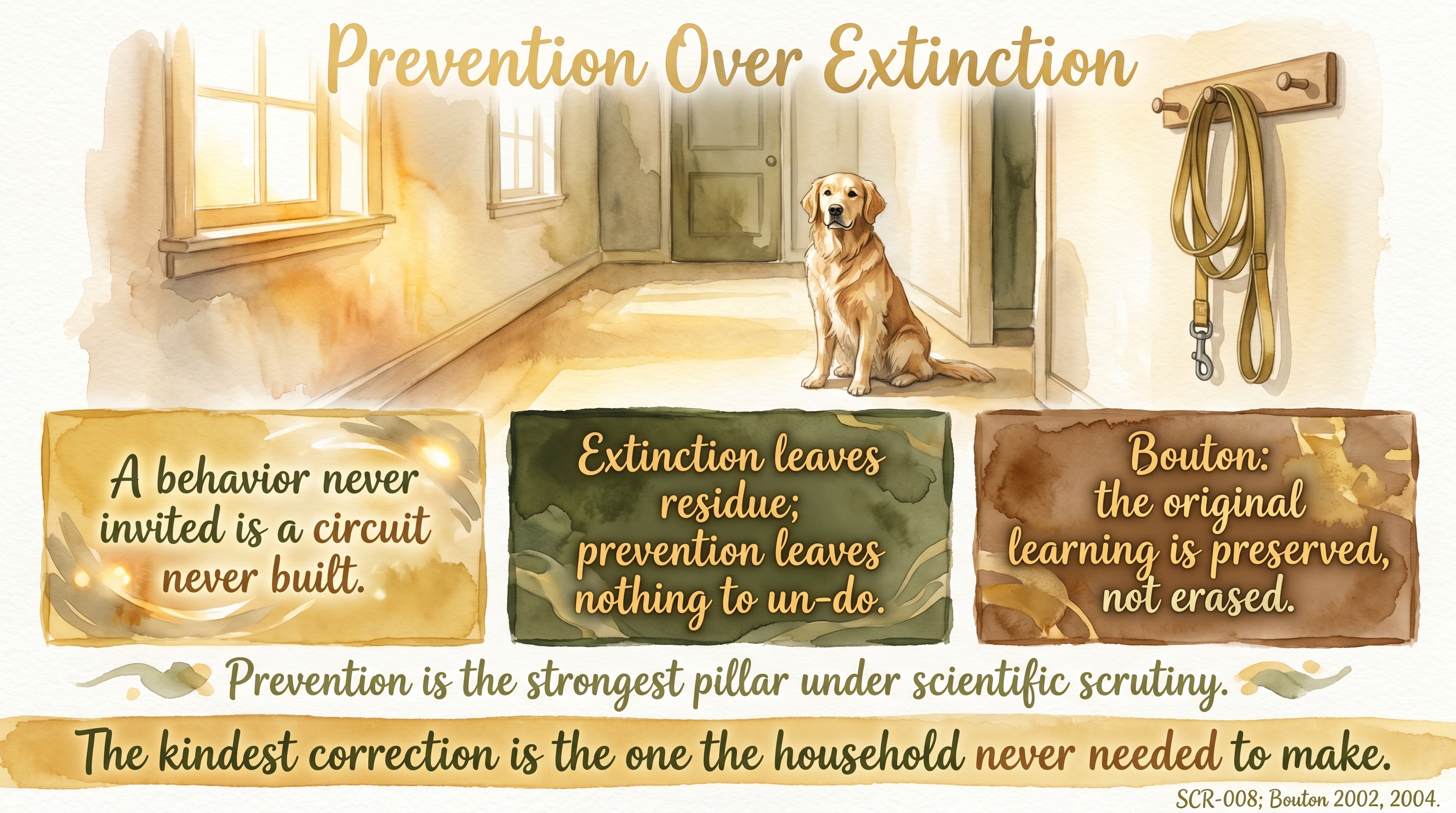
The cleanest behavior to fix is the one that was never started.
Key Takeaways
- Prevention and extinction are not two routes to the same destination. Hebbian circuit-building, activity-dependent myelination, the asymmetry of extinction, and basal ganglia habit automation jointly argue that what the dog practices during the first developmental months becomes physically and behaviorally different from what the dog never practiced.
- Bouton extinction research is the clearest documented anchor: extinction generates a context-dependent inhibitory layer that suppresses but does not erase the original learning. Gazit and colleagues (2005) demonstrated the renewal effect directly in domestic dogs.
- The component findings are documented; the convergent canine behavioral application is interpretive. JB names it as a well-supported operating principle rather than a directly demonstrated canine neurobiological end state.
- Operationally, prevention is environmental and relational design: mealtime structure before food-begging forms, calm thresholds before excited-greeting forms, anchored resource locations before resource conflict has the chance to practice itself. The principle trades structure now for unrehearsed circuitry later.
The Evidence
This entry uses observed claim-level tags beyond the dedicated EvidenceBlocks below. These tags mark JB program observation or practice-derived claims that need dedicated EvidenceBlock coverage in a later content pass.
This entry uses mixed-evidence claim-level tags beyond the dedicated EvidenceBlocks below. These tags mark claims that combine documented findings with observed practice, heuristic application, or unresolved gaps.
- Hebb, D. O. (1949)foundational neuroscience principle
The Organization of Behavior introduced the principle that repeated co-activation of neuronal populations produces lasting changes that increase the efficiency and stability of that activity pattern. Subsequent experimental work confirmed the cellular substrate (long-term potentiation, spike-timing-dependent plasticity). - Bliss, T. V. P. & Lømo, T. (1973); Bi, G.-Q. & Poo, M.-M. (1998)rabbits (Bliss & Lømo); rats (Bi & Poo)
Direct experimental demonstration of long-term potentiation in rabbit hippocampus and spike-timing-dependent plasticity in cultured rodent hippocampal neurons. The cellular mechanisms underlying Hebbian plasticity are documented in non-canine mammals; behavioral application to canine developmental practice is conserved-mechanism inference.
- Gross, B. et al. (2010)domestic dogs (N=17, longitudinal 1-36 weeks)
Longitudinal MRI and histology correlation documented progressive postnatal myelination, with the canine brain approaching adult-like appearance by approximately 16 weeks and continued subcortical white-matter arborization extending to at least 36 weeks. Brainstem and cerebellum mature earlier than cerebrum, in a central-to-peripheral pattern. - Working dog functional MRI literaturedomestic dogs; rodent (myelination mechanism)
Structured training in working dogs has been associated with measurable changes in functional brain connectivity that correlate with behavioral performance. The activity-dependent myelination mechanism that would plausibly underlie this is documented in rodents and applied to dogs as conserved-mechanism inference, not as direct canine cellular evidence.
- Bouton, M. E. (2002, 2004); Bouton, Winterbauer, & Todd (2012)rats (primary experimental work)
Extinction generates a new, context-dependent inhibitory circuit that suppresses but does not erase the original conditioned response. The original pathway remains structurally present and reappears under spontaneous recovery (time), renewal (context change), reinstatement (re-exposure to trigger), and rapid reacquisition (fresh training). Bouton states the asymmetry: 'Although extinction is relatively context-specific, conditioning is usually less so.' - Gazit, I., Goldblatt, A., & Terkel, J. (2005)domestic dogs (5 Belgian Malinois, 2 Labrador Retrievers; explosives detection)
Direct canine demonstration of the renewal effect. Dogs trained on Path A (5 explosives) and Path B (0 explosives) showed detection collapse on Path B (52.46% accuracy, 46.89% ambling). When tested in novel Path C with identical low target density, search behavior renewed: detection rebounded to 95.83%, ambling dropped to 28.62%. Authors explicitly cite Bouton & Ricker (1994). Direct evidence that extinction is context-dependent inhibition, not erasure, in domestic dogs. - Lacagnina, A. F. et al. (2019); Knox, D. et al. (2016)rodents
Extinction relies on separable neuronal ensembles, not erasure of the original fear memory trace. Single prolonged stress disrupts retention of extinguished fear, confirming the fragility of extinction learning under stress. Direct canine neural evidence comparing prevented versus extinguished states does not exist; the prevention-superiority argument rests on convergent mechanistic inference, not direct canine neural proof.
- Jog, M. S. et al. (1999); Barnes, T. D. et al. (2005); Graybiel, A. M. (2008)rats (Jog 1999, Barnes 2005); rats and macaques (Graybiel 2008 review)
Striatal ensemble recordings during procedural learning documented task-bracketing firing patterns as behaviors became automated. Habit representations persist through extinction and rapidly reconsolidate during reacquisition. The dorsomedial-to-dorsolateral striatal shift transfers behaviors from goal-directed control to automatic control with characteristic action-chunking. Once chunked, behaviors fire in response to environmental triggers without active prefrontal evaluation. The mammalian basal ganglia architecture is highly conserved; the specific striatal shift has not been directly demonstrated in domestic dogs.
- Seppälä, E. H. et al. (2011), PLoS Geneticsdomestic dogs (canine machinery confirmation); general developmental neuroscience principle established cross-species
Synaptic pruning as a developmental mechanism, in which unused neural connections are eliminated through activity-dependent elimination and microglial engulfment, is established across multiple mammalian species in the general developmental neuroscience literature. Seppälä and colleagues documented that LGI2 gene truncation disrupts canine synaptic pruning, confirming the pruning machinery is functionally necessary in the developing dog brain. Dog-specific pruning timelines (synapse density counts across puppy development) remain unmapped. The JB application that prevention leverages pruning to eliminate the corresponding circuits is logical synthesis grounded in a verified mechanism, not a directly tested canine behavioral intervention.
- JB Methodology synthesisfamily-raised Golden Retrievers
The combined argument that prevention is categorically superior to extinction in canine household raising is JB's synthesis of Hebbian circuit-building, activity-dependent myelination, the documented asymmetry of extinction (with direct canine renewal demonstration), and basal ganglia habit automation. Each component is independently documented in its source species; convergent application to canine developmental raising is well-supported mechanistic inference rather than directly demonstrated fact. JB program observation suggests prevention-first raising can produce Golden Retriever puppies without established mouthing patterns at family transition; no controlled study has compared the JB prevention-only protocol against graduated bite-inhibition or other industry-standard approaches. RF-013 names this comparative trial as the most important open methodological gap in the prevention evidence base.
No controlled trial has compared prevention-first developmental raising against graduated correction or extinction-based protocols on long-term canine behavioral, physiological, or relational outcomes (RF-013).
Direct canine neural comparison of prevented versus extinguished behavioral end states (functional connectivity, basal ganglia engagement, prefrontal-amygdala coupling) has not been published.
Dog-specific synaptic pruning timelines (synapse density across puppy development) are not established; the pruning machinery is confirmed in dogs, the developmental calendar is not.
The specific striatal shift from dorsomedial to dorsolateral control and action-chunking demonstrated in rats and macaques has not been mapped in domestic dogs.
SCR References
Sources
Barnes, T. D., Kubota, Y., Hu, D., Jin, D. Z., & Graybiel, A. M. (2005). Activity of striatal neurons reflects dynamic encoding and recoding of procedural memories. Nature, 437(7062), 1158-1161.
Bi, G.-Q., & Poo, M.-M. (1998). Synaptic modifications in cultured hippocampal neurons: Dependence on spike timing, synaptic strength, and postsynaptic cell type. The Journal of Neuroscience, 18(24), 10464-10472.
Bliss, T. V. P., & Lømo, T. (1973). Long-lasting potentiation of synaptic transmission in the dentate area of the anaesthetized rabbit following stimulation of the perforant path. The Journal of Physiology, 232(2), 331-356.
Bouton, M. E. (2002). Context, ambiguity, and unlearning: Sources of relapse after behavioral extinction. Biological Psychiatry, 52(10), 976-986.
Bouton, M. E. (2004). Context and behavioral processes in extinction. Learning & Memory, 11(5), 485-494.
Bouton, M. E., Winterbauer, N. E., & Todd, T. P. (2012). Relapse processes after the extinction of instrumental learning: Renewal, resurgence, and reacquisition. Behavioural Processes, 90(1), 130-141.
Gazit, I., Goldblatt, A., & Terkel, J. (2005). The role of context specificity in learning: The effects of training context on explosives detection in dogs. Animal Cognition, 8(3), 143-150.
Graybiel, A. M. (2008). Habits, rituals, and the evaluative brain. Annual Review of Neuroscience, 31, 359-387.
Gross, B., Garcia-Tapia, D., Riedesel, E., Ellinwood, N. M., & Jens, J. K. (2010). Normal canine brain maturation at magnetic resonance imaging. Veterinary Radiology \u0026 Ultrasound, 51(4), 361-373.
Hebb, D. O. (1949). The Organization of Behavior: A Neuropsychological Theory. New York: Wiley.
Jog, M. S., Kubota, Y., Connolly, C. I., Hillegaart, V., & Graybiel, A. M. (1999). Building neural representations of habits. Science, 286(5445), 1745-1749.
Knox, D., Stanfield, B. R., Staib, J. M., David, N. P., Keller, S. M., & DePietro, T. (2016). Neural circuits via which single prolonged stress exposure leads to fragmented spatial reference memory. Learning \u0026 Memory, 23(4), 193-198.
Lacagnina, A. F., Brockway, E. T., Crovetti, C. R., Shue, F., McCarty, M. J., Sattler, K. P., Lim, S. C., Santos, S. L., Denny, C. A., & Drew, M. R. (2019). Distinct hippocampal engrams control extinction and relapse of fear memory. Nature Neuroscience, 22(5), 753-761.
Seppälä, E. H., Jokinen, T. S., Fukata, M., Fukata, Y., Webster, M. T., Karlsson, E. K., Kilpinen, S. K., Steffen, F., Dietschi, E., Leeb, T., Eklund, R., Zhao, X., Rilstone, J. J., Lindblad-Toh, K., Minassian, B. A., & Lohi, H. (2011). LGI2 truncatio