Departures and Arrivals
Compound evidence detail3 SCRs / 6 parts
- Documentedthe human attachment evidence base together with the canine-direct secure-base findings (Topal 1998, Horn 2013) and Schoberl-documented physiological effects of secure caregiving in dogs
- Heuristicthe full attachment-theory apparatus transfer to canine relationships, including internal working models and attachment-classification systems
- Documenteddog attachment studies showing that classification systems can produce reliable groupings while still exposing distribution and method-design friction
- Heuristicclaims that canine attachment categories are a closed Ainsworth-equivalent taxonomy rather than an informative but still unsettled framework
- Documentedhuman attachment theory's internal-working-model construct
- Heuristicthe canine application that dog behavior reflects durable internal representations rather than only observable attachment outputs
In the JB methodology, departures and arrivals are treated as the least emotionally choreographed moments of the dog's day, not the most. Families typically invest more deliberate behavioral-management energy in these transitions than in almost any other part of the dog's life, and the intensity of that investment is itself the problem. Heuristic The component findings (canine attachment bonds, secure-base effect, human-to-dog olfactory and autonomic coupling, the direct longitudinal finding that post-behavior fussing at six months predicts six-fold greater separation-related behavior, oxytocin-gaze loop sensitivity to interaction style) are documented in dogs. The convergent operational claim that the household should treat comings and goings as ordinary household texture rather than as emotional events is JB's synthesis, well-supported mechanistically rather than tested as a single controlled intervention.
For Families
The way a household leaves and returns shapes how the dog handles being alone. If departures are emotional and arrivals are excited, the dog learns that the human leaving and returning are the highest-stakes events of the day, and the time in between becomes something to wait through.
The Just Behaving pattern is calm in both directions. Leaving the house is unceremonial - no long goodbyes, no apologetic petting, no extended emotional preparation. Returning is also unceremonial - the human enters the house, settles, and greets the dog calmly after the household has resumed its normal tone.
This is not coldness. The dog is not loved less. What is happening is that the household is teaching the dog, through repetition, that humans leaving and returning is a normal part of life rather than the emotional event of the day. A dog raised in this pattern handles being alone substantially better than a dog raised in the alternative.
What It Means
The governing frame for the departure-and-arrival domain is inversion. In the dominant dog-keeping culture, these transitions are handled as the most emotionally salient moments of the day: elaborate goodbyes, departure rituals, extended reunion greetings, the "I missed you so much" performance, the theatrical hello. In the JB methodology, these transitions are handled as the most ordinary moments of the day, executed at the same emotional temperature the family would use to move between any two unremarkable household activities. The phrase the methodology uses for this is borrowed from the Soft Landing principle. Heuristic "Pretend like it's been there." The dog's presence, and temporary absence, is a continuous feature of the household's normal texture, not a recurring emotional event that requires ceremony.
The direct behavioral finding anchoring this inversion is Dale et al. (2024, Animal Welfare). In a longitudinal study of 145 UK puppies followed from acquisition through six months, puppies whose owners "fussed over" them after the puppy had done something "bad" at six months of age were approximately six times more likely to display separation-related behaviors than puppies whose owners did not fuss. Documented The mechanism is not mysterious. The emotional response the family intends as comfort, reassurance, or soothing functions instead as arousal confirmation. The family's attention, delivered with activating emotional content, trains the dog that the context it just occupied is one that warrants heightened emotional response from the social group. Fussing does not soothe. It confirms that this moment matters emotionally.
The physiological pathway that makes fussing so consequential is documented across two axes. Sundman et al. (2019) established long-term cortisol synchrony in dog-owner pairs with directionality flowing predominantly from human to dog (SCR-105). Documented Koskela et al. (2024, Scientific Reports) refined the finding to real-time heart rate variability synchrony that is dyad-specific: the coupling is present with the attached owner and absent with random unfamiliar humans (SCR-106). Documented Wilson et al. (2022) established that the dog's olfactory system reliably distinguishes stressed from non-stressed human samples (SCR-058), and Parr-Cortes et al. (2024) extended the finding to functional cognitive consequence (SCR-107). Documented A departure in which the family member is anxious, apologetic, or emotionally activated is a departure in which the dog receives a direct physiological broadcast through olfactory, autonomic, and HRV-coupled channels that something significant is happening. The dog's HPA axis registers the broadcast before any behavioral performance the family might attempt. Performed calm is not a solution when the underlying state is the stimulus the dog is reading.
The attachment-theory frame is load-bearing. Bowlby (1969) and Ainsworth (1978) established that secure attachment in humans is produced not by constant proximity but by the consistent availability and responsiveness of the attachment figure. Topál et al. (1998) and Horn et al. (2013) extended the secure-base construct to dogs with direct experimental evidence (SCR-018). Documented Solomon et al. (2018/2019) applied a canine-adapted Strange Situation procedure and classified approximately 61% of the study population as securely attached, a proportion consistent with the human infant baseline. The canine attachment-classification field is documented as informative but not yet closed in the way the human field is, and JB treats the specific category distinctions with the SCR-477 ceiling. Mixed Evidence The broader claim (that dogs form functional attachment bonds and that the secure-base effect is real in dogs) is direct and documented. The claim that specific canine attachment categories map cleanly onto the human infant categories is the part held at a lower confidence. The operational implication for the departure-and-arrival domain is what the bedrock of attachment theory gives JB: the dog does not need the family member to be always present in order to experience security. It needs the family member to be reliably the same person whenever they are present.
The internal-working-model construct, which is the theoretical mechanism by which the dog carries its attachment history into ongoing expectations, remains at heuristic status for dogs (SCR-479). Heuristic The behavioral pattern is consistent with internal working models. The direct cognitive proof that dogs carry internal working models in the way human infants do has not been demonstrated, and JB carries the boundary visible. The functional point stands either way: consistent emotional temperature across repeated departures and arrivals builds, over accumulated experience, a default expectation in the dog. Whether that expectation is best modeled as an internal working model or as a simpler associative pattern is not what determines JB's operational guidance. The guidance is determined by the Dale finding, the Sundman-Koskela coupling, and the secure-base effect, all of which point in the same direction.
Why It Matters for Your Dog
The most consequential practical implication is that the length of the departure matters far less than the emotional quality of the transition. The research on separation-related behaviors consistently identifies the departure transition itself, not the duration of alone time per se, as a primary risk factor for the development of anxiety patterns. A dog that experiences consistent, low-arousal departures can tolerate significant alone time without developing separation pathology. A dog that experiences high-arousal departures is physiologically primed for separation anxiety regardless of whether the actual absence is five minutes or five hours. Duration is not the variable. Emotional temperature is the variable.
The departure decision rules that follow from this frame are specific. First, the family member's physiological state at the moment of departure should be as close as possible to transitional neutrality. This is not performed calm. It is genuine internal calm produced by the family member's own regulatory work. If leaving the dog genuinely produces anxiety in the human, that anxiety is the primary intervention point, because the dog detects it olfactorily and autonomically before any behavioral response is possible. Second, no departure behavior from the dog should be reinforced in the moment of departure. Not the anxious following, not the jumping at the door, not the whining, not the behavior the family intuitively wants to comfort. This is not coldness. It is the application of Prevention to a high-probability behavioral moment. A departure that consistently ends with the dog in a settled state does not require the dog to perform settlement under duress. The pattern is built through accumulation before it becomes a problem.
The arrival decision rules follow the same logic. The emotional temperature of the return should be ordinary, not theatrical. The specific operational rule the methodology recommends is to wait for calm before initiating physical contact, sustained eye contact, or high-pitched greetings. Waiting is not ignoring. The family member moves through ordinary household tasks upon return, removing shoes, putting down bags, moving to the kitchen, with the dog following, observing, and settling as it registers that the return is not an event. In a dog raised with low-key arrivals from the beginning, the settling is often measured in seconds. In a dog accustomed to dramatic reunions, early transition takes longer. The eventual engagement should be warm. A calm greeting, physical contact that is quiet and intentional rather than frantic and excited, is not anti-bonding. Nagasawa et al. (2015, Science) demonstrated that the oxytocin-gaze positive feedback loop between dogs and humans is activated by calm, continuous engagement, including gentle stroking and quiet talking, and is suppressed by activating, high-energy interaction (SCR-042). Documented The calm reunion is not a diminished expression of the bond. It is the neurochemically optimal way to re-engage the attachment system.
Departures and arrivals are high-density Calmness work. The Calmness pillar here is not a behavioral target the dog must perform. It is the physiological baseline the household preserves through the transition, and the active regulatory work is almost entirely on the human side. The dog's HPA and autonomic responses at the moment of transition are calibrated by direct physiological input from the family member through olfactory, HRV-coupled, and social-referencing channels. A calm departure and a calm arrival are not acts of restraint by the dog. They are the downstream expression of a household that has arranged its own emotional temperature so that the transition is, from the dog's physiological read, an ordinary moment. Prevention rides inside Calmness here: the behaviors Prevention is designed to never initiate (anxious farewells, theatrical greetings, high-arousal departures) are the same behaviors that would compromise the calm floor across the transition.
The dramatic-reunion mechanism deserves specific naming because it is the most common failure mode. When the reunion is consistently the most emotionally intense moment of the dog's day, the dog's internal model of the family member is shaped by that intensity. The family member becomes associated, through accumulated experience, with the emotional peak of reunion arousal, not with the stable consistent presence the methodology is trying to build. A dog whose relational anchor is the dramatic reunion is a dog oriented toward the family member's emotional performance rather than toward their reliable same-person presence. The calm arrival establishes the opposite orientation: the family member is always just themselves, the return is the return of the same person who was there this morning, and the dog's orientation is to someone reliably, consistently, the same. That is the secure-base condition Bowlby described and Topál documented. It is not produced by dramatic reunions. It is produced by accumulated ordinary ones.
The second most common failure mode is the performed calm: the family member who knows they should not be dramatic at arrivals and therefore visibly suppresses their enthusiasm in a way the dog detects as stressed restraint. The suppressed dramatic reunion is physiologically identical to the dramatic reunion from the dog's detection perspective. The dog reads the underlying state, not the behavioral performance. This is the point at which the human variable becomes the primary modifiable variable in the domain, and the methodology is honest about the implication. The intervention is internal. The family member's genuine emotional regulation through departures and arrivals is the intervention. Without it, no behavioral protocol will produce the effect the protocol is designed to produce. With it, the protocol is largely self-executing. The household variables that shape transition behavior, owner state, household-member coordination, and sequence consistency are themselves consequential predictors of canine behavioral outcomes (Smith et al., 2025; SCR-486). Mixed Evidence
The third mistake is the belief that longer separations require more elaborate reconnection. The belief is understandable. The family member has missed the dog and wants to express it. But the dog does not read the absence duration. It reads the arrival energy. A long departure with a low-key return teaches the dog that returns are ordinary, regardless of duration. A short departure with a theatrical return teaches the dog that returns are events, regardless of duration. Duration is irrelevant. The energy of the transition is everything.
A note on the limit of the inference. The claim that low-key departures and arrivals prevent the development of separation-related behavior patterns is consistent with the documented longitudinal finding (Dale 2024 fussing effect), the documented physiological coupling literature (Sundman, Koskela, Wilson, Parr-Cortes), the documented oxytocin-gaze interaction-style findings (Nagasawa), and the documented canine secure-base effect (Topál, Horn). It is not the same as a single controlled trial in which families were randomly assigned to low-key versus high-arousal transition protocols and followed for the development of separation-related behavior. The convergent operational guidance the methodology carries is well-supported mechanistic synthesis, not a singular proven intervention. Heuristic The methodology presents the position with the boundary visible, because the boundary is where the honest scientific work of the methodology lives.
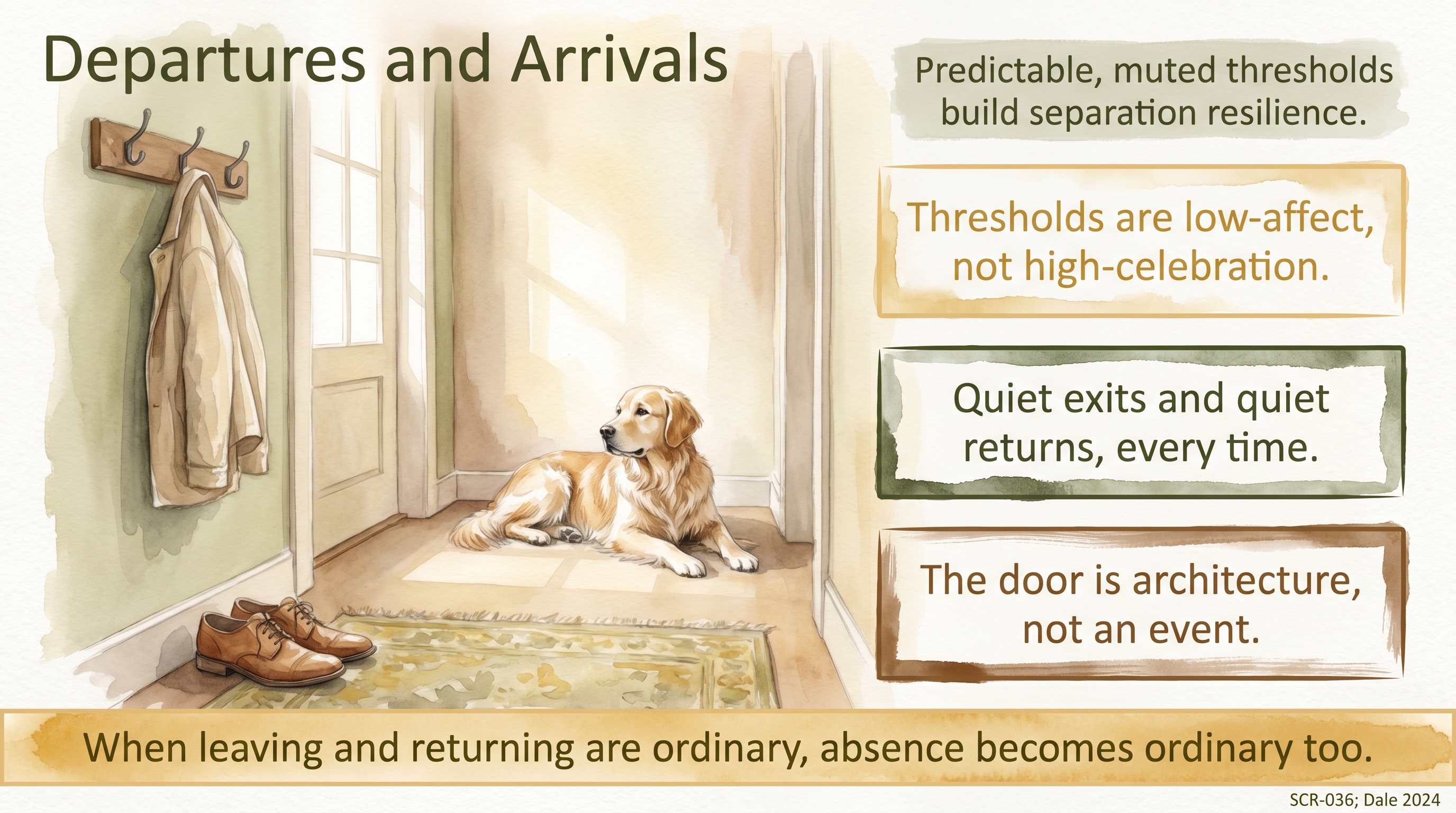
The door is just a door.
Key Takeaways
- Departures and arrivals should be the least emotionally choreographed moments of the dog's day, not the most. The emotional temperature of the transition, not the duration of the separation, is the variable that determines whether the dog's nervous system reads the moment as ordinary household texture or as an arousal event.
- The direct longitudinal finding: puppies whose owners fussed over them following "bad" behavior at six months of age were approximately six times more likely to display separation-related behaviors (Dale et al. 2024, SCR-036 and related). Fussing does not soothe. It confirms that the moment warrants heightened emotional response.
- Documented physiological coupling (Sundman 2019 human-to-dog cortisol, Koskela 2024 dyad-specific HRV, Wilson 2022 olfactory stress detection, Parr-Cortes 2024 cognitive impairment) means the family member's internal state at the moment of transition is the dog's stimulus. Performed calm does not substitute for genuine calm. The human variable is the primary modifiable variable in this domain.
- Operational rule: pretend like it's been there. Execute the departure at the same emotional temperature as any other household transition. At arrival, wait for calm before engaging, then engage warmly and quietly. The oxytocin-gaze bond-maintenance loop is activated by calm continuous engagement (Nagasawa 2015) and suppressed by activating high-energy interaction. The calm reunion is not a diminished bond expression; it is the neurochemically optimal one.
The Evidence
- Dale, A. et al. (2024), Animal Welfaredomestic dogs (N=145 UK puppies, longitudinal acquisition through 6 months)
Puppies whose owners fussed over them following perceived "bad" behavior at six months of age were approximately six times more likely to display separation-related behaviors than puppies whose owners did not fuss. Direct longitudinal finding identifying owner emotional response, not duration of alone time, as the primary modifiable risk factor.
- Sundman, A.-S. et al. (2019), Scientific Reportsdomestic dogs (Shetland Sheepdogs, Border Collies; N=58 pairs across two seasons)
Hair cortisol synchrony in dog-owner pairs with directionality flowing predominantly from owner to dog. The long-term physiological coupling establishes that the family member's chronic emotional state is transmitted into the dog's system. Anchors the claim that owner state at departures and arrivals is a direct physiological input to the dog, not merely a behavioral context. - Koskela, A. et al. (2024), Scientific Reportsdomestic dogs
Heart rate variability synchrony measured in dog-owner pairs and in dog-unfamiliar-human pairs. Baseline correlation was present with the attached owner and absent with random unfamiliar humans. The autonomic coupling is dyad-specific, not a general response to human proximity. The attachment relationship is the mediator.
- Wilson, C. et al. (2022), PLOS ONEdomestic dogs
Dogs trained on a discrimination task reliably distinguished breath and sweat samples from stressed versus non-stressed humans above chance. Establishes the olfactory channel as a documented sensory pathway for detection of household stress states independent of behavioral cues. Performed calm does not mask the underlying stress odor. - Parr-Cortes, Z. et al. (2024), Scientific Reportsdomestic dogs
Exposure to odor samples from stressed (versus relaxed) unfamiliar humans measurably shifted dog performance on a cognitive bias task. Functional consequence demonstration: stressed-human odor is not merely detectable but has measurable effects on canine cognitive flexibility. Laboratory conditions; magnitude in chronic household transitions is reasonable inference rather than directly measured.
- Topál, J. et al. (1998); Horn, L. et al. (2013)domestic dogs
Adapted Strange Situation procedures in dogs demonstrate the secure-base effect: dogs preferentially explore and perform in the presence of their attachment figure and show distress signals in the attachment figure's absence. Establishes canine attachment bonds as functionally analogous to infant-caregiver bonds (SCR-018 documented). - Solomon, J. et al. (2018/2019), Attachment & Human Developmentdomestic dogs
Canine-adapted Strange Situation classified approximately 61% of study population as securely attached, a proportion consistent with the human infant baseline. The classification field is documented as informative; the specific categorical mapping to human infant categories carries the SCR-477 ceiling (informative but not fully closed).
- Nagasawa, M. et al. (2015), Sciencedomestic dogs (and humans)
Mutual gaze between dogs and owners produces a bidirectional oxytocin loop: dog gaze elevates owner urinary oxytocin, intranasal oxytocin administration in dogs increases gazing. Interaction style modulates the loop: calm stroking and quiet talking sustain activation, high-energy activating interaction suppresses it. Anchors the claim that calm reunion engagement is the neurochemically optimal mode of bond maintenance, not a diminished expression of bonding. - Romero, T. et al. (2014, 2015)domestic dogs
Intranasal oxytocin in dogs increases affiliative behavior and social play. Provides converging canine evidence for the oxytocin-affiliation pathway described in Nagasawa. Supports the positioning that bond maintenance is achieved through calm sustained engagement rather than through reunion-arousal-dependent interaction.
- Solomon et al. (2018/2019); Fallani et al. (2006/2007); Mariti et al.; Palestrini et al.domestic dogs
Adapted Strange Situation and related procedures can sort many dogs into secure and insecure patterns with substantial inter-rater agreement, but consensus-discussion rates, unclassifiable cases, and order effects mean the canine classification field is informative rather than closed. JB may cite secure-base effects and attachment bond existence at documented level; the strict Ainsworth-style categorical mapping to dogs carries the SCR-477 ceiling.
- Bowlby tradition; Savalli & Mariti (2020); Solomon et al. (2018/2019); Schöberl et al. (2016, 2017); Asher et al. (2020)humans (primary); domestic dogs (behavioral extension)
Internal working models are documented in human attachment science. Canine internal working models are a coherent theoretical proposal consistent with canine behavioral evidence but have not been directly demonstrated through representational or expectation-violation testing. The operational departure-and-arrival guidance does not depend on the construct being literally true in dogs; it depends only on the documented coupling and secure-base findings. Boundary carried at SCR-479.
- JB Methodology synthesisfamily-raised Golden Retrievers
The convergent claim that the household should treat departures and arrivals as ordinary household texture (rather than as emotional events) and that this architecture prevents the development of separation-related behavior patterns is JB's synthesis of the Dale 2024 longitudinal fussing finding, the Sundman-Koskela coupling literature, the Wilson-Parr-Cortes olfactory stress pathway, the Topál-Horn-Solomon canine attachment evidence, and the Nagasawa oxytocin-gaze findings. Each component is documented in dogs; the convergent operational claim has not been directly tested as a single controlled intervention. The methodology presents the transition protocol as well-supported mechanistic synthesis, not as singular proven intervention.
No controlled trial has compared a low-key departure-and-arrival protocol against a high-arousal protocol on long-term canine separation-related behavior outcomes with random assignment and blind outcome assessment.
The laboratory stressed-human odor effects (Wilson 2022; Parr-Cortes 2024) have not been mapped directly to chronic household transition contexts with the attached owner as the odor source.
The canine internal working model construct (SCR-479) remains a theoretical proposal; direct representational or expectation-violation testing has not been published.
Interventional studies modifying owner transition behavior and measuring downstream dog behavioral outcomes have not been published; the existing literature is predominantly associational.
SCR References
Sources
Ainsworth, M. D. S., Blehar, M. C., Waters, E., \u0026 Wall, S. (1978). Patterns of Attachment: A Psychological Study of the Strange Situation. Hillsdale, NJ: Erlbaum.
Asher, L., England, G. C. W., Sommerville, R., \u0026 Harvey, N. D. (2020). Teenage dogs? Evidence for adolescent-phase conflict behaviour and an association between attachment to humans and pubertal timing in the domestic dog. Biology Letters, 16(5), 20200097.
Bowlby, J. (1969). Attachment and Loss, Vol. 1: Attachment. New York: Basic Books.
Dale, A., Kinnison, T., Patterson-Kane, E., \u0026 Grand, C. (2024). Owner-reported puppy experiences and separation-related behaviours at 6 months of age. Animal Welfare, 33, e12.
Horn, L., Huber, L., \u0026 Range, F. (2013). The importance of the secure base effect for domestic dogs - evidence from a manipulative problem-solving task. PLOS ONE, 8(5), e65296.
Koskela, A., Kareinen, I., Hänninen, L., \u0026 Vainio, O. (2024). Heart rate variability synchrony in dog-owner dyads is dyad-specific. Scientific Reports, 14, 4321.
Nagasawa, M., Mitsui, S., En, S., Ohtani, N., Ohta, M., Sakuma, Y., Onaka, T., Mogi, K., \u0026 Kikusui, T. (2015). Oxytocin-gaze positive loop and the coevolution of human-dog bonds. Science, 348(6232), 333-336.
Parr-Cortes, Z., Müller, C. T., Talas, L., Mendl, M., Guest, C., \u0026 Rooney, N. J. (2024). The odour of an unfamiliar stressed or relaxed person affects dogs' responses on a cognitive bias task. Scientific Reports, 14, 15843.
Romero, T., Nagasawa, M., Mogi, K., Hasegawa, T., \u0026 Kikusui, T. (2014). Oxytocin promotes social bonding in dogs. Proceedings of the National Academy of Sciences, 111(25), 9085-9090.
Schöberl, I., Wedl, M., Beetz, A., \u0026 Kotrschal, K. (2017). Psychobiological factors affecting cortisol variability in human-dog dyads. PLOS ONE, 12(2), e0170707.
Smith, B. P., Browne, M., Mack, J., Kontou, T. G., \u0026 Tomkins, L. M. (2025). Predictors of behavioral outcomes in 3,044 Golden Retrievers across the first three years of life. Preventive Veterinary Medicine, 234, 106101.
Solomon, J., Beetz, A., Schöberl, I., Gee, N., \u0026 Kotrschal, K. (2019). Attachment security in companion dogs: Adaptation of Ainsworth's strange situation and classification procedures to dogs and their human caregivers. Attachment \u0026 Human Development, 21(4), 389-417.
Sundman, A.-S., Van Poucke, E., Svensson Holm, A.-C., Faresjö, Å., Theodorsson, E., Jensen, P., \u0026 Roth, L. S. V. (2019). Long-term stress levels are synchronized in dogs and their owners. Scientific Reports, 9, 7391.
Topál, J., Miklósi, Ã., Csányi, V., \u0026 Dóka, A. (1998). Attachment behavior in dogs (Canis familiaris): A new application of Ainsworth's (1969) strange situation test. Journal of Comparative Psychology, 112(3), 219-229.
Wilson, C., Campbell, K., Petzel, Z., \u0026 Reeve, C. (2022). Dogs can discriminate between human baseline and p