The Treat Economy
In the JB methodology, the treat economy is one of the most frequently misunderstood points of contact between the approach and the broader dog-raising culture. The methodology is not anti-treat. It is anti-vending-machine, anti-bribery, and opposed to the substitution of a food-reward economy for the relational and structural work the Five Pillars describe. Heuristic The evaluative question for any treat use is what the treat is doing in the specific interaction, and the decision rules that follow from that question determine whether a given treat use supports or undermines the methodology's goals. The component findings (documented reinforcer-habituation, documented overimitation modulated by caregiver relationship, Bouton's return-of-behavior asymmetry, and mammalian SEEKING-system anticipation neurochemistry with canine operationalization of Panksepp's framework) are documented; the convergent claim that treat-primary raising produces a categorically different relational structure than treat-free or bridge-only raising is JB's synthesis, well-supported mechanistically rather than tested as a direct comparison.
What It Means
The starting position is distinction, not prohibition. Treats in the JB methodology have three legitimate functions. The first is the bridge period of a new behavior or new association, the early phase when a dog is learning what a word, gesture, or context means, and food reward provides the motivational bridge that makes the learning salient. The second is systematic counter-conditioning in the context of an established anxiety or fear response, where food is being used not to reward behavior but to change an emotional association, pairing the feared stimulus with parasympathetic activation through calm, palatable food. The third is structured, brief engagement work with young dogs in which a small food reward marks the end of a specific focused-attention exercise. All three are legitimate uses with defined purposes, defined contexts, and defined exit strategies.
The problematic dynamic is the vending machine. The methodology's precise definition of the vending-machine dynamic is: the state in which the dog's behavioral compliance is mediated primarily by food availability rather than by the relational and structural context the methodology establishes. The dog that sits when food is present and does not sit when food is absent has not been raised in the JB sense. It has been operantly conditioned to a specific contingency, and the contingency requires constant maintenance, which means constant treat use, escalating treat value as the dog habituates to lower-value rewards, and the perpetual problem of the dog that performs beautifully in sessions and behaves inconsistently outside them.
The habituation science is documented. Feuerbacher and Wynne (2015) demonstrated that dogs prefer physical contact over verbal praise as a reinforcer, and that verbal praise loses functional reinforcement value rapidly across successive lab sessions (SCR-052). Documented The pattern extends to food rewards through the broader mammalian reward-adaptation literature: habituation of reward value is a documented phenomenon, and chronic exposure to a constant reward stream elevates the dog's baseline expectation while diminishing the marginal value of each delivery. This is Panksepp's anticipation-versus-consummation distinction made operational. The SEEKING system is energized by anticipation of reward, not by the habituated consumption of a predictable reward stream (SCR-014). The framework is built primarily on rodent work with cross-mammal conservation; dog-specific PET imaging of the SEEKING circuit during food anticipation has not been established. The canine operationalization is recent but real: Bhave et al. (2024) and Cetintav et al. (2025) applied Panksepp's seven affective categories to canine facial expression and body posture data, giving dog-direct behavioral support to the anticipation framework even where dog-specific PET imaging is not yet available. The dog that receives treats constantly is not in a state of heightened motivation for those treats. It is in a state of reward adaptation, in which the baseline is elevated and the treat itself carries progressively less behavioral leverage over time.
The household-level long-term claim (that constant treat delivery across months degrades signal value and relational orientation) is an extrapolation from documented lab-session habituation and the broader signal-detection literature rather than a directly tested long-term canine intervention study. Heuristic The mechanism is documented; the specific household magnitude is inference.
The relational-frame argument draws on the overimitation literature. Huber et al. (2018) demonstrated that dogs copied causally irrelevant actions from their caregivers but very few dogs copied the same action from an unfamiliar experimenter (SCR-010). Documented Subsequent work (Huber et al., 2020; Huber, Kubala, \u0026 Cimarelli, 2022) extended the finding and linked overimitation specifically to caregiver relationship quality. The relationship modulates what is copied. The methodology's heuristic interpretation of this finding is that the relational context changes what the dog attends to and how it processes information from the human. A dog in a relational context, one in which the human is a calm, competent, consistent presence, attends to the human for reasons that extend far beyond food. A dog in a dispensing context attends to the human primarily when food is visible or probable. Whether this interpretation holds as stated at the household level is not a direct experimental finding; it is a logical extension of a documented relationship-modulation effect. Heuristic
The structural vulnerability of treat-conditioned behavior is documented. Bouton (2002, 2004) established that extinction does not erase original learning; it generates a context-dependent inhibitory circuit that temporarily suppresses the original pathway but leaves the original intact (SCR-008). Documented Gazit, Goldblatt, and Terkel (2005) demonstrated the renewal effect directly in domestic dogs. Any behavior established through operant conditioning, including treat-based protocols, will exhibit Bouton's four return-of-behavior phenomena: spontaneous recovery with time, renewal with context change, reinstatement with trigger re-exposure, and rapid reacquisition with fresh training. The treat-conditioned behavior is in the same structural position as any operant behavior. It has been built on a contingency, and the contingency-vulnerability is the same.
A boundary worth naming. The SCR-004 claim that engineered operant reinforcement protocols (the clicker-mark-treat-repeat schedule as deployed in modern training methodology) have no documented analog in natural canine development is a heuristic claim, not a documented scientific finding. Heuristic The methodology distinguishes between operant processes broadly (natural behavioral contingencies clearly exist: puppy whines, receives nursing) and engineered operant protocols specifically. The claim addresses the protocol. The logical argument that such protocols are a cultural invention rather than an ethological continuity is sound but has not been formally tested.
Why It Matters for Your Dog
The practical question the methodology asks the family to hold, at any point in the dog's raising, is whether the treats currently in use are bridges or replacements. A bridge uses food as a temporary motivational scaffold during a period when the relational context is not yet established enough to do the work alone. The puppy that has been in the home for ten days is not yet in a relationship with the family in the full sense the methodology describes. Food can help bridge that period, marking attention to the human, marking settle-on-mat behavior, marking calm greetings, while the deeper relational structure is being built. The bridge is intended to be retired. When the relational structure is sufficiently established, the scaffold comes down.
A replacement uses food as the ongoing mechanism of behavioral compliance because the relational structure has not been built. This is the most common failure mode of positive-reinforcement-primary approaches, and it is the pattern the methodology is designed to prevent. The dog that requires continuous treat reinforcement to maintain daily behavioral compliance is not in a relational failure state because treats are being used. It is in a relational failure state because treats were used instead of building the relationship, and the treats are now doing the structural work that the relationship was supposed to do.
The diagnostic is practical. At any point, the family can ask whether the treats in use are bridges or replacements by removing them temporarily in a low-stakes context. If the dog's behavioral compliance collapses without treats in an established relational context, the treats have become replacements. If the dog remains oriented to the family and demonstrates the same general behavioral quality without treats, the treats were bridges and the relationship is intact. The test is not proof of a relational pathology. It is a read of where the household currently stands, and it is available any week the family wants to run it.
The treat-economy question is in the first instance a Prevention question. The behaviors being conditioned in many treat-heavy protocols, jumping that gets marked and redirected, loose-leash walking that requires continuous reinforcement, settle-on-mat behavior that requires constant marking, are behaviors JB Prevention would have precluded from the beginning through environmental and relational design. The architectural answer to "what treat protocol should I use for counter-surfing?" in many cases is "the puppy was never allowed to counter-surf, so no protocol is needed." The treat-based remediation conversation is often a conversation about a prevention gap. Naming the gap opens the possibility of closing it, rather than building a reinforcement schedule to manage around its consequences.
For families evaluating treat-heavy advice from trainers, veterinarians, or online communities, the methodology does not recommend rejection on principle. It recommends evaluation through the decision rules. What is the treat doing in the specific interaction, marking a behavioral moment or serving as a constant background reward for existing in the human's presence? Is the behavior being conditioned one Prevention would have precluded, or is it genuine remediation of an established pattern? Does the protocol have an exit strategy, or does it require perpetual maintenance? Does the treat use maintain the relational frame, or does it erode it? The methodology's final structural test is Bouton's four phenomena: the treat-conditioned behavior will exhibit the same vulnerabilities as any operant behavior. The family should understand what they are signing up for when they adopt a treat-primary approach and make that choice with full knowledge of its maintenance requirements.
The most common treat-economy failure modes are specific. First, the high-value override: stuffing food in front of a dog that is over threshold as if this is counter-conditioning. It is distraction. The dog that accepts food while in a state of elevated arousal has not had its arousal addressed. The arousal will return when the distraction is removed, and the family has now paired the trigger context with food delivery without changing the underlying emotional association. Second, the purposeless treat: the treat offered because the dog is present and the family member has treats available, with no specific behavioral or emotional work being done. This is the purest vending-machine pattern and the easiest to slip into unconsciously. Third, the binary trap: the belief that either all treats are used all the time or no treats are ever acceptable. Neither pole matches the methodology's actual position, which is more specific and more practical.
A note on the limit of the inference. The documented science supports Feuerbacher and Wynne on lab-session praise habituation (SCR-052), Huber on caregiver-relationship-modulated overimitation (SCR-010), Bouton on extinction asymmetry and canine renewal (SCR-008), and the cross-species Panksepp anticipation-versus-consummation distinction with canine operationalization (SCR-014). The convergent long-term household claim (that treat-primary raising produces a categorically different relational structure than bridge-only or treat-free raising) is JB's synthesis of those components, well-supported mechanistically rather than directly compared in a controlled canine study. The methodology presents the position with the boundary visible, because the boundary is where the honest scientific work of the methodology lives.
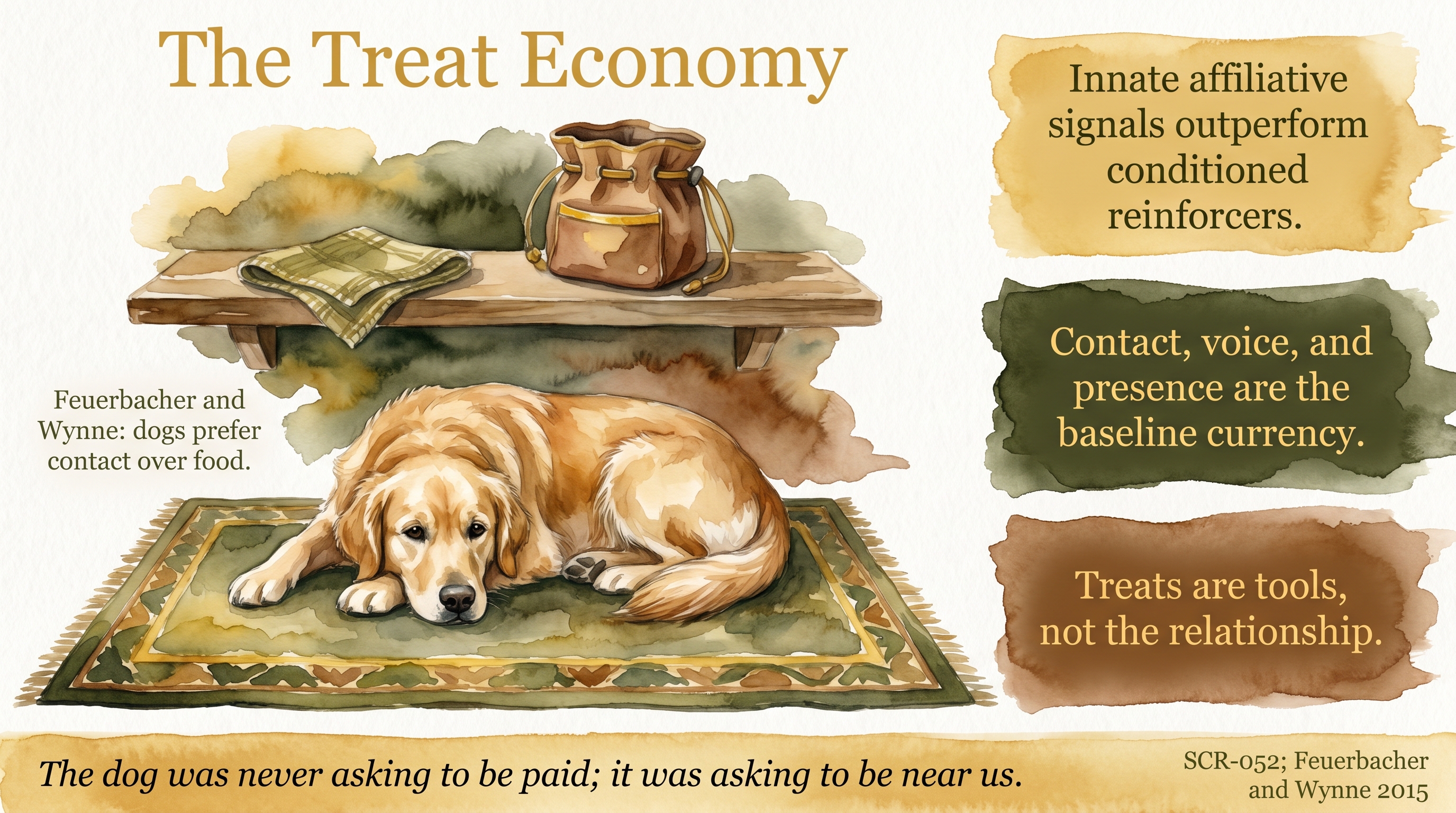
A treat is a sentence, not a salary.
Key Takeaways
- The methodology is not anti-treat. It is anti-vending-machine. Treats have three legitimate functions (bridge period, counter-conditioning for established anxiety, structured brief engagement work with young dogs), each with defined purpose, context, and exit strategy.
- The vending-machine dynamic has a precise definition: behavioral compliance mediated primarily by food availability rather than by relational and structural context. The pattern is diagnosable (remove treats in a low-stakes context; watch what remains) and correctable (close the prevention gap, rebuild the relational architecture, retire the scaffold).
- Treat-conditioned behavior inherits the structural vulnerabilities of any operant behavior: Bouton's four return-of-behavior phenomena (SCR-008, with canine renewal directly demonstrated by Gazit et al. 2005). Prevention-built responses sit in a different structural position.
- Evaluative rule: at any point, ask whether current treat use is a bridge or a replacement. If the dog's behavioral compliance collapses without treats in an established relational context, the treats have become replacements. If the dog remains oriented without treats, the treats were bridges and the relationship is doing the structural work.
The Evidence
- Feuerbacher, E. N. & Wynne, C. D. L. (2015), Journal of the Experimental Analysis of Behaviordomestic dogs
Dogs strongly prefer physical contact over verbal praise as a reinforcer. Verbal praise loses functional reinforcement value rapidly across successive lab sessions. Direct canine reinforcer-preference and short-term habituation data. Extension to long-term household-level food-reward degradation is an inference from habituation and signal-detection theory rather than directly tested (per SCR-052 ceiling).
- Huber, L. et al. (2018, 2020, 2022); Mackie & Huber (2023); Mackie, Trehorel & Huber (2024)domestic dogs
Dogs preferentially copy demonstrated actions from human caregivers; the effect is modulated by caregiver relationship quality (Huber et al. 2022 specifically). The family's relational status with the dog is one of the variables that shapes what the dog attends to and learns. JB's extension of this finding to the claim that treat-dispenser dynamics structurally degrade the caregiver relationship is a reasoned inference rather than a directly tested household-level finding.
- Panksepp, J. (1998), Affective Neurosciencemultiple mammals (primarily rats); cross-species framework
Seven core mammalian affective systems identified, including the dopaminergic SEEKING system activated by reward anticipation. The mechanism is a cross-species mammalian finding established primarily in rodent work; conserved-mechanism extension to dogs is the standard inference in comparative affective neuroscience. - Bhave, S. et al. (2024); Cetintav, B. et al. (2025), Applied Animal Behaviour Sciencedomestic dogs
Canine operationalization of Panksepp's seven affective categories using machine-learning classification of facial expression and body posture. The SEEKING state is measurable in dogs at the behavioral and observable level, bringing canine-direct empirical support to the framework even where dog-specific PET imaging of food anticipation is not yet established. The implication for the treat economy is that constant treat delivery elevates baseline and diminishes marginal value, producing reward adaptation rather than heightened motivation.
- Bouton, M. E. (2002, 2004); Bouton, Winterbauer, & Todd (2012)rats (primary experimental work)
Extinction generates a context-dependent inhibitory circuit that suppresses but does not erase the original conditioned response. Any behavior established through operant conditioning, including treat-based protocols, retains the original pathway and exhibits spontaneous recovery, renewal, reinstatement, and rapid reacquisition. Treat-conditioned behavior inherits the same structural vulnerabilities as any operant behavior. - Gazit, I., Goldblatt, A., & Terkel, J. (2005), Animal Cognitiondomestic dogs (5 Belgian Malinois, 2 Labrador Retrievers; explosives detection)
Direct canine demonstration of the renewal effect. Confirms that the Bouton return-of-behavior framework operates in domestic dogs. A treat-extinguished behavior can rebound sharply when context changes.
- JB Methodology / ethological reasoningdomestic dog (ethological reasoning)
The SCR-004 claim that the contingent operant reinforcement protocol (clicker-mark, timed treat, conditioned vocal marker delivered as a systematic engineered reward schedule) has no documented analog in natural canine development is heuristic. The distinction is between operant processes broadly (natural consequences exist) and engineered operant protocols specifically (the systematically engineered reward schedule is the thing claimed to lack an ethological analog). The argument is logically sound but has not been formally tested. JB maintains this as reasoned position, not as documented finding.
- JB Methodology synthesisfamily-raised Golden Retrievers
The convergent claim that treat-primary raising produces a categorically different relational structure (dog attends to human primarily when food is visible or probable) than bridge-only or treat-free raising (dog attends to human for reasons that extend beyond food) is JB's synthesis of the documented reinforcer-habituation, caregiver-relationship-modulated social learning, SEEKING-system anticipation literature, and Bouton extinction asymmetry. Each component is documented in dogs; the convergent long-term household claim has not been directly compared in a controlled canine study. The methodology presents the position as well-supported synthesis with the boundary visible.
No controlled trial has compared treat-primary raising against bridge-only or treat-free raising on long-term canine attachment, signal-reading, or relational outcomes.
The household magnitude of food-reward habituation (versus the lab-session habituation documented in Feuerbacher & Wynne 2015) has not been directly measured across treatment durations matching household practice.
The specific claim that engineered operant protocols lack ethological analogs (SCR-004) remains inherently difficult to disprove; the claim is best carried as reasoned ethological argument rather than as documented finding.
Remediation-versus-prevention controlled comparisons (treat-heavy remediation of an established behavior versus prevention architecture precluding the behavior) have not been published for canine populations.
SCR References
Sources
Bhave, S. et al. (2024). Machine-learning classification of canine emotional states using Panksepp's seven affective categories. Applied Animal Behaviour Science. (preprint/early-access; canine application of Panksepp framework)
Bouton, M. E. (2002). Context, ambiguity, and unlearning: Sources of relapse after behavioral extinction. Biological Psychiatry, 52(10), 976-986.
Bouton, M. E. (2004). Context and behavioral processes in extinction. Learning \u0026 Memory, 11(5), 485-494.
Bouton, M. E., Winterbauer, N. E., \u0026 Todd, T. P. (2012). Relapse processes after the extinction of instrumental learning: Renewal, resurgence, and reacquisition. Behavioural Processes, 90(1), 130-141.
Cetintav, B. et al. (2025). Canine emotional state classification using Panksepp's framework. Applied Animal Behaviour Science. (extension of Bhave et al. 2024 dataset)
Feuerbacher, E. N., \u0026 Wynne, C. D. L. (2015). Shut up and pet me! Domestic dogs (Canis lupus familiaris) prefer petting to vocal praise in concurrent and single-alternative choice procedures. Journal of the Experimental Analysis of Behavior, 103(2), 261-281.
Gazit, I., Goldblatt, A., \u0026 Terkel, J. (2005). The role of context specificity in learning: The effects of training context on explosives detection in dogs. Animal Cognition, 8(3), 143-150.
Huber, L., Popovová, N., Riener, S., Salobir, K., \u0026 Cimarelli, G. (2018). Would dogs copy irrelevant actions from their human caregiver? Learning \u0026 Behavior, 46(2), 160-174.