Signal Precision
Compound evidence detail1 SCR / 2 parts
- Observed-JBthe ethological evidence that adult dogs deploy specific social signals with situational selectivity and brief contextual deployment (Abrantes, Bekoff, Mech) together with the Bray, MacLean et al. 2021 retriever puppy demonstration that canine attention to human gestural cues is biologically pre-loaded
- Heuristicthe JB application generalizing the dog signal-precision pattern into a universal social-signaling principle and the corollary claim that high-frequency human verbal praise categorically degrades communicative information in household contexts
Signal Precision is one of JB's core philosophical positions. The claim begins with something strongly grounded in canine ethology: dogs use social signals selectively, contextually, and with meaningful timing. Documented JB then extends that observation into a broader argument about communication quality: signals carry more information when they are precise and less information when they are constant, noisy, or indiscriminate. That second step is the interpretive move.
What It Means
In ordinary conversation, people often assume more communication is better communication. Dogs do not seem to operate that way. Their social world is full of signals, but those signals are not sprayed everywhere at maximum volume. They are tied to context, body orientation, distance, tension level, and social history.
Approach angle matters. Spatial positioning matters. Whether a dog comes directly or in a curve matters. Documented Calming signals can function as de-escalatory social behavior in conflict contexts. Documented A play signal means something because it appears at a particular moment and changes the meaning of what follows. A spatial interruption means something because it happens in response to a specific movement and not to every movement all the time.
JB uses the phrase "signal precision" to capture that quality of communicative economy. Mixed Evidence Not silence. Not passivity. Precision.
This also helps explain why JB distinguishes innate affiliative and social signals from conditioned reinforcement systems. Mixed Evidence A play bow, a soft curved approach, a pause, a grooming invitation, or calm resource tolerance belongs to the animal's social repertoire. A clicker does not. A clicker can become meaningful, but only after it is artificially charged. It is a constructed signal system. JB is not denying that conditioned systems can work. JB is saying they are categorically different from natural communicative repertoires.
The human side of the argument is where the evidence ceiling becomes especially important. JB often says humans flood the channel: constant praise, constant chatter, constant repetition, constant treats, constant commentary. That is a useful philosophical frame, but it should not be mistaken for a fully quantified law of canine communication. The safer formulation is that human communication often becomes so frequent and nonspecific that its informational value may drop.
In other words, signal precision is partly an ethological observation and partly an information-theory analogy. The observation is that dogs use context-sensitive signals. The analogy is that rare, well-timed, and discriminative signals generally carry more usable information than signals delivered continuously without contrast.
This has a direct effect on how mentorship looks in practice. A calm adult who says less, moves clearly, and responds proportionally can become easier for a dog to read than an adult who is emotionally generous but behaviorally noisy. Precision creates legibility.
Why It Matters for Your Dog
If JB is right about signal precision, then many families are not failing because they care too little. They are failing because they communicate too much and too vaguely.
Examples:
- Saying "good boy" fifty times a day may make the phrase affectionate, but not necessarily informative.
- Repeating cues through rising emotion may increase volume while decreasing clarity.
- Constant intervention can make the adult harder to read, not easier.
JB treats communication quality as a function of precision, not volume. The goal is not to become cold or silent. The goal is to become readable.
This is why "less is more" shows up so often in the JB framework. Less does not mean emotional withdrawal. It means each cue, boundary, invitation, and moment of approval is more specific and therefore more intelligible.
It also clarifies why mentorship feels different from drill-based training. Mentorship depends on the puppy being able to read the adult as an integrated organism. Mixed Evidence Signal Precision is part of what makes that possible.
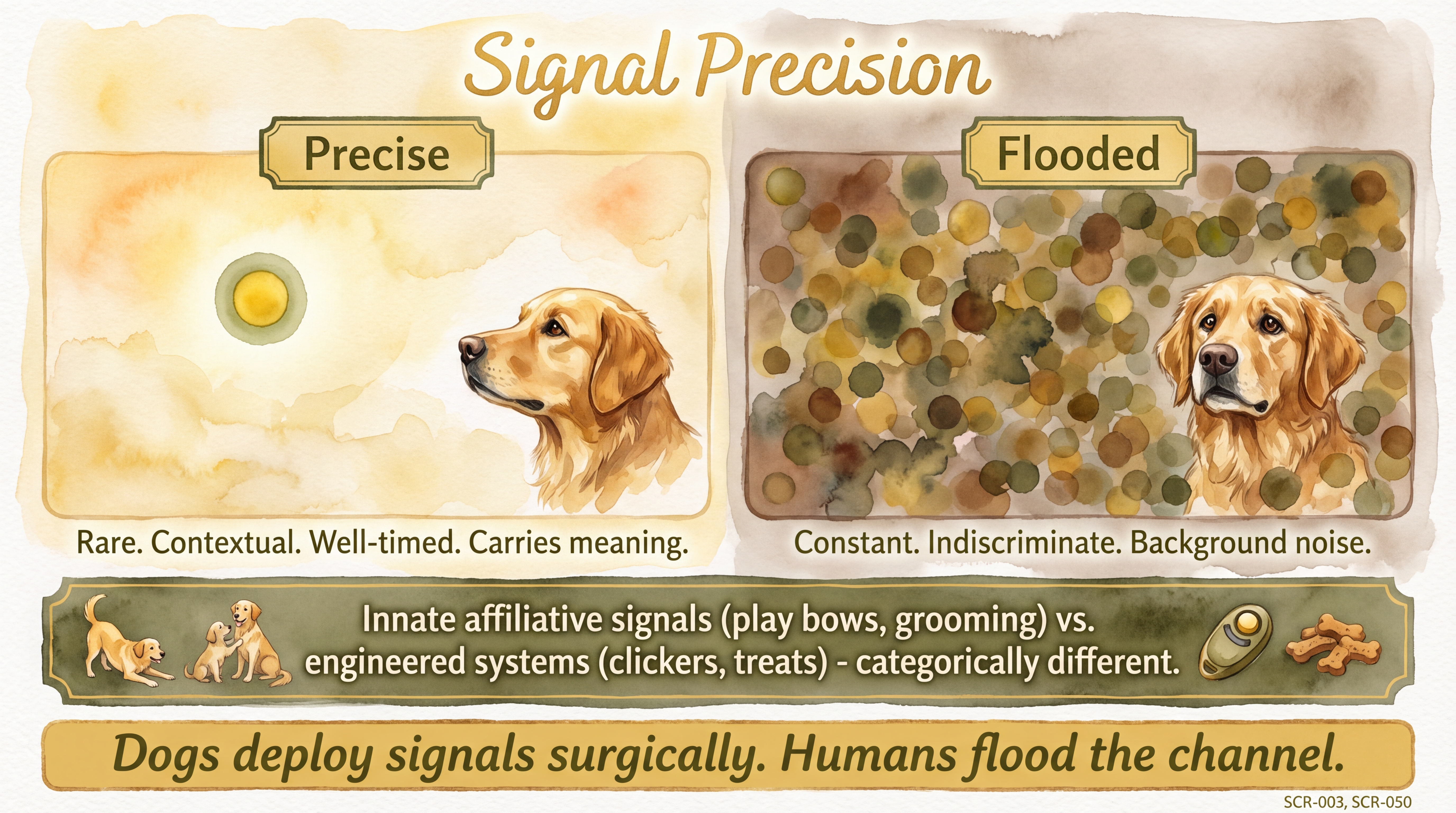
Dogs deploy signals surgically - humans flood the channel until individual signals carry no information.
Key Takeaways
- Dogs use social signals carefully and contextually, not constantly - a signal carries more information when it is rare and well-timed than when it is delivered constantly.
- Constant praise, constant chatter, and constant treats can make communication less clear, not more, because the signals lose contrast and become background noise.
- Your puppy will find you easier to read if you communicate with precision - saying less, moving clearly, and responding proportionally rather than being emotionally generous but behaviorally noisy.
- This is why 'less is more' shows up so often in JB: each cue, boundary, and moment of approval becomes more intelligible because it is not competing with constant noise.
The Evidence
This entry uses mixed-evidence claim-level tags beyond the dedicated EvidenceBlocks below. These tags mark claims that combine documented findings with observed practice, heuristic application, or unresolved gaps.
- Byosiere et al. and related canine communication literature summarized in SCR-110domestic dogs
Approach angle, body orientation, and spatial positioning function as meaningful social signals. Curved approaches are generally more affiliative; direct approaches more confrontational. - Rugaas-derived calming-signal literature and subsequent pilot evidence summarized in SCR-050domestic dogs
Calming signals appear to play a de-escalatory role in dog social interactions. The evidence base is meaningful but includes methodological limits, so claims should stay close to the actual data. - Horowitz, Bekoff, Mariti, and related work summarized in SCR-003domestic dogs and canids
Dogs use signals in context-sensitive ways rather than as indiscriminate output. The documented core is selectivity and timing, not an overbroad claim that every meaningful signal is universally rare.
JB's claim that humans often flood the channel and reduce informational value is a heuristic extension of documented canine signal selectivity. It is best presented as an explanatory framework rather than a settled empirical law.
No published study directly tests the specific claims or protocols described in this entry within a controlled canine trial.
SCR References
Sources
- Byosiere, S. E., et al. (2016). Body orientation as a component of the "play bow" in domestic dogs (Canis lupus familiaris). Behavioural Processes, 125, 35-42.
- Mariti, C., et al. (2017). Analysis of social, non-social and human-directed behaviors in dogs. Ethology, 123(12), 1059-1067.
- Rugaas, T. (2005). On talking terms with dogs: Calming signals. Dogwise.