Meals and Food
Compound evidence detail1 SCR / 3 parts
- Documentedthe Baumrind authoritative-parenting literature in human child development
- Documentedthe canine correlational evidence linking dog-directed caregiving styles to attachment, attention, sociability, and problem-solving outcomes (van Herwijnen 2018/2020, Brubaker and Udell 2023)
- Heuristicthe JB inference that one specific caregiving style experimentally produces the best long-term developmental outcomes in dogs
In the JB methodology, the meal is the household's most reliable daily opportunity to demonstrate Structured Leadership without commands and to model regulated anticipation in a high-motivation context. The governing position is that food is relationship infrastructure rather than behavioral currency, and that the architecture of the meal, the sequence and the emotional temperature, is what the dog's nervous system orients to. Heuristic The component findings (mammalian SEEKING-system anticipation neurochemistry with canine operationalization of Panksepp's framework, dog-directed authoritative caregiving outcomes, social learning from caregivers, the Bouton extinction asymmetry) are documented; the integrative claim that meals raised inside relational architecture produce a categorically different psychological relationship to food than meals raised inside command-mediated contingencies is JB's synthesis, well-supported mechanistically rather than directly tested as a controlled comparison.
For Families
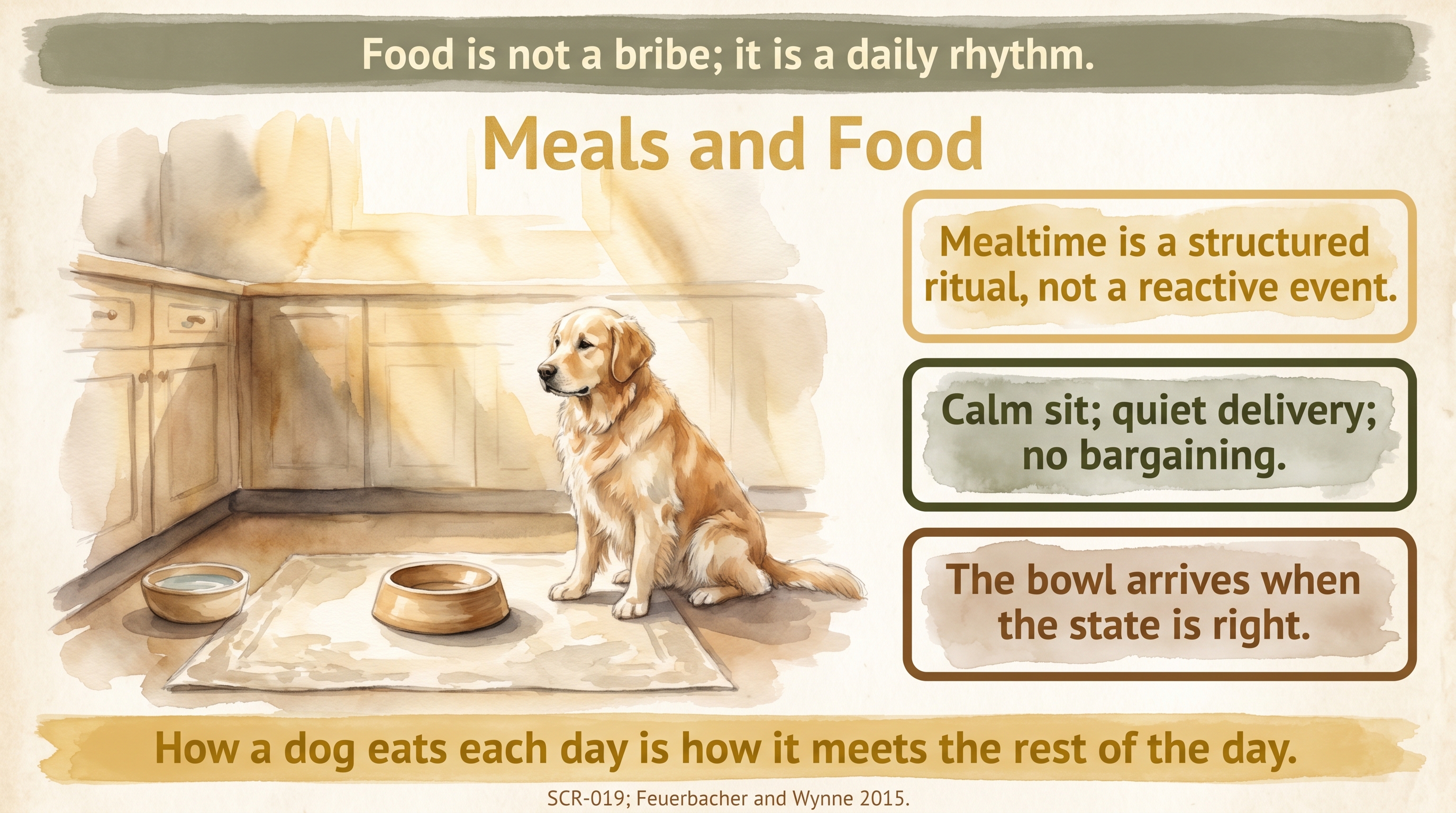
Mealtime is one of the highest-leverage moments in a dog's day. Done well, it reinforces calm, structure, and the dog's understanding that food appears reliably without drama. Done poorly, it builds excitement, food-guarding pressure, and a dog who treats every meal as the most important event of the household day.
The Just Behaving pattern is simple. Meals happen at predictable times. The dog is calm before the food is put down - not sitting on cue, but actually settled. The food is placed without ceremony. The dog eats. The bowl is picked up. No one hovers, no one negotiates, no one builds the meal into a high-arousal event.
What you are teaching is not "wait for permission." What you are teaching is that meals are normal, predictable, and not worth becoming excited about. That is the foundation for a dog who lives easily with food across a long life.
What It Means
The transactional framing of meals, food as currency in a reward economy, is identified by the methodology as the central conceptual mistake of the domain. The dog that has been raised inside command-mediated meals (the dog must "sit," then "wait," then is released to a bowl) has learned an explicit operant contingency: behavior produces food. This is not dangerous. It is also not neutral. It is a specific and narrow relationship to food, and to the family member who controls food access, that has implications extending well beyond the kitchen. The dog raised inside structured meals (the meal arrives in the same sequence at the same emotional temperature, the bowl goes down when the dog is settled because settled is what the meal sequence has always required structurally) has also learned through operant processes (the meal reliably follows settled behavior). What changes is the relational and architectural context surrounding the operant mechanics, and the methodology's position is that this context changes what the dog takes away from the experience. Heuristic
The neurochemical setup begins with the SEEKING system. Panksepp's affective neuroscience framework identifies seven core mammalian affective systems, of which SEEKING is the dopaminergic anticipation circuit activated by the prospect of reward (SCR-014). The framework is built primarily on rodent work with cross-mammal conservation; direct canine PET imaging of the SEEKING circuit during food anticipation has not been established. The canine operationalization of the framework is recent but real: Bhave et al. (2024) and Cetintav et al. (2025) applied Panksepp's seven affective categories to canine facial expression and body posture data (dataset: 2,184 images) to classify emotional states including anticipatory SEEKING. The dog at the food preparation moment is not merely "excited." It is, by the conserved-mechanism inference supported by the canine behavioral operationalization, in an anticipatory affective state that is high-attention and high-motivation. What the dog observes during this state is learned with particular efficiency. The question is what it is being given to observe.
A boundary worth naming. The dopamine system is essential for canine learning, motivation, and social reward; the methodology rejects the simple framing of dopamine as the neurochemical adversary of healthy development (SCR-014, v1.8 ceiling). Documented The defensible JB contrast is at the autonomic level (parasympathetic tone versus unregulated sympathetic dominance) rather than at the molecular level. The meal does not aim to suppress dopamine. It aims to demonstrate that anticipatory motivation is compatible with behavioral regulation, in a context where both are simultaneously active, repeatedly, across hundreds of meals.
The mentorship channel inside the meal is documented. Huber et al. (2018) found that dogs copied causally irrelevant actions from their human caregivers but very few dogs copied the same action from an unfamiliar experimenter (SCR-010). Documented Subsequent work (Huber et al., 2020; Huber, Kubala, \u0026 Cimarelli 2022; Mackie \u0026 Huber 2023) extended the finding and linked overimitation specifically to caregiver relationship quality. The relationship modulates what is copied. The implication for mealtime is direct: the family member who prepares and delivers meals is a primary relationship figure, and behavioral modeling that occurs during the high-motivation pre-meal period is attended to and absorbed in a way that the same modeling from a stranger or from a video tutorial cannot replicate. The meal is a mentorship domain, not merely a nutritional event.
The structural piece is the dog-directed authoritative caregiving literature. Brubaker and Udell (2023) studied 48 dog-owner dyads and found that dogs with authoritative owners (high warmth combined with clear structural expectations) showed the most secure attachment and the best problem-solving persistence (SCR-019). Documented van Herwijnen et al. (2018, N=518; 2020) operationalized dog-directed parenting styles and linked them to observable owner behaviors and dog attention. Bouma et al. (2024) extended the evidence to attachment, sociability, and intergenerational-pattern associations. The remaining boundary on this literature is causal strength: the canine studies are correlational and have not yet experimentally proven that authoritative caregiving causally produces the best long-term outcomes. Mixed Evidence The authoritative meal in the JB methodology is the operational expression of this style: warmth in the family member's presence and attention combined with the structural clarity that settled behavior is the condition of the meal.
The Hebbian principle (SCR-022) operates without reference to whether the family intends the association. Documented Every meal during which food appears while the dog is spinning is a meal that strengthens the neural circuit linking spinning to food delivery. Every meal during which food appears while the dog is settled strengthens a different circuit. The mechanism is foundational neuroscience documented across mammals; the canine application is conserved-mechanism inference rather than direct canine-cellular finding. The meal architecture is the family's daily Hebbian intervention, repeated three or four times a day depending on the dog's feeding schedule, accumulating across the developmental window during which canine circuits are most actively wiring.
The verbal-praise piece is the signal-economy companion finding. Feuerbacher and Wynne (2015) demonstrated that dogs prefer physical contact (petting) over verbal praise as a reinforcer, and that verbal praise loses functional reinforcement value rapidly through habituation in lab sessions (SCR-052). Documented The household-level claim that constant praise across months degrades signal value is consistent with documented habituation and signal-detection theory but is itself an extrapolation from laboratory findings. Heuristic The implication for meals is that the meal narrated with constant cheerful commentary, the bowl delivered with theatrical celebration, and the post-meal congratulatory chatter are operating against a documented pattern of reinforcer habituation. The quiet meal preserves signal value for moments when the family's vocal attention actually carries information.
Why It Matters for Your Dog
The meal in the JB approach has a recognizable shape. The family member prepares the food at the same pace and sequence as always. The dog is nearby, observing. The dog's arousal builds, because food preparation is anticipatory and anticipation activates the SEEKING system in mammals. The family member does not respond to that arousal by speeding up, slowing down, or engaging with it. They continue at the same pace. The bowl is placed down when the dog's state is settled. Not because the dog was commanded to be settled. Because settled behavior is what always precedes the bowl going down. The meal, executed this way, does several things simultaneously. It demonstrates Structured Leadership without commands. It provides a high-frequency Mentorship moment in which the dog observes a calm adult model the appropriate response to anticipatory arousal. It enacts Prevention by structurally excluding the spinning-at-the-bowl circuit from the beginning. It preserves the calm floor by not turning the meal into the day's emotional peak. And it requires almost no Indirect Correction, because the architecture of the meal makes the rare needed correction proportional and brief.
The deeper distinction is between the dog learning a stimulus-response pair and the dog learning the relational texture of the family. The dog raised on command-mediated meals has learned that this human has food and uses specific words as the release signal. The leadership the family member feels is real but narrow: it is leadership within the mechanical structure of the command sequence. Outside that sequence, in the hundred other daily interactions that do not involve food and commands, that leadership has not been established. The dog raised on structured meals has learned within a broader context: meals are part of the predictable rhythm of the relationship with this person, this person's preparation of food is a signal worth orienting to calmly, and that calm orientation is what characterizes the family's entire relational texture. Both processes can be described in operant terms; the methodology acknowledges the description. The methodology's claim is that the relational and developmental context surrounding the operant mechanics changes what the dog takes away. Heuristic
The meal is the methodology's clearest illustration that Structured Leadership does not require directives. The structure is in the sequence, the pace, and the consistent emotional temperature, not in the words the family member uses to manage the dog's behavior. A dog that settles at mealtime because settling is what the meal has always required is not a dog performing for its food. It is a dog inhabiting its normal relationship with the meal. The leadership extends across all the household contexts that mealtime is one expression of, rather than terminating at the boundary of the command sequence.
There is one further clarification worth making about treats and the meal's relationship to operant tools. The methodology is not anti-treat. It is anti-vending-machine. Treats have legitimate functions during the bridge period of new association acquisition, in systematic counter-conditioning for established anxiety responses, and in brief structured engagement work with young dogs (these are detailed in The Treat Economy entry). What the methodology rejects is the substitution of food-reward economies for the relational and structural work of the meal architecture. A behavior that is established through operant conditioning, including treat-based protocols, will exhibit Bouton's four return-of-behavior phenomena (spontaneous recovery, renewal, reinstatement, rapid reacquisition), with the original pathway persisting under context shift, time, and re-exposure (SCR-008; Gazit et al. 2005 demonstrated the renewal effect directly in domestic dogs). Documented A behavior that is structurally embedded in the family's daily rhythm has been built differently and carries different vulnerabilities. Both are legitimate; the family should understand which they are choosing.
For the household with multiple feeders, the operative variable is consistency. Smith et al. (2025) analyzed 3,044 Golden Retrievers in the Golden Retriever Lifetime Study and identified household management variables as significant predictors of behavioral trajectory (SCR-485). Documented Who feeds the dog, and how, is a household management variable. The dog fed calmly by one family member and fed with theatrical excitement by another is not receiving consistent architectural information about what meals feel like. The fix is rarely the family member who is naturally calm. It is calibration of the family member who is naturally enthusiastic toward the same emotional temperature the rest of the household is using. This is a coordination problem, not a personality problem, and it is solvable through explicit household agreement about what mealtime looks like.
A note on the limit of the inference. The owner-variable literature establishes that household management variables predict canine outcomes (SCR-485, documented). The stronger claim that owner-managed variables are the primary predictor across all contexts is consistent with the literature but has not been definitively established (SCR-486, heuristic). Mixed Evidence The methodology presents the meal architecture as the operational expression of well-supported caregiving-style associations rather than as a singular proven intervention.
The unglamorous part is the part that does the work. The settled dog at breakfast is not the result of breakfast technique. It is the result of having lived through hundreds of mealtimes that arrived at the bowl in exactly the same way.
Food is the most reliable conversation you will have every day.
Key Takeaways
- Food is relationship infrastructure, not currency. The transactional framing of meals (food as reward in exchange for behavior) is a specific psychological setup with documented vulnerabilities (SCR-008 Bouton return-of-behavior phenomena), and the methodology's alternative is structural rather than technical: meals are part of the family's predictable daily rhythm.
- The meal demonstrates Structured Leadership without commands. The dog settles because settling has always characterized the meal sequence, not because settling has been verbally requested. The leadership extends across all household contexts that mealtime is one expression of.
- Meals are documented mentorship moments. Anticipatory activation of the SEEKING system (Panksepp; canine application via Bhave 2024 and Cetintav 2025) makes the pre-meal period high-attention. Caregiver-relationship modulation of overimitation (Huber et al. 2018, 2020, 2022) means what the family member models during meal preparation is preferentially absorbed.
- Operational rule: same sequence, same pace, same emotional temperature, every meal, by every household member. The dog's mealtime calm is not produced at the bowl. It is produced by the accumulated meals that arrived at the bowl the same way.
The Evidence
This entry uses mixed-evidence claim-level tags beyond the dedicated EvidenceBlocks below. These tags mark claims that combine documented findings with observed practice, heuristic application, or unresolved gaps.
- Panksepp, J. (1998), Affective Neurosciencemultiple mammals (primarily rats); cross-species framework
Seven core mammalian affective systems identified, including the dopaminergic SEEKING system activated by reward anticipation. The mechanism is a cross-species mammalian finding established primarily in rodent work; conserved-mechanism extension to dogs is the standard inference in comparative affective neuroscience. Boundary: the molecular framing of dopamine as the adversary of good development is rejected; the JB contrast is autonomic, not molecular. - Bhave, S. et al. (2024); Cetintav, B. et al. (2025), Applied Animal Behaviour Sciencedomestic dogs
Canine operationalization of Panksepp's seven affective categories using machine-learning classification of facial expression and body posture (dataset: 2,184 images). The SEEKING state is measurable in dogs at the behavioral/observable level, bringing canine-direct empirical support to the framework even where dog-specific PET imaging of food anticipation is not yet established.
- Huber, L. et al. (2018), Learning and Behaviordomestic dogs
Dogs copied causally irrelevant actions from human caregivers but very few dogs copied the same action from an unfamiliar experimenter. The relationship modulates what is copied. Direct evidence that family-member modeling at mealtime is preferentially absorbed. - Huber, L., Salobir, K., Mundry, R., & Cimarelli, G. (2020); Huber, L., Kubala, D., & Cimarelli, G. (2022); Mackie & Huber (2023); Mackie, Trehorel & Huber (2024)domestic dogs
Successive replications and extensions confirm canine overimitation and the caregiver-relationship modulation effect. Huber et al. (2022) specifically links overimitation to caregiver relationship quality, providing the link between meal mentorship and longer-term relational structure.
- Brubaker, L. & Udell, M. A. R. (2023), Animal Cognitiondomestic dogs (N=48 dog-owner dyads)
Dogs with authoritative owners (high warmth combined with clear structural expectations) showed the most secure attachment and the best problem-solving persistence. The authoritative meal is the operational expression of this style: warmth in presence and attention combined with structural clarity that settled behavior is the meal's structural condition. - van Herwijnen, I. R. et al. (2018, N=518; 2020); Bouma, E. M. C. et al. (2024), Animalsdomestic dogs
Operationalization of dog-directed parenting styles and link to observable owner behaviors, dog attention, sociability, and intergenerational-pattern associations. The literature is correlational; the causal claim that authoritative caregiving experimentally produces the best canine outcomes remains an inference from correlated outcomes (per SCR-019 ceiling).
- Feuerbacher, E. N. & Wynne, C. D. L. (2015), Journal of the Experimental Analysis of Behaviordomestic dogs
Dogs strongly prefer physical contact over verbal praise as a reinforcer; verbal praise loses functional reinforcement value rapidly across successive lab sessions. The household-level claim that constant praise degrades signal value over months is consistent with documented habituation and signal-detection theory but is itself an extrapolation from laboratory findings (per SCR-052 ceiling).
- Bouton, M. E. (2002, 2004); Bouton, Winterbauer, & Todd (2012)rats (primary experimental work)
Extinction generates a context-dependent inhibitory circuit that suppresses but does not erase the original conditioned response. Behaviors established through operant conditioning, including treat-based protocols, retain the original pathway and exhibit spontaneous recovery, renewal, reinstatement, and rapid reacquisition. Treat-conditioned mealtime behavior carries the same return-of-behavior vulnerabilities as any operant behavior. - Gazit, I., Goldblatt, A., & Terkel, J. (2005), Animal Cognitiondomestic dogs (5 Belgian Malinois, 2 Labrador Retrievers; explosives detection)
Direct canine demonstration of the renewal effect. Confirms that the Bouton framework operates in domestic dogs and is not a rodent-only phenomenon.
- Hebb, D. O. (1949); Bliss & Lømo (1973); Bi & Poo (1998)foundational neuroscience principle (rabbit, rat); cross-species
Neurons that fire together wire together; circuits strengthen with repetition. Mechanism is foundational neuroscience documented across non-canine mammals; behavioral application to canine mealtime practice is conserved-mechanism inference. Each meal during which spinning precedes food delivery strengthens the spinning-precedes-food circuit; each meal during which settled behavior precedes food strengthens a different circuit.
- Smith, B. P. et al. (2025), Preventive Veterinary Medicinedomestic dogs (N=3,044 Golden Retrievers, Golden Retriever Lifetime Study)
Household management variables identified as significant predictors of behavioral trajectory across the first three years of life. Who feeds the dog and how, sleeping arrangement, household structure, and related variables are consistently associated with measurable outcome differences. Cross-feeder consistency at meals is one expression of the household-management variable cluster. - Dale et al. (2024); Dodman et al. (2018); Powell et al. (2021); Bouma et al. (2024)domestic dogs (multiple cohorts)
Convergent evidence across cohorts and study designs that owner-managed variables predict canine behavioral outcomes. Stronger ranking claim (that owner variables are the primary predictor across all contexts) is well-supported synthesis but not yet definitively established (per SCR-486 ceiling).
- JB Methodology synthesisfamily-raised Golden Retrievers
The convergent claim that the structural-meal architecture produces a categorically different psychological relationship to food (and to the family member) than the command-mediated meal architecture is JB's synthesis of the SEEKING-system anticipation literature, the caregiver-relationship modulation of social learning, the dog-directed authoritative caregiving association, and the Bouton extinction asymmetry. Each component is independently documented in dogs (or in directly extended canine application). The convergent operational claim has not been tested as a single controlled comparison. Methodology presents structural meals as well-supported synthesis, not as singular proven intervention.
No controlled trial has compared a structural-meal protocol against a command-mediated protocol on long-term canine attachment, behavioral, or relational outcomes.
The household-level magnitude of verbal-praise habituation effects (versus the laboratory-session habituation documented by Feuerbacher & Wynne 2015) has not been directly measured.
Dog-directed authoritative-caregiving causal inference (versus the existing correlational evidence base) requires intervention-based study designs that do not yet exist.
Cross-feeder consistency interventions have not been studied as a single manipulable variable in multi-feeder households.
SCR References
Sources
Bhave, S. et al. (2024). Machine-learning classification of canine emotional states using Panksepp's seven affective categories. Applied Animal Behaviour Science. (preprint/early-access; canine application of Panksepp framework)
Bouma, E. M. C., Reijgwart, M. L., \u0026 Dijkstra, A. (2024). Dog-directed parenting styles and intergenerational patterns in dog-owner dyads. Animals, 14(3).
Bouton, M. E. (2002). Context, ambiguity, and unlearning: Sources of relapse after behavioral extinction. Biological Psychiatry, 52(10), 976-986.
Bouton, M. E. (2004). Context and behavioral processes in extinction. Learning \u0026 Memory, 11(5), 485-494.
Brubaker, L., \u0026 Udell, M. A. R. (2023). The effects of dog-directed parenting style on dog cognition and behavior. Animal Cognition, 26(2), 363-377.
Cetintav, B. et al. (2025). Canine emotional state classification using Panksepp's framework. Applied Animal Behaviour Science. (extension of Bhave et al. 2024 dataset)
Dale, R. et al. (2024). Risk factors associated with separation-related behaviours and other potentially undesirable behaviours in puppies. Animal Welfare, 33, e22.
Feuerbacher, E. N., \u0026 Wynne, C. D. L. (2015). Shut up and pet me! Domestic dogs (Canis lupus familiaris) prefer petting to vocal praise in concurrent and single-alternative choice procedures. Journal of the Experimental Analysis of Behavior, 103(2), 261-281.
Gazit, I., Goldblatt, A., \u0026 Terkel, J. (2005). The role of context specificity in learning: The effects of training context on explosives detection in dogs. Animal Cognition, 8(3), 143-150.
Hebb, D. O. (1949). The Organization of Behavior: A Neuropsychological Theory. New York: Wiley.
Huber, L., Popovová, N., Riener, S., Salobir, K., \u0026 Cimarelli, G. (2018). Would dogs copy irrelevant actions from their human caregiver? Learning and Behavior, 46(4), 387-397.
Huber, L., Salobir, K., Mundry, R., \u0026 Cimarelli, G. (2020). Selective overimitation in dogs. Learning \u0026 Behavior, 48, 113-123.
Huber, L., Kubala, D., \u0026 Cimarelli, G. (2022). Overimitation in dogs: Is there a link to the quality of the relationship with the caregiver? Animals, 12(3), 326.
Mackie, J., \u0026 Huber, L. (2023). Socially priming dogs in an overimitation task. Animal Cognition, 26, 1473-1486.
Panksepp, J. (1998). Affective Neuroscience: The Foundations of Human and Animal Emotions. New York: Oxford University Press.
Smith, B. P., Browne, M., Mack, J., Kontou, T. G., \u0026 Tomkins, L. M. (2025). Predictors of behavioral outcomes in 3,044 Golden Retrievers across the first three years of life. Preventive Veterinary Medicine, 234, 106101.
van Herwijnen, I. R., van der Borg, J. A. M., Naguib, M., \u0026 Beerda, B. (2018). The existence of parenting styles in the owner-dog relationship. PLOS ONE, 13(2), e0193471.
van Herwijnen, I. R., van der Borg, J. A. M., Naguib, M., \u0026 Beerda, B. (2020). Dog ownership satisfaction determinants in the owner-dog relationship and the dog's behaviour. PLOS ONE, 15(8), e0237854.