The Vieira de Castro 2020 Study
Ana Catarina Vieira de Castro and colleagues published one of the strongest dog-training welfare studies in 2020, and it matters because it moves beyond opinion, owner report, and single-metric claims. The paper, "Does training method matter? Evidence for the negative impact of aversive-based methods on companion dog welfare," appeared in PLOS ONE in December 2020. It examined ninety-two companion dogs from seven training schools in Portugal and compared dogs attending reward-based schools with dogs attending aversive-based schools. Documented
What makes the study important is not only its conclusion but its design. Documented The researchers did not rely on one simple measure. They coded stress-related behaviors during training sessions. They collected salivary cortisol as a physiological stress indicator. They also used a cognitive-bias test to probe broader affective state outside the training context. That combination matters because it helps answer a familiar objection. Critics of aversive-welfare studies often say the dog may simply be stressed in the moment. Vieira de Castro asked whether the welfare signal extended beyond the moment.
The answer was yes, at least in this sample. Dogs from aversive-based schools showed more lip licking, yawning, crouching, body-turning, and other stress-related behaviors during training. They also showed larger post-training cortisol increases. Most strikingly, they produced more pessimistic responses in an ambiguous-cue cognitive-bias task, suggesting a more negatively valenced affective state that generalized beyond the immediate training session.
JB treats this study as one of the field's clearest warnings about the welfare cost of aversive-heavy training. JB also reads it with the limits the authors themselves could not eliminate. This was not a randomized trial. Owners self-selected schools. Seven schools in one country are not the whole dog-training world. Baseline temperament differences cannot be fully excluded. Those constraints matter, but they do not erase the power of seeing behavior, physiology, and affect all bend in the same direction.
What It Means
Why This Study Is Stronger Than a Typical Training Paper
Most dog-training papers are limited in at least one major way. They may depend on owner recall, short demonstrations, or a single outcome variable. Vieira de Castro's paper is stronger because it triangulates across multiple types of evidence. Behavioral coding tells us what the dog looked like during training. Salivary cortisol gives a physiological measure that is harder to dismiss as mere interpretation. The cognitive-bias task reaches further by asking whether training history is associated with a more pessimistic response to ambiguous situations.
That design matters because welfare is not one thing. A dog can show outward stress signs, inward endocrine activation, or broader affective pessimism, and those do not always align perfectly in weaker studies. Documented Here, several lines converged. That is why the paper changed the debate so much.
What the Researchers Actually Found
The sample included ninety-two dogs across seven Portuguese schools, with forty-two dogs in reward-based schools and fifty in aversive-based schools according to the notebook synthesis. The aversive-trained dogs displayed significantly more stress-related behaviors during training, including behaviors such as yawning, lip licking, body lowering, and turning away. Post-training salivary cortisol was also higher in the aversive group.
The most discussed finding came from the cognitive-bias test. Dogs were trained to expect food in one location and no food in another, then presented with ambiguous bowl positions in between. Dogs from aversive schools were slower and more pessimistic in approaching ambiguous locations. In welfare science, that pattern is interpreted as evidence of a more negative underlying affective state. This pushed the literature past the narrower claim that aversive methods are stressful during use. It suggested the training context may be associated with a wider emotional shift.
Why the Paper Did Not Settle Everything
The study is powerful, but it is still observational. Documented Owners chose schools. Schools differed in more than method label. Trainers likely differed in personality, environment, pacing, and class culture. The dogs may have differed at baseline before the first data point the researchers observed. Portugal is not every training market, and seven schools are not a comprehensive sample of aversive or reward practice worldwide.
These limits matter because they prevent the paper from proving causation in the strongest possible sense. A critic could still argue that families with more difficult dogs selected aversive schools and that some of the observed pessimism predated training. The paper cannot fully dismiss that possibility. What it can say is that when researchers looked at real-world training schools, the aversive environments were associated with a more negative welfare profile across several measures at once.
Vieira de Castro matters to JB because it turns the calmness question into something measurable. A dog may still perform, but if the path to performance repeatedly elevates stress and shifts affect in a negative direction, JB treats that as a serious cost.
Why the Study Still Carries So Much Weight
The study carries weight because the direction of its findings fits the broader literature while improving the measurement quality. Documented Ziv 2017 had already summarized evidence of aversive-related stress and fear. Deldalle and Gaunet 2014 had already shown more stress behavior in a punishment-oriented school. Vieira de Castro added physiology and cognitive bias in one design. That is not the same as a perfect randomized trial, but it is a large step up from a simple owner questionnaire.
The paper also helps families interpret the difference between suppression and welfare. A training system can create outward control while still shifting the dog's internal state in an unfavorable direction. That is a distinction the dog-training industry often talks around because visible behavior is easier to sell than invisible cost.
Why It Matters for Your Dog
For a Golden Retriever family, this study matters because Goldens are exactly the kind of dog who can make a stressful method look deceptively successful. Documented A retriever may continue working, remain sociable, and still carry elevated stress or a more pessimistic emotional tone beneath the surface. Families then evaluate the training by visible politeness and miss the rest.
Vieira de Castro gives families a way to remember that welfare cannot be read only from whether the dog still performs. Suppose an adolescent Golden begins looking more obedient under a correction-heavy program. The key question is not only "Is the jumping reduced?" It is also "What is happening to the dog's body state, anticipation, and trust around the learning process?" This paper shows why that second question is legitimate and not sentimental.
A practical Golden example helps. Imagine a retriever enrolled in a class where sharp leash interruptions, verbal reprimands, and correction sequences are normal. Within weeks the dog looks more controlled around greetings and leash walking. The owner feels relief. Without a study like Vieira de Castro, the owner may think the result settles the matter. With this study in mind, the owner knows there are at least three further things to watch. Is the dog showing subtle stress signals around the trainer or class setup? Is enthusiasm becoming caution? Is calmness becoming a thinner, tenser version of silence?
This matters even more for families with children. Children often read the room through the dog. If the dog becomes more wary, more conflict-avoidant, or more brittle under correction, the whole social atmosphere of the home shifts. A dog can be "better behaved" while also becoming a less secure family member. That is exactly the kind of outcome a welfare study helps us hold in view.
The cognitive-bias piece is especially useful for family life because it reaches beyond the training floor. A dog who responds more pessimistically to ambiguous cues may be carrying a more negative baseline expectation about the world. Families do not need to become amateur cognitive scientists to understand the practical point. If the method is altering the dog's general emotional outlook in the wrong direction, that is not a trivial side effect.
Goldens also highlight another application. Many families do not use extreme aversives, but they do use regular correction when the dog is overexcited, mouthy, or unruly. Vieira de Castro does not directly test every mild correction event in a good household. Still, it raises the threshold for comfort around any system in which aversive pressure becomes normal, frequent, and central. It tells families that welfare cost is not only a possibility in theory. It shows up measurably in dogs.
The study should also steer expectations about what "evidence-based" means. If a trainer dismisses welfare concerns as emotional overreaction, this paper is a useful corrective. If a trainer claims the paper proves every kind of correction in every context is equally harmful, that is also an overread. The value of the study lies in its precision. It gives strong evidence against aversive-heavy training environments. It does not license careless generalization beyond what it actually measured.
For JB, the application is clear. A family-dog pathway that requires a lot of correction pressure is already suspect on developmental grounds. Vieira de Castro adds strong welfare reasons to be wary of such pathways even before JB's larger philosophy enters the room.
The class setting matters too. Families often evaluate a trainer by whether the room looks organized and the dogs are under control. Vieira de Castro reminds them to ask a second question: what is the emotional cost of that order? A quiet room can be a sign of learning, and it can also be a sign that pressure has shifted the dogs into a more negative affective state. The study gives families permission to care about that distinction rather than dismissing it as softness.
That point travels well outside formal classes. A home can also become outwardly orderly because the dog has learned that initiative is risky. Families should therefore watch for the difference between composure and inhibition. Is the Golden still playful, socially fluid, and quick to recover after guidance, or is the dog moving more carefully, offering less, and checking the adults with a slightly worried body? Vieira de Castro gives real scientific support to taking that question seriously.
Softer temperaments make that distinction especially easy to miss. A sociable retriever may not explode or shut down dramatically under pressure. Instead the dog may simply become a little flatter, a little less spontaneous, or a little more watchful around correction contexts. The study matters because it tells families those quieter welfare changes count too.
What This Means for a JB Family
The first takeaway is to treat this study as one of the strongest reasons not to normalize aversive-heavy training for a family dog. Documented The paper does not live at the level of vibes. It measures behavior, physiology, and affective interpretation. That is enough to deserve real weight in household decision-making.
The second takeaway is to avoid false precision. The study does not prove that every brief, low-magnitude interruption inside a calm relationship is equivalent to the aversive-school environments it examined. Families should not turn one paper into a universal slogan. They should let it do the job it is actually strong enough to do, which is to caution sharply against making aversive pressure a central feature of training life.
Third, use the paper to widen what you pay attention to. Do not evaluate training only by visible compliance. Watch body language, recovery speed, social softness, initiative, and whether the dog seems more confident or more careful around the adults. Those are family-level ways of staying sensitive to the kind of welfare picture the study measured more formally.
Finally, keep the developmental question active. If a Golden needs frequent correction pressure to function, the household should ask what upstream structures failed to build regulation earlier. JB reads Vieira de Castro not only as a warning about method but also as a reminder that family life should be organized so such methods become less attractive to begin with.
That makes the paper practical in a surprisingly immediate way. A family choosing between two programs does not need to become expert in cortisol methodology to use it. They only need to recognize that measurable welfare cost is part of the decision, ask what a trainer watches for besides compliance, and treat calmness as something to protect rather than something to force into existence after stress has already been normalized.
That is a strong filter when comparing classes, private trainers, or board-and-train sales language. The better professional answer will not be defensive about welfare. It will show how the dog is taught, what signs of strain are monitored, and why visible control is not accepted as the only definition of progress. A family that brings those questions into the search is already using this paper well.
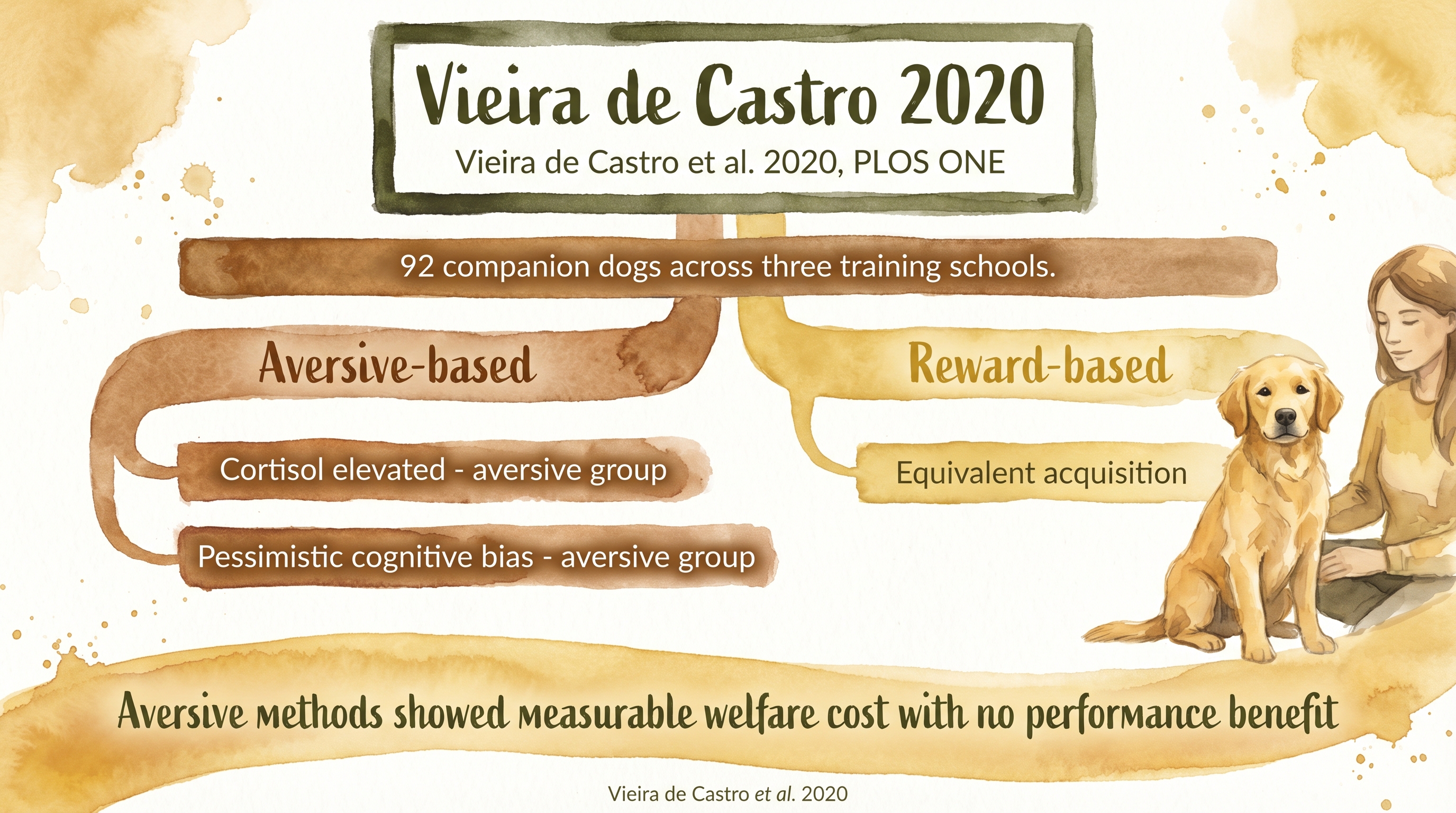
Aversive methods showed measurable welfare cost with no performance benefit.
Key Takeaways
- Vieira de Castro 2020 matters because it combines behavioral observation, physiology, and cognitive-bias testing in one study.
- Its findings support the claim that aversive-based training environments carry welfare costs that reach beyond the immediate training session.
- The paper is strong, but it remains observational and cannot fully eliminate self-selection or baseline-difference confounds.
- For families, the study is a powerful reason to question correction-heavy training systems even when visible compliance improves.
The Evidence
- Vieira de Castro et al. (2020)companion dogs
Ninety-two dogs from seven schools showed higher stress behavior, higher salivary cortisol, and more pessimistic cognitive-bias responses in aversive-based environments. - companion dogs
Highlights the study's methodological strengths and its non-randomized, self-selection limits. - Deldalle & Gaunet (2014)companion dogs
Provides school-comparison evidence in the same general direction, though with a weaker design. - Ziv (2017)companion dogs
Shows why Vieira de Castro is best read as strengthening an existing welfare pattern rather than creating it from nothing.
- domestic dogs
No published follow-up study directly tests how the findings summarized under the vieira de castro 2020 study generalize across breeds, households, and long-term outcomes.
SCR References
Sources
- Vieira de Castro, A. C., Fuchs, D., Morello, G. M., Pastur, S., de Sousa, L., & Olsson, I. A. S. (2020). PLOS ONE.
- Ziv, G. (2017). Journal of Veterinary Behavior.
- Deldalle, S., & Gaunet, F. (2014). Effects of two training methods on stress-related behaviors of the dog and on the dog-owner relationship. Journal of Veterinary Behavior, 9(2), 58-65.
- Vieira de Castro, A. C., Fuchs, D., Morello, G. M., Pastur, S., de Sousa, L., & Olsson, I. A. S. (2020). Does training method matter? Evidence for the negative impact of aversive-based methods on companion dog welfare. PLOS ONE, 15(12), e0225023.