Stage-Specific Environmental Scaffolding
Good environmental management is not static. The structure a young puppy needs, the freedoms it can handle, and the kinds of mistakes it is developmentally ready to avoid all change over time, which is why JB treats environmental setup as stage-specific scaffolding rather than as a permanent rule set. Observed-JB
What It Means
Scaffolding is temporary structure that supports growth while the underlying form is still developing. Observed-JB The construction analogy is useful because it captures both purpose and exit strategy. Scaffolding is not the building. It is what lets the building be formed safely until the structure can stand on its own.
In puppy raising, that means a ten-week-old puppy and a six-month-old adolescent should not be living inside the same expectations or the same access pattern. The younger puppy has less impulse control, a more open developmental window, and far less experience reading the household. It needs tighter environmental support. The adolescent may need more challenge in some areas and renewed restriction in others because new developmental pressures have arrived.
This stage sensitivity is already implied by the developmental literature. Scott and Fuller showed that what the puppy is developmentally capable of changes by phase, and the early-environment literature shows that those phases matter behaviorally. JB adds the application layer: if development changes, management should change with it. Structure that is too loose for a young puppy invites bad repetition. Structure that is too rigid for a maturing dog can prevent healthy growth.
The observed craft in this Foundation is knowing what to loosen, when to loosen it, and what to tighten again when adolescence shifts the baseline. That is why scaffolding is a better metaphor than restriction. The point is not control for its own sake. The point is well-timed support.
Why It Matters for Your Dog
Families often make one of two mistakes. They either grant too much freedom too early because they want the puppy to "learn naturally," or they hold the same rigid setup forever because they are afraid of any mistake. Observed-JB Both mistakes misunderstand development.
Stage-specific scaffolding lets the household stay honest about what the puppy can handle now. A young puppy may need gates, leash support in greeting scenarios, highly managed guest interaction, and more protected sleep. Observed-JB A more mature dog may need wider movement through the house, more tolerated delay, more responsibility around thresholds, and more carefully chosen opportunities to practice decision-making.
Prevention works best when it matches the developmental moment. The right structure at the right age prevents rehearsal without freezing the dog in permanent babyhood.
This is also one of the clearest ways the breeder-to-family handoff can go wrong. A puppy leaving a structured breeder environment can be dropped into too much freedom at once because the family mistakes affection for access. Observed-JB The developmental cost is usually not immediate disaster. It is the quiet accumulation of bad repetitions that the puppy was not ready to manage.
The practical instruction is to keep asking one question: what does this developmental stage need in order to succeed repeatedly without excessive correction? The answer changes over time, and good scaffolding changes with it. Observed-JB
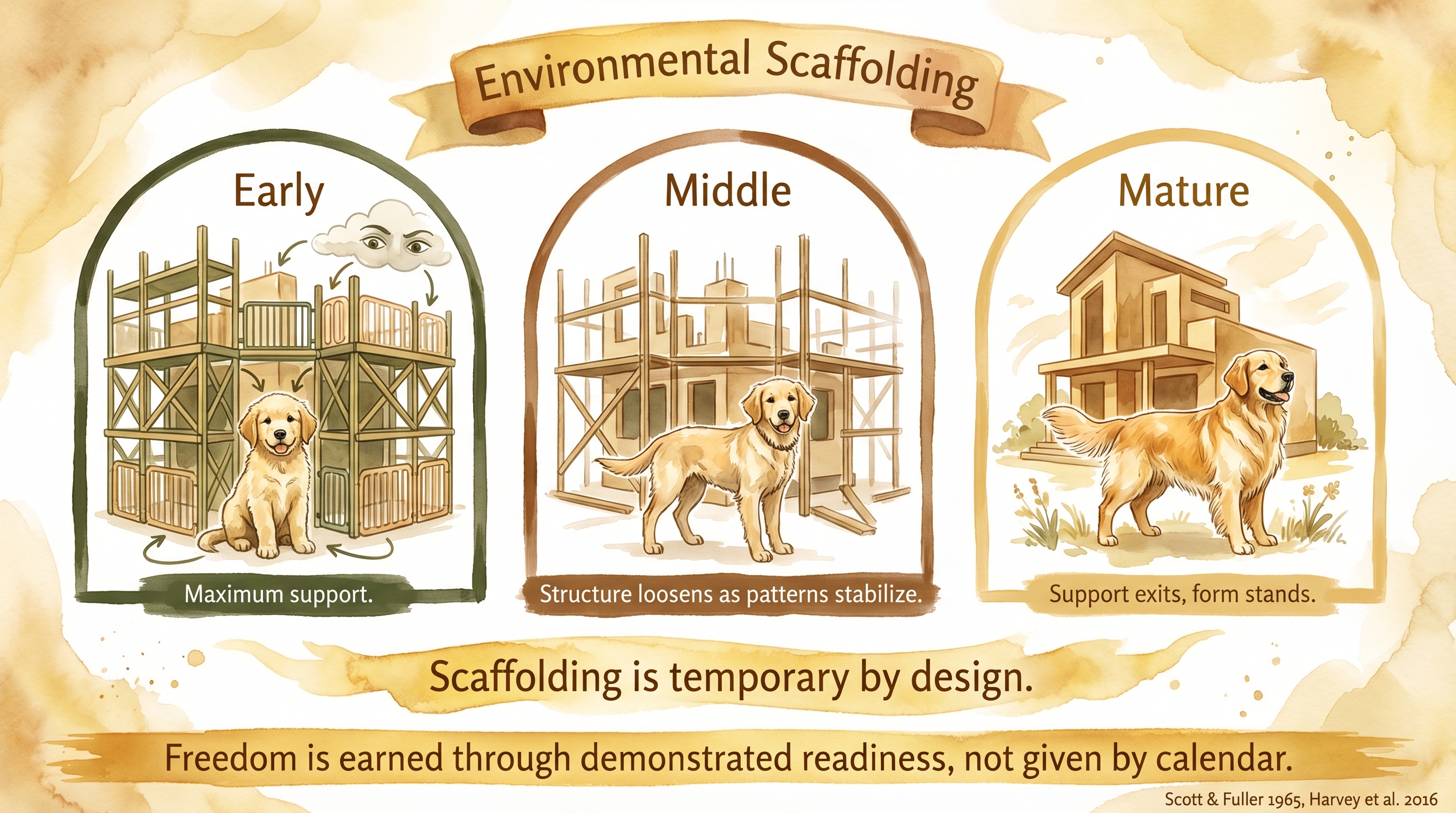
Scaffolding is temporary by design - maximum support early, loosening as patterns stabilize, removed when the underlying form can stand independently.
Key Takeaways
- Environmental scaffolding should change as the puppy changes. One setup does not fit every developmental stage.
- Young puppies usually need tighter structure because their nervous systems and habits are still more open and fragile.
- Good scaffolding is temporary support, not permanent restriction. It should loosen as stable patterns become real.
- Families often help most by matching access and freedom to the dog current stage instead of to the freedom they wish the dog could handle already.
The Evidence
- Scott, J. P. & Fuller, J. L. (1965)domestic dogs
Established that puppies pass through distinct developmental periods with different capacities and sensitivities. - Howell, T. J. et al. (2015)domestic dogs
Confirmed the importance of the gradual socialization-window closure, reinforcing that management demands change as development progresses.
- Harvey, N. D. et al. (2016, 2017)domestic dogs
Showed that developmental environment quality predicts later behavior, supporting the value of age-matched structure. - Guardini, G. et al. (2017)domestic dogs
Linked maternal-care style to later puppy responses, reinforcing that early structure and support have stage-sensitive effects.
- JB stage-specific observationfamily-raised Golden Retrievers
JB consistently observes that puppies do best when gates, leash support, sleep protection, greeting rules, and access are adjusted to developmental stage rather than fixed once and left unchanged.
No published study has established a validated stage-by-stage household management protocol for family-raised puppies and adolescents.
The literature supports developmental timing strongly, but it does not yet quantify the exact points at which common freedoms such as full-house access or unrestricted greeting are safest to add in ordinary homes.
SCR References
Sources
Scott, J. P. & Fuller, J. L. (1965). Genetics and the Social Behavior of the Dog. University of Chicago Press.
Howell, T. J., King, T., & Bennett, P. C. (2015). Puppy parties and beyond: The role of early age socialization practices on adult dog behavior. Veterinary Medicine: Research and Reports, 6, 143-153. https://doi.org/10.2147/VMRR.S62081
Harvey, N. D., Craigon, P. J., Brindle, S. A., England, G. C. W., & Asher, L. (2016). Social rearing environment influences dog behavioral development. Journal of Veterinary Behavior, 16, 13-21. https://doi.org/10.1016/j.jveb.2016.09.004
Harvey, N. D., Craigon, P. J., Sommerville, R., McMillan, C., Green, M., England, G. C. W., & Asher, L. (2017). Test-retest reliability and predictive validity of the Lincoln Infant Puppy Assessment Test (LIPAT). Veterinary Record, 181(22), 591. https://doi.org/10.1136/vr.104285
Guardini, G., Mariti, C., Bowen, J., Fatjo, J., Ruzzante, S., Kaminski, J., & Gazzano, A. (2017). Influence of morning maternal care on the behavioural responses of 8-week-old Beagle puppies to new environmental and social stimuli. Applied Animal Behaviour Science, 181, 137-144. https://doi.org/10.1016/j.applanim.2016.05.006