Social Buffering as Biological Mechanism
Compound evidence detail1 SCR / 2 parts
- Documentedthe human attachment evidence base together with the canine-direct secure-base findings (Topal 1998, Horn 2013) and Schoberl-documented physiological effects of secure caregiving in dogs
- Heuristicthe full attachment-theory apparatus transfer to canine relationships, including internal working models and attachment-classification systems
Social buffering means the presence of a trusted caregiver changes how stress is processed in the body. In mammals broadly, that claim is one of the most replicated findings in developmental stress science. In dogs, attachment and transition studies support a meaningful version of the same story. That is why JB treats the secure base as a physiological mechanism, not just as a nice metaphor for emotional comfort. Heuristic
What It Means
The stressor does not have to disappear for buffering to happen. The environment can still be novel, effortful, or mildly threatening. What changes is the biological load the young animal has to carry alone. Hostinar, Sullivan, and Gunnar (2013) and Hennessy, Kaiser, and Sachser (2009) showed across mammals that familiar caregiver presence can dampen HPA-axis activation, reduce cortisol output, and alter recovery after challenge. Documented That is the foundation-level mechanism JB is leaning on when it talks about calm adults as developmental resources.
Dogs fit into this story in a more bounded way. Documented-Cross-Species The canine literature does not justify saying caregiver presence always fixes stress or that every dog-human bond buffers in the same way. What it does justify is stronger than people often realize. Dogs form real attachment bonds. Securely attached dogs show lower cortisol reactivity in Strange Situation-type testing. Rehoming and unstable intake contexts raise cortisol sharply, while quieter and more predictable home environments reduce that load over time. The relationship is not just social. It is regulatory.
This helps explain why JB resists the idea that structure and warmth are competing goods. Documented-Cross-Species In a buffering model, the adult is valuable precisely because the adult is predictable, calm, and usable under stress. A chaotic adult can be loving and still fail to buffer well. A warm adult who floods the young with stimulation can unintentionally become part of the stressor. Social buffering is therefore not about maximum affection. It is about whether the adult actually functions as a safe haven and secure base when the nervous system needs one.
The cross-species bridge still needs honesty. Mammal-wide buffering is documented. Documented-Cross-Species Dogs form attachment bonds and show related physiological effects. The stronger JB move, that calm family leadership should be understood as an intentional buffering practice across the whole developmental arc, is an interpretive extension. It is well grounded. It is not a completed intervention literature.
Why It Matters for Your Dog
For families, this entry changes what "being there" means. Documented-Cross-Species Calm presence is not empty time. It is part of the dog's stress-regulation environment. A puppy lying quietly near a calm adult is not just keeping company. The puppy is practicing biology inside a lower-cost social state.
Structured Leadership works partly because a reliable adult is itself a physiological intervention. The dog does not only learn from the adult's rules. The dog regulates through the adult's presence.
This is also why the first days and first transitions matter so much. A move into a novel environment is a real physiological event. The more the family can make itself readable, calm, and predictable, the more likely it is to function as a buffer rather than as an amplifier. That does not mean every calm family will eliminate stress. It means the family becomes part of the mechanism through which the dog recovers.
The practical takeaway is simple and profound at the same time: relationship quality changes physiology. That makes calm, stable companionship one of the deepest things adults offer a puppy. Not because it looks nice, but because mammals have been using that strategy for a very long time.
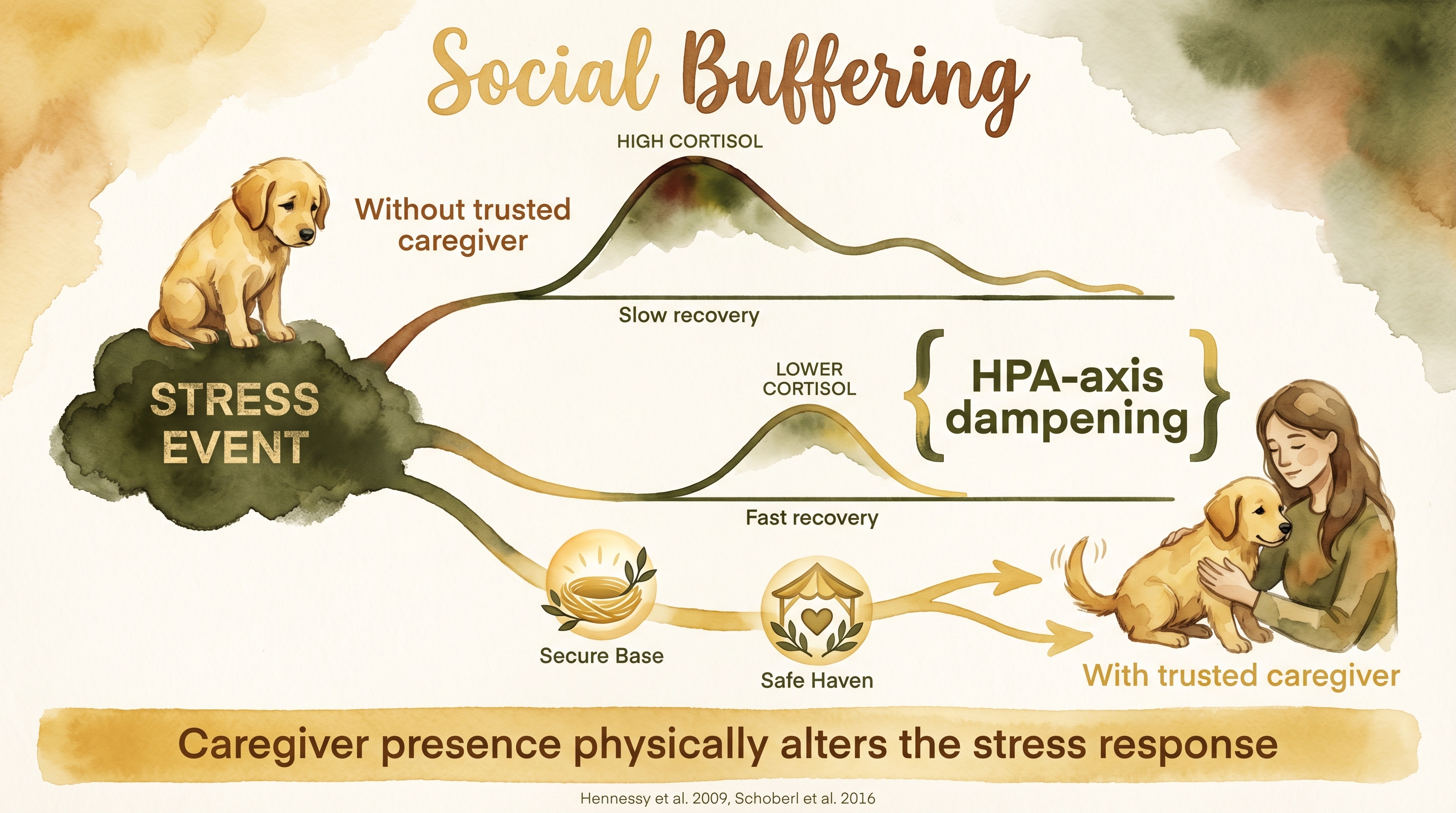
Trusted caregiver presence physically alters the stress response through HPA-axis dampening - the secure base is a physiological intervention, not sentiment.
Key Takeaways
- Social buffering means a trusted caregiver changes how stress is processed in the body, especially through the HPA axis.
- That mechanism is documented across mammals and supported in dogs through attachment and transition physiology studies.
- This is why the secure base is more than a metaphor. A calm adult can become part of the puppy's biological regulation system.
- For families, calm presence is not passive. It is one of the most powerful forms of developmental support a dog can receive.
The Evidence
This entry uses heuristic claim-level tags beyond the dedicated EvidenceBlocks below. These tags mark JB interpretive application rather than direct study findings.
- Hostinar, C. E., Sullivan, R. M., & Gunnar, M. R. (2013)multiple mammals
Reviewed social buffering as a major psychobiological mechanism through which caregiver presence reduces HPA-axis load in the developing young. - Hennessy, M. B., Kaiser, S., & Sachser, N. (2009)multiple mammals
Showed that social buffering is a broadly replicated mammalian pattern, not a metaphorical attachment phrase.
- Schoberl, I. et al. (2016)domestic dogs
Found that securely attached dogs showed lower cortisol reactivity in a Strange Situation procedure. - van der Laan, J. E. et al. (2022)domestic dogs
Showed marked cortisol disruption in shelter intake with reduction after movement into more stable home conditions. - SCR-018 synthesisdomestic dogs
Dogs form attachment bonds functionally analogous to infant-caregiver bonds, making a buffering interpretation biologically plausible.
No published trial directly compares JB-style calm caregiver continuity to more stimulating household reception styles while measuring puppy cortisol or later attachment security. The secure-base application to breeder-to-family transition remains a well-grounded but still inferential bridge.
SCR References
Sources
Hostinar, C. E., Sullivan, R. M., & Gunnar, M. R. (2013). Psychobiological mechanisms underlying social buffering of the hypothalamic-pituitary-adrenocortical axis: a review of animal models and human studies across development. Psychological Bulletin, 140(1), 256-282. https://doi.org/10.1037/a0032671
Hennessy, M. B., Kaiser, S., & Sachser, N. (2009). Social buffering of the stress response: diversity, mechanisms, and functions. Neuroscience & Biobehavioral Reviews, 33(4), 470-482. https://doi.org/10.1016/j.neubiorev.2008.06.001
Schoberl, I., Beetz, A., Solomon, J., Gee, N., Kotrschal, K., & Wedl, M. (2016). Social factors influencing cortisol modulation in dogs during a Strange Situation procedure. Journal of Veterinary Behavior, 11, 77-85. https://doi.org/10.1016/j.jveb.2015.09.005
van der Laan, J. E., Vinke, C. M., van der Borg, J. A. M., Arndt, S. S., & Beerda, B. (2022). Evaluation of hair cortisol as an indicator of long-term stress responses in dogs in an animal shelter and after subsequent adoption. Scientific Reports, 12, 5117. https://doi.org/10.1038/s41598-022-09140-7