Overimitation and Social Affiliation
Dogs do not only copy outcomes. In documented overimitation tasks, domestic dogs sometimes copy causally irrelevant demonstrated actions, especially when the demonstrator is a trusted caregiver. Retriever-puppy work adds a second important point: eight-to-ten-week-old retriever puppies, including Golden Retrievers, arrive already prepared to read human gestures without conditioning. The stronger neural claim, that a mirror-neuron substrate in dogs has been demonstrated, remains too strong. What is documented is the behavior. The precise neural implementation is still bounded. Mixed Evidence
What It Means
Overimitation is the copying of an unnecessary action along with the action that actually solves the task. In a purely efficiency-driven learner, the unnecessary step should disappear quickly. In domestic dogs, it does not always disappear. Huber and colleagues showed that many dogs copied an irrelevant caregiver-demonstrated action before performing the reward-producing action, even though the irrelevant step was not needed to get the food. Documented That matters because it means the model is not just teaching the dog what works. The model is changing what counts as worth copying.
The social side of the finding matters just as much as the copying itself. In the early overimitation work, dogs were far more likely to copy a caregiver than a stranger. Later studies kept strengthening the same picture: some of the copying looks less like cold causal reasoning and more like affiliation, attention, and social alignment. Documented That does not prove human-style norm psychology in dogs. It does show that social relationship changes what information the dog preserves.
The developmental evidence makes the point stronger, not weaker. Documented Bray, MacLean, and colleagues (2021) tested 375 eight-to-ten-week-old retriever puppies, including Golden Retrievers, on human gesture-following tasks and found strong success from the beginning, with flat performance across twelve trials. That is not what conditioning looks like. It means puppies arrive with social hardware already pointed toward human communication. They do not need to be taught to care what adults do. They need adults whose behavior is worth encoding.
This is why the Mentorship Foundation is deeper than simple demonstration. A puppy is not only waiting for formal lessons. A puppy is continually watching what kind of creature the adult is. Fast or slow. Quiet or noisy. Patient or frantic. Still or performative. Overimitation gives that everyday modeling problem empirical teeth.
There is also an important ceiling here. In domestic dogs, Boch, Huber, and Lamm (2024) identified action-observation networks with neuroimaging. Documented That is useful and relevant. It is not the same thing as direct single-cell mirror-neuron recording. The social learning case does not depend on claiming more than the evidence can carry. The behavior is documented already.
Why It Matters for Your Dog
For families, this Foundation shifts attention away from technique obsession and back toward adult example. If puppies are biologically prepared to read human social cues and if dogs sometimes copy even unnecessary parts of a demonstrated sequence, then household rhythm matters more than many people realize.
Mentorship is powerful because the puppy is not merely obeying. The puppy is watching how a trusted adult moves through the world and deciding what parts of that pattern are worth carrying forward.
That means a puppy can learn stillness from an adult who settles deliberately, not only from a formal settle exercise. A puppy can learn frantic transitions from an adult who narrates, rushes, and amplifies ordinary events. The dog is taking in method, not just outcome.
It also explains why JB keeps saying adults need to be worth learning from. Documented The puppy already has the hardware for social learning. The missing ingredient is usually not more stimulation. It is better adult behavior in the room.
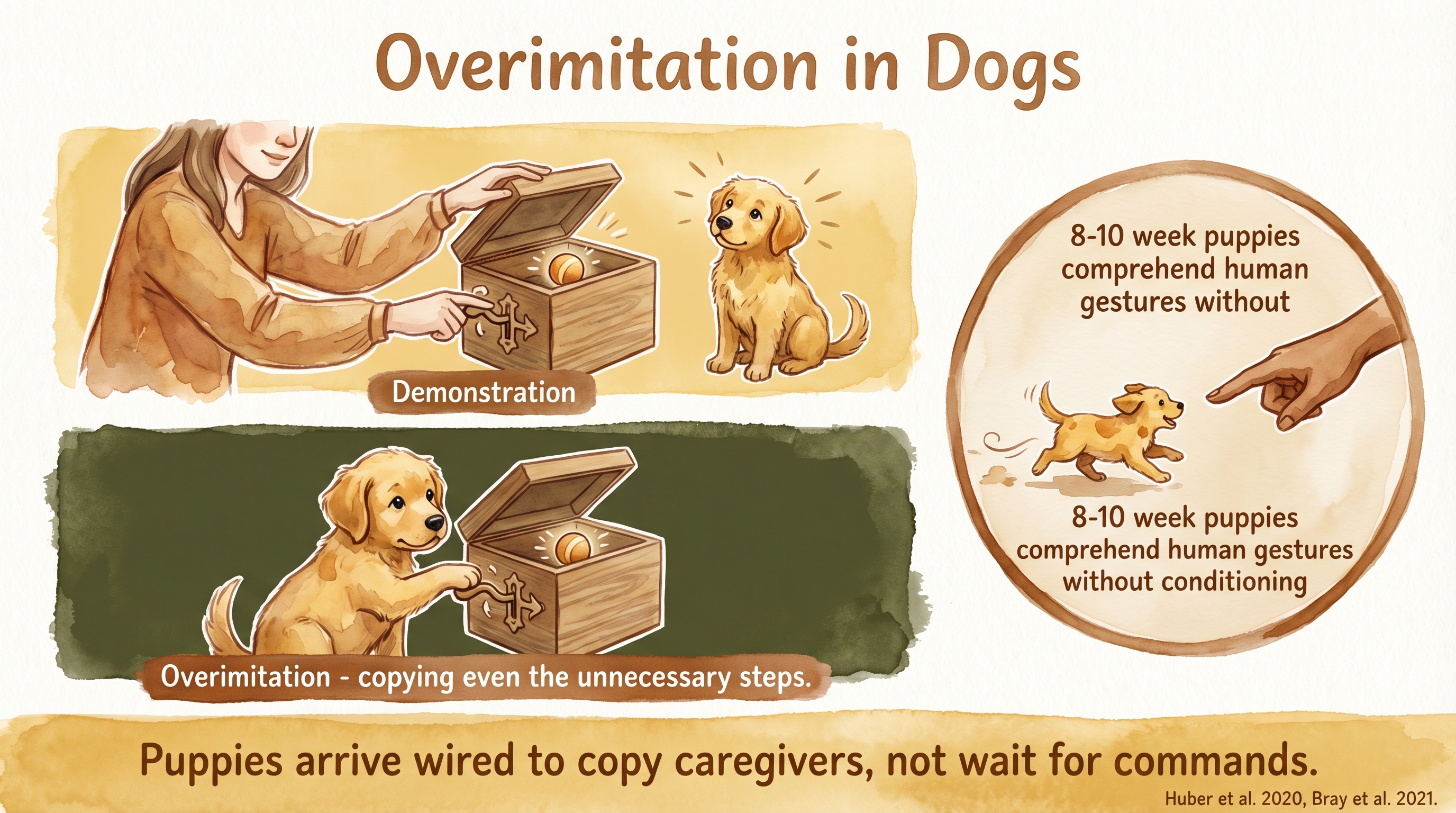
Puppies arrive wired to copy caregivers - overimitation of even unnecessary actions and gesture comprehension at 8-10 weeks without any conditioning.
Key Takeaways
- Dogs sometimes copy caregiver-demonstrated actions even when simpler alternatives exist, which is what makes overimitation so important.
- Retriever puppies, including Golden Retrievers, show human gesture comprehension from the beginning rather than learning it across repeated test trials.
- These findings support the idea that puppies arrive ready for social learning and affiliation, not that they need to be programmed from zero.
- The neural implementation remains bounded: action-observation networks have been imaged in dogs, but direct mirror-neuron claims are still too strong.
The Evidence
This entry uses mixed-evidence claim-level tags beyond the dedicated EvidenceBlocks below. These tags mark claims that combine documented findings with observed practice, heuristic application, or unresolved gaps.
- Huber, L. et al. (2018)domestic dogs
Showed that dogs copied a causally irrelevant caregiver-demonstrated action before completing the reward-producing task. - Huber, L. et al. (2020)domestic dogs
Refined the overimitation picture by showing that dogs sometimes preserve inefficient demonstrated actions rather than dropping them immediately. - Huber, L. et al. (2022)domestic dogs
Tested links between overimitation and relationship quality, reinforcing the social-affiliation interpretation. - Mackie, N. & Huber, L. (2023)domestic dogs
Showed that dogs sometimes reproduced the irrelevant action even after the instrumental goal had already been achieved, which strengthened the case for a separable social component.
- Bray, E. E., MacLean, E. L., et al. (2021)retriever puppies including Golden Retrievers
Tested 375 eight-to-ten-week-old retriever puppies and found robust gesture-following performance with no learning curve across twelve trials, supporting biological preparedness for human communication. - Fugazza, C. et al. (2018)dog puppies
Showed that eight-week-old puppies can learn from human and conspecific demonstration and retain the socially learned solution after delay.
- Boch, M., Huber, L., & Lamm, C. (2024)
In domestic dogs, neuroimaging identified action-observation networks, which is consistent with mirror-like processing but does not amount to direct mirror-neuron recording. - SCR-031 boundary
The Mentorship claim should rest on documented social-learning behavior rather than on strong mirror-neuron language, because the direct canine neural claim remains ambiguous.
No naturalistic household study has yet measured how often puppies overimitate adult everyday routines outside laboratory tasks, which means the daily-life magnitude of the effect remains inferred from controlled experiments.
Two-action control work is still needed to separate true norm-like copying from simpler enhancement-based explanations across the full canine overimitation literature.
SCR References
Sources
Boch, M., Huber, L., & Lamm, C. (2024). Action observation reveals a network with divergent temporal and parietal cortex engagement in dogs compared with humans. Imaging Neuroscience. https://doi.org/10.1162/imag_a_00301
Bray, E. E., MacLean, E. L., et al. (2021). Puppies are born ready to communicate with humans. Current Biology, 31(14), 3132-3136.e5. https://doi.org/10.1016/j.cub.2021.05.034
Fugazza, C., Moesta, A., Pogany, A., & Miklosi, A. (2018). Social learning from conspecifics and humans in dog puppies. Scientific Reports, 8, 9257. https://doi.org/10.1038/s41598-018-27654-0
Huber, L., Popovova, N., Riener, S., Salobir, K., & Cimarelli, G. (2018). Would dogs copy irrelevant actions from their human caregiver? Learning & Behavior, 46(4), 387-397. https://doi.org/10.3758/s13420-018-0322-1
Huber, L., Salobir, K., Mundry, R., & Cimarelli, G. (2020). Selective overimitation in dogs. Learning & Behavior, 48, 113-123. https://doi.org/10.3758/s13420-019-00403-w
Huber, L., Kubala, D., & Cimarelli, G. (2022). Overimitation in dogs: Is there a link to the quality of the relationship with the caregiver? Animals, 12(3), 326. https://doi.org/10.3390/ani12030326
Mackie, N., & Huber, L. (2023). Socially priming dogs in an overimitation task. Frontiers in Psychology, 14, 1183502. https://doi.org/10.3389/fpsyg.2023.1183502