Social Learning as the Primary Mechanism
Compound evidence detail1 SCR / 2 parts
- Documentedthe cross-species evidence for mentorship convergence in non-canid mammals, including chimpanzee tool-use transmission (Inoue-Nakamura and Matsuzawa 1997), dolphin foraging transmission, meerkat prey-handling teaching, and elephant matriarchal knowledge transfer
- Heuristicthe JB application of the cross-species convergence to dog raising, mapping the pattern in function rather than mechanism, with no formal canine teaching study under the strict definition
Puppies do not wait for formal instruction before they begin learning. They learn by watching what older dogs and humans do, extracting information from demonstration, and carrying that information forward into their own behavior, which is why social learning is a foundation beneath Mentorship rather than a decorative extra. Documented
What It Means
Social learning means acquiring information from another individual instead of discovering everything through direct trial and error. Documented In dogs, that capacity is not speculative. It is documented in puppies, in adults, with canine demonstrators, and with human demonstrators. Fugazza and colleagues showed that puppies as young as eight weeks can acquire novel actions through observation. That matters because eight weeks is exactly when many families believe learning must begin through active instruction. The evidence says learning was already underway.
This is where the JB analogy of the math professor versus the gym coach earns its place. The gym coach runs drills, calls repetitions, and corrects visible mistakes one by one. The math professor works through the logic of a problem while the student watches the pattern emerge. Both can teach something. They do not teach the same kind of learner. Social learning is the mechanism that makes the math-professor model possible in dogs. Documented
The Do As I Do literature deepens the point. Documented Adult dogs can learn a generalized rule for copying demonstrated human actions and later apply it to novel tasks. Later work comparing socially demonstrated learning against shaping or clicker-based acquisition found stronger retention and generalization for the social-learning route in the tested tasks. That does not mean consequences stop mattering. It means instruction is not the only road into behavior, and in socially rich environments it may not be the first road at all.
Breed-weighted demonstrator effects sharpen the picture further. Dogs selected for close cooperation with humans often gain more from human demonstrators, while breeds selected for greater functional independence can gain more from conspecific ones in certain tasks. Observed-JB That is a useful reminder that social learning is not a vague magic trait. It is a biologic system shaped by developmental timing, demonstrator identity, and selection history.
Why It Matters for Your Dog
The reason this Foundation matters is practical. If puppies are built to learn through observation, then the adult in front of them matters before any cue is spoken. The household does not need to start by telling the puppy what to do every minute. It needs to become worth copying.
In a JB setting, the adult dog demonstrates how to settle, how to move around people, how to handle thresholds, and how to recover after correction or brief challenge. Documented The human demonstrates the same system in a different form: calm movement, quiet authority, consistent follow-through, and restraint. The puppy is not receiving two separate lesson plans. It is reading one social world from two kinds of teachers.
Mentorship is not a poetic idea layered on top of canine science. It works because puppies are documented social learners. The puppy is always watching the adult solve the problem of how to live in the environment.
This also explains why over-instruction can get in the way. When the human talks constantly, prompts every choice, and stages every repetition as a command-response game, the observational channel gets crowded out by a dependence channel. The puppy still learns, but it learns to wait for direction rather than to absorb the pattern.
The JB claim is not that consequences vanish. It is that dogs often learn how to be before they learn how to perform. Social learning is the mechanism that makes that developmental order biologically plausible.
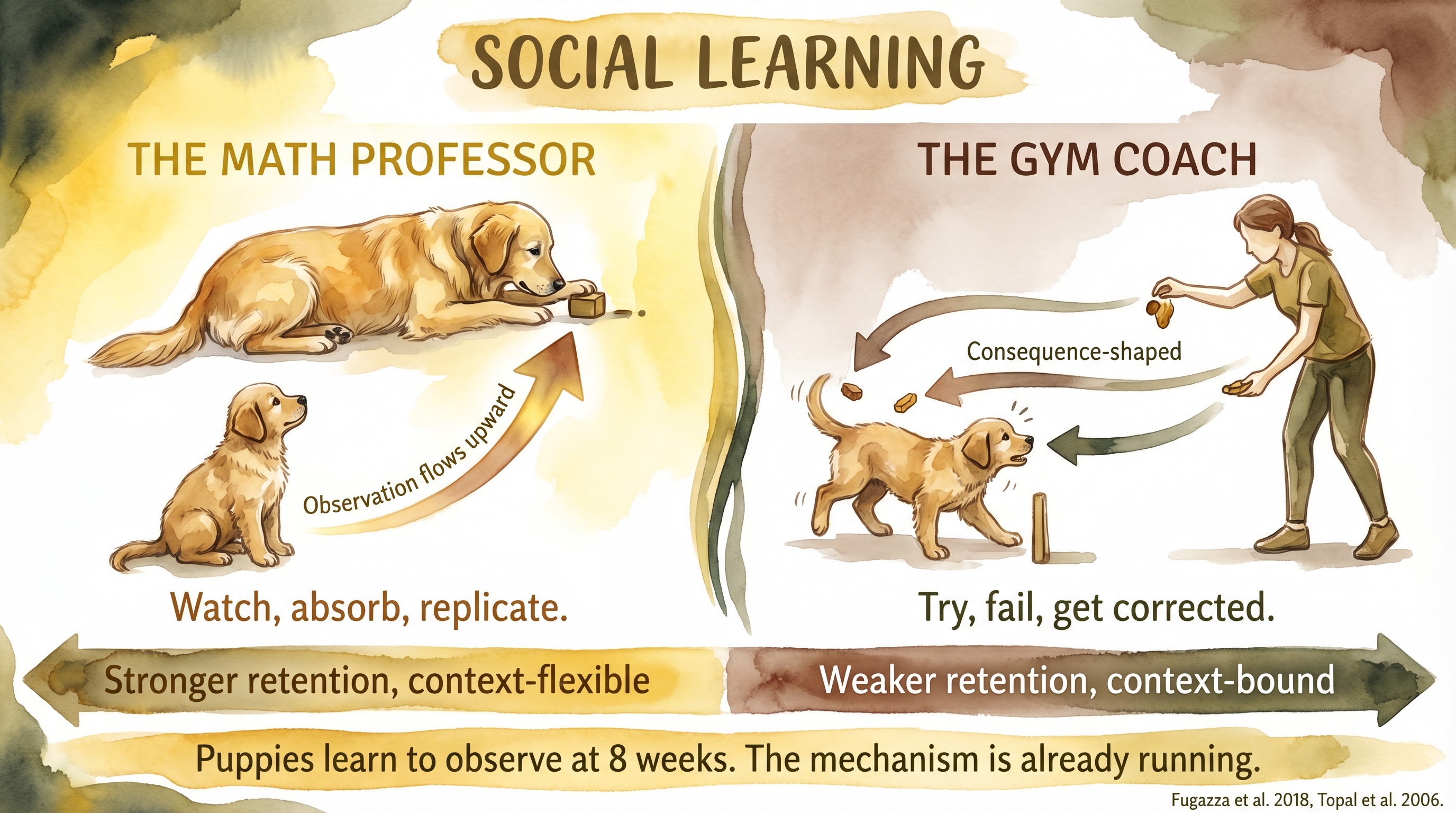
Puppies learn to observe at 8 weeks - socially learned behavior shows stronger retention than shaped behavior, and breed history shapes demonstrator preference.
Key Takeaways
- Puppies are documented social learners, which means observation is not a soft philosophy claim but a real biological pathway for behavior acquisition.
- The Do As I Do literature shows that dogs can copy demonstrated actions and, in some tasks, retain and generalize socially learned behavior better than shaped behavior.
- The adult dog and the human serve as different kinds of demonstrators inside the same learning system.
- When families rely less on constant instruction and more on living the pattern clearly, they make better use of the channel puppies are already built to use.
The Evidence
This entry uses observed claim-level tags beyond the dedicated EvidenceBlocks below. These tags mark JB program observation or practice-derived claims that need dedicated EvidenceBlock coverage in a later content pass.
- Fugazza, C. et al. (2018)domestic dogs
Demonstrated that puppies as young as eight weeks acquire novel behavior through social learning from both canine and human demonstrators. - Adler, L. L. & Adler, H. E. (1977)domestic dogs
Provided early developmental evidence that observational learning appears during puppyhood rather than only after maturity. - Slabbert, J. M. & Rasa, O. A. E. (1997)working-dog puppies
Showed that puppies can acquire maternal behavior patterns through observation, reinforcing the developmental importance of demonstrator effects.
- Fugazza, C. & Miklosi, A. (2015)domestic dogs
Found that dogs taught through the Do As I Do social-learning method showed strong acquisition and task transfer compared with shaping or clicker routes in the tested paradigms. - Huber, L. et al. (2018)domestic dogs
Documented overimitation in dogs, showing that dogs sometimes copy demonstrated actions even when simpler alternatives exist. - Topal, J. et al. (2006)domestic dogs
Established a strong early version of the Do As I Do framework by showing that dogs can reproduce demonstrated human actions and action sequences.
- Dobos, P. & Pongracz, P. (2023)domestic dogs
Showed that functional breed selection history shapes the strength of learning from human demonstrators. - Lugosi, C. A. et al. (2024)domestic dogs
Found that breeds selected for functional independence can outperform cooperative breeds when the demonstrator is a conspecific rather than a human.
No published study directly compares a JB-style mentorship environment against an operant-only or cue-heavy household while holding breeder quality, genetics, and family skill constant.
The literature documents that social learning is available very early, but it has not fully partitioned how much ordinary family-dog development depends on observation versus consequence-shaped trial and error in natural home settings.
SCR References
Sources
Adler, L. L., & Adler, H. E. (1977). Ontogeny of observational learning in the dog (Canis familiaris). Developmental Psychobiology, 10(3), 267-271.
Dobos, P., & Pongracz, P. (2023). Would you detour with me? Association between functional breed selection and social learning in dogs sheds light on elements of dog-human cooperation. Animals, 13(12), 2001.
Fugazza, C., & Miklosi, A. (2015). Social learning in dog training: The effectiveness of the Do As I Do method compared to shaping or clicker training. Applied Animal Behaviour Science, 171, 146-151.
Fugazza, C., Moesta, A., Pogany, A., & Miklosi, A. (2018). Social learning from conspecifics and humans in dog puppies. Scientific Reports, 8, 9257.
Huber, L., Popovova, N., Riener, S., Salobir, K., & Cimarelli, G. (2018). Would dogs copy irrelevant actions from their human caregiver? Learning & Behavior, 46(4), 387-397.
Lugosi, C. A., Udvarhelyi-Toth, K. M., Dobos, P., & Pongracz, P. (2024). Independent, but still observant: Dog breeds selected for functional independence learn better from a conspecific demonstrator than cooperative breeds in a detour task. BMC Biology, 22(1), 245.
Slabbert, J. M., & Rasa, O. A. E. (1997). Observational learning of an acquired maternal behaviour pattern by working dog pups. Applied Animal Behaviour Science, 53(4), 309-316.
Topal, J., Byrne, R. W., Miklosi, A., & Csanyi, V. (2006). Reproducing human actions and action sequences: Do as I Do in a dog. Animal Cognition, 9(4), 355-367.