Hebbian Learning and Prevention
Hebbian Learning and Prevention explains why the fourth pillar has such unusual scientific leverage. The core principle is simple: repeated co-activation strengthens neural pathways. Documented In practical terms, repetition makes behavior easier to repeat. JB then applies that principle to puppy raising: if an unwanted behavior never gets practiced, the pathway supporting it never receives the repetitions that would make it durable. That application is the interpretive step.
What It Means
Donald Hebb gave neuroscience one of its most enduring rules: neurons that fire together wire together. The phrasing is famous because it captures something foundational about how experience reshapes the brain. Activity is not neutral. Repeated activation changes the system that produced the activation. Mixed Evidence
That matters for behavior because a behavior is not just an outward act. Documented It is a pattern of neural activity expressed through the body. The first time a puppy jumps on a visitor, mouths a hand, screams in a crate, or explodes toward the door, the behavior may be weak, fragmented, and inconsistent. But if that same sequence gets repeated over and over, the underlying circuit becomes easier to run. The path gets worn in.
JB does not need to overclaim here. The scientific literature does not directly show a Golden Retriever puppy's mouthing circuit strengthening under a microscope after ten repetitions. What it does show is that Hebbian plasticity and long-term potentiation are foundational mammalian mechanisms. The behavioral application is therefore not fantasy. It is an inference from established neurobiology to real-life raising.
This is where Prevention becomes more than common sense. It becomes strategy.
If repeated behavior strengthens the circuit that supports that behavior, then every unwanted repetition is costly in a way families do not usually see. The cost is not just that the puppy "got away with it." The cost is that the behavior got one more rehearsal.
That is the asymmetry JB keeps pointing to:
- building is easy because repetition strengthens
- unbuilding is hard because extinction does not erase
- therefore the cheapest moment to intervene is before repetition accumulates
This is why the Prevention pillar is so tightly linked to the extinction literature. Hebbian learning tells us that practice strengthens the original pathway. Bouton's work tells us that later extinction does not remove that pathway. Documented Together they create the logic of Prevention: do not hand a bad behavior the repetitions that will later have to be managed forever.
JB often puts this in a memorable phrase: a behavior never initiated is a circuit never built. Observed-JB That line should be handled carefully. The underlying mechanisms are well grounded. The exact behavioral application in dogs is still a synthesis. But as a practical framework, it is exceptionally coherent.
Why It Matters for Your Dog
Families often think of unwanted behavior as a future problem. Observed-JB JB treats it as a present construction project.
If a puppy practices:
- jumping for greeting
- mouthing during play
- frantic barking for release
- pulling to reach exciting things
those actions do not stay isolated. They become increasingly available options because the puppy keeps rehearsing them.
Every repetition is teaching. Prevention matters because the nervous system does not care whether a behavior is cute now and unwanted later. It strengthens what gets used.
This is why JB puts so much emphasis on tiny early choices that look insignificant from the outside. Not wrestling with the puppy's mouth. Not rewarding frantic greetings with eye contact and laughter. Not rehearsing chaos for entertainment. Each of those choices is small in the moment. Over time they become developmental architecture.
The point is not perfection. No family prevents every unwanted behavior with absolute consistency. The point is direction. A prevention-based home dramatically reduces the number of repetitions an unwanted pathway receives, which changes the long-term burden on both dog and human.
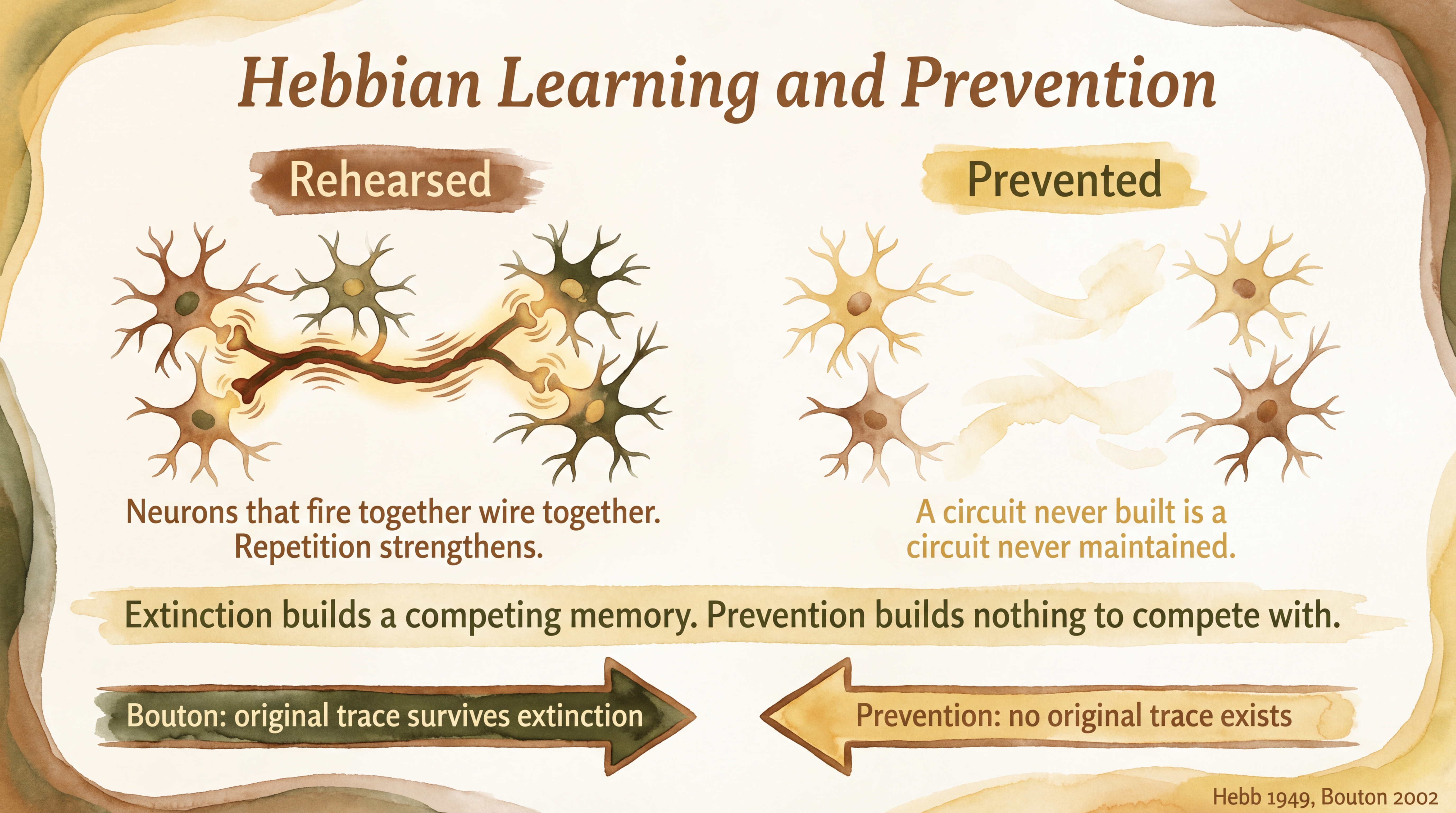
Neurons that fire together wire together - but a circuit never built is a circuit never maintained.
Key Takeaways
- Repeated behavior strengthens the neural circuits that support it, which means every practice session makes a behavior easier to repeat.
- Unwanted behaviors that never get practiced are circuits that never get built - preventing the early repetitions is cheaper than managing the behavior forever.
- Once a behavior gets rehearsed repeatedly, removing it through correction is much harder than preventing it from starting in the first place.
The Evidence
This entry uses observed claim-level tags beyond the dedicated EvidenceBlocks below. These tags mark JB program observation or practice-derived claims that need dedicated EvidenceBlock coverage in a later content pass.
This entry uses mixed-evidence claim-level tags beyond the dedicated EvidenceBlocks below. These tags mark claims that combine documented findings with observed practice, heuristic application, or unresolved gaps.
- Hebb, D. O. (1949)general mammalian neuroscience
Established the foundational principle that repeated co-activation strengthens connections between neurons, making experience structurally consequential. - Bliss, T. V. P., & Lomo, T. (1973)rabbit
Provided the first experimental demonstration of long-term potentiation, showing that repeated firing can produce lasting increases in synaptic efficiency. - Bi, G. Q., & Poo, M. M. (1998)rat
Clarified spike-timing dependent plasticity, helping explain how repeated and coordinated activation patterns strengthen circuits. - Bouton, M. E. (2002, 2004)rats and general learning models, with partial canine support
Showed that extinction does not erase original learning, which means strengthened pathways are not simply deleted later through correction or non-reinforcement.
The claim that repeated rehearsal of specific puppy behaviors directly strengthens the corresponding canine behavioral pathway is a practical application of conserved neurobiology, not a directly measured canine circuit-mapping finding.
JB's formulation that a behavior never initiated is a circuit never built is best presented as a biologically coherent synthesis rather than as a literal experimentally validated intervention law.
No published study directly tests the specific claims or protocols described in this entry within a controlled canine trial.
SCR References
Sources
- Hebb, D. O. (1949). The Organization of Behavior: A Neuropsychological Theory. Wiley. Supports the foundational neuroscience principle. Prevention-as-circuit application in dog raising remains [Heuristic] (anchor: SCR-167); not a tested prevention intervention in this literature.
- Bi, G. Q., and Poo, M. M. (1998). Synaptic modifications in cultured hippocampal neurons: Dependence on spike timing, synaptic strength, and postsynaptic cell type. Journal of Neuroscience, 18(24), 10464-10472. Supports the foundational neuroscience principle. Prevention-as-circuit application in dog raising remains [Heuristic] (anchor: SCR-167); not a tested prevention intervention in this literature.
- Bliss, T. V. P., and Lomo, T. (1973). Long-lasting potentiation of synaptic transmission in the dentate area of the anaesthetized rabbit following stimulation of the perforant path. Journal of Physiology, 232(2), 331-356. DOI: 10.1113/jphysiol.1973.sp010273. Supports the foundational neuroscience principle. Prevention-as-circuit application in dog raising remains [Heuristic] (anchor: SCR-167); not a tested prevention intervention in this literature.
- Bouton, M. E. (2002). Context, ambiguity, and unlearning: Sources of relapse after behavioral extinction. Biological Psychiatry, 52(10), 976-986.
- Bouton, M. E. (2004). Context and behavioral processes in extinction. Learning & Memory, 11(5), 485-494. Supports the foundational neuroscience principle. Prevention-as-circuit application in dog raising remains [Heuristic] (anchor: SCR-167); not a tested prevention intervention in this literature.