Learned Controllability
Compound evidence detail1 SCR / 3 parts
- Documentedthe Baumrind authoritative-parenting literature in human child development
- Documentedthe canine correlational evidence linking dog-directed caregiving styles to attachment, attention, sociability, and problem-solving outcomes (van Herwijnen 2018/2020, Brubaker and Udell 2023)
- Heuristicthe JB inference that one specific caregiving style experimentally produces the best long-term developmental outcomes in dogs
Learned controllability is one of the strongest scientific reasons JB cares so much about structure. A puppy does not become resilient because life is random. Mixed Evidence A puppy becomes more resilient when the world is predictable enough that actions, limits, and recovery begin to make sense.
What It Means
The older learned-helplessness story was often told as though helplessness itself had to be taught. Maier and Seligman's later revision sharpened the picture: passivity is the default under adversity, and controllability is what must be learned. Organisms become more resilient when they encounter environments that are legible enough for effort, prediction, and recovery to matter.
That matters enormously for puppies because much of what owners call stubbornness, defiance, or overreaction is actually noise generated by an incoherent environment. If rules change, emotional tone swings, boundaries arrive late, and the adult's behavior depends on mood, the puppy is living in a social world that is hard to read. Hard-to-read worlds produce more frantic testing and less settled confidence.
Structured Leadership solves that problem by reducing ambiguity. The puppy learns:
- what the rules are
- that the rules are stable
- that the adult is steady
- that return to baseline is normal
Those are controllability lessons, even when nobody uses that term.
This does not mean puppies need total control over the environment. Documented It means they need enough predictability to develop a working sense of order. The puppy does not choose whether the couch is allowed, but it should not have to guess differently every day. The puppy does not run the greeting routine, but it should not be met with calm one day and shrieking excitement the next. Structure lowers interpretive chaos.
JB therefore treats consistency as a developmental gift rather than a matter of obedience style. Heuristic The puppy who lives inside stable rhythms can allocate less energy to scanning for volatility and more energy to exploring, resting, and learning. That is the practical relevance of controllability science.
This principle also helps distinguish structure from coercion. Coercion creates compliance through pressure. Structure creates orientation through predictability. The difference is not cosmetic. Coercion can suppress behavior while making the world feel less safe. Documented Structure gives the dog a more dependable map of the world.
The original helplessness literature is also a useful warning. When the environment repeatedly teaches that effort does not matter, behavior degrades. The point for JB is not to replay those experiments in a home. The point is to recognize that confusion and inconsistency are smaller household versions of the same lesson. If the puppy can never tell what applies, then thoughtful response becomes harder to maintain.
That is also why JB prefers fewer clear standards over a hundred shifting micro-rules. Too many unstable expectations make the environment harder to parse. A small set of dependable boundaries often gives the puppy more real footing than an elaborate household philosophy nobody can enforce consistently.
The parenting connection follows naturally. Authoritative caregiving combines warmth with dependable limits. That combination gives the young organism both emotional safety and environmental legibility. In JB language, the adult is not trying to dominate uncertainty out of the puppy. The adult is trying to remove unnecessary uncertainty from the puppy's daily life.
Panksepp's caregiving framework matters here too. Mammalian development happens in relationship, not in abstraction. Documented Predictability is more powerful when it arrives through a caregiver who is calm, responsive, and stable. The rule is not just stable. The person holding it is stable.
This is why Learned Controllability belongs inside Structured Leadership rather than living as a separate neuroscience concept. It is the hidden reason JB cares about quiet routines, early boundaries, calm transitions, and adults who do not wobble socially. A stable leader teaches the puppy that the world can be read. Once the world can be read, the puppy can cope with it better.
Why It Matters for Your Dog
Families usually notice learned controllability in reverse. They see the problems created when it is missing: frantic boundary testing, poor recovery after excitement, exaggerated reactions to small changes, and a dog who seems constantly unsure about what applies when. Mixed Evidence
Predictability is not a small convenience. It is part of how the puppy learns that the world is manageable enough to stay thoughtful instead of reactive.
What teaches controllability in daily life:
- stable rules
- calm routines
- similar responses from all family members
- low-drama correction and quick return to baseline
- enough repetition that the puppy stops having to guess
What erodes controllability:
- changing the rule based on mood
- rewarding excitement on some days and punishing it on others
- overcomplicating household expectations
- asking the puppy to manage adult inconsistency
A few concrete examples:
- If rest always means rest, the puppy learns how the household downshifts.
- If doorways always slow the body down, the puppy stops treating thresholds as gambling opportunities.
- If the same calm interruption appears every time a boundary is crossed, the dog learns the boundary faster and with less drama.
These examples look simple because they are simple. That is part of the point. Controllability is usually built through ordinary repetition, not heroic moments. The puppy learns the world is readable because the adults keep making it readable.
The practical result of good structure is often a calmer dog, but the deeper result is a dog with better footing. The dog begins to act as if the world makes sense because, from the dog's perspective, it increasingly does.
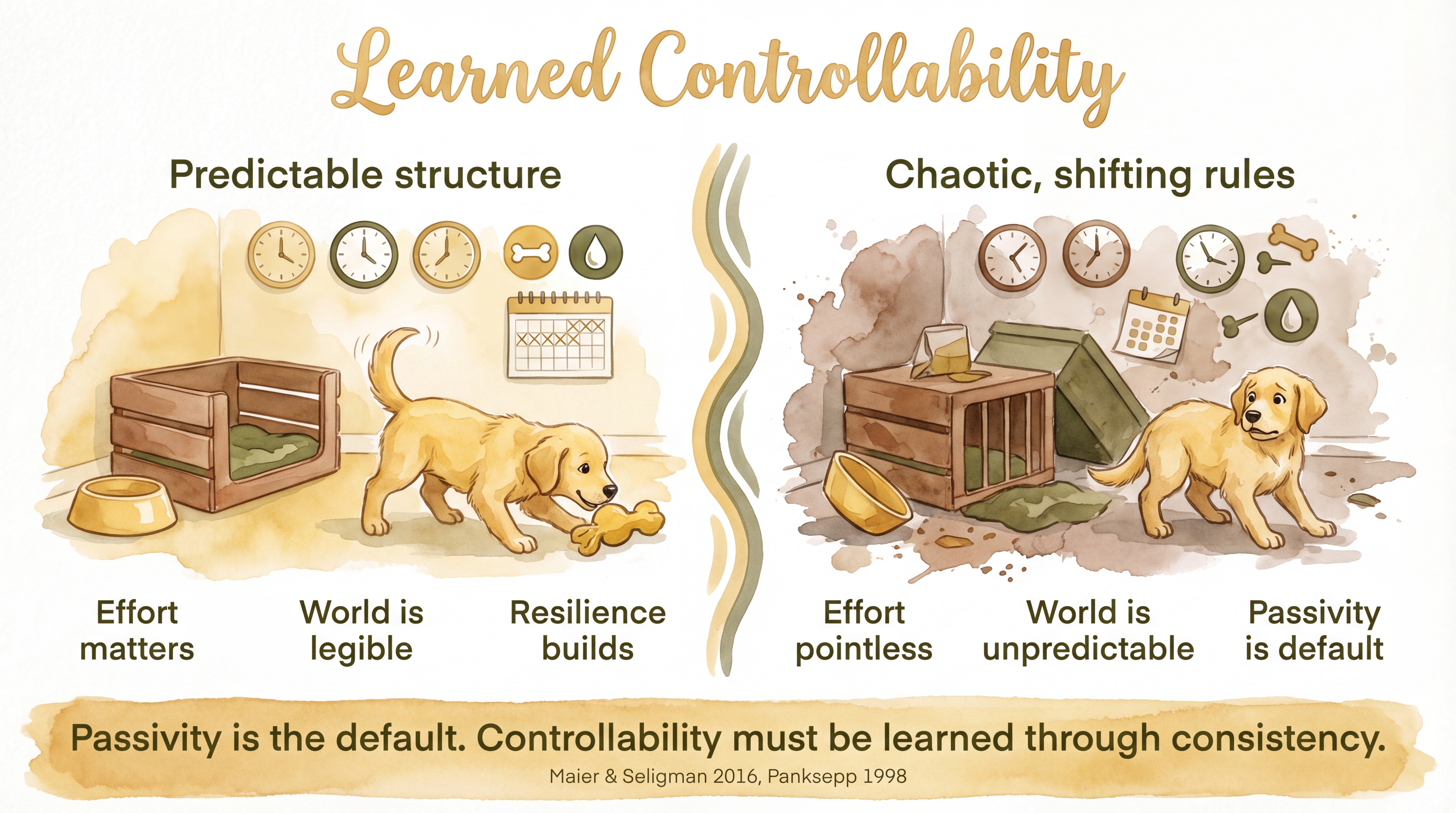
Passivity is the default under chaos - controllability must be learned through consistent, predictable structure.
Key Takeaways
- Predictability teaches your puppy that effort, boundaries, and recovery all make sense - that the world is readable and manageable.
- When rules change with your mood or mood, the puppy does not learn boundaries; the puppy learns to scan for volatility instead of settling.
- Consistency is not about control - it is about reducing interpretive chaos so your puppy can allocate energy to learning and exploring instead of guessing.
- A stable routine with a calm adult teaches the puppy they have some influence over their world, which builds resilience far better than random or confusing environments.
The Evidence
This entry uses mixed-evidence claim-level tags beyond the dedicated EvidenceBlocks below. These tags mark claims that combine documented findings with observed practice, heuristic application, or unresolved gaps.
- Seligman and Maier (1967)domestic dogs
The original helplessness work in dogs established how uncontrollable adversity alters later responding. - Maier and Seligman (2016)multiple mammals
Updated the framework by arguing that passivity is the default and controllability is what organisms learn through predictable environments and prefrontal regulation.
- Panksepp (1998)multiple mammals
Mammalian affective systems place caregiving and attachment at the center of developmental regulation.
- JB synthesisdomestic dogs
The claim that stable household structure builds better coping in puppies is a direct developmental interpretation of controllability science, not a dog-specific trial of the full JB protocol. - JB synthesisdomestic dogs and humans
The overlap with authoritative caregiving is conceptual: warmth plus dependable limits creates a more legible world for the young organism.
No published study directly tests the specific claims or protocols described in this entry within a controlled canine trial.
SCR References
Sources
- Maier, S. F., & Seligman, M. E. P. (2016). Learned helplessness at fifty: Insights from neuroscience. Psychological Review, 123(4), 349-367.
- Panksepp, J. (1998). Affective neuroscience: The foundations of human and animal emotions. Oxford University Press.
- S
- Maier, S. F., and Seligman, M. E. P. (2016). Learned helplessness at fifty: Insights from neuroscience. Psychological Review, 123(4), 349-367. DOI: 10.1037/rev0000033.
- Seligman, M. E. P., and Maier, S. F. (1967). Failure to escape traumatic shock. Journal of Experimental Psychology, 74(1), 1-9. DOI: 10.1037/h0024514.