Alone Time and Separation
Compound evidence detail5 SCRs / 11 parts
- Documentedthe cross-species behavioral principle that parasympathetic-dominant autonomic states support social engagement, with direct canine HRV evidence (Berg 2026, Wormald 2017, Koskela 2024)
- Ambiguousthe polyvagal-theory-specific neuroanatomical mechanism, with the Grossman 2026 critique and Porges 2026 rebuttal active in current literature
- Documentedthe human attachment evidence base together with the canine-direct secure-base findings (Topal 1998, Horn 2013) and Schoberl-documented physiological effects of secure caregiving in dogs
- Heuristicthe full attachment-theory apparatus transfer to canine relationships, including internal working models and attachment-classification systems
- Documentedthe Baumrind authoritative-parenting literature in human child development
- Documentedthe canine correlational evidence linking dog-directed caregiving styles to attachment, attention, sociability, and problem-solving outcomes (van Herwijnen 2018/2020, Brubaker and Udell 2023)
- Heuristicthe JB inference that one specific caregiving style experimentally produces the best long-term developmental outcomes in dogs
- Documenteddog attachment studies showing that classification systems can produce reliable groupings while still exposing distribution and method-design friction
- Heuristicclaims that canine attachment categories are a closed Ainsworth-equivalent taxonomy rather than an informative but still unsettled framework
- Documentedhuman attachment theory's internal-working-model construct
- Heuristicthe canine application that dog behavior reflects durable internal representations rather than only observable attachment outputs
In the JB methodology, alone time is not a gap in the family's care that must be managed. It is an architectural feature of the dog's day, built in advance through a graduated independence sequence so that the dog's internal regulatory capacity keeps pace with the duration of separation being asked of it. Heuristic The component findings (canine attachment bond existence, secure-base effect, documented longitudinal reduction of separation-related behaviors with pre-sixteen-week overnight enclosure, documented association between authoritative caregiving style and secure attachment, conserved cross-mammalian social-buffering architecture, parasympathetic HRV signature of genuine rest) are established in dogs or in well-conserved cross-mammalian literature. The convergent claim that building alone-time capacity through graduated developmental architecture prevents separation anxiety more reliably than managing separation anxiety after it develops is JB's synthesis, well-supported mechanistically rather than tested as a single controlled intervention.
For Families
Most dogs are not separation-distressed by nature. They are made anxious about being alone by patterns the household builds without realizing it. Constant proximity, emotional departures, excited returns, and the dog never being out of human sight teach the dog that being alone is the unusual state.
The Just Behaving approach builds quiet independence from the start. The puppy spends time alone in short, calm stretches, in the presence of the household but not always at the human's feet. Departures are unceremonial. Returns are calm. The dog learns that being alone is normal - the same baseline tone as being with the family - rather than something to wait through.
A dog raised in this pattern handles being left alone substantially better than a dog who has spent every waking moment in close proximity to someone. Separation tolerance is built early or repaired later, and building is much easier.
What It Means
The first distinction in this domain is definitional. Alone time, in the JB methodology, is not a deficiency in the family's presence. It is a deliberately constructed structural element of the dog's day, arrived at through a graduated developmental process. The difference between architecture and abandonment is not the duration of alone time. Dogs can tolerate significant periods of solitude when those periods are structurally anticipated and physiologically prepared for. The difference is in whether the alone time is part of the day's predictable shape, built through accumulated experience of brief, low-stress physical separations within the home, or whether it is imposed abruptly on a dog that has no developmental scaffolding for it.
The attachment-theory frame sets the paradox at the heart of this domain. Secure attachment, which is the condition that enables comfortable alone time, is produced not by maximizing proximity but by maximizing consistency. Bowlby (1969) and Ainsworth (1978) established in humans that the securely attached individual does not need the attachment figure to be constantly present. They need the attachment figure to be reliably available, predictably responsive, and consistently the same person across contexts. Topál et al. (1998) and Horn et al. (2013) extended the secure-base construct to dogs with direct experimental support (SCR-018). Documented Solomon et al. (2019, Attachment \u0026 Human Development) applied a canine-adapted Strange Situation procedure and classified approximately 61% of the study population as securely attached, a proportion consistent with the human infant baseline. The canine attachment classification field is documented as informative but not fully closed, and JB carries the SCR-477 ceiling on strict categorical mapping. Mixed Evidence What is directly documented is that dogs form functional attachment bonds and show secure-base effects. The internal working model construct, which is the theoretical mechanism for how the dog carries attachment history into ongoing expectations, remains at heuristic status for dogs (SCR-479). Heuristic The operational implication does not depend on the construct. It depends on the documented secure-base effect and on the directly measured finding that the quality of consistent caregiving, not the quantity of present time, is what produces secure attachment.
The direct longitudinal finding anchoring the methodology's prevention architecture for separation anxiety is Dale et al. (2024, Animal Welfare). In the same UK cohort of 145 puppies, 46.9% of puppies displayed separation-related behaviors at six months of age. Documented The prevalence is the baseline the methodology is trying to prevent rather than treat. Within the cohort, puppies who were crated or enclosed overnight and received nine or more hours of uninterrupted sleep before sixteen weeks of age showed significantly reduced separation-related behaviors at the six-month outcome measurement. The mechanism is prevention-architectural. The pre-sixteen-week puppy that has experienced overnight physical separation as an ordinary, predictable, low-stress feature of the household has built the circuit that registers alone time as ordinary. The pre-sixteen-week puppy that has never experienced that structural anticipation is, at the moment of first extended alone time, encountering a novel high-arousal context, and novelty in high-arousal contexts is exactly the developmental input that produces separation-related behavior.
The cross-mammalian social-buffering literature supplies the regulatory mechanism. Hennessy et al. (2009) and Hostinar, Sullivan, and Gunnar (2013) established that across mammals, the presence of a familiar responsive caregiver dampens offspring stress physiology through social buffering of the HPA axis, and that the effective buffer broadens across development from the mother to the broader social network and eventually to the organism's own internal regulatory capacity (SCR-492). The developmental program that allows an adult mammal to self-regulate in the absence of an external caregiver is built through graduated exposure during the juvenile period. A puppy that has been buffered continuously by constant human proximity through early development has not had the opportunity to develop its own regulatory capacity. The graduated separation sequence is not deprivation. It is the developmental program that builds the internal regulatory system the adult dog will depend on. The application of this multi-mammalian principle to exact canine developmental protocols carries a heuristic ceiling at SCR-492, but the underlying conserved mechanism is documented.
The caregiving-style association is documented in dogs at the associational level. Brubaker and Udell (2023), van Herwijnen et al. (2018, 2020), and Bouma et al. (2024) collectively establish that dog-directed caregiving styles are measurable and that authoritative-style caregiving (high warmth, high structure) is associated with more securely attached dogs (SCR-019). Documented The causal claim that authoritative caregiving experimentally produces the best long-term dog-raising outcomes remains heuristic, and JB carries that boundary explicitly. What the associational finding supports operationally is the structural point the methodology depends on. Authoritative-style owners do not maximize proximity. They are consistently warmly available when present and consistently calmly unavailable when engaged in their own activities, including activities that exclude the dog. The dog in such a household experiences its own version of graduated independence throughout every ordinary day. The family member moves to another room without the dog. The family member engages in work at a desk without attending to the dog. The family member is physically present but not interactionally available. These ordinary household experiences are the graduated independence curriculum in miniature. They teach the dog, accumulation by accumulation, that it can occupy itself while the family member is occupied. That capacity for self-occupation during the family's presence is the precise capacity the dog will draw on during actual alone time.
Why It Matters for Your Dog
The graduated independence sequence in the JB approach begins in the earliest weeks. Brief periods of physical separation within the home, the puppy in a contained space while the family member is elsewhere in the house, establish that physical separation is ordinary and temporary. These periods are not extended dramatically. They are simply interwoven into the normal texture of the household day. The puppy is in the crate while the family eats dinner. The puppy is behind a gate in the kitchen while the family watches television. These are not departures. They are simply moments in which the dog's physical space does not include direct contact with the family member. The deliberateness of this sequence serves Prevention directly: a dog that has never experienced brief non-stressful physical separations within the home has not built the circuit that registers alone time as ordinary. When that dog first faces actual alone time, the situation is novel, not familiar, and the physiological response to novelty in a high-arousal context is the response that precedes separation-related behavior.
The crate's function within the methodology is misunderstood in direct proportion to its association with confinement-as-punishment in the broader cultural conversation about dogs. The methodology's position is specific and structurally grounded. The crate is a safe haven, a place of structured rest, an architectural feature of the dog's day that provides physical containment as a precondition for the nervous system rest the dog requires. It is not punishment. It is not a solution to behavior problems. It is the spatial manifestation of the rest architecture the methodology treats as essential. The safe haven function is drawn directly from attachment theory. Ainsworth (1978) distinguished secure base behavior (using the attachment figure as a launch point for exploration) from safe haven behavior (returning to the attachment figure for comfort under stress or after exploration). In the crate architecture the methodology builds, the crate functions as a spatial safe haven: a predictable, comfortable, protected space to which the dog can retreat and in which the nervous system can fully disengage from environmental monitoring.
The disengagement is physiologically significant. Berg et al. (2026, Applied Animal Behaviour Science) documented via heart rate variability measurement that resting states in dogs correspond to profound parasympathetic activation, with the lowest heart rates and highest HRV values measured during those states (SCR-013). Documented Rest is not passive. It is an active physiological state that requires specific conditions: the absence of arousal demands, physical comfort, and predictable safety. A dog that cannot disengage from environmental monitoring, because its rest space is not architecturally distinct from the spaces in which it must attend to social and environmental stimuli, is a dog that accumulates arousal debt throughout the day, resting without recovering. A crate the dog has been introduced to as a consistently comfortable, consistently positive-association space can provide the disengagement conditions reliably. A crate that has been used as a time-out location or as an emergency containment tool for behavioral problems cannot. The crate's association is entirely determined by the history of what happens in and around it, and Prevention applies here with particular force. The crate should never be a correction tool. It is a rest architecture, and the architecture must be protected.
Separation anxiety is one of the cleanest domains in the methodology for Prevention logic to operate. The behaviors that characterize separation-related pathology, vocalization, destructive behavior, elimination, escape attempts, are not behaviors that are best addressed through remediation after the fact. They are behaviors whose underlying circuit can be prevented from being built in the first place through three converging architectural elements: the graduated independence sequence, the low-key departure-and-arrival protocol, and the crate or rest-space architecture that gives the dog a spatial safe haven used throughout the day for ordinary rest, not only in the context of the family's departure. Dale et al.'s (2024) finding of 46.9% separation-related behavior prevalence at six months is the problem. The methodology's prevention architecture is the response. Remediation of established separation anxiety is harder, slower, and less complete than prevention, and it is avoidable in the developmental window Prevention operates in.
The third component of the prevention architecture deserves specific elaboration because it is the component most commonly missed. A common pattern in households where separation anxiety develops is that the crate or enclosed rest space is used exclusively in the context of departure. The family puts the dog in the crate when they leave and releases it when they return. This pattern teaches the dog exactly what the dog will later perform anxiously: crate equals departure. The methodology's prevention requires that the rest space be used throughout the day, during family presence as well as absence, so that the rest space is associated with rest rather than with the family's departure. The dog that takes midday naps in its crate while the family is home does not experience the crate as a departure predictor. It experiences the crate as a rest location. When the family does leave, the dog is in a location that means rest, not abandonment. The governing operational rule for the domain is compact: alone time must be built before it is needed, and built gradually enough that the dog's internal regulatory capacity keeps pace with the duration of separation being asked.
The most common mistake in the alone-time domain is the hypervigilant owner response to early signs of distress during alone-time development. The puppy that vocalizes in the crate during the first nights is communicating. It is in a novel situation, its nervous system is activating, and it is broadcasting the activation. The methodology's recommended response is not immediate rescue, which teaches that vocalization produces human contact and reinforces distress as a communicative strategy. It is also not punitive suppression, which adds threat to an already anxious state. It is calm, non-reactive waiting, performed by a family member who trusts the architecture they have built, who knows the dog is physically safe, that the crate is comfortable, that this distress is the normal signal of a novel-but-safe experience. The family member's physiological state during this period matters. The anxious owner who monitors the crate camera every thirty seconds, who rushes in at every sound, who narrates their own distress in a tight voice, is transmitting that distress into the dog's space through the olfactory and autonomic coupling channels. The calm family member is practicing the regulatory function Feldman (2012, Monographs of the Society for Research in Child Development) described in the human caregiver literature: the caregiver as external regulatory organ for the developing organism. The application of that construct to dogs is a reasoned cross-species extension, consistent with the documented canine coupling literature, rather than a directly tested canine intervention.
The second common mistake is inconsistency in crate use. Using the crate as a correction tool for behavioral problems and then expecting the dog to enter it calmly as a rest space. The crate's association is what its history makes it. Mixed-use histories produce mixed associations, and mixed associations produce the pattern of the dog that resists crating, that experiences the crate as ambiguous, that cannot settle into it as a safe haven because it is not, in the dog's experience, consistently a safe haven. Prevention protects the crate's architecture by keeping the association history clean.
A note on the limit of the inference. The claim that graduated independence architecture prevents separation-related behavior is consistent with the Dale 2024 longitudinal overnight-crating finding, the documented canine secure-base effect, the documented dog-directed authoritative caregiving associations, the documented parasympathetic HRV rest signature, and the conserved cross-mammalian social-buffering literature. It is not the same as a single controlled trial in which families were randomly assigned to build alone-time capacity through graduated independence versus to minimize alone time versus to address separation anxiety after it developed. The household variables that shape alone-time development, owner state, crate-association history, schedule consistency, and household-member coordination, are themselves consequential predictors of canine behavioral outcomes (Smith et al., 2025; SCR-486). Mixed Evidence The convergent operational guidance is well-supported mechanistic synthesis, not singular proven intervention. The methodology carries the boundary visible.
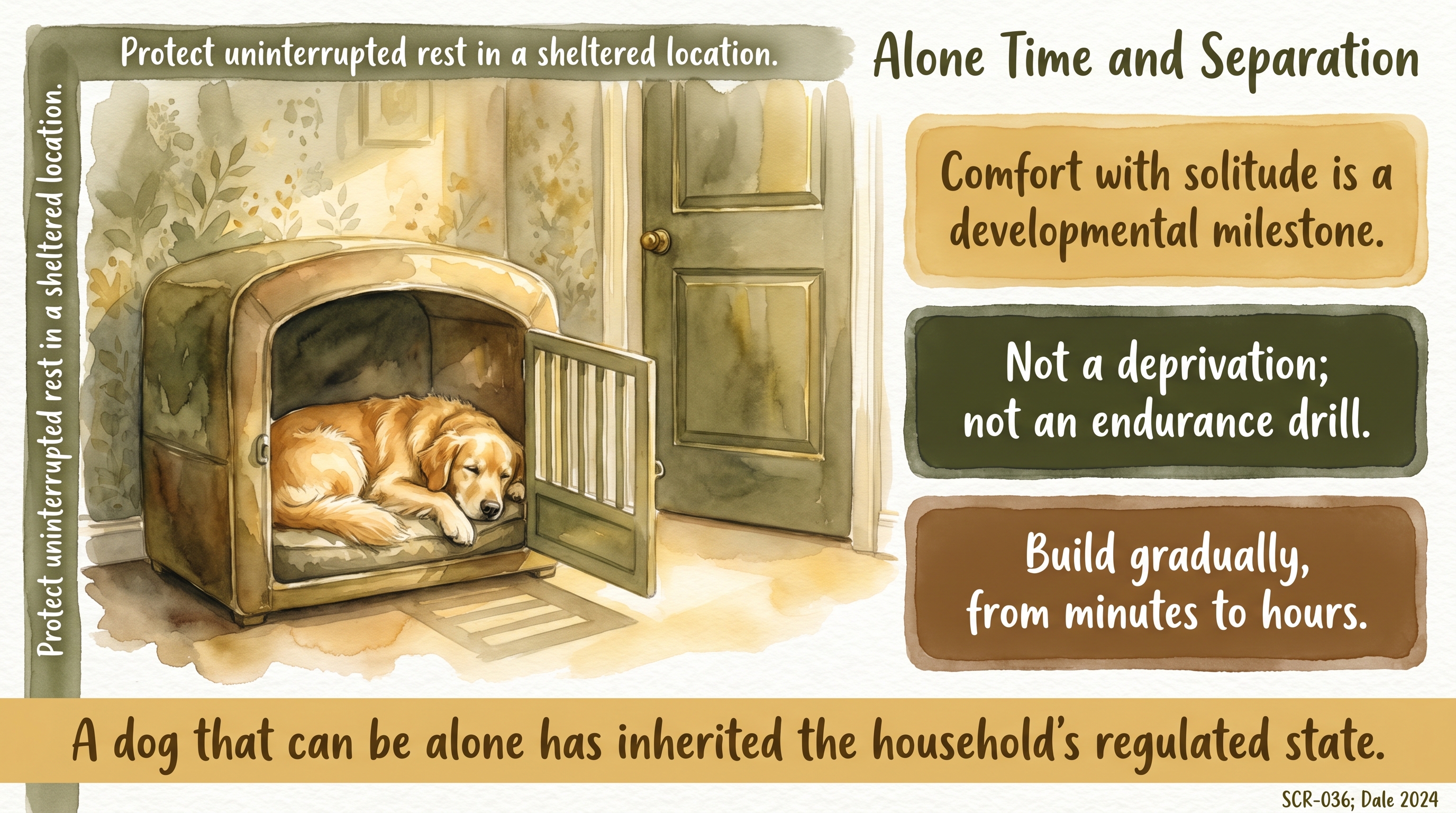
The dog that can be alone was never made to feel alone.
Key Takeaways
- Alone time is not a gap in care to be managed. It is an architectural feature of the dog's day, built in advance through graduated independence so that the dog's internal regulatory capacity keeps pace with the duration of separation being asked of it.
- The direct longitudinal finding: 46.9% of puppies in a UK cohort displayed separation-related behaviors at six months (Dale 2024). Puppies who were crated or enclosed overnight with nine-plus hours of sleep before sixteen weeks of age showed significantly reduced prevalence. The prevention mechanism is structural: pre-sixteen-week experience of overnight separation as ordinary builds the circuit; absence of that experience leaves the circuit to be built during high-arousal first exposure.
- The crate is a safe haven, not a punishment tool or an emergency containment device. Rest is a physiologically distinct state characterized by profound parasympathetic activation (Berg et al. 2026). The crate provides the conditions for that state when its association history is consistently positive and when it is used throughout the day for ordinary rest, not only at the moment of family departure.
- Operational rule: build alone time before it is needed. Use the rest space during presence as well as absence so that it is associated with rest, not with departure. Trust the architecture during early distress signals; the anxious rescuing owner is transmitting distress through coupled physiological channels and reinforcing vocalization as a communicative strategy.
The Evidence
- Dale, A. et al. (2024), Animal Welfaredomestic dogs (N=145 UK puppies, longitudinal acquisition through 6 months)
46.9% of puppies displayed separation-related behaviors at six months of age. Puppies who were crated or enclosed overnight with nine-plus hours of uninterrupted sleep before sixteen weeks of age showed significantly reduced prevalence of separation-related behaviors at the six-month outcome measurement. Direct longitudinal evidence for the structural anticipation mechanism.
- Topál, J. et al. (1998); Horn, L. et al. (2013)domestic dogs
Adapted Strange Situation procedures in dogs demonstrate the secure-base effect: dogs preferentially explore and perform in the presence of their attachment figure. Establishes canine attachment bonds as functionally analogous to infant-caregiver bonds (SCR-018 documented). - Solomon, J. et al. (2019), Attachment & Human Developmentdomestic dogs
Canine-adapted Strange Situation classified approximately 61% of study population as securely attached, a proportion consistent with the human infant baseline. The classification field is documented as informative; specific categorical mapping to human infant categories carries the SCR-477 ceiling. - Thielke, L. E. & Udell, M. A. R. (2019)domestic dogs (shelter and foster contexts)
Securely attached dogs in shelter and foster contexts showed lower neuroticism scores and improved performance on cognitive tasks. Supports the claim that secure attachment has measurable correlates beyond the Strange Situation behavioral markers.
- Brubaker, L. & Udell, M. A. R. (2023), Animal Cognitiondomestic dogs
Measurable dog-directed parenting style findings: authoritative-style (high warmth, high structure) owners were associated with more securely attached dogs and with better dog performance on social and problem-solving tasks. Associational evidence; causal interpretation carries SCR-019 heuristic ceiling. - van Herwijnen, I. R. et al. (2018, 2020)domestic dogs
Operationalization of dog-directed parenting styles (authoritative, authoritarian, permissive) with validated survey instruments and links to observable owner behaviors and dog attention. Foundational instrument work for the caregiving-style literature in dogs. - Bouma, E. M. C. et al. (2024), Animalsdomestic dogs
Extension of the caregiving-style findings to attachment, sociability, problem-solving, and intergenerational pattern associations. Strengthens the dog-direct evidence base; does not upgrade causal claims.
- Berg et al. (2026), Applied Animal Behaviour Science, 296, 106899domestic dogs
Heart rate variability measurement during short-term behavioral states in dogs. Resting states correspond to the lowest heart rates and highest HRV values, indicating profound parasympathetic activation. Rest is an active physiological state with distinct autonomic signature; the conditions for it (absence of arousal demands, physical comfort, predictable safety) are what the crate safe haven architecture is designed to supply. - Wormald et al. (2017), Physiology & Behaviordomestic dogs
Reduced HRV in dogs with anxiety-related behavior problems. Convergent evidence that chronic arousal elevation registers as depressed autonomic variability, providing a physiological anchor for the claim that inadequate rest architecture has accumulating costs.
- Sundman, A.-S. et al. (2019), Scientific Reportsdomestic dogs
Hair cortisol measurement across two seasonal sampling periods in Shetland Sheepdogs and Border Collies. Owner personality significantly predicted dog cortisol concentrations; dog personality did not significantly predict owner cortisol. Direction of long-term physiological coupling flows predominantly human-to-dog. Anchors the claim that the anxious owner monitoring early crate distress is transmitting state into the dog (SCR-105). - Wilson, C. et al. (2022), PLOS ONEdomestic dogs
Dogs trained on a discrimination task reliably distinguished breath and sweat samples from stressed versus non-stressed humans above chance. Olfactory detection of human stress is a documented sensory channel operating prior to behavioral interpretation (SCR-058). - Parr-Cortes, Z. et al. (2024), Scientific Reportsdomestic dogs
Exposure to odor samples from stressed (versus relaxed) unfamiliar humans measurably shifted dog performance on a cognitive bias task. Stressed-human odor has functional cognitive consequences (SCR-107). Lab conditions; chronic household magnitude is reasonable inference. - Koskela, A. et al. (2024)domestic dogs
Heart rate variability coupling between dog and owner is dyad-specific. HRV correlation is present with the attached owner and absent with random unfamiliar humans (SCR-106). The attachment relationship mediates the coupling rather than human proximity in general.
- Hennessy, M. B., Kaiser, S., & Sachser, N. (2009), Frontiers in Neuroendocrinologymultiple mammals
Cross-species review of social buffering: the presence of a familiar responsive caregiver dampens offspring stress physiology through HPA-axis buffering, and the identity of the effective buffer shifts across development from mother to broader social network as the organism develops its own regulatory capacity. Conserved mammalian developmental framework. - Hostinar, C. E., Sullivan, R. M., & Gunnar, M. R. (2013), Psychological Bulletinmultiple mammals, primarily rodent and primate
Social buffering as a conserved mammalian regulatory mechanism. The graduated independence sequence in JB is framed as the developmental expression of this mechanism for the canine case; the exact mapping to canine protocols carries the SCR-492 heuristic ceiling. - Feldman, R. (2012), Monographs of the Society for Research in Child Developmenthumans (primary)
The caregiver as an external regulatory organ for the developing organism. Application to the canine case via cross-species extension consistent with the documented canine coupling literature; not a directly tested canine intervention.
- Solomon et al. (2019); Fallani et al. (2006/2007); Mariti et al.; Palestrini et al.domestic dogs
Canine-adapted classification procedures can sort many dogs into secure and insecure patterns with substantial agreement, but consensus-discussion rates, unclassifiable cases, and order effects mean the canine classification field is informative rather than closed. JB cites attachment bond existence and secure-base effects at documented level; strict Ainsworth-style categorical mapping carries the SCR-477 ceiling.
- Bowlby tradition; Savalli & Mariti (2020); Solomon et al. (2018/2019); Schöberl et al. (2016, 2017); Asher et al. (2020)humans (primary); domestic dogs (behavioral extension)
Internal working models are documented in human attachment science. Canine IWMs are a coherent theoretical proposal consistent with canine behavioral evidence but have not been directly demonstrated through representational or expectation-violation testing. The alone-time guidance does not depend on the construct being literally true in dogs; it depends on the documented secure-base and caregiving-style findings. Boundary carried at SCR-479.
- JB Methodology synthesisfamily-raised Golden Retrievers
The convergent claim that building alone-time capacity through graduated developmental architecture prevents separation anxiety more reliably than managing separation anxiety after it develops is JB's synthesis of the Dale 2024 longitudinal overnight-crating finding, the Topál-Horn-Solomon canine secure-base evidence, the Brubaker-Udell authoritative caregiving associations, the Berg HRV rest signature, and the Hennessy-Hostinar conserved social-buffering framework. Each component is documented in dogs or in well-conserved cross-mammalian literature; the convergent operational architecture has not been directly tested as a single controlled intervention. The methodology presents the graduated independence architecture as well-supported mechanistic synthesis.
No controlled trial has compared a graduated independence architecture against a minimize-alone-time approach or a treat-after-it-develops approach on long-term canine separation-related behavior outcomes with random assignment.
The developmental timing of the graduated independence sequence (earliest effective onset, critical versus sensitive windows) has not been mapped directly beyond the Dale 2024 sixteen-week overnight-crating finding.
The crate association-history variable has not been formally studied: does the dog that first experiences the crate at three months in a positive-association protocol differ from the dog that first experiences it at eight weeks, or from the dog that experiences mixed-use crating?
The caregiving-style-to-secure-attachment causal direction remains inferred from associational findings; interventional studies modifying caregiving style and measuring downstream canine attachment outcomes have not been published.
SCR References
Sources
Ainsworth, M. D. S., Blehar, M. C., Waters, E., \u0026 Wall, S. (1978). Patterns of Attachment: A Psychological Study of the Strange Situation. Hillsdale, NJ: Erlbaum.
Berg, M., Thorsen, J., \u0026 Christensen, J. W. (2026). Behavior-related heart rate variability changes during short-term measurement in domestic dogs. Applied Animal Behaviour Science, 296, 106899.
Bouma, E. M. C., van der Borg, J. A. M., \u0026 Endenburg, N. (2024). Intergenerational transmission of dog-directed caregiving patterns. Animals, 14(6), 921.
Bowlby, J. (1969). Attachment and Loss, Vol. 1: Attachment. New York: Basic Books.
Brubaker, L., \u0026 Udell, M. A. R. (2023). Does pet parenting style predict the social and problem-solving behavior of pet dogs? Animal Cognition, 26(1), 345-356.
Dale, A., Kinnison, T., Patterson-Kane, E., \u0026 Grand, C. (2024). Owner-reported puppy experiences and separation-related behaviours at 6 months of age. Animal Welfare, 33, e12.
Feldman, R. (2012). Bio-behavioral synchrony: A model for integrating biological and microsocial behavioral processes in the study of parenting. Monographs of the Society for Research in Child Development, 77(2), 42-51.
Hennessy, M. B., Kaiser, S., \u0026 Sachser, N. (2009). Social buffering of the stress response: Diversity, mechanisms, and functions. Frontiers in Neuroendocrinology, 30(4), 470-482.
Horn, L., Huber, L., \u0026 Range, F. (2013). The importance of the secure base effect for domestic dogs - evidence from a manipulative problem-solving task. PLOS ONE, 8(5), e65296.
Hostinar, C. E., Sullivan, R. M., \u0026 Gunnar, M. R. (2013). Psychobiological mechanisms underlying the social buffering of the hypothalamic-pituitary-adrenocortical axis. Psychological Bulletin, 140(1), 256-282.
Koskela, A., Kareinen, I., Somppi, S., Törnqvist, H., Vainio, O., Kujala, M. V. (2024). Heart rate variability coupling in dog-human dyads. Scientific Reports, 14, 8213.
Parr-Cortes, Z., Rooney, N. J., \u0026 Mills, D. S. (2024). The odour of an unfamiliar stressed or relaxed person affects dogs' responses on a cognitive bias test. Scientific Reports, 14, 15843.
Schöberl, I., Wedl, M., Beetz, A., \u0026 Kotrschal, K. (2017). Psychobiological factors affecting cortisol variability in human-dog dyads. PLOS ONE, 12(2), e0170707.
Smith, B. P., Browne, M., Mack, J., Kontou, T. G., \u0026 Tomkins, L. M. (2025). Predictors of behavioral outcomes in 3,044 Golden Retrievers across the first three years of life. Preventive Veterinary Medicine, 234, 106101.
Solomon, J., Beetz, A., Schöberl, I., Gee, N., \u0026 Kotrschal, K. (2019). Attachment security in companion dogs: Adaptation of Ainsworth's strange situation and classification procedures to dogs and their human caregivers. Attachment \u0026 Human Development, 21(4), 389-417.
Sundman, A.-S., Van Poucke, E., Svensson Holm, A.-C., Faresjö, Å., Theodorsson, E., Jensen, P., \u0026 Roth, L. S. V. (2019). Long-term stress levels are synchronized in dogs and their owners. Scientific Reports, 9, 7391.
Thielke, L. E., \u0026 Udell, M. A. R. (2019). Characterizing human-dog attachment relationships in foster and shelter environments as a potential mechanism for achieving mutual wellbeing and success. Animals, 9(3), 67.
Topál, J., Miklósi, Á., Csányi, V., \u0026 Dóka, A. (1998). Attachment behavior in dogs (Canis familiaris): A new application of Ainsworth's (1969) strange situation test. Journal of Comparative Psychology, 112(3), 219-229.
van Herwijnen, I. R., van der Borg, J. A. M., Naguib, M., \u0026 Beerda, B. (2018). The existence of parenting styles in the owner-dog relationship. PLOS ONE, 13(2), e0193471.
Wilson, C., Campbell, K., Petzel, Z., \u0026 Reeve, C. (2022). Dogs can discriminate between human baseline and psychological stress condition odours. PLOS ONE, 17(9), e0274143.
Wormald, D., Lawrence, A. J., Carter, G., \u0026 Fisher, A. D. (2017). Reduced heart rate variability in pet dogs affected by anxiety-related behaviour problems. *Physiology \u0026 Behavio