Protect the Foundation When Layering
Compound evidence detail1 SCR / 2 parts
- Documentedethological evidence that dogs modulate corrective signals by intensity, duration, and immediate social context rather than treating correction as a prolonged generalized state
- Heuristicthe JB synthesis that this canine correction pattern reflects a broader social-mammal principle rather than only a species-specific observation
In JB, Protect the Foundation When Layering is the operating principle that evaluates add-on methods, task training, treat-based protocols, marker training, and other approaches, against a single criterion: does this approach strengthen or erode the foundational calm, relationship, and prevention architecture the JB methodology is built on? Heuristic The welfare evidence on aversive methods (Vieira de Castro 2020; Hiby 2004; review literature in preparation) is documented; the convergent operational claim that the JB household should use foundation-compatibility as its gate for all add-on methods is JB's synthesis of that evidence combined with the internal methodology architecture.
What It Means
The JB methodology is commonly mistaken for a prohibition on other training approaches. It is not. It is a foundation. The distinction matters because it changes how the family relates to the wider world of dog-training advice: the trainers they might hire, the methods recommended by well-meaning friends and neighbors, the protocols they encounter in articles and online resources, and the specialized skills a particular family might want their dog to acquire. The JB foundation is not in competition with most of those methods. It sits underneath them and determines how well they work.
The useful analogy is structural. A house built on solid ground can accept almost any addition. It can support a second floor, a deck, a finished basement, an addition on the back. What it cannot accept is an addition that undermines the foundation. An addition that introduces vibration, weight, or moisture in ways that compromise the structural integrity below is not an "enhancement" regardless of how useful the addition would have been on its own merits. The same logic applies to the JB foundation. A family that has established calm, structured companionship, prevention, and a parental relationship can layer almost anything on top of that foundation and find that it works better than it would have without the foundation underneath. Treat-based methods work better when the dog is not in a vending-machine relationship with food. Task training works better when the window of tolerance is wide and the relationship is secure. Marker training works better when signal economy is intact and the marker actually carries information. The foundation does not own those methods. It makes them cleaner.
The evaluation criteria for what conflicts with the foundation are specific, and each rests on documented canine evidence.
A method that increases ambient arousal in the household as its operational mode, that relies on exciting the dog to engage it or that uses high-intensity stimulation as a primary communication tool, conflicts with the Calmness pillar at the physiological level. The JB reasoning here is not preference. A household's baseline arousal state is its operating condition, and the Calm Floor Principle rests on the claim that parasympathetic tone must be built first and expanded from. Methods that treat chronic elevated arousal as a feature rather than a cost are operating in the opposite developmental direction.
A method that introduces aversive control beyond the indirect-correction spectrum conflicts with the welfare evidence and the Indirect Correction pillar. Vieira de Castro and colleagues (2020), in a study of 92 dogs across multiple training schools, found that dogs trained with aversive methods showed elevated salivary cortisol, more stress-related behaviors during training, and pessimistic cognitive bias in standardized spatial judgment tests. The effects persisted outside the training context, indicating welfare costs that were not confined to the formal sessions (SCR-026). Documented The study has methodological limitations worth naming: a single non-blinded coder, no baseline cortisol, no random assignment, a breed confound, and no control for relationship quality. The conclusion it supports is that aversive-trained dogs showed worse welfare markers on multiple measures in this sample, not that any specific aversive technique has been shown to cause a specific welfare outcome at a specific threshold. Hiby, Rooney, and Bradshaw (2004), surveying 364 dog owners, found that the number of behavior problems correlated significantly with punishment use (P < 0.001) (SCR-028). Documented The finding is correlational; it does not license dose-dependent language. The review literature on dog training methods (Ziv 2017 and related work) has further documented welfare concerns associated with aversive methods; pending primary-source verification, JB treats the broader review-literature claim at the secondary-synthesis level rather than citing specific prevalence numbers (SCR-027). Documented The direction of the welfare evidence is consistent across multiple methodologically imperfect studies and is not controversial among canine behavior-science specialists. What the evidence does not license is a claim that the JB alternative has been directly compared under controlled conditions. It has not.
A method that requires abandoning the prevention architecture, that asks the family to deliberately introduce behaviors they will later need to suppress, conflicts with the Prevention pillar at its most basic level. This includes any protocol whose active step is "let the behavior form and then train through it." The Bouton-Gazit extinction evidence makes that trade neurologically expensive; the JB methodology treats the prevention architecture as non-negotiable for that reason, which means protocols that require its abandonment are not compatible, regardless of their internal logic.
The positive half of the principle is what remains. Most add-on methods conflict with none of these criteria and are fully compatible with the JB foundation. Task training in calm sessions, with the relationship already established, extends the dog's repertoire of specific skills. Treat-based rewards, used as a communication tool rather than a relational substitute, carry information the dog can use. Clicker training, applied in contexts where signal economy is intact and the marker genuinely carries information, operates through documented learning mechanisms the JB methodology fully acknowledges. The JB methodology does not own every pathway to a well-mannered family companion. It provides the substrate on which many pathways function more reliably than they would have otherwise.
The final thread of this principle is what it implies about advice. Families who have absorbed the foundation read trainer recommendations, book chapters, and online protocols differently. They do not ask "does this method work?" They ask two more precise questions: does this method work with what we have built, and does it preserve what we have built? Those two questions handle almost every situation the family will encounter. The method that passes both is compatible. The method that fails either is not, regardless of its reputation or its apparent efficacy in other households.
Why It Matters for Your Dog
The practical effect of this principle is that the family is not forced to choose between "JB" and "every other method." The choice is a false one the principle is designed to dissolve. A family that has internalized the foundation can use positive-reinforcement task training for specialty skills, continue to shape conflict-prone contexts through prevention, layer in marker training for precise behaviors where a clear signal helps, and still be operating entirely within the JB methodology. The methodology is generous about the surface. It is strict about the substrate.
The principle also protects the family from a common failure mode: the drift toward aversive tools as behaviors become more difficult. Adolescent Goldens test boundaries. Adult dogs develop context-specific reactivity. Households under stress look for fast solutions. The temptation to reach for methods that promise quick suppression of unwanted behavior, shock collars marketed as training aids, prong collars presented as control tools, high-intensity correction sequences, is real and recurring. The foundation-protection criterion gives the family a principled place to stop. The welfare evidence does not support those tools. The JB Indirect Correction pillar explicitly excludes them. The family that holds the foundation line under pressure is a family that has prevented the category of problem those tools create in exchange for the category of problem they claim to solve.
The reverse drift is equally common and equally worth naming. Some families, having absorbed the JB philosophy, become anxious about using any form of structured training with their dog. They wonder whether a training class will compromise the foundation. They worry that using treats will corrupt the relationship. They hesitate to ask for specific behaviors because they do not want to move into a "commanding" mode. That anxiety, too, is a misreading of the principle. The foundation is robust. It accepts compatible additions. Structured training in a calm class, treats used communicatively, specific behaviors taught for clarity rather than control, all of those are within the foundation's tolerance. The principle is not minimalism. It is discrimination about what kind of addition the foundation can absorb.
Protect the Foundation When Layering is the operating-principle expression of the Indirect Correction pillar's categorical distinction between correction and punishment. The pillar draws the line. The principle tells the family how to apply it when external methods are being considered. A method that operates in the indirect-correction register, subtle, non-threatening, canine-legible, can be compatible with the JB foundation. A method that operates in the punishment register, fear-based, intensity-escalating, relationship-costing, cannot. The Indirect Correction pillar sets the boundary. The layering principle holds the boundary when the family is evaluating what to layer on top.
The principle also has a particular application to the Golden Retriever context. Goldens are responsive to almost any training method in the short term. The breed's cooperative disposition means that many methods that are welfare-costly for less-cooperative breeds will appear to work on a Golden because the dog will try to comply regardless of how the request is framed. That apparent cooperativeness can mask welfare cost. A Golden trained with harsh methods may produce the behavior the family asked for while paying measurable cortisol, cognitive-bias, and attachment costs in the background. The surface legibility of compliance is not a safety check on method choice. The foundation-protection criterion is the safety check. For a breed that will try to please, it is especially important that the family not interpret willingness-to-comply as evidence that the method is fine.
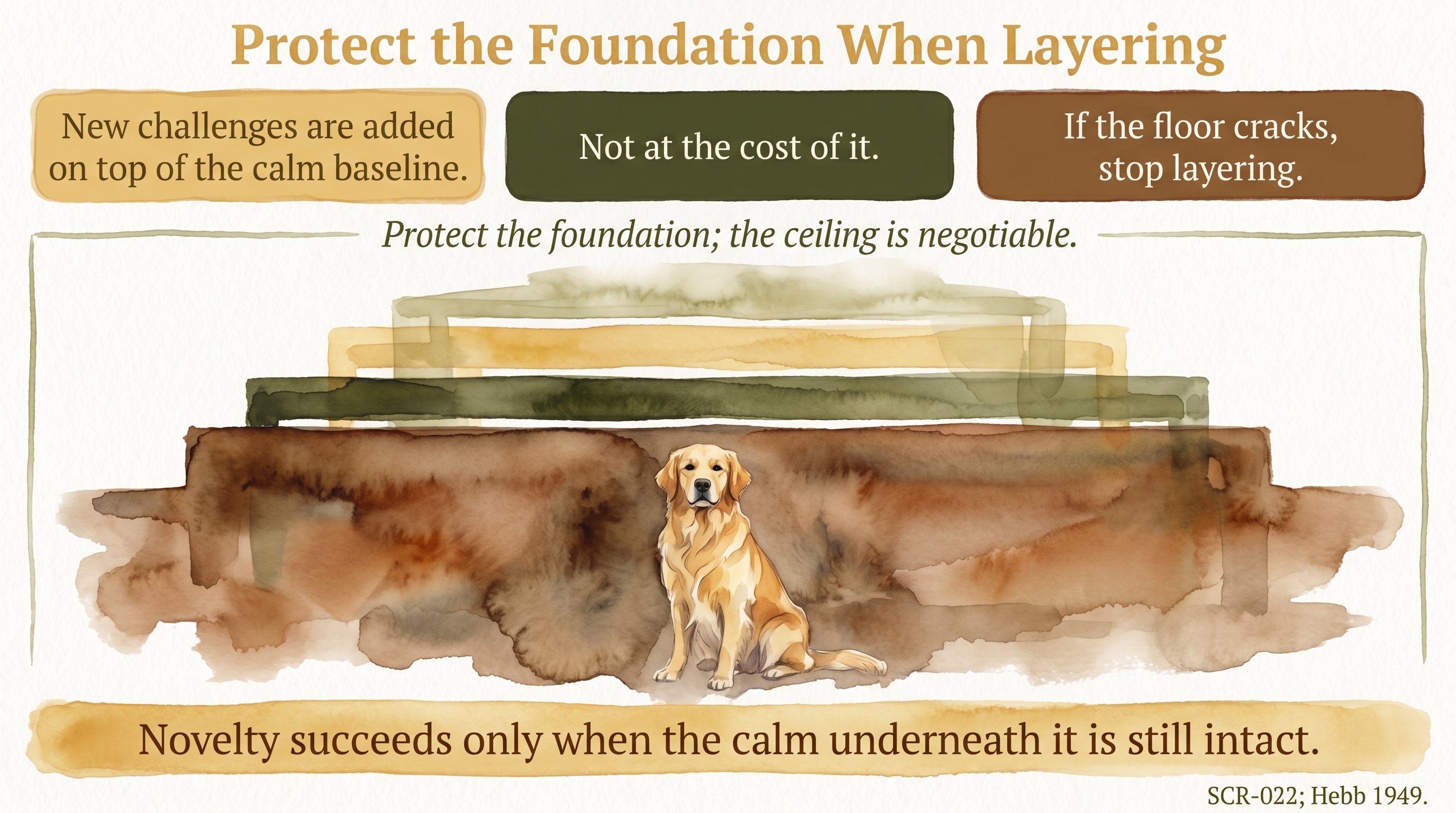
The foundation has to still be there when you stop looking at it.
Key Takeaways
- The JB methodology is not a prohibition on other training approaches. It is a foundation that other approaches can be layered onto. The family's evaluation question is not "does this method work?" but "does this method work with what we have built, and does it preserve what we have built?"
- Methods that increase ambient household arousal conflict with the Calmness pillar. Methods that operate beyond the indirect-correction spectrum conflict with the documented welfare evidence on aversive methods (Vieira de Castro 2020; Hiby 2004) and with the Indirect Correction pillar. Methods that require abandoning the prevention architecture conflict with the Prevention pillar.
- Most add-on methods conflict with none of these criteria. Task training in calm sessions, communicative treat use, marker training inside an intact signal economy, and structured skill-building are all compatible with the JB foundation and often function more reliably because the foundation is under them.
- The Golden Retriever's cooperative disposition can mask the welfare cost of incompatible methods. Willingness to comply is not a safety check on method choice. The foundation-protection criterion is the safety check for a breed that will try to please.
The Evidence
- Vieira de Castro, A. C. et al. (2020)domestic dogs (N=92, multiple training schools)
Cross-sectional study comparing dogs trained at schools using aversive methods against dogs trained at schools using reward-based methods. Aversive-trained dogs showed elevated salivary cortisol, more stress-related behaviors during training, and pessimistic cognitive bias in standardized spatial judgment tests. Effects persisted outside the training context. Methodological limitations: single non-blinded coder, no baseline cortisol, no random assignment, breed confound, no control for pre-existing relationship quality. The study supports the direction of the welfare evidence; it does not license dose-dependent or threshold claims.
- Hiby, E. F., Rooney, N. J., & Bradshaw, J. W. S. (2004)domestic dogs (N=364 dog owners surveyed)
Owner-survey study found that the number of behavior problems correlated significantly with punishment use (P < 0.001). The finding is correlational; it does not establish direction of causality (punishment-use producing problems vs. behavior-problems prompting punishment-use) and does not support dose-dependent language. What the finding contributes to the foundation-protection criterion is a documented statistical association between punishment-based methods and household behavioral outcomes in a community sample.
- Ziv, G. (2017) and related review literaturedomestic dogs (synthesis across multiple primary studies)
Review of training method literature documents welfare concerns associated with aversive methods across multiple primary studies. JB treats the broader review-literature claim at the secondary-synthesis level pending primary-source verification of specific prevalence claims. The direction of the evidence is consistent across studies; JB cites the review at the level the review actually supports rather than at specific numeric thresholds that may be citation-folklore rather than primary findings.
- Ethological synthesis: Abrantes; Bekoff; Mechdomestic dogs and wolves
Descriptive ethological work establishes that intra-canine correction is typically low-intensity, brief, and precisely timed to the behavior in question, with the signaling animal returning to neutral once the de-escalation signal is received. The JB Indirect Correction spectrum is engineered to match those properties; methods operating outside that spectrum (sustained high-intensity aversive stimulation, fear-based control tools) are not extensions of natural canine communication. They are categorically different interventions whose welfare profile is the subject of the documented aversive-methods literature above.
- JB Methodology synthesisfamily-raised Golden Retrievers
The operational claim that the JB household should evaluate all add-on training methods against foundation compatibility (Calmness, Indirect Correction, Prevention) is JB's synthesis of the documented aversive-methods welfare evidence combined with the internal methodology architecture. The component welfare findings are documented in their source studies. The convergent operational gate, as a household-wide default posture, has not been tested as a direct intervention in a controlled canine trial. JB presents the principle as mechanistically coherent operating guidance rather than as a directly demonstrated household-intervention finding.
No controlled canine trial has compared JB-foundation households layering only compatible methods against households using methods that conflict with foundation criteria on long-term behavioral, welfare, or relational outcomes.
Vieira de Castro et al. (2020) has the methodological limitations named above; a replication with blinded coding, random assignment, and breed control would strengthen the finding considerably.
The Hiby et al. (2004) correlational finding is in a community survey sample; the direction of causality (punishment producing problems vs. problems prompting punishment) is not established and would require longitudinal or experimental design to resolve.
Ziv 2017 general welfare-risk-without-superior-efficacy conclusion is supported by direct review of the published source; specific numerical claims (sample sizes within reviewed studies, date ranges, effect sizes) remain absent unless directly confirmed. JB treats the broader claim at secondary-synthesis level until related syntheses are verified.
The welfare cost specific to apparently-cooperative breeds (e.g., Golden Retrievers) trained with aversive methods that produce compliance without overt resistance has not been directly characterized; the concern is extrapolation from the general canine welfare literature.
SCR References
Sources
Hiby, E. F., Rooney, N. J., \u0026 Bradshaw, J. W. S. (2004). Dog training methods: Their use, effectiveness and interaction with behaviour and welfare. Animal Welfare, 13(1), 63-69.
Vieira de Castro, A. C., Fuchs, D., Morello, G. M., Pastur, S., de Sousa, L., \u0026 Olsson, I. A. S. (2020). Does training method matter? Evidence for the negative impact of aversive-based methods on companion dog welfare. PLOS ONE, 15(12), e0225023.
Ziv, G. (2017). The effects of using aversive training methods in dogs: A review. Journal of Veterinary Behavior, 19, 50-60.
Mech, L. D. (1999). Alpha status, dominance, and division of labor in wolf packs. Canadian Journal of Zoology, 77(8), 1196-1203.
Abrantes, R. (1997). Dog Language: An Encyclopedia of Canine Behavior. Naperville, IL: Wakan Tanka Publishers.
Bekoff, M. (2001). Social play behaviour: Cooperation, fairness