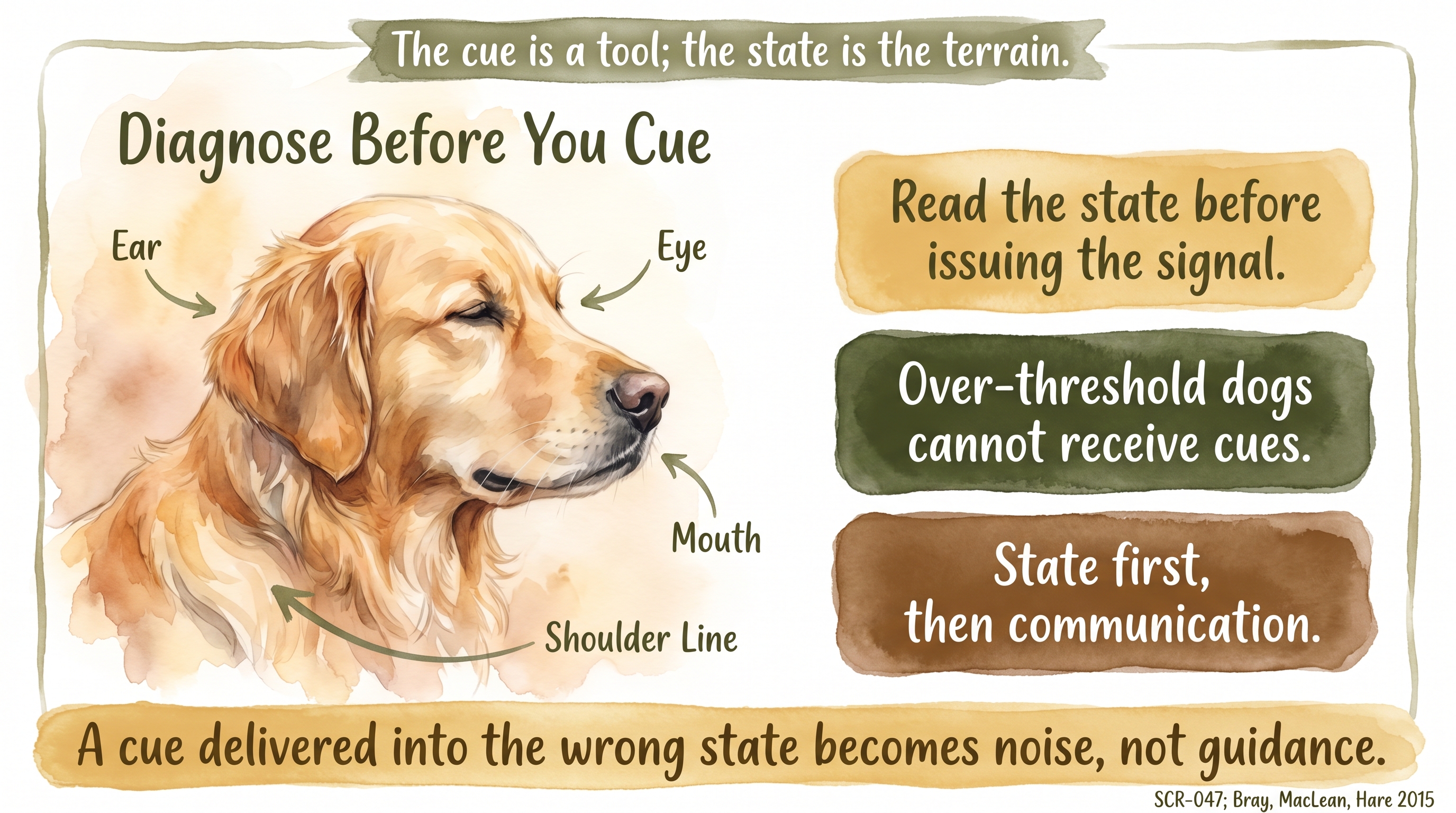
Diagnose Before You Cue
Compound evidence detail1 SCR / 2 parts
- Documentedethological evidence that dogs modulate corrective signals by intensity, duration, and immediate social context rather than treating correction as a prolonged generalized state
- Heuristicthe JB synthesis that this canine correction pattern reflects a broader social-mammal principle rather than only a species-specific observation
In JB, Diagnose Before You Cue is the operating principle that places a diagnostic question, what is actually happening in this dog and in this relationship right now, ahead of the cueing question, what command should I give. Heuristic The component findings anchoring the principle are documented: excessive verbalization slows canine processing; anxious dogs show measurably compromised learnability; verbal praise loses reinforcer value when flooded; natural canine correction is deployed only after the signaling dog has read the state of the receiver. The convergent claim that the JB household should adopt a diagnostic-before-prescriptive posture as its default mentorship mode is JB's operational synthesis.
What It Means
Most behavioral moments in a household end with a command. The dog is jumping, the family says "off." The dog is pulling, the family says "heel." The dog is barking at the threshold, the family says "stay." Commands feel like action. They are concrete, they engage the human's sense of control, and they seem to aim directly at the behavior. The JB methodology asks the family, before reaching for the command, to ask what the command is actually being asked to do. In most cases the answer is revealing. The command is being asked to compensate for an arousal state, a relational condition, or an environmental setup that the household has not addressed and the command cannot repair.
The first thread of evidence is about what extra verbal load actually does to canine cognition. D'Aniello, Scandurra, Alterisio, Valsecchi, and Prato-Previde (2016) documented that excessive owner verbalization increased dogs' processing time and response latency. Documented A command delivered into a context already saturated with verbal input is a low-information signal landing in a channel that has been desensitized to input. Feuerbacher and Wynne (2015) documented that verbal praise loses effectiveness rapidly as a reinforcer when delivered continuously, with dogs clearly preferring physical contact; the long-term household praise-flooding case remains extrapolation from the laboratory finding (SCR-052). Documented The implication for cueing is that the family who reaches for a command reflexively is operating inside the same signal-flooding dynamic. The cue competes with the ambient verbal stream rather than cutting through it.
The second thread is about the neurological state of the dog the command is being issued to. Xu and colleagues (2023) found, using resting-state functional MRI, that anxious dogs displayed measurably abnormal amygdala-salience network functional connectivity, with abnormally high amygdala global efficiency correlating with stranger-directed fear, general excitability, and impaired learnability (SCR-049). Documented The finding is in clinically anxious dogs, so generalization to normal pet populations requires qualification. But the direction of the relationship clarifies the structural problem with reflexive cueing: commands operate in the same neurological environment that is degraded when the threat-detection system is running hot. Cueing a dog over threshold is not merely less effective than cueing a regulated one. It is asking the prefrontal system to process a command while the amygdala is pulling resources away from exactly the circuits the command would engage. The command does not fail because the dog is being willful. The command fails because it is being delivered into a state that is not available to receive it.
The third thread looks at what well-functioning canine social signaling actually looks like, and it inverts the cueing-first habit. Natural canine correction in stable social groups is not prescriptive. It is contextual. The signaling dog reads the receiving dog's state and responds with a signal calibrated to what the receiver can absorb, returning to neutral once the signal has landed (SCR-029). Documented Mariti and colleagues (2017), in a pilot study of 96 off-leash canine encounters, catalogued 2,130 distinct calming-signal instances; zero aggression episodes were preceded by a calming signal from the target dog, suggesting that the signals function as diagnostic responses to the reader's social situation rather than as context-independent commands issued by the signaler. Documented The finding comes from a pilot and requires replication, but the pattern it describes is consistent with the ethological literature on canine social communication: dogs deploy their signals surgically, in response to a reading of state. The methodology's request that the family do the same, reading before commanding, aligns the family's communication with the channel the dog's nervous system is documented to use.
The fourth thread is what happens when the diagnostic posture is in place. Deldalle and Gaunet (2014) compared dogs trained with positive-reinforcement methods against dogs trained with aversive methods and found that positive-reinforcement dogs showed increased visual engagement with their handlers, which is the behavioral signature of a dog attending to its primary social reference rather than avoiding it. Documented Visual engagement of that kind is a resource the family can only tap when the relationship supports it. When the relationship supports it, a quiet cue lands in a system that is oriented toward the handler and ready to receive. When the relationship does not support it, volume and repetition will not substitute. The diagnostic principle is not a prohibition on commands. It is a recognition that cues are most effective in the same conditions under which they are also least necessary.
The diagnostic question the JB household asks before cueing has four parts in practice. Where is this dog on the arousal curve, and is it within the window of tolerance? What has this context historically produced, and what circuit is already active here? What is the human's current physiological state, and what is that state communicating before any command is issued? Is this a relationship question masquerading as a compliance question? Those four questions are short. A household that has learned to run them in a second or two runs them automatically and commands rarely. A household that has never learned to run them lives in the cueing reflex.
Why It Matters for Your Dog
The practical consequence is that the family stops treating commands as first-line tools. Commands become situational resources available to a relationship that has already been built, not a replacement for building it. The most common failure mode of family dog-raising is not that the family does not know the right commands. It is that the family has built the relationship around the commands rather than the commands around the relationship. A dog that will sit when asked in a quiet living room and cannot sit when asked at the front door is not a dog who has forgotten the command. It is a dog whose system is operating in a state where the command's pathway is not open. The diagnostic posture reads that state and responds to it rather than escalating into repetition.
The principle also has a protective effect on the family. Households that live in the cueing reflex tend to generate their own frustration, because the feedback loop runs: the behavior happens, the family commands, the command does not produce the outcome, the family commands again louder, the outcome still does not arrive, the family feels unheard by their own dog. That loop is physiologically taxing for both sides. The diagnostic posture breaks the loop upstream. It asks the family to notice, before the first command is issued, whether the moment calls for a command at all. In most moments, the answer is no. The environment can be adjusted. The arousal can be allowed to settle. The model can be offered instead of the instruction. The cue can be held in reserve for the situations where it genuinely adds information.
Diagnose Before You Cue is the operating-principle expression of Mentorship in its most immediate form: the willingness to read before acting. A mentor does not command at a student who is not yet in a state to absorb the instruction. The mentor waits for the state to be available, or arranges the conditions under which it will become available, or models rather than instructs when the instruction cannot land. The JB household's cueing discipline is the same posture translated into dog-raising. The cue matters, but the reading is what makes the cue effective when it is used.
There is a particular application to Golden Retrievers that is worth naming. The breed's social intelligence and visual engagement are both well-documented dispositions. A Golden whose family has not developed the diagnostic habit is a Golden whose attentiveness is being used against itself: the dog is reading the family's state continuously, including the state in which the family issues commands without having first read the dog. What the dog reads, across thousands of such moments, is a relationship in which the human does not appear to notice what the dog is experiencing. The slow erosion of visual engagement in that household is not a training problem. It is the dog's accurate reading of a relationship that stopped reading back. The diagnostic principle protects the reciprocity that the breed's social intelligence makes available.
There is also a version of this principle that is purely medical in its analogy, and the analogy is instructive because families feel it. A physician who prescribes before examining is not practicing good medicine, regardless of how well the prescription has worked for other patients. Symptom-matching produces mismatches, and mismatches produce worse outcomes than no intervention would have produced. The JB cueing discipline is the same stance translated into dog-raising. Diagnose first. Prescribe, when prescription is actually indicated. Recognize that in many moments, what the situation calls for is not a command at all.
Read the weather before you plan the walk.
Key Takeaways
- Commands come last, not first. Before asking the dog to do something, the JB household reads the dog's state, the relationship's state, and the environment's setup. If the relationship is functioning, most commands are unnecessary. If it is not, no command will repair it.
- Excessive verbalization slows canine processing (D'Aniello 2016), verbal praise loses reinforcer value when flooded (Feuerbacher & Wynne 2015), and anxious dogs show measurably compromised learnability under amygdala hyperconnectivity (Xu 2023). Reflexive cueing operates inside all three failure modes simultaneously.
- Natural canine social signaling is diagnostic before it is prescriptive. Dogs read before they signal. The JB cueing discipline aligns the family's communication with the channel the dog's nervous system is documented to use.
- Cues are most effective in the same conditions under which they are also least necessary. A household with a strong diagnostic posture commands rarely and finds the commands it uses land cleanly when it does.
The Evidence
- D'Aniello, B., Scandurra, A., Alterisio, A., Valsecchi, P., & Prato-Previde, E. (2016)domestic dogs
Experimental evidence that excessive owner verbalization increased dogs' processing time and response latency. Commands delivered into a context already saturated with verbal input are low-information signals landing in a channel that has been desensitized to input. - Feuerbacher, E. N. & Wynne, C. D. L. (2015)domestic dogs
Experimental evidence that verbal praise loses effectiveness rapidly as a reinforcer when delivered continuously; dogs clearly preferred physical contact over continuous verbal praise. The laboratory finding is documented. The long-term household case, in which years of praise-flooding might further degrade verbal signal value, remains extrapolation.
- Xu, Y. et al. (2023)domestic dogs (resting-state functional MRI in anxious vs. non-anxious dogs)
Direct canine neuroimaging evidence that anxious dogs display measurably abnormal amygdala-salience network functional connectivity, with the amygdala showing abnormally high global efficiency. The hyperconnectivity correlated behaviorally with stranger-directed fear, general excitability, and impaired learnability. The finding is in clinically anxious dogs and should not be generalized to normal pet populations without qualification. What it clarifies for the cueing principle is that commands delivered to a dysregulated nervous system operate in a neurological environment in which the prefrontal systems governing voluntary compliance are compromised by the same state that produced the behavior.
- Ethological synthesis: Abrantes; Bekoff; Mech; Mariti et al. (2017)domestic dogs (Mariti pilot, N=96 encounters, 24 dogs, 2,130 calming-signal instances)
The ethological literature establishes that intra-canine correction is typically low-intensity, brief, and precisely timed to the behavior in question, with the signaling animal returning to neutral once the de-escalation signal is received. Mariti and colleagues' pilot documented 2,130 distinct calming-signal instances across 96 off-leash encounters; zero aggression episodes were preceded by a calming signal from the target dog, and 79.4% of post-aggression calming signals de-escalated conflict. The pattern is consistent with signals functioning as diagnostic responses to the reader's social situation rather than as context-independent commands. Pilot-study qualifier applies; replication required.
- Deldalle, S. & Gaunet, F. (2014)domestic dogs
Comparative study of dogs trained with positive-reinforcement methods versus aversive methods documenting increased handler-directed visual engagement in the positive-reinforcement group. Visual engagement is the behavioral signature of a dog attending to its primary social reference rather than avoiding it. The engagement is available precisely when the relationship supports it; under those conditions, a quiet cue lands in a receptive system. When the relationship does not support it, volume and repetition will not substitute.
- JB Methodology synthesisfamily-raised Golden Retrievers
The claim that a JB household should adopt a diagnostic-before-prescriptive posture as its default mode is JB's operational synthesis of the documented findings on verbalization, reinforcer flooding, anxious-dog learnability, natural canine signaling, and handler visual engagement. The component findings are independently documented. The convergent claim that a household-wide diagnostic posture produces better behavioral and relational outcomes than a cueing-first posture has not been tested as a direct intervention in a controlled canine trial. JB presents the principle as mechanistically coherent operating guidance rather than as a directly demonstrated household-intervention finding.
No controlled canine trial has compared cueing-first households against diagnostic-first households on long-term handler engagement, behavioral compliance outside of formal training, or cortisol profile.
Mariti et al. (2017) is a pilot study and requires replication before its pattern of calming-signal deployment as diagnostic response can be treated as fully established rather than suggestive.
Xu et al. (2023) is cross-sectional in clinically anxious dogs. Whether comparable amygdala-salience patterns emerge in non-clinical but chronically unpredictable household environments has not been examined.
The long-term household praise-flooding case, in which verbal signal value degrades across years of continuous low-information verbal input, remains an extrapolation from laboratory habituation findings rather than a directly tested household effect.
SCR References
Sources
D'Aniello, B., Scandurra, A., Alterisio, A., Valsecchi, P., \u0026 Prato-Previde, E. (2016). The importance of gestural communication: A study of human-dog communication using incongruent information. Animal Cognition, 19(6), 1231-1235.
Deldalle, S., \u0026 Gaunet, F. (2014). Effects of two training methods on stress-related behaviors of the dog (Canis familiaris) and on the dog-owner relationship. Journal of Veterinary Behavior, 9(2), 58-65.
Feuerbacher, E. N., \u0026 Wynne, C. D. L. (2015). Shut up and pet me! Domestic dogs (Canis lupus familiaris) prefer petting to vocal praise in concurrent and single-alternative choice procedures. Behavioural Processes, 110, 47-59.
Mariti, C., Falaschi, C., Zilocchi, M., Fatjó, J., Sighieri, C., Ogi, A., \u0026 Gazzano, A. (2017). Analysis of the intraspecific visual communication in the domestic dog (Canis familiaris): A pilot study on the case of calming signals. Journal of Veterinary Behavior, 18, 49-55.
Xu, Y., Vandeleest, J. J., Jin, L., Hollingshad, N. W., Marshall-Pescini, S., Range, F., Cherbuin, N., Salibián-Barrera, M., \u0026 Miller, M. (2023). Resting-state functional connectivity differences between anxious and non-anxious domestic dogs. Translational Psychiatry, 13, [volume page details pending primary source