The Neural Pathway Argument
Compound evidence detail1 SCR / 2 parts
- Documentedthe synaptic pruning mechanism documented in cross-mammal developmental neuroscience and confirmed functionally necessary in dogs by canine LGI2 evidence (Seppala 2011)
- Heuristicthe JB-specific application asserting that prevention of behaviors during development translates into pruning of the corresponding neural circuits
If one argument in the JB system can be made almost entirely in peer-review language, it is this one: repeated behavior strengthens pathways, and later suppression does not erase those pathways cleanly. That combination is the neural-pathway argument for Prevention, and it is the most scientifically durable reason JB prefers not starting problems to correcting them later. Documented
What It Means
Hebbian learning gives the first half of the equation. Neurons that fire together wire together is a simplification, but a useful one. Repeated co-activation changes the brain so that the pattern becomes easier to run again. Documented Every rehearsal matters because repetition is not just practice at the behavioral level. It is stabilization at the pathway level.
Bouton and later extinction research provide the second half. Documented Extinction does not delete the original learning. It adds new learning that competes with or suppresses the earlier pattern. That is why extinguished behavior can return through renewal, reinstatement, or spontaneous recovery. The original path remains available enough to reappear under the right conditions.
Put together, those two findings create a sharp difference between two kinds of success. One success says, "The dog used to do this and now usually does not." Observed-JB The other says, "The dog never built that pattern strongly enough to need suppression." Those are not the same neurobiological achievement.
The analogy is a trail through grass. If many feet walk the same route, the trail deepens. Later, you can stop using it and let grass grow over it, but the ground remembers where the trail was and it reappears quickly when traffic returns. Documented A trail never made is different. There is nothing to reappear.
Why It Matters for Your Dog
This argument changes the emotional tone of puppy raising. Documented It makes early setup feel less like paranoia and more like respect for how learning actually works. If every jump on a visitor, every tugging game, every frantic doorway charge, and every hand-mouthing rehearsal strengthens a path, then early prevention is not fussiness. It is intelligent economy.
Families often get told not to worry because unwanted behaviors can always be trained out later. The neural-pathway argument does not say later improvement is impossible. It says later improvement is a different job from never building the pathway strongly in the first place. That difference matters for effort, reliability, and relapse risk.
Prevention is strongest where pathway science is strongest. When the behavior never gets repeated, the household avoids both the building of the circuit and the later burden of trying to suppress it.
This also explains why JB becomes cautious about "just let the puppy be a puppy" advice when that advice means repeated rehearsal of behaviors the family will later dislike. Puppyhood is exactly when repetition matters most. The pathway does not care that the rehearsal looked cute at the time.
The practical instruction is direct: be much more serious about first repetitions than culture usually tells you to be. The first few runs are not innocent. They are the start of the trail.
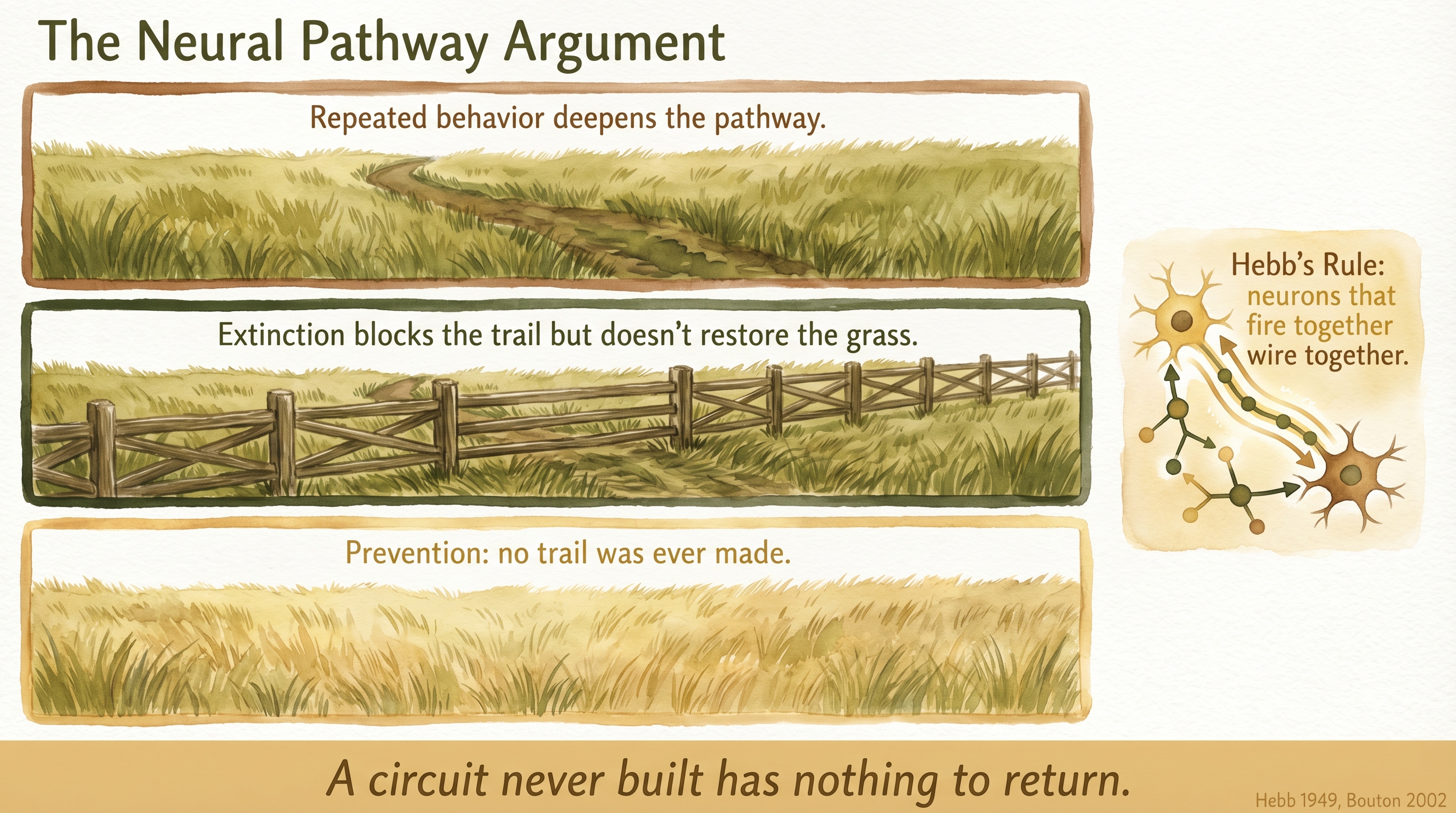
Hebbian learning plus extinction science makes the strongest case for prevention - a trail never made has nothing to reappear, no matter what triggers arise.
Key Takeaways
- The neural-pathway argument combines two documented findings: repetition strengthens pathways, and later extinction does not erase them cleanly.
- A behavior that was never strongly rehearsed is different from a behavior that was built and then suppressed.
- This is why JB treats first repetitions seriously. The pathway starts forming immediately.
- Prevention is not only philosophically tidy. It is the most efficient path if the goal is long-term behavioral stability.
The Evidence
This entry uses observed claim-level tags beyond the dedicated EvidenceBlocks below. These tags mark JB program observation or practice-derived claims that need dedicated EvidenceBlock coverage in a later content pass.
- Hebb, D. O. (1949)broader neuroscience framework
Established the foundational principle that co-activated neural elements strengthen together, giving later prevention arguments a neural basis.
- Bouton, M. E. (2002, 2004)multiple species
Showed that extinction is context-sensitive and does not cleanly erase the original learning trace. - Rescorla, R. A. (2004)multiple species
Demonstrated spontaneous recovery, reinforcing the persistence of prior learning after apparent suppression. - Hall, N. J. & Wynne, C. D. L. (2016)domestic dogs
Reviewed extinction persistence and practical resistance to unlearning in dogs, bringing the principle into canine application.
- Gazit, I., Goldblatt, A., & Terkel, J. (2005)domestic dogs
Showed context sensitivity in extinction of canine search behavior, reinforcing that the learning system documented broadly also behaves that way in dogs.
No published family-dog intervention study has mapped which early unwanted behaviors create the most durable later relapse burden after correction attempts.
The pathway logic is strong, but the field has not yet quantified how many repetitions of a common puppy behavior are enough to create meaningful long-term management burden in the home.
SCR References
Sources
Bouton, M. E. (2002). Context, ambiguity, and unlearning: Sources of relapse after behavioral extinction. Biological Psychiatry, 52(10), 976-986.
Bouton, M. E. (2004). Context and behavioral processes in extinction. Learning & Behavior, 32(4), 485-494.
Gazit, I., Goldblatt, A., & Terkel, J. (2005). The role of context in extinction of searching behavior in dogs. Animal Cognition, 8(2), 91-99.
Hall, N. J., & Wynne, C. D. L. (2016). Persistence and resistance to extinction in the domestic dog: Basic research and applications to canine training. Behavioural Processes, 129, 67-72.
Hebb, D. O. (1949). The Organization of Behavior. Wiley.
Rescorla, R. A. (2004). Spontaneous recovery. Learning & Memory, 11(5), 501-509.