Habit Formation and Basal Ganglia Automation
Compound evidence detail1 SCR / 2 parts
- Documentedthe rodent and primate evidence for striatal habit formation and the dorsomedial-to-dorsolateral shift via action chunking (Jog 1999, Barnes 2005, Graybiel 2008)
- Heuristicthe JB application of basal ganglia habit-formation principles to canine behavioral development, a conserved-architecture inference not directly tested in domestic dogs at the striatal level
Repeated behavior does not only become stronger. It becomes easier to run. Graybiel's basal ganglia work showed that with enough rehearsal, behavior shifts toward more automatic habit systems and becomes harder to interrupt or modify. That mechanism is documented in mammals such as rats and macaques. Applying it to family dogs is a cross-species bridge, but it is a very informative one for the Foundations-level logic of Prevention. Documented-Cross-Species
What It Means
When a behavior is new, it is usually more variable and more dependent on attention. Observed-JB With repetition, the brain stops treating it as something that needs to be reconsidered step by step. Instead, the sequence becomes more efficient and more automatic. Graybiel described this as action chunking. Neural activity becomes concentrated around the beginning and end of the routine while the middle of the sequence runs with less evaluative effort. In practical terms, the behavior starts to feel like a script.
That matters because an automated script is not the same thing as a one-off action. Documented-Cross-Species A puppy that experimentally jumps once is doing something different from a dog whose body launches toward people as soon as the door opens. A mouth that occasionally lands during high arousal is different from a mouth that rises automatically in greeting. The concern is not just repetition in the abstract. It is repetition hardening into ease.
Barnes et al. (2005) deepened that point by showing that habit representations persist through extinction and can rapidly reconsolidate during reacquisition. Documented That means the brain does not treat a habit like a disposable draft. Once rehearsal has moved behavior toward automaticity, later suppression is fighting on harder terms. This is exactly why the basal ganglia story belongs beside the extinction story. Bouton explains why the old learning remains. Graybiel explains why repetition can make it run faster and with less conscious interruption.
The canine application still needs correct language. We do not have Graybiel-style invasive striatal recordings from pet dogs rehearsing household problems. What we have is a documented mammalian mechanism plus a very familiar canine phenotype: behaviors that begin as choices and later look like autopilot. Documented-Cross-Species The bridge is therefore cross-species and interpretive in application, not direct canine recording.
Why It Matters for Your Dog
For families, the basal ganglia lesson is straightforward. Early prevention has leverage because it stops behaviors before they become easy for the brain to run. That is why JB cares so much about first repetitions. The first doorway rush, first counter-surf, or first mouthing loop is not important only because it happened once. It is important because every clean repetition makes the next one cheaper.
Prevention is not merely about avoiding trouble. It is about keeping unwanted behavior out of the chunking pipeline before repetition makes it neurologically cheap.
This also helps families understand why some behaviors feel stubborn. The dog is not necessarily making a fresh moral choice every time. Sometimes the dog is running a routine that has become easier than the alternative. That does not excuse the behavior, but it changes what adults need to do. Documented They need fewer speeches and more environmental interruption, fewer corrections after rehearsal and more prevention before rehearsal.
The practical result is again the same one JB keeps reaching: doing less early can be more powerful than doing more late. A habit not yet automated is easier to redirect. A habit that has become a script can still be changed, but the brain is already helping it.
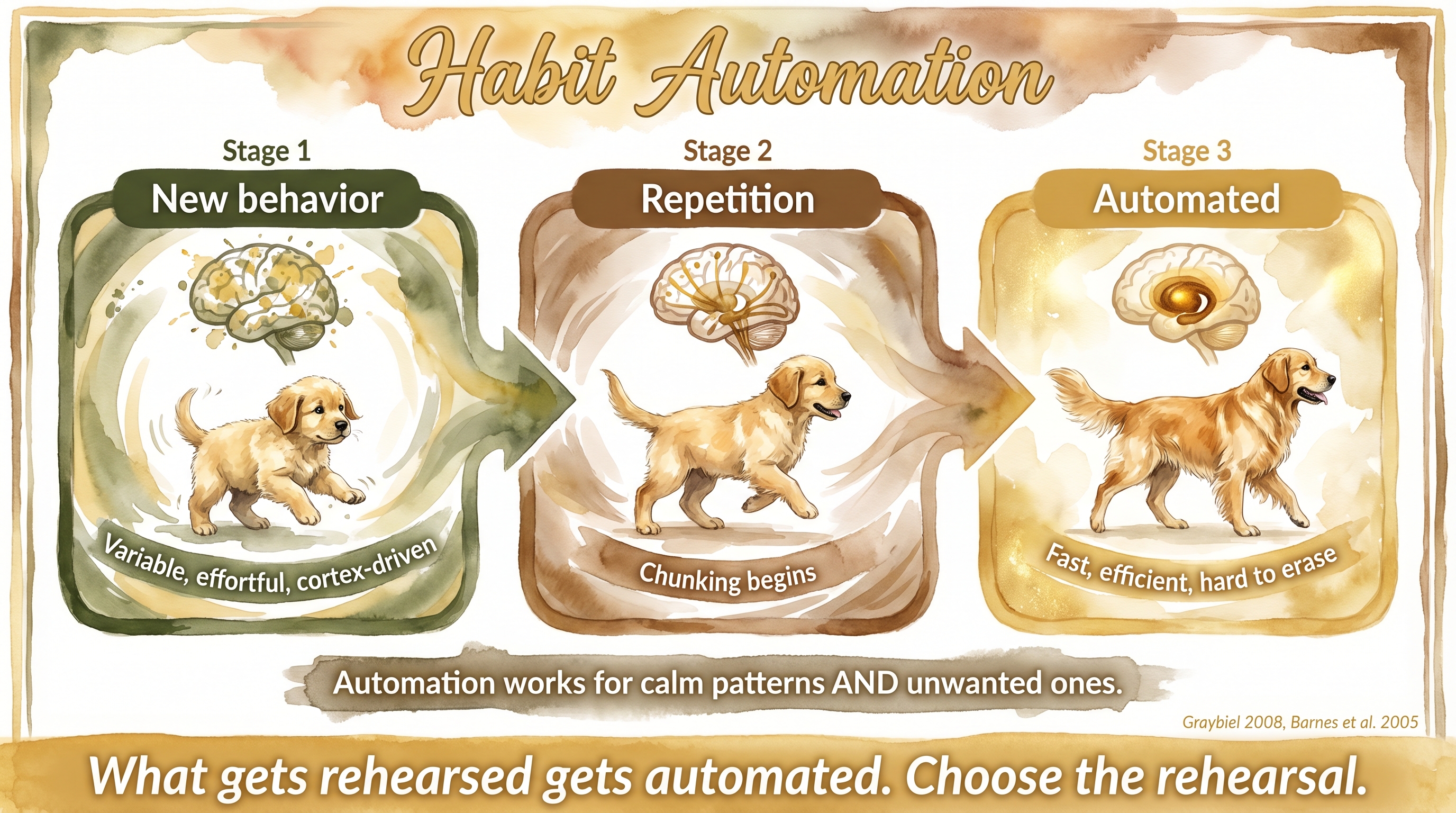
Repeated behavior shifts from effortful cortex control to automatic basal ganglia routines - automation works for calm patterns and unwanted ones alike.
Key Takeaways
- Repeated behavior becomes easier for the brain to run, which is why habits feel automatic rather than freshly chosen each time.
- Graybiel's basal ganglia research documents that shift in mammalian habit systems, even though the exact recordings come from non-canine models.
- This matters for dogs because early repetitions are not neutral. They can push a behavior toward autopilot.
- Prevention has special leverage because it keeps unwanted behavior out of the automation pipeline before rehearsal makes it cheap.
The Evidence
This entry uses documented claim-level tags beyond the dedicated EvidenceBlocks below. These claims should remain tied to the entry Sources and SCR references during the next evidence-chain authoring pass.
This entry uses observed claim-level tags beyond the dedicated EvidenceBlocks below. These tags mark JB program observation or practice-derived claims that need dedicated EvidenceBlock coverage in a later content pass.
- Jog, M. S. et al. (1999)rats
Documented striatal task-bracketing activity as procedural behavior became automated through rehearsal. - Barnes, T. D. et al. (2005)rats
Showed that procedural-memory representations persist through extinction and rapidly reconsolidate during reacquisition. - Graybiel, A. M. (2008)rats and macaques
Synthesized the evidence that repeated behavior shifts from deliberative processing toward chunked habit systems in the basal ganglia.
- SCR-023 boundarymammals broadly and domestic dogs
Habit transfer to basal ganglia control is documented in mammalian models, while the household-dog application remains a cross-species inference rather than a direct canine recording finding. - Smith, K. S. & Graybiel, A. M. (2016)mammals broadly
Reviewed habit formation as a conserved neural process, strengthening the plausibility of the canine bridge without removing the need to keep the species note visible.
No published study directly tracks the neural transfer of a naturally occurring household behavior in dogs from early repetition into later automaticity. The day-to-day canine application remains inferred from conserved mammalian habit neuroscience.
SCR References
Sources
Jog, M. S., Kubota, Y., Connolly, C. I., Hillegaart, V., & Graybiel, A. M. (1999). Building neural representations of habits. Science, 286(5445), 1745-1749. https://doi.org/10.1126/science.286.5445.1745
Barnes, T. D., Kubota, Y., Hu, D., Jin, D. Z., & Graybiel, A. M. (2005). Activity of striatal neurons reflects dynamic encoding and recoding of procedural memories. Nature, 437, 1158-1161. https://doi.org/10.1038/nature04053
Graybiel, A. M. (2008). Habits, rituals, and the evaluative brain. Annual Review of Neuroscience, 31, 359-387. https://doi.org/10.1146/annurev.neuro.29.051605.112851
Smith, K. S., & Graybiel, A. M. (2016). Habit formation. Dialogues in Clinical Neuroscience, 18(1), 33-43.