Prevention as Neural Pruning
Prevention as Neural Pruning is one of JB's most powerful ideas and one of the places where evidence discipline matters most. Synaptic pruning is a documented developmental mechanism. The stronger JB claim - that preventing a behavior from ever starting means the would-be behavioral circuit never gets built and therefore never gains developmental support - is a logical synthesis, not a directly tested canine intervention result. Heuristic
What It Means
The developing brain does not keep every possible connection forever. It overbuilds and then refines. Connections that receive activity-dependent support are stabilized. Heuristic Connections that do not are vulnerable to elimination through pruning.
That biological fact is what gives the Prevention pillar such theoretical force.
If a puppy repeatedly practices a behavior, the corresponding neural activity is being recruited, strengthened, and preserved. If a behavior never receives meaningful rehearsal, the brain has less reason to retain circuitry that would support it. Heuristic JB turns that developmental logic into a raising principle: the cleanest way to avoid a future behavior problem is to prevent the behavior from receiving the repetitions that would help it survive development.
This is not the same claim as saying every possible unwanted behavior is sitting in the brain waiting to be pruned away if ignored. That would overstate the science. The more careful claim is that developmental brain architecture is use-sensitive, and prevention keeps certain pathways from receiving the repeated activation that would stabilize them.
The socialization window makes the argument even more important. During early development, experience has disproportionate leverage on what the dog becomes. Documented If the brain is especially plastic during that period, then the difference between rehearsed and unrehearsed behavior likely matters even more than it does later.
JB therefore treats prevention not as avoidance but as sculpting. A family is not merely stopping the puppy from doing something annoying. They are shaping which patterns gain developmental traction and which do not.
The caution is essential, though. No study has directly tested whether preventing a particular canine behavior during development leads to measurable pruning of the corresponding circuit. Heuristic That exact claim remains inferential. The mechanism is real. The specific raising application is the extrapolation.
Why It Matters for Your Dog
This page helps explain why JB sounds so decisive about early boundaries. It is not because JB believes puppies should be controlled harshly. It is because early development is unusually consequential.
During the puppy period, prevention may do more than stop a habit from getting started. It may change which patterns ever receive enough use to become stable parts of the dog's repertoire. Heuristic
JB's pruning argument is simple: what never gets meaningful rehearsal does not receive the same developmental investment as what gets practiced over and over.
That logic supports a very specific style of early raising:
- do not repeatedly invite behavior you plan to suppress later
- do not confuse entertainment with harmlessness
- use the developmental window to build the patterns you actually want
The claim is strongest as a framework, not as a laboratory-proven dog-training equation. But as frameworks go, it is unusually well aligned with what developmental neuroscience says about use, retention, and elimination.
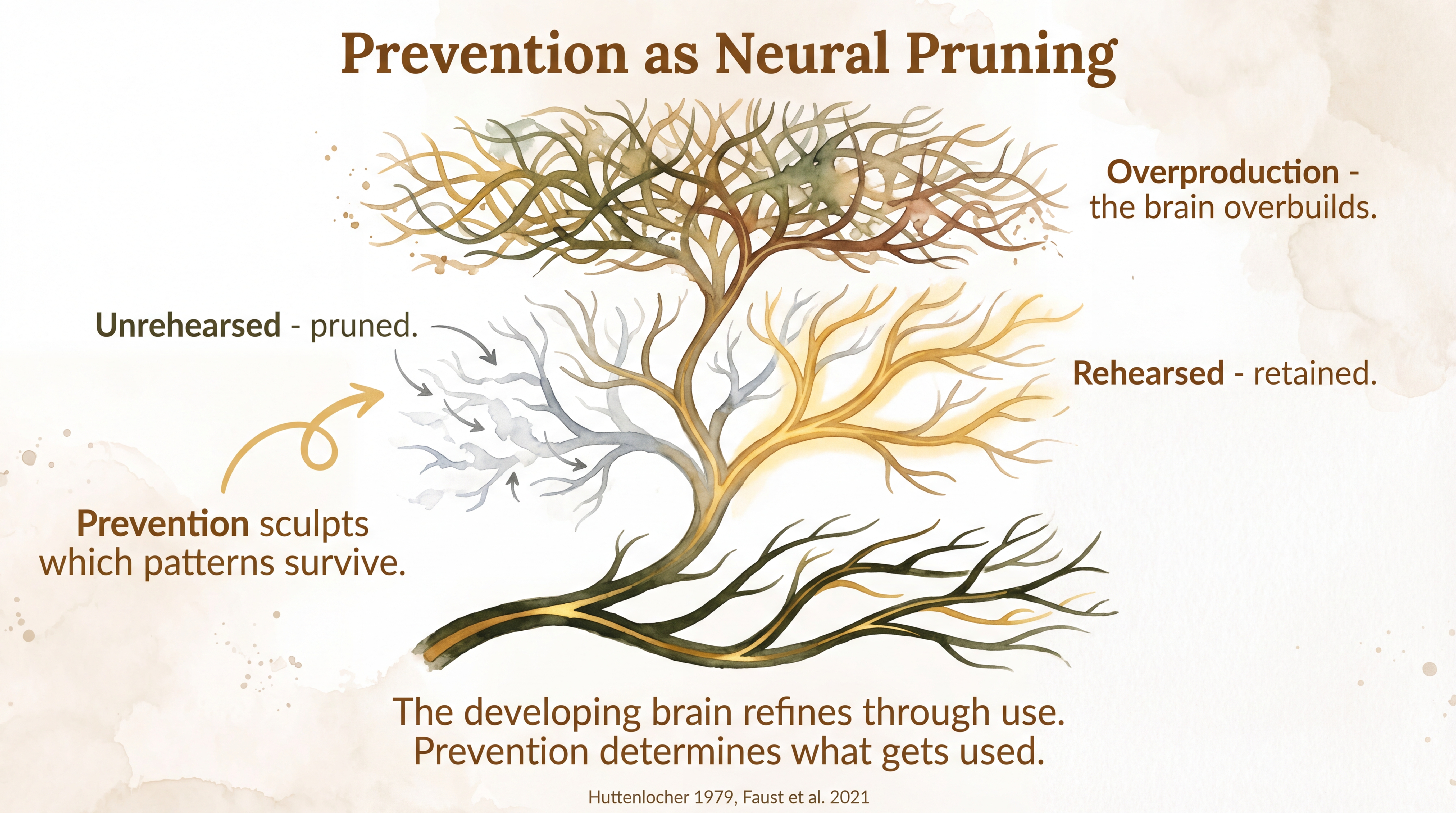
The developing brain refines through use - prevention determines which patterns survive pruning.
Key Takeaways
- The developing brain builds more connections than it keeps - circuits that get used repeatedly are strengthened and kept, while circuits that are not used get pruned away.
- During the puppy period, this developmental pruning is especially powerful: behaviors that never get practiced may never develop the neural support to become stable patterns.
- Prevention during early development is not just stopping misbehavior - it is shaping which patterns gain enough stability to become part of the dog's permanent repertoire.
The Evidence
- Huttenlocher, P. R. (1979)human
Established the classic finding that developing cortex overbuilds synapses and later eliminates a substantial portion through developmental refinement. - Rakic, P. et al. (1986)primate
Extended the overproduction-and-pruning picture across primate cortex, supporting activity-sensitive developmental refinement as a broader mammalian principle. - Faust, T. E., Gunner, G., & Schafer, D. P. (2021)general mammalian neuroscience
Reviewed the microglial and complement mechanisms involved in pruning unused synapses during development.
No published canine study directly demonstrates that preventing a specific unwanted behavior during development produces measurable pruning of the would-be behavioral circuit. The prevention-as-pruning claim is therefore a biologically strong synthesis rather than a directly tested intervention finding.
The most accurate phrasing is that JB's prevention logic is consistent with documented pruning mechanisms and with the use-sensitive character of developmental neural architecture.
No published study directly tests the specific claims or protocols described in this entry within a controlled canine trial.
SCR References
Sources
- Huttenlocher, P. R. (1979). Synaptic density in human frontal cortex: Developmental changes and effects of aging. Brain Research, 163(2), 195-205. DOI: 10.1016/0006-8993(79)90349-4. Supports documented synaptic-pruning neuroscience. Prevention-as-pruning application in dog raising remains [Heuristic] (anchor: SCR-167); the prevention-pruning bridge is JB synthesis, not a tested canine intervention.
- Faust, T. E., Gunner, G., and Schafer, D. P. (2021). Mechanisms governing activity-dependent synaptic pruning in the developing mammalian CNS. Nature Reviews Neuroscience, 22(11), 657-673. DOI: 10.1038/s41583-021-00507-y. Supports documented synaptic-pruning neuroscience. Prevention-as-pruning application in dog raising remains [Heuristic] (anchor: SCR-167); the prevention-pruning bridge is JB synthesis, not a tested canine intervention.
- Rakic, P., Bourgeois, J. P., Eckenhoff, M. F., Zecevic, N., and Goldman-Rakic, P. S. (1986). Concurrent overproduction of synapses in diverse regions of the primate cerebral cortex. Science, 232(4747), 232-235. DOI: 10.1126/science.3952506. Supports documented synaptic-pruning neuroscience. Prevention-as-pruning application in dog raising remains [Heuristic] (anchor: SCR-167); the prevention-pruning bridge is JB synthesis, not a tested canine intervention.