Habit Formation and Basal Ganglia Transfer
Habit Formation and Basal Ganglia Transfer explains why prevention matters even after a behavior has been learned. Repetition does not only strengthen a behavior. Over time it can move the behavior toward automatic control, where it runs faster, with less conscious evaluation, and with greater resistance to interruption. The habit-formation mechanism is well documented in rodent and primate work. Its canine application remains an informed extrapolation. Mixed Evidence
What It Means
Not all behavior is equally deliberate.
When a puppy first experiments with something, the action is often clumsy and variable. Observed-JB It may require attention, novelty, and situational motivation. But with sufficient rehearsal, behavior changes character. It becomes smoother, faster, and more automatic. That shift is what the habit literature is trying to explain.
Graybiel's work describes how repeated behavioral sequences become "chunked" into more automatic routines associated with basal ganglia processing. Documented The broad practical consequence is easy to recognize even if the underlying neuroscience feels technical: once something becomes a habit, it tends to run before reflective control can intervene.
That observation has obvious implications for family dogs.
A dog that occasionally noses the counter is doing something different from a dog whose body automatically swings toward the counter the moment food appears. A puppy that experiments with mouthing during one overstimulating moment is different from a dog whose mouth rises toward hands as a default feature of social interaction. In the first case, you are looking at emerging behavior. In the second, you may be looking at a rehearsed script.
This is why JB connects prevention to automation. Prevention is not only about avoiding a single bad event. It is about keeping unwanted behavior from crossing the threshold into something the dog performs almost before thinking. Documented
The science needs careful phrasing here. The classic neural evidence comes from rats and macaques, not companion dogs wearing electrodes in ordinary homes. Documented-Cross-Species So JB should not speak as though canine striatal chunking has already been imaged in the exact behaviors families care about. It has not. The safer statement is that habit systems are highly conserved across mammals, and the automaticity seen in repeated dog behavior is consistent with that literature.
Why It Matters for Your Dog
Families often notice the habit stage intuitively. They say things like:
- "He does it before I can stop him."
- "It is like he goes on autopilot."
- "He knows better, but once he starts, he just does it."
Those descriptions may not be scientifically precise, but they are pointing at something real: repetition changes how available a behavior becomes. Documented
The earlier an unwanted behavior is interrupted, the less opportunity it has to become automatic. Prevention protects the dog from rehearsing itself into a harder problem.
This is also why JB emphasizes catching things early rather than waiting for them to become "real issues." Once a pattern is deeply rehearsed, families are no longer only teaching a new response. They are competing with a script the dog can run with very little deliberation.
That does not mean change is impossible. It means the cost of change rises with rehearsal.
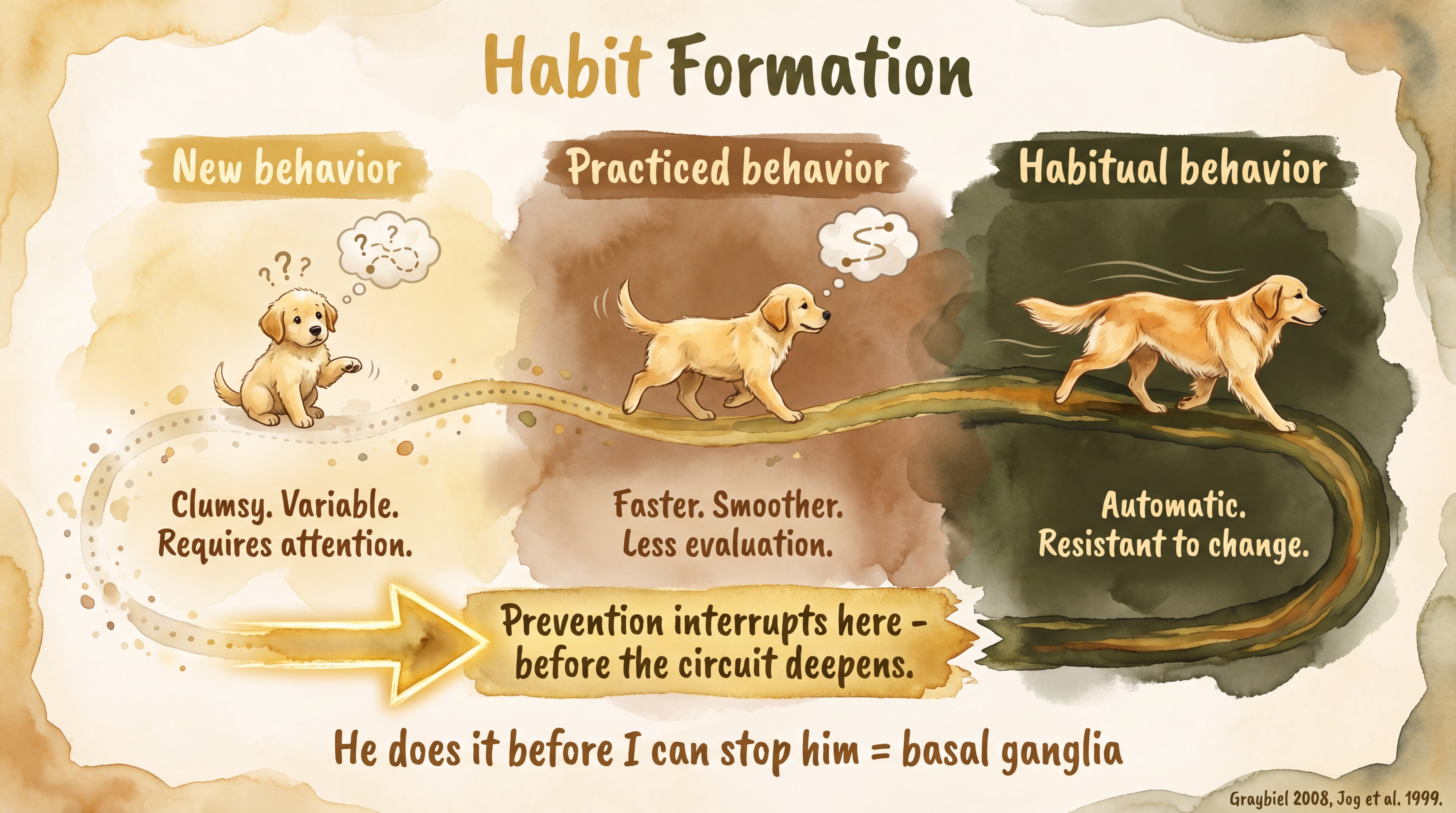
Prevention interrupts before the circuit deepens - once behavior transfers to automatic control, change becomes harder.
Key Takeaways
- When a puppy repeats a behavior many times, it stops being something the dog thinks about and becomes something the dog does automatically - like reaching for a counter or mouthing hands without pausing.
- Once behavior becomes automatic habit, it is much harder to interrupt or change because it is running on automatic pilot rather than deliberate choice.
- Prevention is especially powerful early on, before habits form, because it stops behaviors from crossing the threshold from chosen action into automatic routine.
The Evidence
This entry uses documented claim-level tags beyond the dedicated EvidenceBlocks below. These claims should remain tied to the entry Sources and SCR references during the next evidence-chain authoring pass.
This entry uses observed claim-level tags beyond the dedicated EvidenceBlocks below. These tags mark JB program observation or practice-derived claims that need dedicated EvidenceBlock coverage in a later content pass.
This entry uses mixed-evidence claim-level tags beyond the dedicated EvidenceBlocks below. These tags mark claims that combine documented findings with observed practice, heuristic application, or unresolved gaps.
- Jog, M. S. et al. (1999)rat
Striatal ensemble recordings showed task-bracketing activity as procedural behavior became automated. - Barnes, T. D. et al. (2005)rat
Demonstrated dynamic encoding, extinction, and reacquisition of procedural memory in striatal neurons, supporting persistence of habit representations. - Graybiel, A. M. (2008)rat and macaque
Synthesized the shift from goal-directed processing toward automatic, chunked behavior in basal ganglia systems.
Direct canine demonstrations of Graybiel-style basal ganglia chunking have not been published. The use of this framework in dog raising is based on conserved mammalian neurobiology and on the observable automaticity of rehearsed canine behavior.
No published study directly tests the specific claims or protocols described in this entry within a controlled canine trial.
SCR References
Sources
- Jog, M. S., et al. (1999). Building neural representations of habits. Science, 286(5445), 1745-1749.
- Barnes, T. D., et al. (2005). Activity of striatal neurons reflects dynamic encoding and recoding of procedural memories. Nature, 437(7062), 1158-1161.
- Graybiel, A. M. (2008). Habits, rituals, and the evaluative brain. Annual Review of Neuroscience, 31, 359-387.