The Extinction Residue
Compound evidence detail1 SCR / 2 parts
- Documentedthe rodent and primate evidence for striatal habit formation and the dorsomedial-to-dorsolateral shift via action chunking (Jog 1999, Barnes 2005, Graybiel 2008)
- Heuristicthe JB application of basal ganglia habit-formation principles to canine behavioral development, a conserved-architecture inference not directly tested in domestic dogs at the striatal level
Extinction does not erase the original learning. It creates new inhibitory learning that suppresses the earlier pathway, which is why behavior can return through spontaneous recovery, renewal, reinstatement, or rapid reacquisition. That is the heart of Bouton's framework, and it is one of the strongest pieces of science behind JB's Prevention pillar. Documented
What It Means
When families say a dog has "unlearned" a behavior, they usually mean the behavior is currently absent. Observed-JB Bouton's work forces a more careful description. In rodent learning research, extinction does not delete the old association. It adds a second layer of learning that tells the animal, in effect, that the old response is not currently paying off in this context. That is why the old behavior can come back when enough time passes, when the context changes, or when the original trigger is reintroduced.
The four relapse phenomena matter because each shows the same basic point from a different angle. Documented Spontaneous recovery means the behavior can reappear after time. Renewal means it can reappear when the animal moves to a different context. Reinstatement means it can return after the original aversive or rewarding condition is sampled again. Rapid reacquisition means it comes back faster the second time than it formed the first time. None of those patterns make sense if the original learning has truly been erased.
The dog evidence is especially important here because JB is not leaning only on rat work. Gazit, Goldblatt, and Terkel (2005) showed renewal directly in explosives detection dogs. Search performance collapsed in the extinction context and then recovered in a novel context, which is exactly what Bouton's framework predicts. Bentosela et al. (2008) and later canine synthesis work support the same general picture: behavior changes under reward withdrawal, but the original learning is not best understood as gone.
The modern neuroscience makes the point even sharper. In rats, Lacagnina et al. (2019) found distinct neural ensembles for fear learning and extinction learning. Documented In rats, Knox et al. (2016) showed that maintaining extinction depends on active prefrontal-amygdala suppression and that stress can disrupt that suppression. The logic is expensive: the old circuit remains, and the brain has to keep holding it down. A never-built behavior has no such maintenance cost.
Why It Matters for Your Dog
This is why JB keeps drawing such a hard line between prevention and later correction. A prevented behavior is a path that never had to be built. A corrected behavior may be quiet for long stretches and still remain available underneath. That does not mean change is impossible. It means families should stop describing suppression as deletion.
The strongest scientific argument for Prevention is not that correction never works. It is that correction creates a more fragile and metabolically costly solution than a behavior that never became established in the first place.
The practical value of this entry is honesty. It helps families understand why some problems feel solved until context changes. Documented A dog that appears settled in the kitchen may regress at a relative's house. A dog who seems over a habit can regress after stress. The behavior is not coming from nowhere. Bouton's framework says the original learning was preserved and the suppressive layer was context-dependent all along.
This also gives adults a calmer picture of what late change requires. Documented They are not trying to "wipe" a behavior. They are building a newer, more stable overlay while also changing the environment so the older circuit gets less opportunity to reassert itself. That is harder than prevention, which is exactly JB's point.
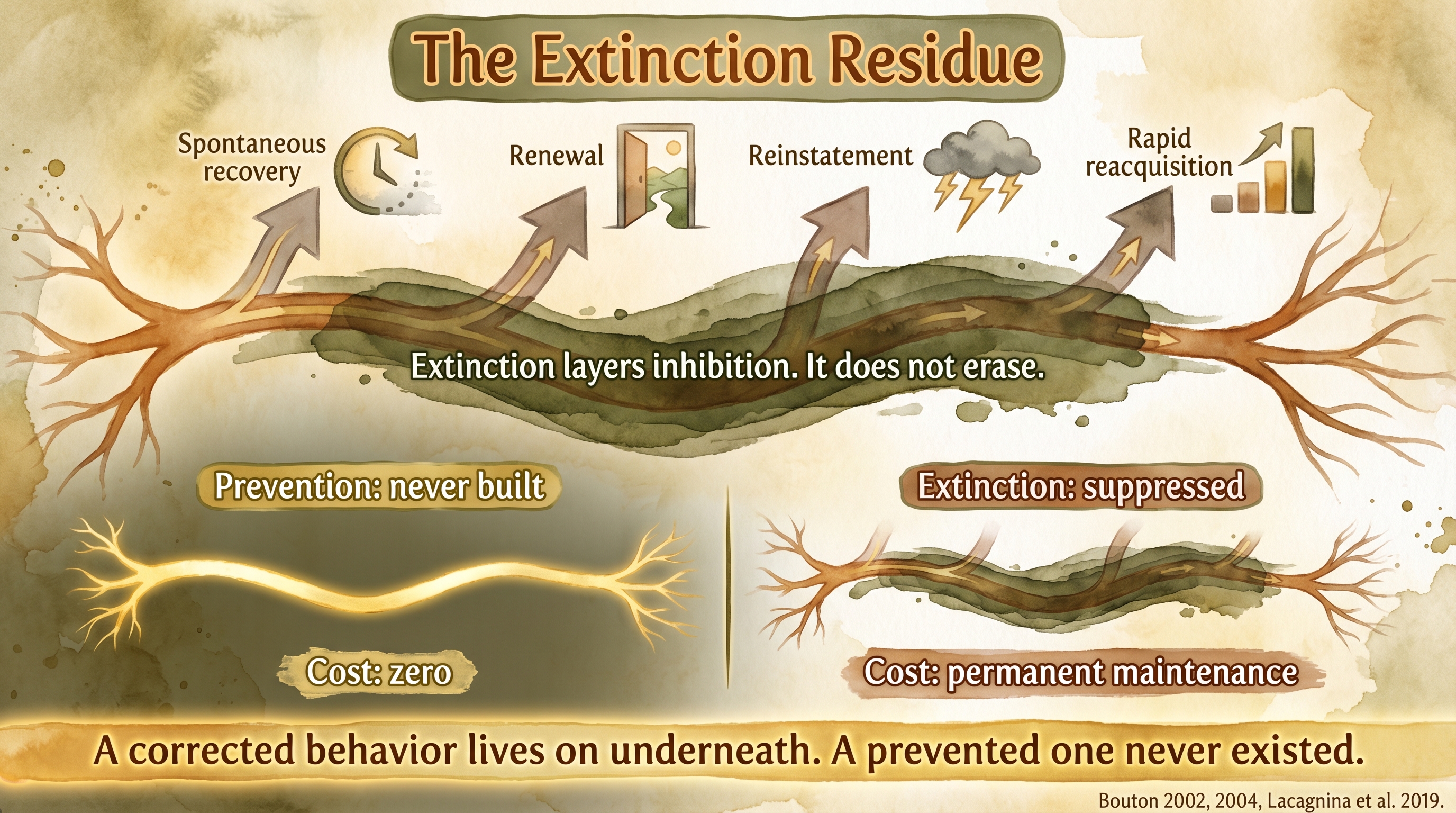
Extinction layers inhibition over the original pathway but does not erase it - spontaneous recovery, renewal, reinstatement, and rapid reacquisition can return.
Key Takeaways
- Extinction does not erase learning. It layers inhibition over an older pathway that can still return.
- Spontaneous recovery, renewal, reinstatement, and rapid reacquisition are the classic signs that the original learning remains available.
- Dogs have direct evidence for the renewal effect, which means this is not only a rodent story.
- That is why Prevention matters so much. A behavior never built is biologically cheaper than a behavior the brain must keep suppressing.
The Evidence
This entry uses observed claim-level tags beyond the dedicated EvidenceBlocks below. These tags mark JB program observation or practice-derived claims that need dedicated EvidenceBlock coverage in a later content pass.
- Bouton, M. E. (2002, 2004, 2012)rats and other mammalian models
Established that extinction creates inhibitory learning rather than erasing the original association, with relapse shown through spontaneous recovery, renewal, reinstatement, and rapid reacquisition. - Gazit, I., Goldblatt, A., & Terkel, J. (2005)domestic dogs
Directly demonstrated the renewal effect in explosives detection dogs, showing context-dependent return of search behavior after extinction-like suppression. - Bentosela, M. et al. (2008)domestic dogs
Showed rapid behavioral changes during reinforcement withdrawal in dogs, supporting the broader canine relevance of extinction and frustration processes.
- Lacagnina, A. F. et al. (2019)rats
Found distinct neural ensembles for fear learning and extinction, showing that extinction does not simply overwrite the original memory. - Knox, D. et al. (2016)rats
Showed that retaining extinguished fear depends on active prefrontal-amygdala regulation and that stress can break that suppression.
No published canine trial directly compares long-term outcomes of prevention-based raising to correction-based behavior suppression across ordinary household problems. The neuroscience makes the difference biologically plausible, but the exact household effect size has not been isolated experimentally.
SCR References
Sources
Bouton, M. E. (2002). Context, ambiguity, and unlearning: sources of relapse after behavioral extinction. Biological Psychiatry, 52(10), 976-986. https://doi.org/10.1016/S0006-3223(02)01546-9
Bouton, M. E. (2004). Context and behavioral processes in extinction. Learning & Memory, 11(5), 485-494. https://doi.org/10.1101/lm.78804
Bouton, M. E., Winterbauer, N. E., & Todd, T. P. (2012). Relapse processes after the extinction of instrumental learning: renewal, resurgence, and reacquisition. Behavioural Processes, 90(1), 130-141. https://doi.org/10.1016/j.beproc.2012.03.004
Gazit, I., Goldblatt, A., & Terkel, J. (2005). The role of context specificity in learning: the effects of training and extinction on explosives detection dogs. Animal Cognition, 8(3), 143-150. https://doi.org/10.1007/s10071-004-0248-9
Bentosela, M., Barrera, G., Jakovcevic, A., Elgier, A. M., & Mustaca, A. E. (2008). Effect of reinforcement, omission and extinction on a communicative response in domestic dogs. Behavioural Processes, 78(3), 464-469. https://doi.org/10.1016/j.beproc.2008.03.004