The Secure Base Effect in Dogs
Compound evidence detail1 SCR / 2 parts
- Documentedthe human attachment evidence base together with the canine-direct secure-base findings (Topal 1998, Horn 2013) and Schoberl-documented physiological effects of secure caregiving in dogs
- Heuristicthe full attachment-theory apparatus transfer to canine relationships, including internal working models and attachment-classification systems
The secure base effect is one of the clearest ways attachment shows up in dogs. A securely used caregiver does not only attract the dog inward. The caregiver changes what the dog can do outward by making exploration, persistence, and recovery feel safer. Documented
What It Means
The phrase secure base can sound abstract until it is translated into everyday behavior. It means the caregiver functions as a reliable starting point and return point. The dog is not secure because it never leaves the human. The dog is secure because it can leave, investigate, and come back without losing organization.
That distinction matters because clinginess and secure attachment are not the same thing. A dog can stay physically close because it is worried, overstimulated, or unsure. A securely attached dog often looks more balanced than that. The dog checks in, uses the caregiver, and then moves outward again. The relationship supports independence properly understood rather than constant contact.
It also helps to separate secure base from safe haven. A safe haven is where the dog comes back when stress rises and comfort is needed. A secure base is what allows the dog to move away again with enough confidence to investigate, persist, or solve. The two functions are connected, but they are not identical. A dog can seek comfort intensely without then becoming more competent in the environment. The secure-base effect is specifically about that second piece, the return of outward capacity.
Horn, Huber, and Range made this visible in a very concrete laboratory design. Dogs were tested in a quiet novel room with unfamiliar food-dispensing apparatuses after a pre-test had already familiarized them with eating in the room and with the possibility that the caregiver might step out. The crucial comparisons were simple: caregiver absent, caregiver present but silent, caregiver present and verbally encouraging, and in a second experiment caregiver replaced by an unfamiliar person. Dogs manipulated the apparatus for significantly less time when the caregiver was absent, and encouragement mattered less than simple presence. In other words, the adult was not just coaching performance. The adult's availability changed whether the dog stayed engaged with the problem at all.
That detail matters more than it may seem at first glance. If encouragement had done most of the work, then the result could be explained mainly as instruction, arousal, or cueing. But Horn's design suggested something quieter and more foundational. The dog performed differently because the base was available, not because the adult was constantly directing the behavior. For JB, that is a meaningful distinction. It supports the idea that a calm, stable adult can organize learning even when the adult is not actively "working" the dog.
That is also what the secure base effect is not. It is not merely separation distress, because the Horn design controlled for surprise and food motivation and still found that persistence dropped when the base was unavailable. It is not merely proximity maintenance either, because the key readout was not how tightly the dog clung to the adult but whether the dog could remain organized enough to explore and work. Secure base means outward capacity. The dog can investigate, manipulate, and persist because the attachment figure is usable in the background.
This is why frantic attachment behavior and secure attachment should not be collapsed into the same thing. A dog can protest separation loudly and still fail to return to organized exploration after reunion. The disciplined question is not only "How much does the dog want the adult?" but also "What happens to the dog's competence when the adult is available again?" Secure-base language earns its keep by focusing on that second question.
That point also protects families from rewarding the wrong picture. If frantic reunion behavior is mistaken for especially deep bonding, adults may end up reinforcing dependence while missing the absence of secure-base function. The stronger attachment picture is usually quieter than that. It shows up when the dog can reconnect, settle, and turn back outward.
Later work extended the idea beyond a single laboratory paradigm. Thielke and Udell found that dogs in shelter and foster contexts who were classified as more secure showed lower neuroticism and stronger persistence on some cognitive tasks. Documented Stahl and colleagues then moved the question into commercial breeding kennels, one of the few attachment studies in an institutional environment rather than a settled companion-dog home. Dogs were grouped into secure, ambivalent, avoidant, and disorganized attachment-style categories, then assessed for approach and contact-solicitation toward an unfamiliar person. Attachment classification predicted those social responses, and caretaker presence showed a buffering pattern across styles. That matters because it suggests the secure-base logic survives in a rehoming-relevant setting, not only in idealized pet-dog households.
That broader sampling matters for interpretation. If secure-base effects appeared only in highly attached pet dogs living in stable homes, critics could dismiss the phenomenon as a narrow artifact of especially bonded families. The kennel and foster results make that harder to do. They suggest the secure-base pattern is a general feature of attachment organization that can still be detected when the dog's housing history is more institutional and the relationship is operating under more practical strain.
That does not erase context differences. A kennel dog, foster dog, and long-settled family dog are not living the same life. But the recurrence of the pattern across those settings strengthens the core claim that secure-base behavior is part of attachment organization itself rather than a side effect of one unusually favorable lifestyle. Documented
One useful analogy is a child at the edge of a swimming pool who keeps looking back toward the adult on the deck. The goal is not to freeze the child beside the adult. The goal is for the adult to be stable enough that the child can enter the water with confidence. Secure-base behavior in dogs works the same way. Documented The relationship is what makes outward movement manageable.
This also clarifies why the secure base effect matters so much to JB. The Five Pillars depend on the idea that the relationship is a delivery mechanism, not merely an emotional bonus. If the dog explores, solves, and recovers differently when the caregiver is present, then the bond is shaping cognition and behavior in real time.
In practical terms, this gives families a better observational standard. A usable adult is one whose presence helps the dog orient, investigate, and regain balance in novelty. The question is not whether the dog always wants to touch the adult. The question is whether the dog's thinking stays available when the adult is there.
That is one reason secure-base thinking changes how exposure itself should be understood. Exposure without enough relational organization can become mere endurance. Exposure with a usable adult becomes more like scaffolding. The same novel object, room, or social moment may therefore teach very different things depending on whether the dog can lean on a functioning base while moving through it.
Why It Matters for Your Dog
Families often misread secure attachment as a demand for more affection, more contact, or more reassurance. Observed-JB The secure base effect points in a more disciplined direction. What matters is not maximum involvement. What matters is whether the dog can use the adult well.
The secure base effect supports JB emphasis on a calm, organized adult. The dog benefits most from a caregiver who is usable under stress, not one who is constantly performing closeness.
In daily life this changes how many common problems are interpreted. A dog who struggles to move confidently into novelty may not only need more exposure. The dog may need a more legible social base from which to face that novelty. A dog who looks frantic on reunion may not be showing extra love. The dog may be showing less organization. Secure-base language helps families tell those stories apart.
It also keeps families from using affection as the only metric of relational health. Plenty of dogs are affectionate. The more diagnostic question is whether affection is paired with organized recovery, competent exploration, and workable independence. That is the everyday shape of a secure base.
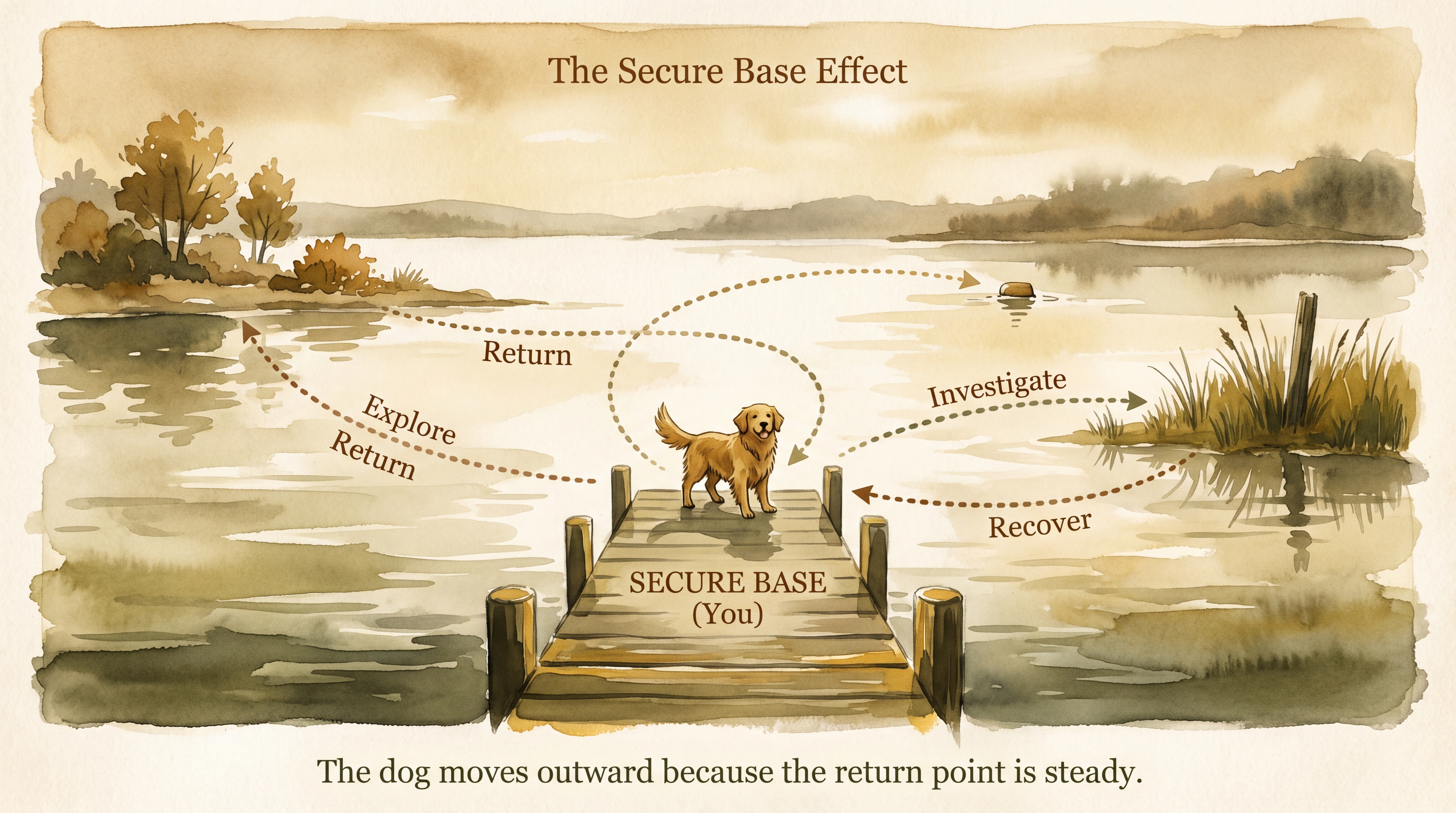
Dogs explore more confidently when their attachment figure is present, mirroring the secure-base effect documented in human infants.
Key Takeaways
- A secure base does not keep the dog glued to the caregiver. It allows the dog to move outward and come back without losing organization.
- The secure base effect is documented in dogs through changes in exploration, persistence, and social behavior when the caregiver is present.
- Clinginess and secure attachment are not the same thing. Secure attachment often looks more balanced, not more desperate.
- For families, the practical question is whether the dog can use the adult well under novelty and stress.
The Evidence
This entry uses observed claim-level tags beyond the dedicated EvidenceBlocks below. These tags mark JB program observation or practice-derived claims that need dedicated EvidenceBlock coverage in a later content pass.
- Horn, L., Huber, L., and Range, F. (2013)domestic dogs
Documented that owner presence altered exploration and task engagement in a novel setting, confirming a secure-base effect in dogs. - Thielke, L. E., and Udell, M. A. R. (2019)domestic dogs
Found that attachment security in shelter and foster contexts was associated with lower neuroticism and stronger task persistence. - Stahl, A. et al. (2024)domestic dogs
Reported that attachment-style groupings in commercial breeding kennels predicted social behavior and caretaker-buffer effects in a rehoming-relevant population.
- Bowlby, J. (1969/1982)humans
Described the caregiver as both safe haven and secure base, allowing outward exploration when the relationship is dependable. - Ainsworth, M. D. S. et al. (1978)humans
Operationalized secure-base behavior through separation, reunion, and exploratory balance in the Strange Situation.
- SCR-017 boundarydomestic dogs and humans
The secure-base effect itself is documented in dogs, but stronger claims about exactly which caregiving pattern causes stronger secure-base performance remain more bounded than the human literature.
No published puppy trial has directly compared breeder-to-family transition approaches and then measured secure-base strength as a formal outcome across the first weeks in the home.
SCR References
Sources
- Ainsworth, M. D. S., Blehar, M. C., Waters, E., and Wall, S. (1978). Patterns of Attachment: A Psychological Study of the Strange Situation. Erlbaum.
- Bowlby, J. (1969/1982). Attachment and Loss, Volume 1: Attachment. Basic Books.
- Horn, L., Huber, L., and Range, F. (2013). The importance of the secure base effect for domestic dogs. PLoS ONE, 8(1), e65296. https://doi.org/10.1371/journal.pone.0065296
- Stahl, A., Barnard, S., Diana, A., Udell, M. A. R., and Croney, C. (2024). Attachment style and social behavior in dogs from commercial breeding kennels. Applied Animal Behaviour Science. https://doi.org/10.1016/j.applanim.2024.106238
- Thielke, L. E., and Udell, M. A. R. (2019). Evaluating cognitive and behavioral outcomes in conjunction with the secure base effect for dogs in shelter and foster environments. Animals, 9(11), 932. https://doi.org/10.3390/ani9110932