The Mammalian Parenting Convergence
Compound evidence detail1 SCR / 2 parts
- Documentedcross-species evidence for mentorship convergence in non-canid mammals, including chimpanzee tool-use transmission (Inoue-Nakamura and Matsuzawa 1997), dolphin foraging transmission, meerkat prey-handling teaching, and elephant matriarchal knowledge transfer
- HeuristicJB application of the cross-species convergence to dog raising, mapping the pattern in function rather than mechanism, with no formal canine teaching study under the strict definition
The Five Pillars are not presented by JB as a dog-training invention. They are presented as a named description of patterns that appear repeatedly in group-living mammals with extended parental investment. The cross-species evidence for those patterns is strong. The stronger claim that the Five Pillars themselves are the definitive universal map is more interpretive. That difference is exactly why this entry sits at documented-cross rather than at pure documented. Documented-Cross-Species
What It Means
Parental investment theory gave the field its broad logic. Trivers argued that when offspring require extended support, adults face a real biological task: keep the young alive long enough to become functional. Clutton-Brock then widened that picture by showing how long juvenile dependence reshapes social systems, life history, and the value of continued adult involvement. Once a species produces slow-developing young who must learn socially, a familiar toolkit keeps appearing: adults model, buffer stress, control access to the wider environment, and correct proportionally rather than by routinely injuring the young.
That is the convergence JB is pointing to. In primates, the young learn by prolonged apprenticeship and social observation. In killer whales, complex techniques such as intentional beaching take years of repeated adult-guided exposure. In meerkats, prey is introduced in graduated form rather than dumped on the inexperienced juvenile all at once. Documented-Cross-Species In vervet monkeys and other cooperative breeders, alloparents contribute to developmental stability and social competence. These are not identical species stories. They are recurring solutions to the same developmental problem.
The reason the convergence matters is that it weakens the idea that dog raising should begin from an industrialized training frame. Documented-Cross-Species If distantly related mammals keep solving extended juvenile development with social modeling, regulation, structure, and graded correction, then the burden of explanation shifts. The odd thing is no longer that JB sees those patterns in dogs. The odd thing is that modern companion-dog culture so often assumes they should be replaced by high-frequency instruction and formalized behavior engineering from the outset.
The evidence ceiling still matters. Documented-Cross-Species Cross-species recurrence is documented. The claim that these recurring patterns map exactly onto the named Five Pillars is interpretive. JB is naming a convergence, not reporting that evolutionary biology itself already uses JB's categories. That distinction preserves both honesty and strength. The broad patterns are real enough without pretending the synthesis has already been canonized by the literature.
Why It Matters for Your Dog
This entry matters because it gives families a different question to ask. Instead of asking, "What technique do I need for this species?" they can ask, "How do high-investment mammals usually pull the young toward competence?" Observed-JB That question leads away from constant performance culture and toward relationship, rhythm, and developmental staging.
Cross-species convergence strengthens the case that adult example is not a sentimental preference. It is one of the oldest developmental tools mammals have.
For dogs, this does not mean wolves, whales, chimpanzees, and meerkats are all doing the same thing in the same way. It means the broad architecture is familiar: the young are not matured mainly by technical instruction from strangers. They are matured by living in an adult social world that regulates arousal, demonstrates skills, and controls access to challenge. That is exactly why JB keeps saying "raising" instead of "training." The word points to the level where the convergence lives.
The practical result is surprisingly calming for families. It means they do not have to invent a complex system before they can start doing good work. Calm adult example, staged exposure, consistent boundaries, and proportionate interruption are not exotic methods. They are old mammalian solutions to an old developmental problem. JB's philosophical claim is that dogs still make sense inside that older logic. Heuristic
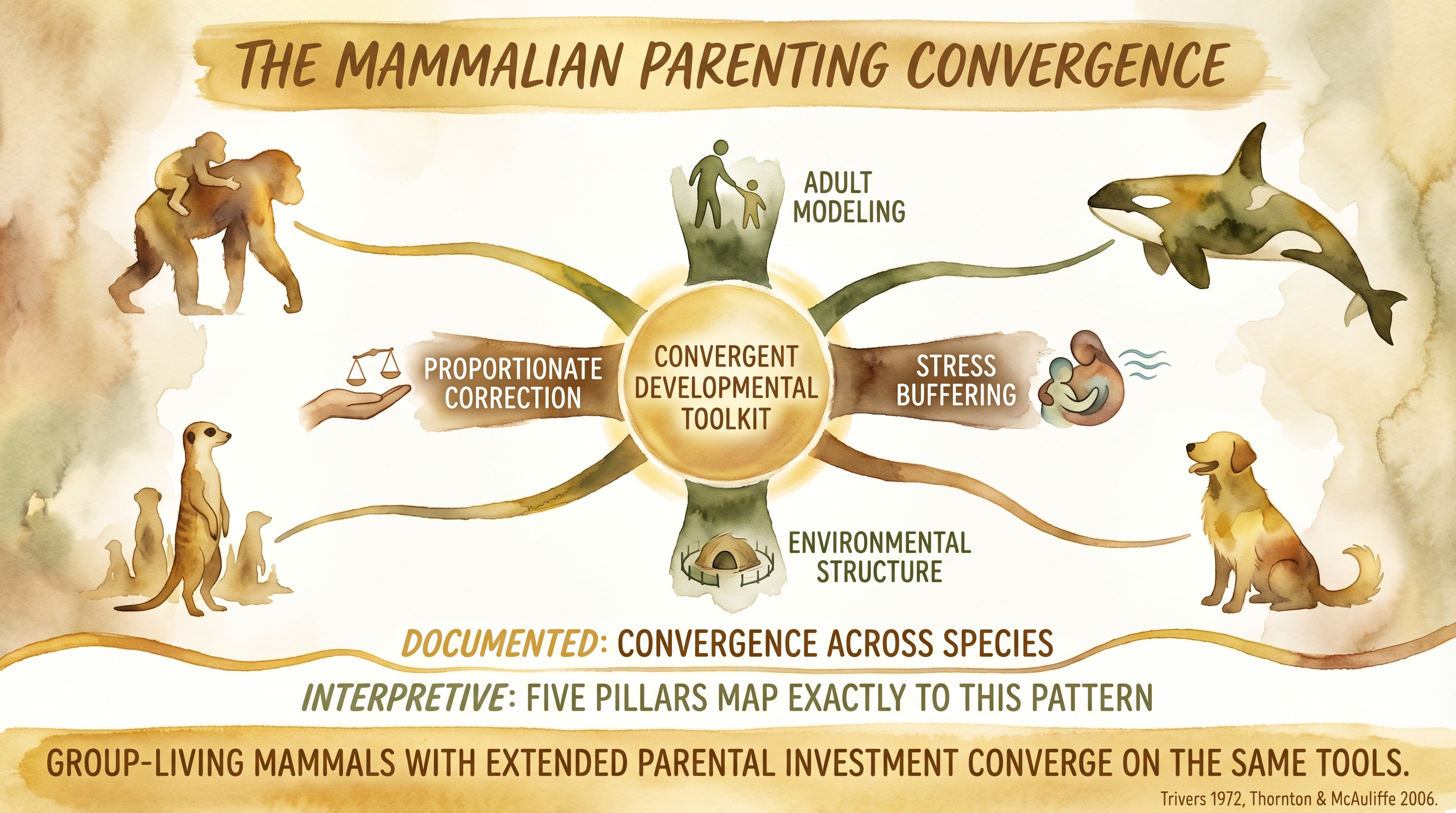
Across group-living mammals with extended parental investment, the same developmental toolkit keeps appearing - modeling, buffering, structure, and proportionate correction.
Key Takeaways
- Across many group-living mammals, extended parental investment repeatedly produces the same broad developmental tools: modeling, regulation, structure, and proportionate correction.
- That convergence is documented even though the exact details differ by species.
- JB's stronger claim is interpretive: the Five Pillars are a named description of that recurring pattern, not a phrase the science itself uses.
- For families, the takeaway is simple: raising through calm adult social life is a biologically familiar strategy, not an eccentric alternative to training culture.
The Evidence
This entry uses observed claim-level tags beyond the dedicated EvidenceBlocks below. These tags mark JB program observation or practice-derived claims that need dedicated EvidenceBlock coverage in a later content pass.
- Trivers, R. L. (1972)multiple animals
Established parental investment theory, showing why species with dependent young evolve prolonged adult involvement. - Clutton-Brock, T. H. (1991)mammals broadly
Showed how extended juvenile dependence reshapes social systems and the role of continued adult care. - Hrdy, S. B. (2009)primates and cooperative breeders
Argued that cooperative caregiving and alloparenting are central to how socially complex mammals raise functional young. - Thornton, A. & McAuliffe, K. (2006)meerkats
Documented graduated prey scaffolding as a direct example of adults adjusting challenge to juvenile competence.
- SCR-002 boundarymultiple mammals
The composite claim that the Five Pillars represent a universal mammalian raising pattern is heuristic even though many component patterns are individually documented. - SCR-032 synthesismultiple mammals
Cross-species mentorship convergence is real, but translating it into a single named JB framework remains interpretive.
No published comparative study directly tests the Five Pillars as a single operational framework across species. The convergence is assembled from many literatures rather than demonstrated as one formally unified model.
SCR References
Sources
Trivers, R. L. (1972). Parental investment and sexual selection. In Sexual Selection and the Descent of Man (pp. 136-179). Aldine.
Clutton-Brock, T. H. (1991). The Evolution of Parental Care. Princeton University Press.
Hrdy, S. B. (2009). Mothers and Others: The Evolutionary Origins of Mutual Understanding. Harvard University Press.
Thornton, A., & McAuliffe, K. (2006). Teaching in wild meerkats. Science, 313(5784), 227-229. https://doi.org/10.1126/science.1128727
Brent, L. J. N., Franks, D. W., Foster, E. A., Balcomb, K. C., Cant, M. A., & Croft, D. P. (2015). Ecological knowledge, leadership, and the evolution of menopause in killer whales. Current Biology, 25(6), 746-750. https://doi.org/10.1016/j.cub.2015.01.037