Structured Companionship
Compound evidence detail1 SCR / 2 parts
- Documentedthe canine methylation pattern reported by Awalt 2024 for NR3C1 and OXTR in dogs with measured early-life history
- Heuristicthe JB extrapolation that ordinary calm raising produces durable epigenetic advantages in dogs beyond preventing adverse environments
Structured Companionship is Just Behaving's primary bonding modality. It describes the deepening of a human-dog relationship through shared calm, quiet exploration, and settled co-existence rather than through manufactured excitement. Heuristic The relationship strengthens through proximity, safety, and consistent presence - not through arousal. This is radically at odds with the cultural assumption that bonding happens through high-energy play, excitement games, and the management of arousal. In the Just Behaving approach, you never create the problem you then manage. You create calm and let the dog encounter life from that foundation. Bonding does not require excitement. The deepest bonds in nature do not form through arousal. They form through something quieter and more durable.
What It Means
Structured Companionship is bonding through activity, not passivity. It is not about isolation or deprivation. It is about the quality and direction of shared presence.
Structured Companionship looks like: quiet walks where the dog experiences the world while you remain the calm reference point. Heuristic It looks like sitting together in the same room while you work and the dog settles nearby. It looks like car rides, trips to the hardware store, errands where the dog is simply present and the human is calm. It looks like grooming sessions, meal preparation together, watching the world from the porch. It looks like the dog following you through your day because your presence feels like safety, not because you have manufactured excitement.
Structured Companionship does not look like: fetch marathons as bonding strategy. Wrestling as relationship building. Roughhousing that escalates arousal. Heuristic Games designed to produce excitement and then manage the fallout. Constant verbal praise and physical stimulation. Toys deployed strategically to create dopamine spikes. The human as entertainment system rather than secure base.
The distinction matters because what we practice is what becomes real. If bonding is practiced through excitement, the dog learns that the relationship is strongest when arousal is highest. If bonding is practiced through calm, the dog learns that the deepest safety is found in stillness alongside the human.
This is not deprivation of play. A Just Behaving dog plays. But play emerges from a calm foundation. It is not the primary bonding tool. It is not the signature of the relationship. The signature is that the dog chooses proximity to you, even when you are doing nothing interesting. The signature is that your calm settles the dog. The signature is that being near you, in whatever you are doing, feels like home.
Why It Matters for Your Dog
Your nervous system touches your dog's nervous system constantly. This is not metaphorical. Dogs read your emotional state through olfaction - they detect the biochemical markers of stress, calm, and arousal through smell. Documented They also synchronize their stress hormones (cortisol) with yours over time, and this synchronization persists. Documented The owner's baseline emotional state is the primary driver of this synchronization, not the dog's breed or temperament.
What this means: when you are calm, your dog's nervous system receives constant, invisible messaging that the world is safe. When you are excited, your dog's nervous system receives messaging that something requires heightened attention or response. When you are anxious, your dog's nervous system mirrors that anxiety. You are not just teaching your dog behavior. You are literally sculpting the dog's nervous system baseline through your consistent emotional presence.
Structured Companionship works with this biology instead of against it. It means that your calm presence is not just comfortable for the dog. It is foundational to how the dog's stress-regulation system develops. Early experiences of calm caregiving produce measurable changes in how the young nervous system calibrates and responds to stress. Documented This is not about being a passive observer. It is about bringing the right emotional quality to every interaction.
Structured Companionship is the Calmness pillar in action. The relationship deepens through shared calm, quiet exploration, and settled co-existence. Your calm presence synchronizes with your dog's nervous system. The deepest bonds in nature form through proximity, safety, and consistent presence - not through manufactured excitement.
A puppy raised in structured companionship learns that proximity to the human is the solution to uncertainty, not the source of more uncertainty. A puppy raised with high-energy bonding learns that proximity triggers activation. Those are very different operating systems.
The second layer: Golden Retrievers are cooperative, responsive breeds. They are neurologically wired to detect and synchronize with human emotional state. This is part of what makes them such excellent companions - but it also means they are exquisitely sensitive to your approach. A retriever will mirror your anxiety with precision. A retriever will settle into your calm with precision. You cannot fool a retriever's nervous system. You can only align with it or work against it.
Structured Companionship is alignment. It says: I will bring peace. I will be the secure base. I will be consistent. I will not import excitement as a bonding strategy because that teaches you to need my chaos to feel my attention. I will be your solid point of reference, and from that reference, you will encounter the world.
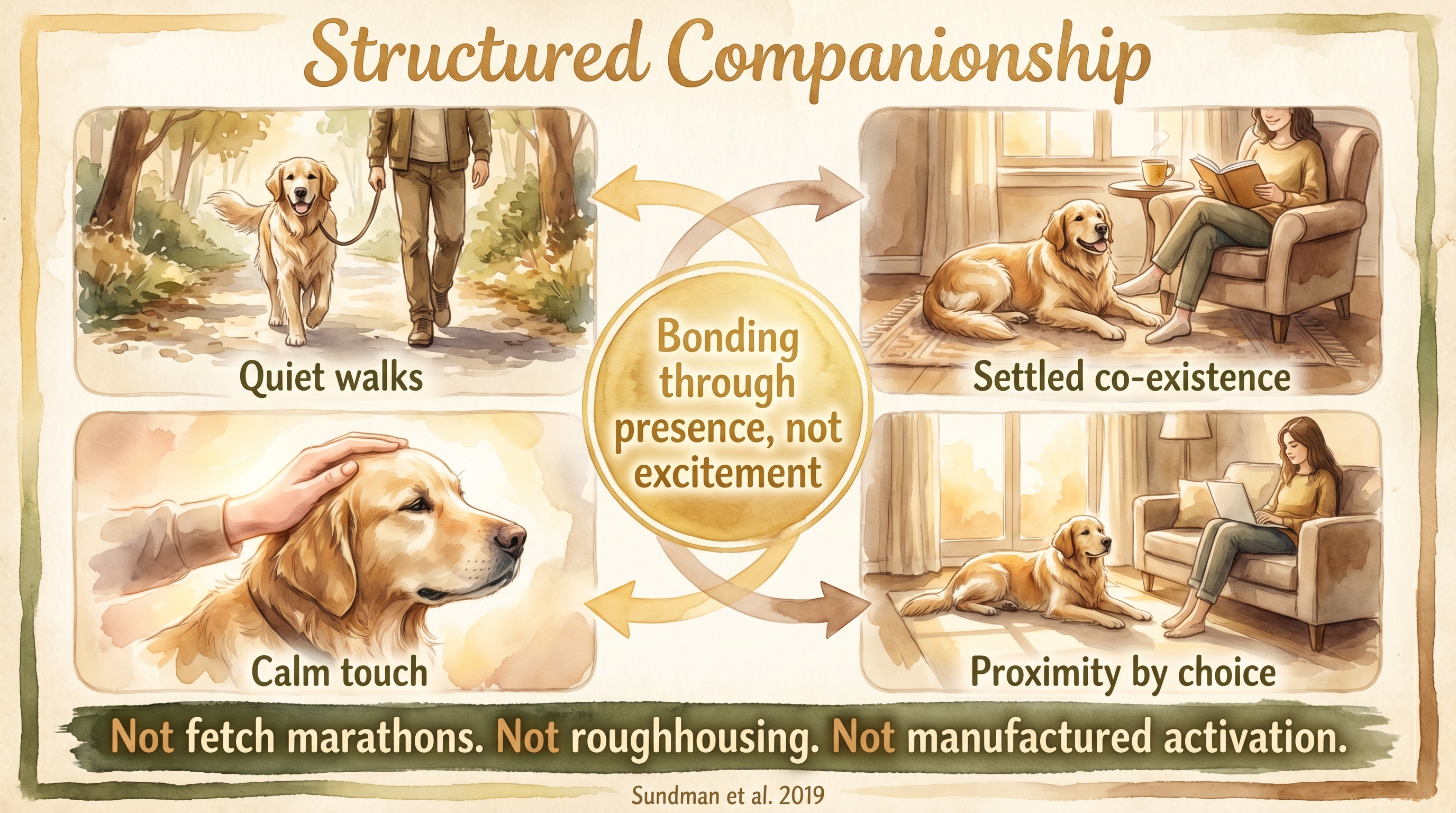
Bonding through presence, not excitement - quiet walks, settled co-existence, calm touch, proximity by choice.
Key Takeaways
- Structured Companionship deepens the bond through calm shared presence - quiet walks, settled co-existence, slow touch, proximity by choice - not through manufactured excitement.
- What you practice becomes the template. If bonding is practiced through excitement, the dog learns the relationship is strongest when arousal is highest.
- Golden Retrievers synchronize with human emotional state through olfaction and cortisol coupling. Your baseline calm is the most powerful bonding tool you have.
- The deepest bonds form through reliable presence and predictable rhythm, not through arousal-based play or stimulation-driven engagement.
The Evidence
This entry uses documented claim-level tags beyond the dedicated EvidenceBlocks below. These claims should remain tied to the entry Sources and SCR references during the next evidence-chain authoring pass.
This entry uses heuristic claim-level tags beyond the dedicated EvidenceBlocks below. These tags mark JB interpretive application rather than direct study findings.
Structured Companionship as Just Behaving names and defines it is a framework concept. The underlying science is clearer.
Maternal care quality - specifically the calm, attentive presence during early development - produces measurable epigenetic changes in how offspring regulate stress. This has been well documented in rats and other mammals. Canine application of this principle follows the same developmental logic [Heuristic], and recent research in working dogs supports it: puppies raised with calm, consistent caregiving show different stress-hormone profiles than puppies raised with inconsistent or high-arousal handling.
Owner-dog cortisol synchronization is documented. Research by Sundman (2019) and others shows that owners and their dogs do synchronize cortisol levels over months and years of living together. This synchronization is stronger with owners who have lower baseline stress, and it is particularly pronounced in cooperative breeds like Golden Retrievers. The owner's emotional baseline is the primary driver. This is not about the dog catching stress from individual anxious moments. It is about the dog's nervous system calibrating to the owner's average emotional state.
Dogs also detect stress biochemistry through olfaction. Multiple studies confirm that dogs can discriminate between human stress odor and human calm odor through smell alone. They are constantly reading your emotional state at a level of precision we cannot consciously match. When you bring structured companionship - when you bring calm - you are literally communicating safety to the dog's primary sensory system.
The claim that this approach produces superior bonding outcomes compared to excitement-based bonding has not been directly tested in comparative studies. But the underlying mechanisms are robust: calm presence synchronizes nervous systems, alters stress-hormone development, and signals safety through olfaction. High-energy bonding does the opposite - it teaches the dog that activation is the signature of attention and closeness.
The deepest bonds in wild nature do not form through manufactured excitement. They form through reliable presence, shared movement, calm proximity, and consistent response to genuine need. Structured Companionship is an alignment with this deeper pattern.
No published study directly tests the specific claims or protocols described in this entry within a controlled canine trial.
SCR References
Practice
Structured Companionship in daily life means:
Quiet exploration. Walk your puppy through the world at the puppy's pace, not for exercise or training. The puppy's job is to notice. Your job is to be calm beside the noticing. The world becomes manageable when you are steady.
Settled co-existence. Bring the puppy into your actual life. If you are reading, the puppy settles in the room. If you are working, the puppy is nearby. Not confined to isolation. Not constantly stimulated. Just nearby in your quiet presence. The puppy learns that being with you feels like safety even when nothing interesting is happening.
Quality touch. Stroking, grooming, and physical contact done slowly and calmly communicates something very different than roughhousing. Calm touch says: I am here. You are safe. Your body can relax. Aroused touch says the opposite.
Predictable rhythm. Meals at the same time. Walks at the same time. Bedtime at the same time. The puppy's nervous system learns it can predict what happens next. Predictability allows the nervous system to downregulate. Chaos keeps it elevated.
Your presence as solution. When the puppy is uncertain, you are there - calm, consistent, unruffled. Not because you have solved the external problem, but because you have communicated through your presence that uncertainty is manageable. The puppy learns to trust your calm more than to trust its own arousal response.
This is not absence of play. It is play that emerges from calm rather than play designed to create chaos. It is not deprivation. It is structure.
The puppy that grows up in structured companionship develops a different relationship to arousal itself. Play remains play - joyful, physical, energetic. But it is something the puppy chooses, not something the puppy has been trained to need. The puppy's baseline does not become elevated. The pup
Sources
- See sourceDocs frontmatter field for internal knowledge base references informing this entry.