The Authoritative Quadrant
Compound evidence detail1 SCR / 3 parts
- Documentedthe Baumrind authoritative-parenting literature in human child development
- Documentedthe canine correlational evidence linking dog-directed caregiving styles to attachment, attention, sociability, and problem-solving outcomes (van Herwijnen 2018/2020, Brubaker and Udell 2023)
- Heuristicthe JB inference that one specific caregiving style experimentally produces the best long-term developmental outcomes in dogs
The authoritative quadrant is the warm-and-structured side of caregiving. In the dog literature, it is the pattern most consistently associated with secure attachment, stronger sociability, and better problem-solving outcomes. The strongest responsible sentence is not that every causal step has been experimentally closed, but that this is the best-supported caregiving direction currently on the board. Documented
What It Means
The authoritative idea comes from parenting science, where it describes adults who combine responsiveness with clear standards. Warmth is present, but it is not permissive. Structure is present, but it is not cold or punitive. That balance matters because living systems generally do best when care is both safe and legible.
When the dog literature adapted this framework, it did not simply copy the human quadrants wholesale and call the job done. van Herwijnen and colleagues first had to show that dog-directed caregiving styles could be measured at all. In their 2018 survey of 518 caregivers, the data recovered an authoritarian-correction pattern and two authoritative patterns, one centered more on the dog's intrinsic value and needs and one centered more on teaching the dog how to function socially. That detail matters because it shows authoritative caregiving is not a single personality mood. It is a family of warm-and-structured orientations.
That two-part authoritative signal is one of the most useful details in the whole literature. One variant emphasizes responsiveness to the dog's needs and emotions. The other emphasizes guidance, manners, and teaching the dog how to behave in shared social life. JB sits closest to the overlap of those two. The adult sees the dog clearly as a dog, stays responsive to real needs, and still expects the dog to grow into orderly participation in family life. That is a much more precise picture than the vague phrase "be nice but firm."
The same study also showed what the field is still missing. Documented No clear permissive or uninvolved cluster emerged in that 518-caregiver sample, likely because the respondents were highly engaged dog families rather than a broad cross-section of less invested households. That limitation matters, but it does not weaken the authoritative result much. If anything, it makes the signal more interesting. Even among comparatively devoted families, the warm-and-structured subgroup still behaved differently enough to stand out.
The 2020 observational follow-up made the difference visible in real behavior. In 40 owner-dog dyads navigating a distraction course, authoritative caregivers used more praise and less correction, while authoritarian-correction predicted more leash tension and more verbal correction. The dogs of authoritative caregivers also tended to look back more at the adult. That looking-back behavior matters in the JB world because it is one of the clearest signs that the adult is functioning as a usable reference point instead of as either background furniture or a source of pressure.
Methodologically, that paper matters because it took the style construct out of questionnaires and into lived interaction. The dogs and caregivers were observed in a more demanding distraction-course setting and a calmer break setting. Style still predicted what happened. Authoritative patterns were expressed in praise and usable attention. Authoritarian-correction was expressed in pressure, corrections, and reduced dog orientation back toward the human. Parenting style explained roughly 30 percent of the variance in the observed interaction, which is substantial for a social-behavior study of this kind. Estimated
That result helps clarify what the authoritative quadrant actually looks like. It is not endless sweetness. It is not silent emotional distance. It is not high-control tightening. It is a style in which the adult remains readable enough that the dog keeps the adult in the behavioral picture. The dog checks in because the adult is worth checking in with.
Brubaker and Udell supplied the strongest direct outcome test. In 48 dyads, dogs of authoritative caregivers showed the highest secure-attachment rates, the strongest persistence on a solvable task, and the best sociability profile. Documented That is an important cluster because it spans relationship quality, emotional organization, and cognitive engagement. The authoritative advantage did not show up in only one narrow domain.
That cluster is exactly why the authoritative quadrant deserves its own page rather than a footnote inside a broader caregiving overview. Secure attachment tells us the dog is using the caregiver well under stress. Sociability tells us the dog's wider social organization is healthier. Persistence on a solvable task tells us the dog stays engaged with effort instead of fragmenting quickly. Those are three different windows into development, and the same style direction performed best across all of them.
One reason the quadrant keeps outperforming its alternatives is that it solves two developmental problems at the same time. Warmth protects the relationship from becoming brittle, avoidant, or fear-based. Structure protects the relationship from becoming vague, permissive, and socially juvenile. If either half is removed, the system loses something important. Too little warmth makes the adult harder to use. Too little structure makes the adult harder to follow.
Bouma's intergenerational work sharpens the same point from another angle. A dog-realistic, protectionistic orientation toward canine needs helped reduce replication of more authoritarian patterns, while more anthropomorphic or compensatory orientations increased the odds of softer but less organized caregiving. That helps explain why authoritative care is not simply a midpoint between strictness and indulgence. It is a distinct orientation in which the adult remains affectionate without collapsing into humanistic projection or abandoning developmental leadership.
That is exactly why JB fits here more naturally than it fits in either the permissive or authoritarian corner. JB's parental language is not an aesthetic preference. It describes a relationship in which the adult is calm enough to regulate with and clear enough to organize around. The authoritative quadrant is simply the research language that comes closest to that configuration.
Bouma's 2024 work strengthens the picture further. Authoritative caregiving aligned with secure attachment, higher sociability, and stronger problem-solving, while permissive caregiving aligned with dogs who followed stranger cues more readily than family cues. That comparison is especially useful because it shows what goes missing when warmth is detached from structure. The dog does not become freer in a developmental sense. The dog becomes less anchored.
The scientific boundary still matters. Dog studies support authoritative caregiving as the strongest documented direction. Documented They do not yet prove that every family outcome can be reduced to one isolated warmth-plus-structure mechanism. But for a family trying to understand what kind of adult to become, the authoritative quadrant is already more than a loose analogy. It is a meaningful evidence-backed target.
Why It Matters for Your Dog
For families, this entry makes an important correction. The opposite of harshness is not permissiveness. The opposite of harshness is warm structure. That is one of the deepest misunderstandings in puppy raising, and it is exactly the misunderstanding the authoritative quadrant helps resolve.
Structured Leadership is JB's lived version of the authoritative quadrant: high warmth, high legibility, and clear parental direction without rivalry or coercive theater.
The practical consequence is substantial. Families do not have to choose between being loving and being clear. The literature increasingly suggests that the best outcomes come from the combination. A puppy needs an adult who feels safe to approach and worth listening to.
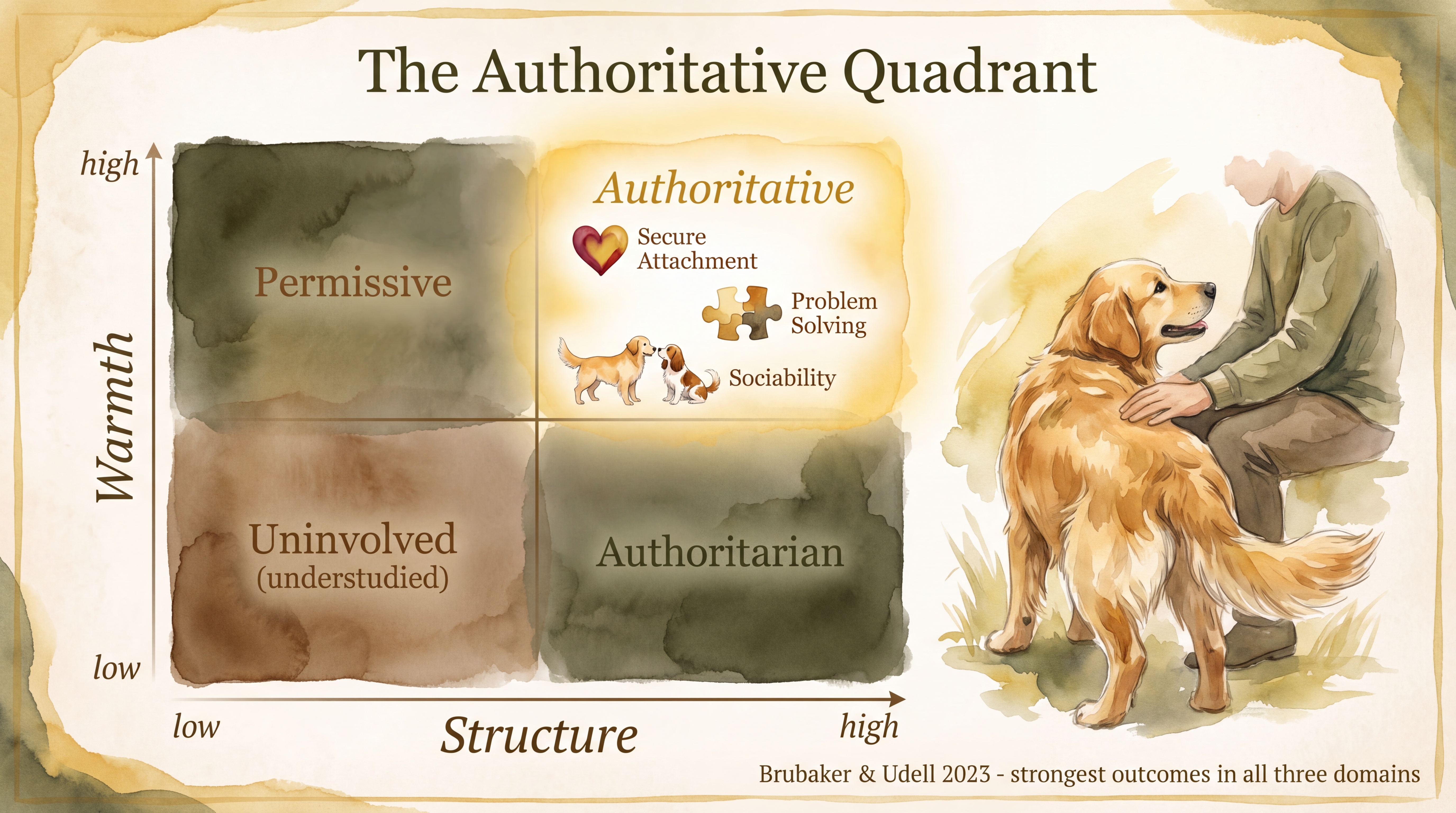
The authoritative quadrant combines high warmth with high structure, the same combination that predicts the best outcomes in human parenting research.
Key Takeaways
- The authoritative quadrant combines warmth with structure rather than choosing one at the expense of the other.
- Dog studies now show that authoritative-like caregiving predicts stronger attachment, sociability, and problem-solving outcomes than comparison styles.
- Warmth without structure tends to weaken the bond as an organizing force, while structure without warmth tends to reduce usability and attention.
- The JB parental model aligns most closely with the authoritative quadrant rather than with permissiveness or control-heavy approaches.
The Evidence
This entry uses estimated claim-level tags beyond the dedicated EvidenceBlocks below. These tags mark approximate ranges or timing claims that should remain bounded by the cited sources.
- van Herwijnen, I. R. et al. (2018)domestic dogs
Recovered authoritative and authoritarian dog-directed caregiving dimensions in a survey of 518 caregivers. - van Herwijnen, I. R. et al. (2020)domestic dogs
Showed that authoritative caregivers used more praise, less correction, and had dogs who oriented back toward them more often in a distraction-course setting. - Brubaker, L., and Udell, M. A. R. (2023)domestic dogs
Found that authoritative caregivers had dogs with the highest secure-attachment rates plus stronger sociability and solvable-task persistence. - Bouma, E. M. C. et al. (2024)domestic dogs
Linked authoritative caregiving to secure attachment, sociability, and problem-solving strength while permissive caregiving aligned with stranger-following and weaker owner anchoring.
- Baumrind, D. (1966, 1991)humans
Established authoritative parenting as the warm-and-structured pattern associated with the strongest overall developmental outcomes in children.
- SCR-019 boundarydomestic dogs and humans
The authoritative direction is strongly supported in dogs, but the full active mechanism behind warmth plus structure remains less experimentally closed than in the strongest human literature.
No published puppy-raising trial has directly compared authoritative-style family routines against permissive or authoritarian family routines from the breeder transition forward.
SCR References
Sources
- Baumrind, D. (1966). Effects of authoritative parental control on child behavior. Child Development, 37(4), 887-907.
- Baumrind, D. (1991). The influence of parenting style on adolescent competence and substance use. Journal of Early Adolescence, 11(1), 56-95.
- Bouma, E. M. C., Vingerhoets, A. J. J. M., & van der Veld, W. M. (2024). Parenting styles and intergenerational transmission in human-dog relationships. Animals, 14(7), 1038. https://doi.org/10.3390/ani14071038
- Brubaker, L., & Udell, M. A. R. (2023). Does pet parenting style predict the social and problem-solving behavior of pet dogs? Animal Cognition, 26(1), 345-356. https://doi.org/10.1007/s10071-022-01694-6
- van Herwijnen, I. R., van der Borg, J. A. M., Naguib, M., & Beerda, B. (2018). The existence of parenting styles in the owner-dog relationship. PLOS ONE, 13(2), e0193471. https://doi.org/10.1371/journal.pone.0193471
- van Herwijnen, I. R., van der Borg, J. A. M., Naguib, M., & Beerda, B. (2020). Dog-directed parenting styles predict verbal and leash guidance in dog owners and owner-directed attention in dogs. Applied Animal Behaviour Science, 232, 105131. https://doi.org/10.1016/j.applanim.2020.105131