Secure Base and Safe Haven
Compound evidence detail2 SCRs / 5 parts
- Documentedthe human attachment evidence base together with the canine-direct secure-base findings (Topal 1998, Horn 2013) and Schoberl-documented physiological effects of secure caregiving in dogs
- Heuristicthe full attachment-theory apparatus transfer to canine relationships, including internal working models and attachment-classification systems
- Documentedthe Baumrind authoritative-parenting literature in human child development
- Documentedthe canine correlational evidence linking dog-directed caregiving styles to attachment, attention, sociability, and problem-solving outcomes (van Herwijnen 2018/2020, Brubaker and Udell 2023)
- Heuristicthe JB inference that one specific caregiving style experimentally produces the best long-term developmental outcomes in dogs
The secure-base and safe-haven idea sits near the heart of Structured Leadership. A healthy caregiver does two things at once: gives the young enough safety to explore, and enough reliability to return when stress rises. Documented For puppies, that means the adult is neither absent nor smothering, neither permissive nor threatening.
What It Means
Bowlby described attachment as a behavioral system organized around security. A young social mammal needs a figure it can use as an anchor. That anchor serves two linked functions. First, it is a secure base: the stable point from which exploration becomes possible. Second, it is a safe haven: the place the young organism seeks when strain, fear, novelty, or overload begin to exceed coping capacity. Documented-Cross-Species
Those functions are easy to separate in theory and easy to confuse in practice. Many people assume safety means closeness all the time. Others assume confidence means pushing independence early. The secure-base model says both are incomplete. Real developmental confidence comes from alternating between supported exploration and reliable return. The young individual moves outward because the base is trusted, and recovers efficiently because the haven is dependable.
Ainsworth made this framework operational. In the Strange Situation, the key question was not whether the child preferred the caregiver in some vague sentimental sense. The question was whether the caregiver changed exploration, distress, reunion, and emotional recovery in a patterned way. That distinction matters for dogs too. The JB claim is not that dogs merely like their owners. It is that the right kind of caregiver relationship organizes behavior under novelty and stress.
Dog research supports the narrower claim strongly. Dogs show attachment-like behavior toward owners and documented secure-base effects in structured testing. Documented In practical terms, the owner is not just a familiar face. The owner changes what the dog can do. Task engagement, exploration, and stress behavior all shift depending on whether that attachment figure is present and how the relationship is organized.
The safe-haven side of the model is especially important for Structured Leadership because it corrects two common mistakes at once.
The first mistake is permissiveness. Some people hear "safe haven" and assume it means endless soothing, loose expectations, and emotional rescue from every small frustration. But a safe haven is not the abolition of boundaries. It is regulated refuge. The puppy returns to an adult who is steady, not to an adult who joins the chaos.
The second mistake is helicoptering. Some people are so afraid of stress that they prevent normal exploration altogether. They over-manage novelty, over-signal concern, and never let the puppy move out into challenge. That weakens the secure-base function. A secure base is not a wall around the puppy. It is a stable point that makes healthy outward movement possible.
This is why JB links secure base and structured leadership so tightly. The puppy needs a person who allows movement but controls tone, allows exploration but defines safety, allows effort but prevents panic. Warmth without containment becomes indulgence. Containment without warmth becomes pressure. The developmental sweet spot is both.
In dogs, attachment quality appears to matter physiologically as well as behaviorally. Securely attached dogs show lower cortisol reactivity in standardized stress procedures, and owner psychological variables predict canine HPA-axis flexibility. Documented That does not mean every moment of reassurance changes a biomarker in some simple one-to-one way. It does mean the relationship is not just emotional poetry. It has measurable consequences.
This is where the connection to Social Buffering becomes especially strong. A safe haven does not merely comfort the puppy subjectively. Under the right relational conditions, the attachment figure can dampen stress responses and improve recovery. Documented JB's language about a calm adult changing the dog's nervous system must still be phrased carefully, but the direction of the evidence is real. The presence and quality of the caregiver matter to the dog's physiological experience of stress.
Practically, that means a secure-base adult has a recognizable feel:
- present without hovering
- available without overhandling
- warm without becoming emotionally leaky
- protective without becoming permissive
- stable enough that the puppy does not have to manage the adult
This also explains why the safe-haven function is inseparable from boundaries. A puppy can only relax into an adult's protection if that adult is actually governing the environment. If doors, guests, furniture, rest routines, and transitions are all chaotic, the adult is not functioning as a haven. A haven is not just kind. A haven is dependable.
The mature version of this looks almost boring from the outside. The puppy ventures out, checks back, recovers, and tries again. There is no drama because the relationship is already doing its work. That is the developmental outcome JB is aiming for: not dependence, and not forced independence, but confident orientation.
Why It Matters for Your Dog
Dogs who have a reliable secure base tend to cope better with novelty, recover faster from minor stressors, and use the owner as information rather than noise. Mixed Evidence That matters in ordinary family life more than people realize. The puppy meeting visitors, hearing the vacuum, navigating a new room, resting through a storm, or settling after a startling moment is always asking the same question in one form or another: What should I do with this? A stable adult answers that question by how they carry themselves.
The adult should be two things at once: a base the puppy can work outward from, and a haven the puppy can come back to when the world gets too large.
What a secure base looks like:
- The puppy explores a room, glances back at the adult, and keeps moving.
- The owner allows the puppy to investigate new things while holding the emotional floor low.
- The puppy can separate briefly, then reconnect without spiraling.
What a safe haven looks like:
- When startled, the puppy moves toward the adult and settles more quickly there than away from them.
- During transition, travel, or novelty, the adult's calm presence lowers the amount of emotional leakage in the system.
- Reunion is steady and reassuring, not frantic and escalating.
What this does not look like:
- Constant hovering that prevents exploration.
- Withholding comfort in the name of toughness.
- Calling anxiety "attachment" when the relationship is actually inconsistent.
- Removing structure and calling the result sensitivity.
The right secure-base relationship produces confidence, not clinginess. The puppy can move outward because it trusts the adult underneath the movement.
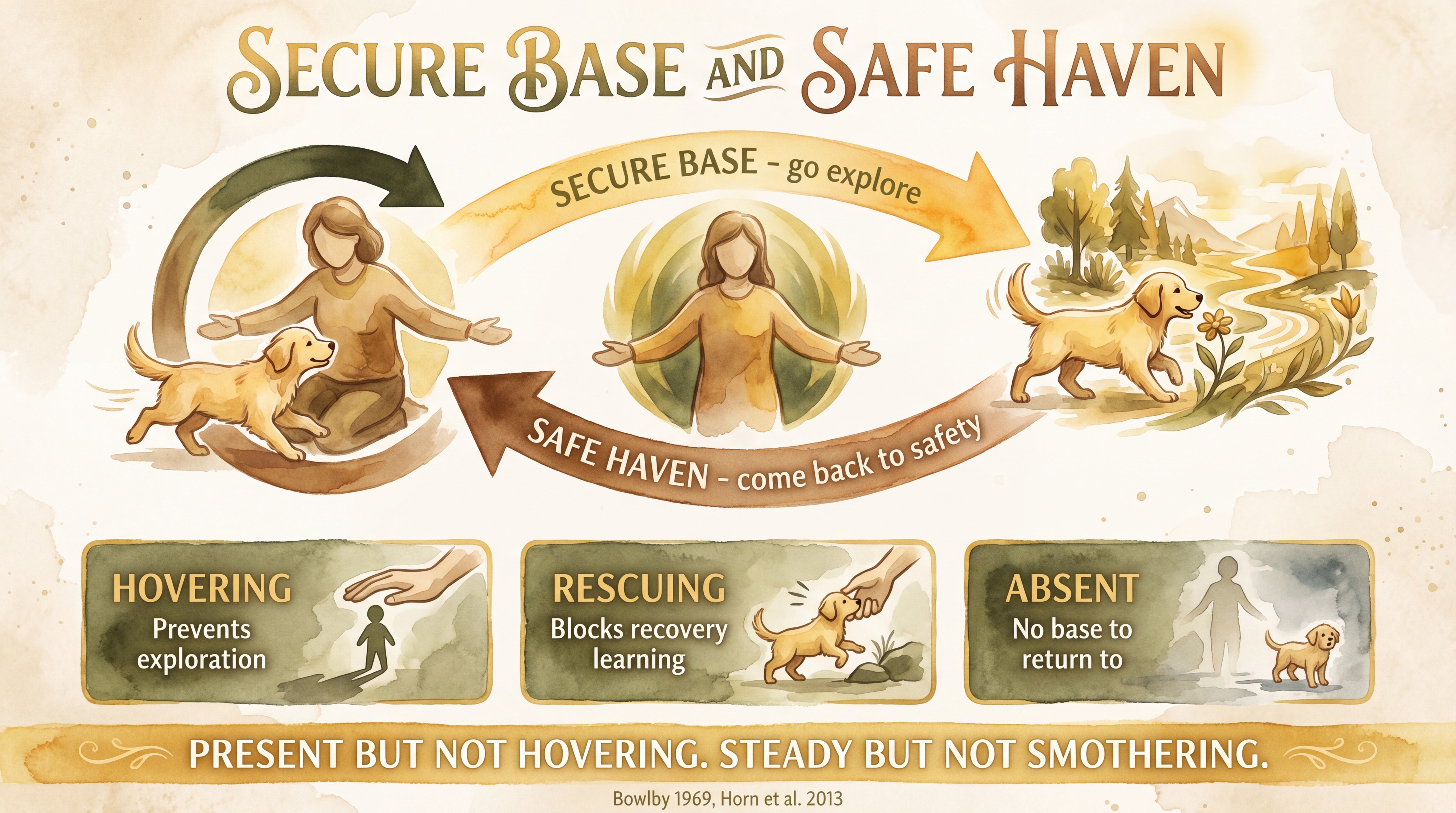
Present but not hovering, steady but not smothering - the dual function that organizes puppy behavior.
Key Takeaways
- Your puppy needs you to be two things at once: a base to explore from, and a haven to return to when things feel overwhelming.
- A secure base does not mean hovering. It means being steady and available, so your puppy can venture out knowing they can come back.
- A safe haven does not mean endless soothing. It means staying calm and organized so your puppy can settle faster than they could alone.
- This balance builds confident independence, not clingy dependence - your puppy learns they can handle challenge because you are managing the security underneath it.
The Evidence
This entry uses mixed-evidence claim-level tags beyond the dedicated EvidenceBlocks below. These tags mark claims that combine documented findings with observed practice, heuristic application, or unresolved gaps.
- Topal et al. (1998)domestic dogs
Dogs showed attachment-like responses toward owners in the Strange Situation paradigm, including differentiated reunion behavior. - Horn et al. (2013)domestic dogs
Demonstrated that owner presence functions as a secure base by changing dog exploration and task persistence in a novel environment. - Schoberl et al. (2016)domestic dogs and humans
Securely attached dogs showed lower cortisol reactivity in standardized stress procedures, linking relationship quality to physiological stress response. - Schoberl et al. (2017)domestic dogs and humans
Owner personality and insecure attachment variables predicted lower HPA-axis flexibility in dogs.
- Bowlby (1969)humans
Defined attachment as an organizing behavioral system in which the caregiver functions as both base and haven. - Ainsworth et al. (1978)humans
Showed that caregiver sensitivity predicts secure attachment patterns and better exploratory balance. - Baumrind (1991)humans
Supports the broader point that warmth plus structure, not warmth alone, predicts stronger developmental functioning.
- JB synthesisdomestic dogs and humans
The claim that Structured Leadership is best understood through the secure-base and safe-haven lens is a principled interpretation of documented dog attachment findings plus human developmental theory. - JB synthesisdomestic dogs
The practical household translation - calm welcome, stable routines, firm boundaries, and emotional steadiness - has strong conceptual support but has not been trialed as a formal JB package in the literature.
No published study directly tests the specific claims or protocols described in this entry within a controlled canine trial.
SCR References
Sources
- Ainsworth, M. D. S., Blehar, M. C., Waters, E., & Wall, S. (1978). Patterns of attachment: A psychological study of the strange situation. Erlbaum.
- Baumrind, D. (1991). The influence of parenting style on adolescent competence and substance use. Journal of Early Adolescence, 11(1), 56-95.
- Bowlby, J. (1969). Attachment and loss. Vol. 1: Attachment. Basic Books.
- Horn, L., Huber, L., & Range, F. (2013). The importance of the secure base effect for domestic dogs. PLoS ONE, 8(1), e65296.
- Schoberl, I., Beetz, A., Solomon, J., Gee, N., Kotrschal, K., & Wedl, M. (2016). Social factors influencing cortisol modulation in dogs during a strange situation procedure. Journal of Veterinary Behavior, 11, 77-85.
- Schoberl, I., Wedl, M., Bauer, B., Day, J., Mostl, E., & Kotrschal, K. (2017). Effects of owner-dog relationship and owner personality on canine cortisol modulation. PLOS ONE, 12(2), e0171373.
- Topal, J., Miklosi, A., Csanyi, V., & Doka, A. (1998). Attachment behavior in dogs (Canis familiaris): A new application of Ainsworth's Strange Situation Test. Journal of Comparative Psychology, 112(3), 219-229. https://doi.org/10.1037/0735-7036.112.3.219tach