The Owner as Physiological Regulator
The human is not merely the dog's trainer, manager, or reward source. The human is part of the dog's biological environment. Long-term cortisol synchrony, owner-to-dog directionality, HPA-axis flexibility, oxytocin-linked interaction, and even stress odor all point in the same direction: what the adult is like to live beside changes what the dog's body has to regulate. Documented
What It Means
The clearest evidence comes from hair cortisol. Documented Sundman et al. (2019) measured long-term cortisol in dog-human dyads and found synchronization across seasons. Later interpretation sharpened the point: dog personality did not significantly predict owner cortisol, but owner personality predicted dog cortisol. In other words, the long-term flow was predominantly human-to-dog. HPA-axis coupling is not a poetic metaphor here. It is a measurable biological relationship.
That is only one pathway. Schoberl et al. (2017) showed that owner psychological profile predicts lower or higher dog cortisol flexibility, with neuroticism and insecure attachment variables associated with less adaptive HPA behavior in the dog. Documented Wilson et al. (2022) then showed dogs can discriminate human baseline odor from human stress odor, and Parr-Cortes et al. (2024) showed that stress odor impairs cognitive flexibility and learning in dogs. The dog does not need to read an adult's face perfectly for the adult's state to matter. The dog can read chemistry.
The oxytocin side rounds out the picture. Calm affiliative interaction patterns help maintain the oxytocin-gaze loop, while activating touch and high-energy handling disrupt it. That means the owner's role is not only negative, as in "your stress leaks onto the dog." It is also positive: the owner's calm can become part of the dog's regulatory environment. The human variable is therefore not a side issue in JB. It is one of the mechanisms by which the whole system works or fails.
This is where families often get the deepest practical correction. They are used to asking, "How do I change the dog?" The physiology says the better first question is often, "What state am I bringing into the room, and how often does the dog have to live inside it?" When the adult changes, the dog is not only receiving a new style of instruction. The dog is receiving a different biological atmosphere.
Why It Matters for Your Dog
For a puppy or young dog, the adult's tone is part of the world. A frantic adult, a chronically stressed adult, or an adult who turns ordinary moments into stimulation will shape what the dog must regulate around. Documented A calm adult does not remove all difficulty, but a calm adult lowers the physiological cost of living in the household.
Calmness matters because the adult's internal state is not private from the dog. The dog's body reads it, couples to it, and often has to cope with it.
This is why JB keeps saying the owner is the environment. That phrase is not a slogan about blame. It is a statement about regulatory power. The dog lives inside a human-mediated world of movement, tone, touch, stress, and recovery. Documented When the adults become calmer, clearer, and less theatrically reactive, the dog is not just getting better guidance. The dog is getting a less costly biology.
It also explains why some families feel change quickly when they stop flooding the room. Documented The dog can settle because the room itself has become settleable. The human variable is not separate from the Five Pillars. It is the mechanism by which they become real in daily life.
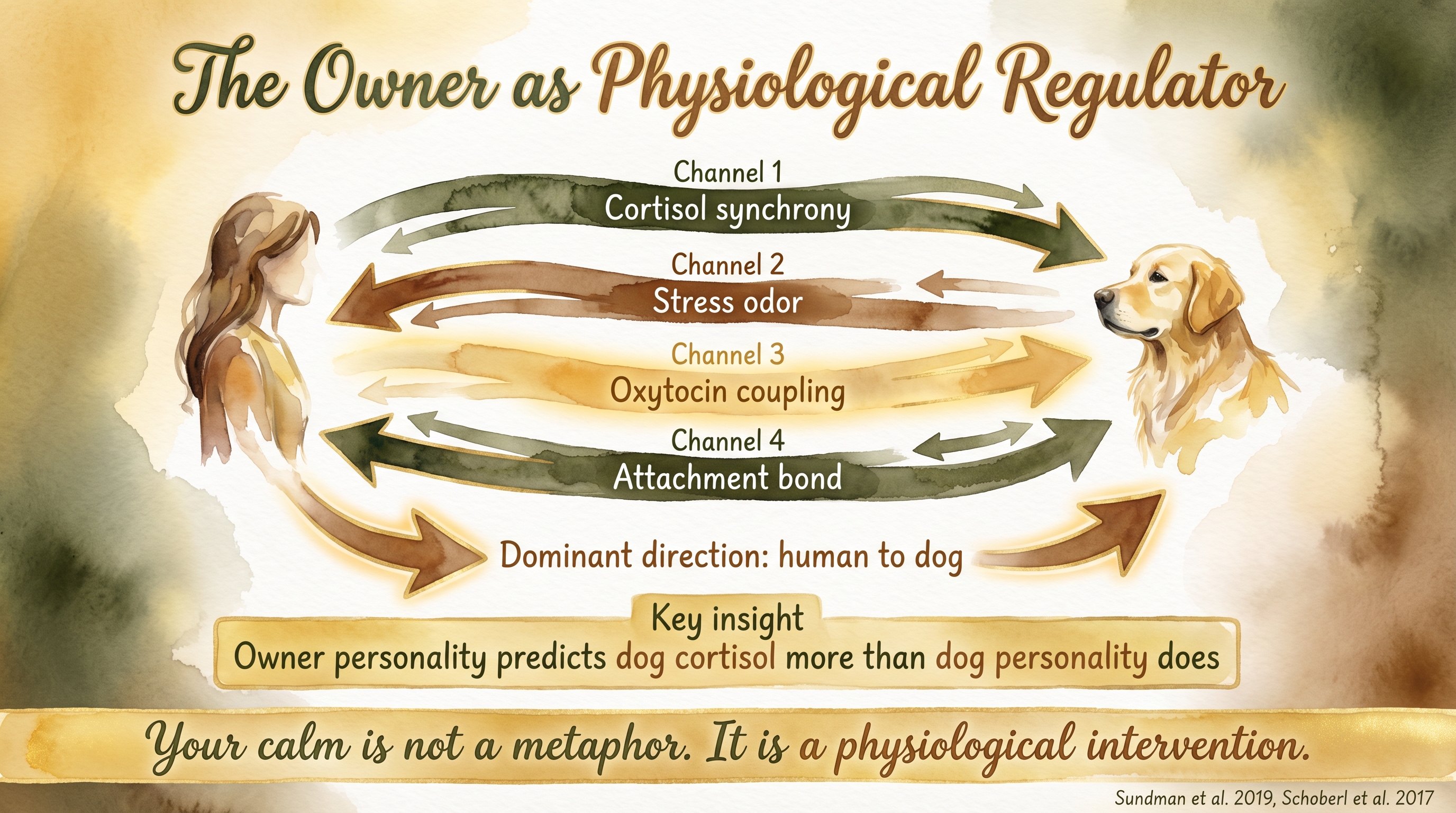
The human is part of the dog's biological environment - cortisol synchrony, stress odor, oxytocin coupling, and attachment all flow predominantly human-to-dog.
Key Takeaways
- The human is part of the dog's biology, not just part of the dog's schedule.
- Hair cortisol work shows long-term stress synchrony, and the strongest evidence suggests the dominant flow is human-to-dog.
- Dogs also detect human stress through odor, and stress odor can impair canine learning and flexibility.
- This is why JB keeps returning to adult calmness. Changing the human changes the dog's environment at the physiological level.
The Evidence
- Sundman, A.-S. et al. (2019)dogs and humans
Found long-term cortisol synchronization between dogs and owners across seasons. - SCR-105 synthesisdogs and humans
Clarified that the predominant direction of long-term cortisol influence is human-to-dog, with coupling strongest in breeds selected for close human cooperation. - Schoberl, I. et al. (2017)dogs and humans
Showed that owner psychological profile predicts dog HPA-axis flexibility more strongly than the dog's own personality traits do.
- Wilson, C. et al. (2022)domestic dogs
Showed that dogs can discriminate human baseline odor from psychological stress odor. - Parr-Cortes, Z. et al. (2024)domestic dogs
Found that odor from a stressed unfamiliar person impaired canine cognitive flexibility and learning performance. - Nagasawa, M. et al. (2015)dogs and humans
Established a documented oxytocin-mediated affiliative loop that helps explain the positive side of owner regulation.
No published household study has yet mapped exactly how much day-to-day owner stress change is required to produce clinically meaningful change in a dog's regulation profile. The pathways are documented, but the practical dose-response curve remains unknown.
Sources
Sundman, A.-S., Van Poucke, E., Holm, A.-C. S., Faresjo, A., Theodorsson, E., Jensen, P., & Roth, L. S. V. (2019). Long-term stress levels are synchronized in dogs and their owners. Scientific Reports, 9, 7391. https://doi.org/10.1038/s41598-019-43851-x
Schoberl, I., Wedl, M., Bauer, B., Day, J., Mostl, E., & Kotrschal, K. (2017). Effects of owner-dog relationship and owner personality on canine cortisol modulation. PLOS ONE, 12(2), e0170707. https://doi.org/10.1371/journal.pone.0170707
Wilson, C., Campbell, K., Petzel, Z., & Reeve, C. (2022). Dogs can discriminate between human baseline and psychological stress condition odours. PLOS ONE, 17(9), e0274143. https://doi.org/10.1371/journal.pone.0274143
Parr-Cortes, Z., Muller, C. T., Talas, L., Mendl, M. T., Guest, C., & Rooney, N. J. (2024). The odour of an unfamiliar stressed or relaxed person affects dogs' responses to a cognitive bias test. Scientific Reports, 14, 16914. https://doi.org/10.1038/s41598-024-66147-1
Nagasawa, M., Mitsui, S., En, S., Ohtani, N., Ohta, M., Sakuma, Y., Onaka, T., Mogi, K., & Kikusui, T. (2015). Oxytocin-gaze positive loop and the coevolution of human-dog bonds. Science, 348(6232), 333-336. https://doi.org/10.1126/science.1261022