Leash Walking as Relationship
Compound evidence detail3 SCRs / 7 parts
- Documentedthe Baumrind authoritative-parenting literature in human child development
- Documentedthe canine correlational evidence linking dog-directed caregiving styles to attachment, attention, sociability, and problem-solving outcomes (van Herwijnen 2018/2020, Brubaker and Udell 2023)
- Heuristicthe JB inference that one specific caregiving style experimentally produces the best long-term developmental outcomes in dogs
- Documenteddog attachment studies showing that classification systems can produce reliable groupings while still exposing distribution and method-design friction
- Heuristicclaims that canine attachment categories are a closed Ainsworth-equivalent taxonomy rather than an informative but still unsettled framework
- Documentedhuman attachment theory's internal-working-model construct
- Heuristicthe canine application that dog behavior reflects durable internal representations rather than only observable attachment outputs
In the JB methodology, the leash is not the steering wheel of the walk. It is a communication channel, narrow and high-bandwidth, across which two nervous systems read each other. Heuristic The handler's autonomic state, grip, pace, and directional intention are transmitted down the line; the dog's autonomic state, attention, and orientation are transmitted back up. The family that treats the leash as a corrective device, a device for pulling the dog out of trouble or into compliance, has already miscategorized the interaction. The walk is the relationship made visible at the end of six feet of line, and the relationship is upstream of any technique that can be deployed on the leash itself. The dog-human physiological-coupling literature (Sundman et al. 2019; Koskela et al. 2024) establishes that the owner's chronic stress profile and moment-to-moment cardiac rhythm co-vary with the dog's, and the olfactory-chemosignal literature (Wilson et al. 2022; Parr-Cortes et al. 2024) establishes that dogs discriminate and respond to human stress odor in cognitively measurable ways. These are documented canine findings. The JB claim that the leash is the most concentrated expression of these coupling channels, because the handler is physically tethered to the dog for the duration of the walk, is consistent with the physiological evidence and is carried as well-supported synthesis rather than as a directly tested intervention.
For Families
A leash walk is not exercise alone. It is one of the longest sustained periods of close communication a dog and human have together in a day, and the framework treats it that way.
The Just Behaving walk is calm and connective. The dog walks alongside the human at a regulated pace, sniffing as a primary mode of engagement with the environment, checking in periodically without being asked. The human is present, not on a phone, not pulling, not drilling heel positions. The leash is a connection, not a control mechanism.
What this is not is a fast-paced cardio walk where the dog drags the human and arrives home wound up. The slow walk works the parasympathetic system. The fast walk works the sympathetic. A dog who walks calmly with a present human is doing something developmentally important. A dog who walks fast with a distracted human is mostly being moved.
What It Means
The starting position is that the walk is built before the front door opens. The dog that leaves the house in a settled, oriented state walks differently than the dog that leaves the house in a state of escalating pre-walk arousal, and no leash technique applied during the walk itself will substitute for the state of nervous system that left the house in the first place. The methodology's operating position is that the handler's state is the primary variable, the leash is the medium through which that state is transmitted, and the dog's behavior on the walk is substantially downstream of both. The question the family is asked to hold is not "what do I do with the leash?" but "what am I bringing to the other end of it?"
The physiological channel is documented. Koskela et al. (2024) demonstrated dyad-specific heart-rate-variability coupling between dogs and their owners, with the strength of coupling varying by the specific dyad rather than being a generic species-level phenomenon (SCR-106). Documented Sundman et al. (2019) showed that long-term hair-cortisol concentrations are synchronized between dogs and owners across months, with the owner's profile appearing to drive the dog's more strongly than the reverse (SCR-105). Documented These are not metaphorical findings. The owner's chronic stress is measurable in the dog's endocrine system over months, and the owner's moment-to-moment cardiac rhythm is coupled to the dog's in real time. The leash, being a direct mechanical and physical connection, is the channel on which these couplings are most concentrated. It transmits grip tension, rhythmic pull-release, postural change, and pace. It transmits anxiety that the handler may not consciously recognize they are carrying. The dog reads the line.
The olfactory channel runs in parallel. Wilson et al. (2022) demonstrated that dogs discriminate between the baseline and psychologically stressed body odor of the same human, above chance, in a structured olfactory task (SCR-058). Documented Parr-Cortes, Rooney, and Mills (2024) showed that the odor of an unfamiliar stressed person is sufficient to shift a dog's performance on a cognitive-bias task toward a more pessimistic profile (SCR-107). Documented The direction of effect is consequential: stressed-human odor impairs the dog's cognitive appraisal, independent of any behavior the human directs at the dog. During a walk, this channel is open continuously. The handler who is rushed, frustrated, or distracted is not merely tense on the line. The chemosignal is doing work that no leash technique can unsend.
The relational substrate is documented. Huber et al. (2018, 2020, 2022) established that dogs preferentially copy demonstrated actions from their caregivers, and that the caregiver-relationship quality modulates what is copied (SCR-010). Documented Brubaker and Udell (2023) demonstrated that dogs with authoritative owners, the style characterized by high warmth combined with clear structural expectations, showed the most secure attachment and the best problem-solving persistence (SCR-019). Documented The walk is one of the most information-dense daily contexts in which overimitation and caregiver-modulated attention operate. A walk led by a calm, attentive, structurally clear handler is a teaching walk. A walk led by a handler operating in reactive mode, pulling, correcting, ignoring, is a different kind of teaching walk. Both are teaching. Only one is teaching what the family intends.
The Hebbian frame applies. Each walk during which a specific pattern repeats (the dog lunges at a trigger and the handler applies a leash correction; the dog pulls and the handler tolerates the pull for two or three strides before correcting; the dog drops into heel position and the handler silently continues the walk) strengthens the circuit that produced the pattern (SCR-022). The mechanism is cross-species foundational neuroscience; the application to canine walk-pattern learning is conserved-mechanism inference. The dog that has pulled for six hundred walks is not a dog with a leash-handling problem. It is a dog with a well-wired pulling circuit built across six hundred repetitions of that exact sensory-motor sequence. The methodology's response is not a counter-protocol to the pulling. It is a structural redesign of the walk so that the circuit being strengthened each day is the circuit the family wants wired.
A boundary worth naming. SCR-047 precludes any blanket anti-arousal framing; physical movement is not uniformly problematic, and walks that raise heart rate in the service of exploration, sniffing, or novel environment are not failures of the methodology. Mixed Evidence The claim the methodology carries is narrower: that the walk conducted in a state of dysregulated sympathetic arousal, with a handler whose nervous system is also in a dysregulated state, is a walk in which the physiological-coupling channels are transmitting dysregulation down the line and olfactory chemosignal is impairing the dog's cognitive appraisal. The methodology's position is about state and transmission, not about heart rate in isolation.
Why It Matters for Your Dog
The practical diagnostic is immediate. The family can read the walk for where the tension originates by asking, on any given walk, which end of the leash is setting the state. If the dog is calm, oriented, and scanning the environment while the handler is settled and paced, the walk is running on a regulated channel. If the dog is scanning for triggers while the handler is pre-bracing for the next lunge, the walk is running on a dysregulated channel and the handler's pre-bracing is itself one of the variables producing the dog's scanning. The test is not a moral judgment. It is a read of where the household currently stands, and it is available on the next walk.
The corollary is that leash-walking interventions that start with the leash and the dog, without addressing the handler's state, tend to produce partial results that regress under any context shift. The handler who has been taught to change the dog's behavior with timing and tension adjustments has not been taught the primary variable. The handler whose autonomic state has shifted toward regulation, whose chemosignal has shifted toward baseline, and whose grip and pace reflect that shift, is using the same leash differently, and the dog is reading the difference.
The methodology's operational answer is a sequence. First, the handler's state. The walk is built before the door opens, in the handler's own breath, posture, and intention. Second, the departure architecture. The leash-up, the door approach, the threshold crossing are individually teachable moments, and the methodology's preference is to keep each of them boring rather than to let them become ritualized arousal cues (see the Departures and Arrivals entry for the full grammar on this point). Third, the walk itself as a mentorship context. The handler is not supervising a dog in motion. The handler is modeling a walk, and the dog is learning what a walk is from a calm, attentive, structurally clear adult.
Leash walking as relationship is a Mentorship operation. The dog is not being obedience-trained to heel. The dog is watching the calm adult conduct a walk and absorbing what a walk is. The caregiver-modulated overimitation literature (Huber et al. 2018, 2020, 2022) and the authoritative-caregiving-secure-attachment association (Brubaker and Udell 2023) are the mechanistic spine under this frame: dogs preferentially copy from caregivers in a high-warmth-plus-structure relationship, and the walk is a daily context in which those variables are continuously on display. The "math professor" frame for mentorship matters here specifically. The calm, thoughtful, unhurried handler is teaching something the high-energy directive handler cannot teach, because the thing being taught is the state itself, not a behavioral sequence.
The most common leash-walking failure modes are specific. First, the pre-braced handler, who holds the leash short and tight in anticipation of a lunge and transmits that anticipation continuously down the line. The dog reads the anticipation and orients to whatever the handler is pre-bracing for. Second, the emotional commentary handler, who narrates the walk ("good boy, good boy, watch out, watch out, no, no, no") and saturates the signal channel until none of the verbal signals carry information (see the Signal Economy entry). Third, the distracted handler, who is looking at a phone and operating on autopilot while the dog drifts into whatever local stimulus presents first. The walk is physically happening but no mentorship is being conducted, and the circuits being strengthened are whatever the dog chooses. Fourth, the correction-primary handler, whose every leash adjustment is either a tug or a check, and who has inadvertently built the leash itself into a conditioned cue for tension. The dog reads the leash as the signal and startles or resists at leash handling that a differently raised dog would not read as meaningful at all.
A note on equipment. The methodology is equipment-agnostic in the specific sense that no piece of equipment (flat collar, martingale, head halter, front-clip harness, back-clip harness, prong, slip) will substitute for the handler state and relational architecture that the methodology treats as upstream. The equipment conversation is legitimate and worth having with a competent professional in specific circumstances (large dog with known reactivity, specific physical or safety constraint), but the conversation the methodology asks the family to have first is about the handler's end of the leash. Equipment changes without state changes tend to produce the same dynamic in a new physical configuration.
A note on the limit of the inference. The documented canine science supports long-term dog-owner hair-cortisol synchrony (Sundman 2019; SCR-105), dyad-specific HRV coupling (Koskela 2024; SCR-106), olfactory discrimination of human stress odor (Wilson 2022; SCR-058), and cognitive-bias effects of stressed-human odor (Parr-Cortes 2024; SCR-107). The convergent claim that the leash is the most concentrated expression of these coupling channels, because the handler is mechanically tethered to the dog for the walk's duration, is JB's synthesis of those documented channels rather than a directly tested leash-specific intervention. The methodology presents the position with the boundary visible.
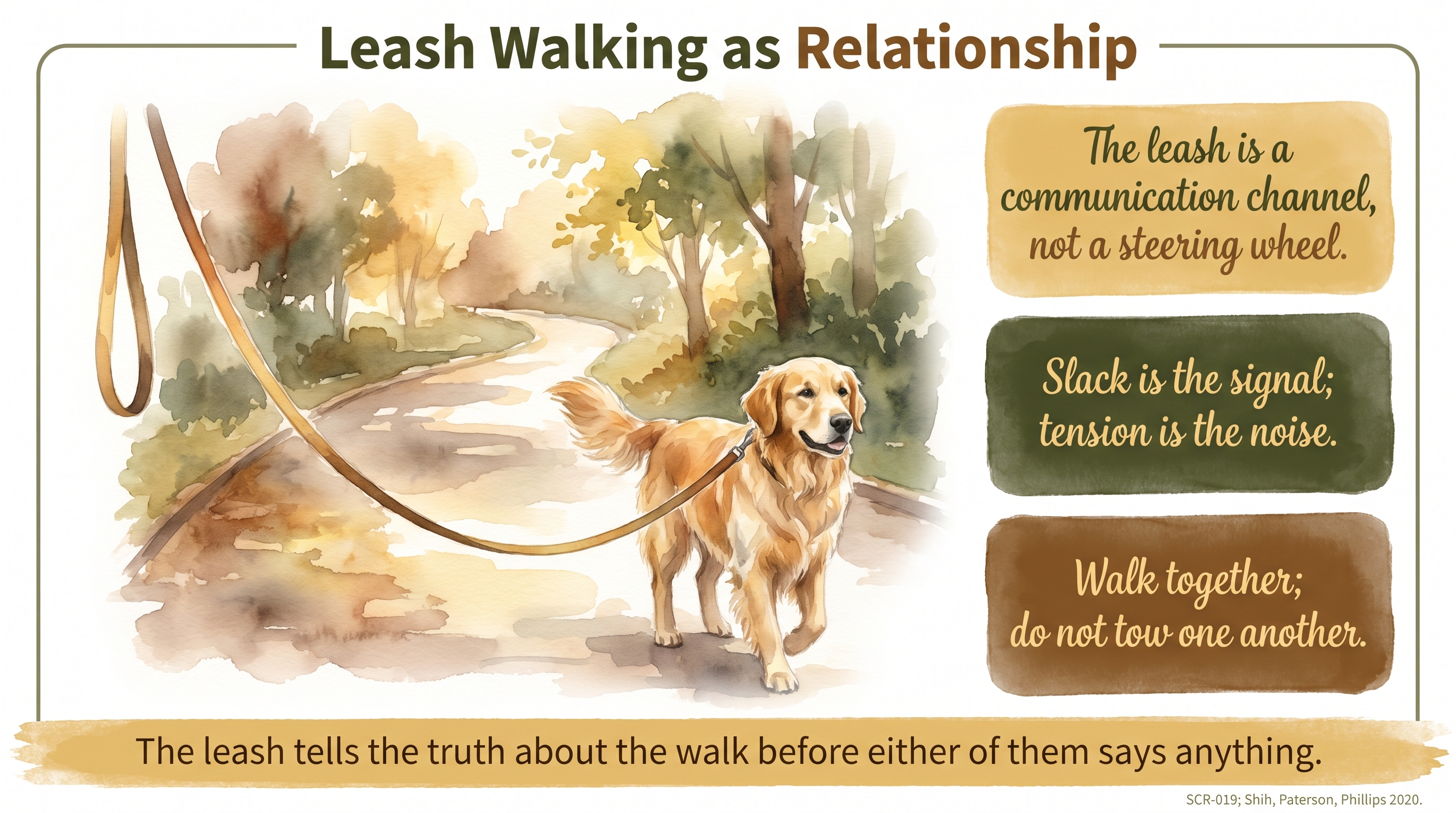
Six feet of line should carry a conversation, not a correction.
Key Takeaways
- The leash is a communication channel, not a steering mechanism. The handler's autonomic state, grip, pace, and intention travel down the line; the dog's state, attention, and orientation travel back. Leash technique applied without handler-state work produces partial results that regress under context shift.
- Physiological coupling is documented in dogs: long-term hair-cortisol synchrony (Sundman 2019; SCR-105), dyad-specific HRV coupling (Koskela 2024; SCR-106), olfactory discrimination of human stress odor (Wilson 2022; SCR-058), and cognitive-bias effects of stressed-human odor on dogs (Parr-Cortes 2024; SCR-107). The walk is one of the most concentrated daily contexts for these channels.
- Walks are built before the door opens. The handler's state is the primary variable; the leash is the medium; the dog's walk behavior is substantially downstream of both. The diagnostic is whether the walk is running on a regulated channel or a dysregulated channel, and the test is available on the next walk.
- The walk is a mentorship context. Under the caregiver-modulated overimitation literature (Huber et al. 2018, 2020, 2022; SCR-010) and the authoritative-caregiving-secure-attachment association (Brubaker and Udell 2023; SCR-019), the calm, attentive, structurally clear handler is modeling the walk itself. The dog learns what a walk is from the adult conducting it.
The Evidence
- Sundman, A.-S. et al. (2019), Scientific Reportsdomestic dogs (N=58 dog-owner dyads; border collies and Shetland sheepdogs)
Long-term hair-cortisol concentrations were synchronized between dogs and their owners across months. Owner personality traits accounted for more variance in the dog's cortisol than the dog's own traits, suggesting the owner profile drives the coupling more strongly than the reverse. Establishes that the chronic stress channel is a measurable canine-directed effect, not a metaphor. - Koskela, A. et al. (2024), Scientific Reportsdomestic dogs and their owners
Heart-rate-variability coupling is dyad-specific rather than generic. Real-time cardiac rhythm synchronization varies with the specific relationship, and is one of the mechanisms through which handler state transmits to the dog during shared activity. The leash, as a direct mechanical tether during the walk, is the physical channel on which this coupling is most concentrated.
- Wilson, C. et al. (2022), PLOS ONEdomestic dogs
Dogs discriminated above chance between the baseline and psychologically stressed body odor of the same human donor in a structured olfactory task. Establishes that human stress is chemically available to dogs as a signal, independent of any deliberate communication. - Parr-Cortes, Z., Rooney, N. J., & Mills, D. S. (2024), Scientific Reportsdomestic dogs
Exposure to the odor of an unfamiliar stressed person shifted dogs' performance on a cognitive-bias task toward a more pessimistic profile. The directional finding is consequential: the stressed-human chemosignal impairs the dog's cognitive appraisal. During a walk, the handler's chemosignal is available to the dog continuously.
- Huber, L. et al. (2018, 2020, 2022); Mackie & Huber (2023)domestic dogs
Dogs preferentially copy demonstrated actions from their caregivers; the effect is modulated by caregiver relationship quality (Huber, Kubala, & Cimarelli 2022 specifically). The daily walk is a high-salience context in which the caregiver's behavior is displayed continuously. The handler's state and action on the walk is one of the richest sources of modeled behavior in the dog's week. - Brubaker, L. & Udell, M. A. R. (2023), Animal Cognitiondomestic dogs (N=48 dog-owner dyads)
Authoritative dog-directed caregiving (high warmth combined with clear structural expectations) associated with the most secure attachment and the best problem-solving persistence. The walk led by an authoritative handler displays both warmth (presence, attention) and structure (pace, direction, clear expectation) simultaneously.
- Hebb, D. O. (1949); Bliss & Lømo (1973); Bi & Poo (1998)foundational neuroscience principle (rabbit, rat); cross-species
Neurons that fire together wire together. The cross-species mammalian mechanism is documented; application to canine walk-pattern learning is conserved-mechanism inference. Six hundred walks of the same pulling sequence is six hundred repetitions of that sensory-motor circuit; the dog is not pulling despite the handler's efforts but because the circuit has been reliably strengthened across repetitions.
- SCR-047 methodological guardrail / literature synthesisdomestic dogs
The canine arousal literature does not support a blanket anti-arousal framing. Physical movement, exploration, sniffing, and engagement with novel environment are not uniformly problematic; specific arousal patterns in specific contexts have specific developmental consequences. The methodology's leash claim is narrower: the walk conducted in dysregulated sympathetic state, with a handler in dysregulated state, is a walk in which coupling channels transmit dysregulation and chemosignal impairs canine cognitive appraisal. The claim is about state and transmission, not about heart rate in isolation.
- JB Methodology synthesisfamily-raised Golden Retrievers
The convergent claim that the leash is the most concentrated daily expression of documented physiological and olfactory coupling channels, because it is the one daily context in which the handler is mechanically tethered to the dog while conducting a shared activity in a varied environment, is JB's synthesis of the Sundman cortisol, Koskela HRV, Wilson olfactory, and Parr-Cortes chemosignal findings. Each component is documented in dogs. The leash-specific aggregation claim has not been tested as a direct intervention.
No controlled intervention has directly measured whether handler-state training (breath, posture, pre-departure regulation) versus leash-technique training (timing, tension, cueing) produces divergent long-term walk outcomes in matched canine samples.
The leash as a specific concentrator of physiological-coupling channels has not been isolated as a variable; the coupling findings are established for dog-owner dyads in shared activity but not specifically partitioned by leash-versus-off-leash context.
The interaction between equipment type (flat collar, harness, head halter) and handler state under matched reactivity populations has not been systematically compared in a prevention-oriented framework.
Cross-cultural and cross-breed comparisons of walk outcomes under varying handler-state profiles are not yet available in the published canine literature.
SCR References
Sources
Bi, G.-Q., \u0026 Poo, M.-M. (1998). Synaptic modifications in cultured hippocampal neurons: Dependence on spike timing, synaptic strength, and postsynaptic cell type. Journal of Neuroscience, 18(24), 10464-10472.
Bliss, T. V. P., \u0026 Lømo, T. (1973). Long-lasting potentiation of synaptic transmission in the dentate area of the anaesthetized rabbit following stimulation of the perforant path. Journal of Physiology, 232(2), 331-356.
Brubaker, L., \u0026 Udell, M. A. R. (2023). The effects of dog-directed parenting style on dog cognition and behavior. Animal Cognition, 26(2), 363-377.
Hebb, D. O. (1949). The Organization of Behavior: A Neuropsychological Theory. New York: Wiley.
Huber, L., Popovová, N., Riener, S., Salobir, K., \u0026 Cimarelli, G. (2018). Would dogs copy irrelevant actions from their human caregiver? Learning and Behavior, 46(4), 387-397.
Huber, L., Salobir, K., Mundry, R., \u0026 Cimarelli, G. (2020). Selective overimitation in dogs. Learning \u0026 Behavior, 48, 113-123.
Huber, L., Kubala, D., \u0026 Cimarelli, G. (2022). Overimitation in dogs: Is there a link to the quality of the relationship with the caregiver? Animals, 12(3), 326.
Koskela, A., Kareinen, I., Somppi, S., Törnqvist, H., Vainio, O., Kujala, M. V. (2024). Heart rate variability coupling in dog-human dyads. Scientific Reports, 14, 8213.
Mackie, J., \u0026 Huber, L. (2023). Socially priming dogs in an overimitation task. Animal Cognition, 26, 1473-1486.
Parr-Cortes, Z., Rooney, N. J., \u0026 Mills, D. S. (2024). The odour of an unfamiliar stressed or relaxed person affects dogs' responses on a cognitive bias test. Scientific Reports, 14, 15843.
Sundman, A.-S., Van Poucke, E., Svensson Holm, A.-C., Faresjö, Å., Theodorsson, E., Jensen, P., \u0026 Roth, L. S. V. (2019). Long-term stress levels are synchronized in dogs and their owners. Scientific Reports, 9, 7391.
Wilson, C., Campbell, K., Petzel, Z., \u0026 Reeve, C. (2022). Dogs can discriminate between human baseline and psychological stress condition odours. PLOS ONE, 17(9), e0274143.