The Hierarchy of Response
Compound evidence detail1 SCR / 2 parts
- Documentedethological evidence that dogs modulate corrective signals by intensity, duration, and immediate social context rather than treating correction as a prolonged generalized state
- Heuristicthe JB synthesis that this canine correction pattern reflects a broader social-mammal principle rather than only a species-specific observation
In JB, the Hierarchy of Response is the operating principle that orders the family's three available tools, prevent first, mentor second, correct last, as a decision sequence rather than as three interchangeable techniques to choose between. Heuristic The component neuroscience of each tier is documented in its source species: Bouton on the asymmetry of extinction, Gazit on canine renewal, Fugazza on eight-week social learning, Hebb and Gross on circuit-building and postnatal myelination, Mech on wolf-family structure. The convergent ordering into a hierarchy the household should follow every time a behavior is in question is JB's synthesis of those findings. The argument is mechanistically coherent, but no controlled comparative trial in dogs has tested the hierarchy as a ranked intervention sequence.
What It Means
The Hierarchy of Response answers a single question. When a behavioral moment arrives, what does the family do first? The methodology's answer is structural. Prevention is the first move. If prevention is not available or was not successful, mentorship is the second move. If neither prevention nor mentorship is available in the moment, indirect correction is the third. Each tier sits above the next in a specific sense: when the upper tier succeeds, the lower tier is unnecessary. The family does not choose between them as equally valid options. The family works down the hierarchy only as far as the situation requires.
The neurological argument for that ordering is not a preference. It is an asymmetry that is documented at each tier.
The first tier is prevention. When the family arranges the environment so that a behavior never gets the chance to practice itself, no learning trace is written. Hebbian plasticity, the foundational 1949 principle that repeated co-activation strengthens the underlying neural pathway, is established cross-species; direct canine cellular demonstrations of LTP do not exist but the mechanism is universally accepted (SCR-022). Documented Gross and colleagues (2010) used longitudinal MRI and histology in 17 dogs from one to thirty-six weeks to document progressive postnatal myelination, with the canine brain reaching a mostly adult-like appearance by approximately sixteen weeks and continued white-matter maturation extending well beyond (SCR-040). Documented What is being insulated by myelin during this period plausibly includes whatever circuits the puppy is most actively engaging, though the link between repetition of a specific behavior and insulation of its specific underlying circuit has not been mapped directly in dogs. Mixed Evidence A behavior never initiated is a circuit never built, never myelinated, and never automated. That is the least expensive neurological condition for the family to produce, and it produces it by arranging the household rather than by doing anything to the dog.
The second tier is mentorship. When prevention is not available, the family's next move is to model the behavior the situation calls for rather than to command it. Fugazza, Moesta, Pogány, and Miklósi (2018) documented that puppies as young as eight weeks can acquire behaviors through observation of conspecifics, with the learned response retained after a one-hour delay; the study used N=41 puppies across seven litters and three demonstrator conditions (SCR-009). Documented The social-learning channel is available at the developmental window when puppies arrive in JB families. It requires no elevated arousal, no verbal instruction, and no treat economy. Mech's 1999 review reframed wolf-pack organization as family-unit structure around parental relationships rather than dominance hierarchies, and subsequent developmental-ecology work has documented regurgitative provisioning, graduated tolerance-withdrawal, and active parental structuring of pup access to food, movement, and social interaction (SCR-021). Documented The structure the JB household provides for mentorship is consistent with that canine-ancestor developmental ecology: calm adults going first, the puppy observing, the response being modeled before it is asked for. The methodology routes the middle tier through this channel because it is the channel the puppy's nervous system is best prepared to receive.
The third tier is indirect correction. When prevention has failed and mentorship is not available in the moment, the family communicates disapproval through body blocking, spatial pressure, a calm vocal marker, or quiet disengagement. The claim that these signals mirror natural canine social communication is supported by ethological work: Abrantes, Bekoff, and Mech documented that canine correction in stable social groups is typically proportional, brief, and context-specific, with the signaling dog returning to neutral once the message has been received (SCR-029). Documented JB's correction protocol is engineered to match those properties and to stop the moment a de-escalation signal appears. The correction tier is last in the hierarchy for two convergent reasons: the prevention window is already gone by the time it is invoked, and the neurological cost of extinguishing a behavior is greater than the cost of never building it. Bouton (2002, 2004) established across extensive rodent work that extinction does not erase the original conditioned response; it generates a new, context-dependent inhibitory circuit that suppresses but does not replace the original, with spontaneous recovery, renewal, reinstatement, and rapid reacquisition all documented return-of-behavior conditions (SCR-008). Documented Gazit, Goldblatt, and Terkel (2005) demonstrated the renewal effect directly in domestic dogs. Detection dogs whose accuracy had dropped to 52.46% in an extinction context rebounded to 95.83% when tested in a novel one. Documented The third tier is not forbidden. It is expensive, and the hierarchy treats it as expensive.
The final structural piece is what correction frequency tells the family about the hierarchy itself. If the family finds itself correcting often, the hierarchy is not failing. It is reporting. Frequent correction is a diagnostic signal that the prevention architecture and the mentorship rhythm above it are not carrying the weight they should. The family's response is not to correct more effectively. It is to move up the hierarchy, look at what the environment has been producing, and redesign upstream. A household that has been running the hierarchy well is a household in which correction is rare because the two layers above it are doing their work.
Why It Matters for Your Dog
The practical consequence of holding the hierarchy in order is that the family stops treating every behavioral moment as a training opportunity. Most behavioral moments are not training opportunities. They are situations the family can prevent, model, or quietly let pass. The hierarchy is the difference between a family that asks "what command do I give here?" and a family that asks "what does this moment actually call for?" The first question points at the dog. The second question points at the whole situation, including what the family has arranged and what the family is modeling.
The inversion, treating correction as first rather than last, is the default mode of most households, and it is the mode the JB methodology is designed to undo. The default is understandable. Something happens, the family reacts, and a correction feels like the most direct route from problem to outcome. But the route is only direct in the moment. The asymmetry between building a circuit and extinguishing it, which is documented in rodents and demonstrated in domestic dogs through Gazit's renewal work, means that the route is long when measured across the life of the dog. Corrections accumulate. Extinguished behaviors reappear under any of the four return-of-behavior conditions Bouton mapped. The household that lives in the third tier is a household that is never finished addressing the same patterns.
The hierarchy is also the principle that allows the family to be generous with itself about imperfection. Prevention will sometimes fail. The second tier, mentorship, is not just a tool; it is the buffer that protects the family from the costs of that failure. A family that has built a strong modeling relationship with its puppy has a middle tier to fall back on when prevention was not enough. A family that has not built that relationship is left with only the third tier, and the third tier is where every failure becomes expensive. The middle tier matters because it makes the third tier rare.
The Hierarchy of Response is the operational expression of all five pillars working as a sequence. Prevention governs the first tier and organizes the upstream architecture that keeps the other two tiers rare. Mentorship governs the second tier, carrying the relational work when the first tier was not available. Indirect Correction governs the third tier, communicating disapproval in a canine-legible way when the first two have been exhausted. Structured Leadership is the relational context that makes each tier possible, and Calmness is the physiological floor that keeps every tier working at its intended cost. Prevention is named at the callout because the hierarchy's weight sits there. The other pillars carry the day-to-day mechanics of what happens inside the sequence Prevention establishes.
A related practical point. The hierarchy is not a license for passivity at the first tier. Prevention is active work. It is environmental arrangement, household routine, and developmental timing held steady across the first months of the puppy's life in the family home. A family that has "prevented" a behavior by accident, because the situation happened not to come up yet, has not prevented anything. They have simply delayed the first practice trial. The hierarchy asks the family to design the household so that the situations the family does not want a circuit for do not arrive on their own terms.
For Golden Retrievers in the JB program, the hierarchy has a developmental leverage the family does not need to engineer alone. The puppy arrives already having spent eight-plus weeks in a structured social group where calm adult dogs modeled the grammar the family is now continuing, where prevention was the ambient operating condition rather than a protocol the family had to introduce, and where indirect correction has been the only correction the puppy has encountered. The family is not starting the hierarchy at the first tier with a blank-slate nervous system. The family is inheriting a puppy whose prevention tier has already been running for two months, whose mentorship tier is already the learning channel the puppy expects, and whose correction tier has only ever been canine-legible indirect signals. The household's job is to continue the sequence, not to install it.
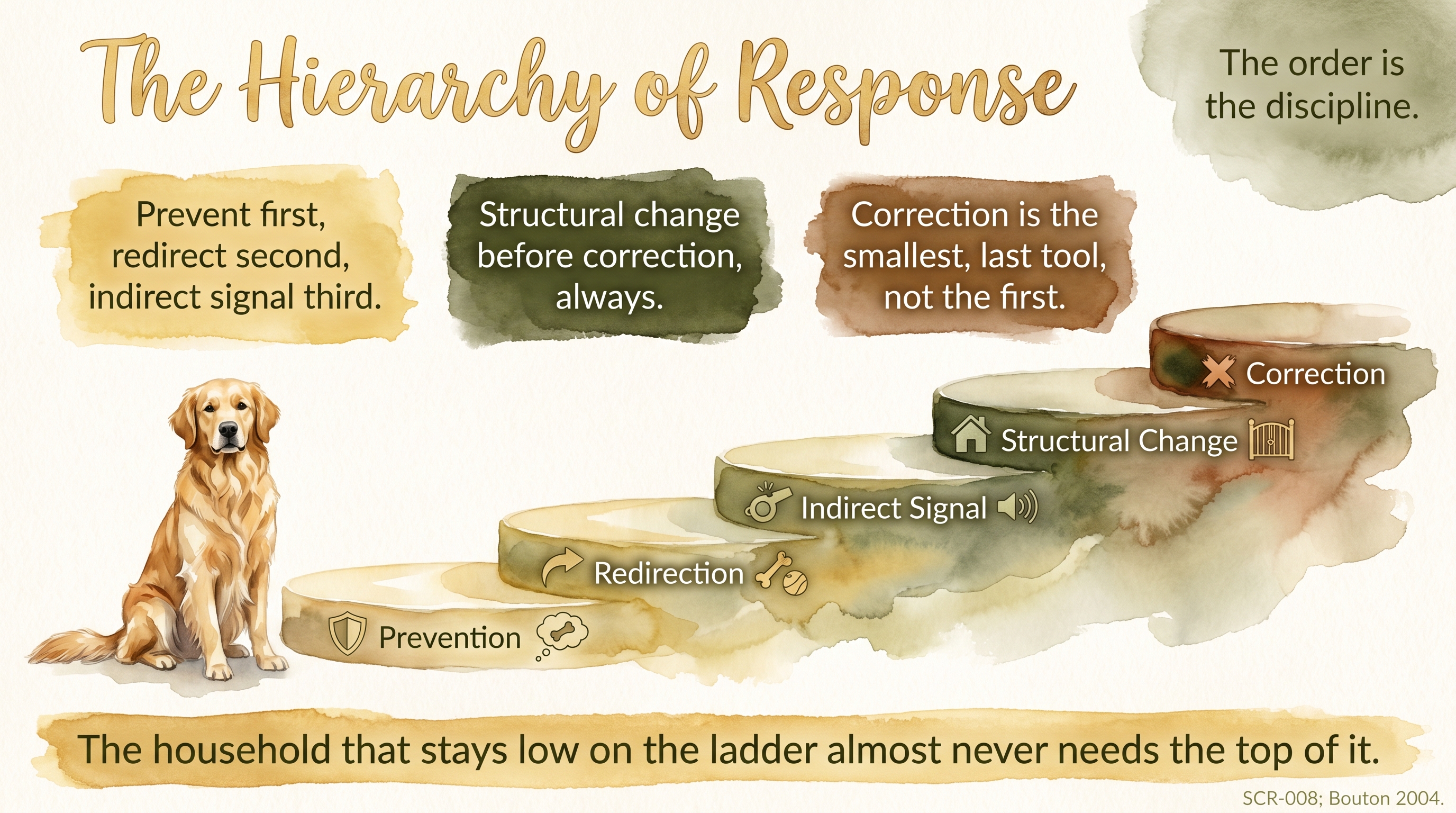
Prevention is the first floor of the house; correction is the last.
Key Takeaways
- Prevention, mentorship, and indirect correction are not three interchangeable tools. They are a ranked sequence. When the upper tier succeeds, the lower tier is unnecessary, and the family works down the sequence only as far as the situation requires.
- The ordering is grounded in documented asymmetries: Hebbian circuit-building and postnatal myelination make unpracticed behaviors the cheapest neurological condition; Fugazza's 8-week social learning finding places mentorship inside the window the puppy arrives in; Bouton's extinction asymmetry, demonstrated in domestic dogs by Gazit, makes correction the most expensive option.
- Correction frequency is a diagnostic signal, not a performance measure. A household correcting often is a household whose prevention and mentorship layers are not carrying the weight they should. The response is to move up the hierarchy and redesign upstream, not to correct more effectively.
- The JB puppy arrives with the hierarchy already running. Eight-plus weeks of structured social group life means prevention has been the ambient condition, mentorship has been the learning channel, and correction has only appeared as canine-legible indirect signal. The family continues the sequence rather than installing it.
The Evidence
This entry uses mixed-evidence claim-level tags beyond the dedicated EvidenceBlocks below. These tags mark claims that combine documented findings with observed practice, heuristic application, or unresolved gaps.
- Hebb, D. O. (1949); Bliss & Lømo (1973); Bi & Poo (1998)rabbits (Bliss & Lømo); rats (Bi & Poo); foundational neuroscience principle
Neurons that fire together wire together. Long-term potentiation and spike-timing-dependent plasticity are the documented cellular substrates. The behavioral application to canine developmental practice is conserved-mechanism inference; direct canine cellular plasticity demonstrations do not exist. The mechanism is foundational and universally accepted. - Gross, B. et al. (2010)domestic dogs (N=17, longitudinal 1-36 weeks)
Longitudinal MRI and histology documented progressive postnatal myelination, with the canine brain approaching adult-like appearance by approximately 16 weeks and continued subcortical white-matter arborization extending well beyond. What is being insulated by myelin during this period plausibly includes whatever circuits the puppy is most actively engaging; the specific link between repetition of a behavior and insulation of its circuit has not been mapped directly in dogs.
- Fugazza, C., Moesta, A., Pogány, Ã., & Miklósi, Ã. (2018)domestic dogs (N=41 puppies, 7 litters, three demonstrator conditions)
Direct canine evidence that eight-week-old puppies can acquire novel behaviors through observation of conspecifics, with the learned response retained after a one-hour delay. The three demonstrator conditions (mother, unfamiliar dog, no demonstration) differentiated observational learning from independent exploration. The mentorship tier of the JB hierarchy operates through a learning channel the puppy's nervous system is documented to use at the exact developmental window it arrives in the family.
- Mech, L. D. (1999, 2000); Mech, Wolf, & Packard (1999); Packard et al. (1992); Ruprecht et al. (2012)wolves
Mech's 1999 review reframed wolf-pack organization as family-unit structure around parental relationships rather than dominance hierarchies. Subsequent work documented regurgitative provisioning, graduated tolerance-withdrawal during weaning, homesite attendance by sex and breeding status, and active parental structuring of pup access to food, movement, and social interaction. The canine-ancestor developmental ecology is consistent with the JB mentorship tier: calm adults going first, young observing, responses modeled before they are asked for. This refutes dominance-based training; it does not, by itself, validate the full JB hierarchy.
- Abrantes; Bekoff; Mech (ethological synthesis)domestic dogs and wolves
Descriptive ethological work establishes that intra-canine correction is typically low-intensity, brief, and precisely timed to the behavior in question, with the signaling animal returning to neutral once the de-escalation signal is received. JB's indirect correction protocol is engineered to match those properties, with explicit stop rules when a canine de-escalation signal appears. The descriptive characterization is documented; the claim that matching it produces specific behavioral outcomes in household contexts is JB's operational application of the ethological pattern.
- Bouton, M. E. (2002, 2004); Bouton, Winterbauer, & Todd (2012)rats (primary experimental work)
Extinction generates a new, context-dependent inhibitory circuit that suppresses but does not erase the original conditioned response. The original pathway reappears under spontaneous recovery (time), renewal (context change), reinstatement (re-exposure to trigger), and rapid reacquisition (fresh training). The four return-of-behavior conditions are the reason the third tier of the hierarchy is last, not forbidden: correcting a behavior the family could have prevented creates a neurological situation that will need managing for the life of the dog. - Gazit, I., Goldblatt, A., & Terkel, J. (2005)domestic dogs (5 Belgian Malinois, 2 Labrador Retrievers; explosives detection)
Direct canine demonstration of the renewal effect. Dogs trained on Path A (5 explosives) and Path B (0 explosives) showed detection collapse on Path B (52.46% accuracy, 46.89% ambling). When tested in novel Path C with identical low target density, search behavior renewed: detection rebounded to 95.83%, ambling dropped to 28.62%. Authors explicitly cite Bouton & Ricker (1994). Direct evidence that extinction is context-dependent inhibition, not erasure, in domestic dogs.
- JB Methodology synthesisfamily-raised Golden Retrievers
The claim that the prevent-mentor-correct sequence is the correct operational ordering of the family's three available tools is JB's synthesis of Hebbian circuit-building, activity-dependent myelination, Fugazza's social-learning finding, Mech's wolf-pack developmental ecology, the ethology of natural canine correction, and the Bouton-Gazit extinction asymmetry. Each component is independently documented in its source species or context; the convergent ordering into a ranked household hierarchy has not been tested as a direct intervention sequence in a controlled canine trial. JB presents the hierarchy as a mechanistically coherent operating principle rather than as a directly demonstrated canine behavioral finding, and treats correction frequency as a diagnostic signal about the two upstream tiers rather than as a performance metric.
No controlled canine trial has compared prevent-first, mentor-second, correct-last household raising against any alternative ordering (e.g., correction-primary protocols) on long-term behavioral, physiological, or relational outcomes.
Direct canine neural comparison of behaviors routed through the three tiers (functional connectivity, basal ganglia engagement, prefrontal-amygdala coupling) has not been published.
Observational learning capacity has been established in eight-week-old puppies (Fugazza 2018). The practical limits of household mentorship as a substitute for direct instruction across diverse behavioral domains in domestic contexts remain under-characterized in the canine literature.
Correction-frequency as a diagnostic signal about prevention and mentorship layer integrity is operational JB inference; no published metric or threshold exists for judging when a household's hierarchy has drifted.
SCR References
Sources
Abrantes, R. (1997). Dog Language: An Encyclopedia of Canine Behavior. Naperville, IL: Wakan Tanka Publishers.
Bekoff, M. (2001). Social play behaviour: Cooperation, fairness, trust, and the evolution of morality. Journal of Consciousness Studies, 8(2), 81-90.
Bi, G.-Q., & Poo, M.-M. (1998). Synaptic modifications in cultured hippocampal neurons: Dependence on spike timing, synaptic strength, and postsynaptic cell type. The Journal of Neuroscience, 18(24), 10464-10472.
Bliss, T. V. P., & Lømo, T. (1973). Long-lasting potentiation of synaptic transmission in the dentate area of the anaesthetized rabbit following stimulation of the perforant path. The Journal of Physiology, 232(2), 331-356.
Bouton, M. E. (2002). Context, ambiguity, and unlearning: Sources of relapse after behavioral extinction. Biological Psychiatry, 52(10), 976-986.
Bouton, M. E. (2004). Context and behavioral processes in extinction. Learning \u0026 Memory, 11(5), 485-494.
Bouton, M. E., Winterbauer, N. E., \u0026 Todd, T. P. (2012). Relapse processes after the extinction of instrumental learning: Renewal, resurgence, and reacquisition. Behavioural Processes, 90(1), 130-141.
Fugazza, C., Moesta, A., Pogány, Ã., \u0026 Miklósi, Ã. (2018). Social learning from conspecifics and humans in dog puppies (Canis familiaris). Scientific Reports, 8, 9257.
Gazit, I., Goldblatt, A., \u0026 Terkel, J. (2005). The role of context specificity in learning: The effects of training context on explosives detection in dogs. Animal Cognition, 8(3), 143-150.
Gross, B., Garcia-Tapia, D., Riedesel, E., Ellinwood, N. M., \u0026 Jens, J. K. (2010). Normal canine brain maturation at magnetic resonance imaging. Veterinary Radiology \u0026 Ultrasound, 51(4), 361-373.
Hebb, D. O. (1949). The Organization of Behavior: A Neuropsychological Theory. New York: Wiley.
Mech, L. D. (1999). Alpha status, dominance, and division of labor in wolf packs. Canadian Journal of Zoology, 77(8), 1196-1203.
Mech, L. D. (2000). Leadership in wolf, Canis lupus, packs. Canadian Field-Naturalist, 114(2), 259-263.
Mech, L. D., Wolf, P. C., \u0026 Packard, J. M. (1999). Regurgitative food transfer among wild wolves. Canadian Journal of Zoology, 77(8), 1192-1195.
Packard, J. M., Mech, L. D., \u0026 Ream, R. R. (1992). Weaning in an arctic wolf pack: Behavioral mechanisms. Canadian Journal of Zoology, 70(7), 1269-1275.
Ruprecht, J. S., Ausband, D. E., Mitchell, M. S., Garton, E. O., \u0026 Zager, P. (2012). Homesite attendance based on sex,