Window of Tolerance
Compound evidence detail2 SCRs / 4 parts
- Documentedthe canine methylation pattern reported by Awalt 2024 for NR3C1 and OXTR in dogs with measured early-life history
- Heuristicthe JB extrapolation that ordinary calm raising produces durable epigenetic advantages in dogs beyond preventing adverse environments
- Documentedthe cross-species behavioral principle that parasympathetic-dominant autonomic states support social engagement, with direct canine HRV evidence (Berg 2026, Wormald 2017, Koskela 2024)
- Ambiguousthe polyvagal-theory-specific neuroanatomical mechanism, with the Grossman 2026 critique and Porges 2026 rebuttal active in current literature
The window of tolerance is the range of arousal within which a dog can function effectively - think, learn, process information, and engage with its environment. Heuristic Outside this window lies dysregulation: too much arousal (frantic, unable to focus) or too little (shutdown, unable to respond). Just Behaving builds the calm floor first. The window of tolerance develops naturally upward from that foundation.
What It Means
The window of tolerance is a concept borrowed from human developmental psychology, originally articulated by Siegel (1999) in the study of trauma and emotional regulation. Documented In humans, the window describes the range of arousal within which the nervous system can function - where the brain is neither flooded with stress nor depressed into shutdown.
Think of it as three zones:
The Hyperarousal Zone (above the window): The dog is in fight-or-flight mode. Heuristic Stressed, reactive, unable to process information. A puppy in this state cannot learn from you. It cannot read social signals. It cannot think clearly. A dog barking at every sound, jumping frantically at visitors, or pulling frantically on the leash is in hyperarousal. The nervous system has shifted into protection mode.
The Window of Tolerance (functional range): The dog is calm but attentive. Heuristic Engaged, able to think, responsive to its environment. The parasympathetic nervous system is the baseline, with sympathetic arousal available when the situation calls for it. A dog in its window can play, explore, encounter novelty, and return to baseline without human intervention. This is where learning happens.
The Hypoarousal Zone (below the window): The dog is shutdown. Frozen, disconnected, or lethargic. A puppy in this state is not learning either - it is dissociating from the situation. Some puppies raised in chaotic environments collapse into this zone as a coping mechanism. Others arrive there through overprotection and never learn to engage with challenge.
The window of tolerance concept itself comes from human developmental psychology. Heuristic The application to canine development is a Just Behaving interpretive framework - the behavioral principle (organisms need a regulated baseline to learn) is conserved across mammals, but the specific developmental sequence in dogs raised under different arousal conditions has not been formally studied.
The Sequence: Building the Floor First
Just Behaving's critical claim is about sequence. Most puppy-raising methods start high and try to train down. They create excitement, then manage it. They encourage arousal, then ask the puppy to control it. This inverts what the nervous system actually needs.
Here is how the inversion works in the industry standard:
- Day 1: The puppy arrives. The family is thrilled. Everyone wants to play, greet enthusiastically, generate excitement. The puppy's arousal goes up.
- Days 2-30: The puppy is naturally high-arousal. This is what the family sees as "the puppy stage." The family works on training the puppy to "settle," "sit," "wait." They are trying to train down from excitement.
- Months 2-6: The puppy's baseline excitability is now chronic. The family continues training down - more "place" commands, more crate time, more management. They have a window that is compressed at the floor. The puppy can operate between "fairly wound up" and "very wound up," but not below that.
Here is the Just Behaving sequence:
- Day 1: The puppy arrives. The household is calm. The humans move calmly. The adult dogs are calm. The puppy enters an environment where calm is ambient.
- Days 2-30: The puppy's baseline is regulated. From that calm floor, the puppy naturally encounters arousal: novel sounds, play with other dogs, new rooms, new experiences. The puppy's nervous system escalates, then returns to baseline on its own. The window is building upward.
- Months 2-6: The puppy's baseline is still calm. But the window has expanded. The puppy has a much larger range of arousal it can navigate - from settled to moderately active to actively playing - and can return to baseline without human instruction. The puppy has learned regulation because regulation was the foundation.
This sequence (build the calm floor first; the window develops upward) has not been formally tested as a comparative intervention study. But it follows directly from what we know about parasympathetic tone, learning capacity, and nervous system development.
Why It Matters for Your Dog
Without a window of tolerance, a dog cannot develop resilience. It cannot encounter challenge, recover, and integrate the experience. It cannot become comfortable with discomfort.
Calm environments and regulated interactions are foundational. Not lethargy - attentive, engaged stability. Parasympathetic tone is the target baseline. JB builds the calm floor first; the window of tolerance develops naturally upward.
What a healthy window looks like:
A Just Behaving puppy goes to the beach with its family. It runs. It digs. It swims. Its arousal is high - this is appropriate. But then lunch happens. The puppy settles, eats, lies in the sand. It returns to calm without being told. The arousal was situational, not chronic. The nervous system completed the cycle.
This is regulation, not suppression. The puppy is not inhibited. It is not held back from playing. It is doing what puppies should do. The difference is that arousal is contextual - it rises in response to something, then falls back to baseline. The puppy is learning the natural rhythm of activation and recovery.
What a collapsed window looks like:
A puppy raised in high-arousal conditions has a different nervous system. Heuristic It goes to the beach and becomes frantic. Even when not actively playing, it is tense, scanning, ready to react. It cannot settle easily. When it finally does settle, it is from exhaustion, not regulation. The arousal never fully comes down because the baseline was never calm to begin with.
This puppy did not learn regulation. It learned management - how to perform calm when exhausted, but not how to recover on its own. Its window is narrow and sits high. It can operate at "somewhat wound up" and "very wound up." Below that is too hard.
The maternal care paradox:
Research by Bray et al. (2017) showed something counterintuitive: higher maternal care was associated with lower resilience in adulthood. The protective instinct - wrap the puppy in safety - can actually prevent the nervous system from learning to cope.
The resolution is not to withdraw care. It is to distinguish between comfort and challenge. A Just Behaving puppy experiences calibrated challenge within a calm framework. The mother is nearby. The environment is safe. But the puppy encounters novelty - new textures, new sounds, unfamiliar dogs. The arousal rises. The mother remains calm. The puppy returns to baseline with mom as the secure base. This teaches resilience: the world has challenge, but I have someone steady, and I can come back to them.
Overprotection - preventing any arousal, managing every variable - teaches dependence. The puppy never learns that arousal goes down on its own. It learns that arousal is dangerous and requires parental rescue. That is how you build anxiety, not resilience.
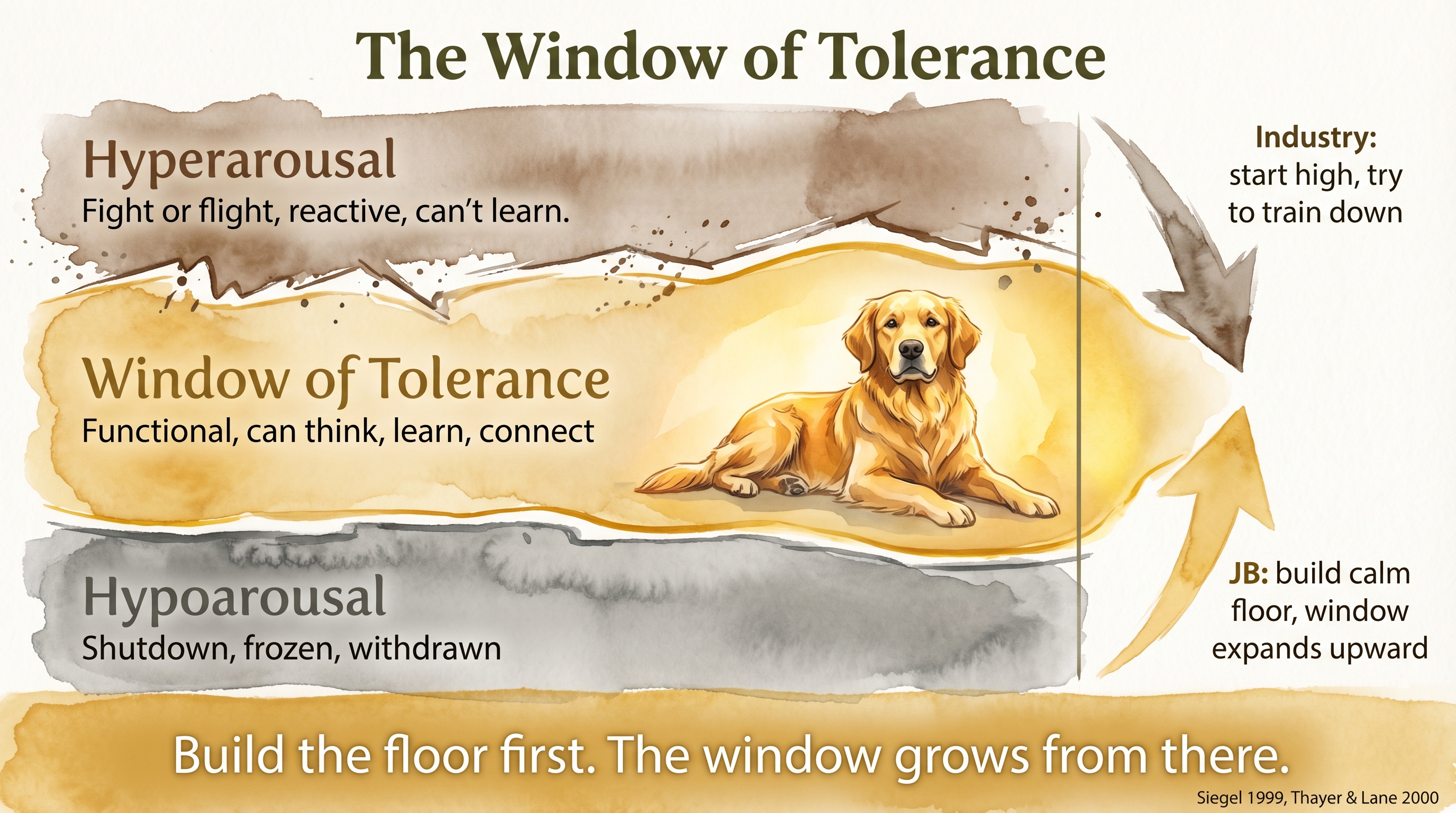
Build the floor first - the window grows upward from a calm baseline, not downward from chronic excitement.
Key Takeaways
- The window of tolerance is the arousal range within which a dog can think, learn, and connect. Below it is shutdown. Above it is reactivity. Inside it is function.
- JB builds the calm floor first so the window expands upward naturally. The industry starts high and tries to train down - producing a narrow window stuck at elevated baseline.
- Calibrated challenge within a calm, secure framework builds resilience. The puppy learns that arousal naturally comes back down and that the secure base is always there.
- Overprotection is as damaging as overstimulation. Preventing all arousal teaches the puppy that challenge is dangerous and requires rescue - that is how you build anxiety.
The Evidence
- Thayer, J. F., & Lane, R. D. (2000)humans
Journal of Affective Disorders. The Neurovisceral Integration Model establishes the connection between cardiac vagal control (a marker of parasympathetic tone) and the capacity for emotion regulation and social processing. - Hennessy, M. B., Kaiser, S., & Sachser, N. (2009)mammals
Frontiers in Neuroendocrinology. Social buffering literature documents that affiliative contact reduces stress responses through oxytocin-mediated pathways across multiple mammalian species. - Kikusui, T., Winslow, J. T., & Mori, Y. (2006)mammals
Philosophical Transactions of the Royal Society B. Oxytocin mediates the calming effects of social contact and proximity, foundational to understanding how calm presence regulates a puppy's nervous system.
- Weaver, I. C. G. et al. (2004)rats
Nature Neuroscience. High-licking/grooming mothers produce offspring with altered glucocorticoid receptor expression through DNA methylation. Cross-fostering confirmed the effect is environmental. This is foundational rat evidence that early caregiving can shape stress biology through methylation-linked mechanisms. - Awalt, S. L. et al. (2024)domestic dogs
Dogs with adverse early histories show different NR3C1 (glucocorticoid receptor) and OXTR (oxytocin receptor) methylation patterns than matched controls. This is dog-direct evidence of an association between adverse early-life history and peripheral methylation patterns; normal-range caregiving and JB-specific raising effects remain bounded extrapolations.
- Handlin, L. et al. (2011, 2012)domestic dogs
Anthrozoös. Slow stroking is associated with calming effects and oxytocin increases. Activating touch (scratching, patting) is associated with cortisol increases. Human touch is not uniformly calming - the type of tactile interaction matters for endocrine arousal.
The claim that building the calm floor first leads to natural window-of-tolerance expansion in puppies is not directly tested in canine research. However, it follows from documented principles: (1) parasympathetic states enable learning and social engagement; (2) early environment shapes stress physiology through epigenetic mechanisms; (3) regulated baseline supports recovery from arousal. The JB-specific claim that calm raising produces expanded windows compared to high-arousal raising remains heuristic.
- Bray, E. E. et al. (2017)domestic dogs
Scientific Reports. In 138 dogs, higher maternal care was associated with lower resilience in adulthood. The mechanism appears to be that unchallenging environments reduce coping capacity. This prevents oversimplifying Calmness as 'maximum comfort.' Calm provides the secure base; calibrated challenge builds the nervous system's capacity to recover.
No published study directly tests the specific claims or protocols described in this entry within a controlled canine trial.
SCR References
Sources
- Awalt, S. L., Boghean, L., Klinkebiel, D., & Strasser, R. (2024). A dog's life: Early life histories influence methylation of glucocorticoid (NR3C1) and oxytocin (OXTR) receptor genes, cortisol levels, and attachment styles. Developmental Psychobiology, 66(3), e22482. https://doi.org/10.1002/dev.22482
- Bray, E. E., Levy, K., Kennedy, B. S., & MacLean, E. L. (2017). Predictability and control in an uncertain world: The influence of parenting style on stress physiology in domestic dogs. Scientific Reports, 7, 40992.
- Handlin, L., Hydbring-Sandberg, E., Nilsson, M., Ejdebäck, M., Jansson, A., & Uvnäs-Moberg, K. (2011). Short-term interaction between dogs and their owners: Effects on oxytocin, cortisol, insulin and heart rate - an exploratory study. Anthrozoös, 24(3), 301-315.
- Handlin, L., Nilsson, M., Ejdebäck, M., Hydbring-Sandberg, E., Uvnäs-Moberg, K., & Jansson, A. (2012). Associations between the psychological characteristics of the dog owner and the cortisol levels of the dog. Anthrozoös, 25(2), 215-228.
- Hennessy, M. B., Kaiser, S., & Sachser, N. (2009). Social buffering of the stress response: Diversity, mechanisms and functions. Frontiers in Neuroendocrinology, 30(4), 470-482.
- Kikusui, T., Winslow, J. T., & Mori, Y. (2006). Social buffering: Relief from stress and anxiety. Philosophical Transactions of the Royal Society B, 361(1476), 2215-2228.
- Siegel, D. J. (1999). The developing mind: How relationships and the brain interact to shape who we are. Guilford Press.
- Thayer, J. F., & Lane, R. D. (2000). A model of neurovisceral integration in emotion regulation and dysregulation. Journal of Affective Disorders, 61(3), 201-216.
- Weaver, I. C. G., Cervoni, N., Champagne, F. A., D'Alessio, A. C., Sharma, S., Seckl, J. R., Dymov, S., Szyf, M., & Meaney, M. J. (2004). Epigenetic programming by maternal behavior. Nature Neuroscience, 7(8), 847-854. https://doi.org/10.1038/nn1276