Environmental Management as Primary Strategy
Environmental management is often treated as a temporary crutch that can be removed once the "real" work begins. The Foundations view inverts that logic: setup is the real work, because behavior that never gets repeated does not become a pathway that later has to be weakened, suppressed, or constantly managed. Documented
What It Means
The science underneath this claim is unusually strong. Hebbian learning tells us that repeated co-activation strengthens pathways. Extinction science tells us that later suppression does not erase original learning cleanly. Put those two facts together and the logic of prevention becomes hard to ignore: every avoided rehearsal is not merely a skipped nuisance. It is an avoided strengthening event.
That is why JB treats gates, leashes, controlled greeting setups, managed access, and supervised interaction as primary strategy rather than as evidence of failure. Heuristic The setup is not standing in for training. It is shaping what gets a chance to exist in the first place. A puppy that never rehearses frantic doorway charging is not "being corrected later less often." It is developing on a different track.
The industry often imagines environmental management as something you do before the actual technique arrives. JB treats it as the actual technique at the deepest level. Not because the dog never learns, but because the dog learns through the environment every hour. Mixed Evidence The environment is always either inviting a pattern or declining to invite it.
Dale and colleagues add a second reason this matters. Punishment-heavy responses to puppy behavior predict later separation-related problems. Documented That means prevention is not only about avoiding one unwanted behavior. It is also about avoiding the downstream cost of needing more correction after the behavior has already formed.
Why It Matters for Your Dog
Families usually encounter environmental management first as something practical and slightly boring. Observed-JB Close the gate. Use the leash. Limit access. Interrupt rehearsals early. The Foundation claim is that this boring layer is often the most powerful layer.
A managed environment lowers the number of bad repetitions without raising the emotional cost of the day. It lets the puppy stay successful more often. It also keeps the human calmer, which matters because prevention protects the relationship as much as it protects behavior. The fewer crises the puppy is allowed to rehearse, the fewer chances the human has to overreact.
Environmental management is Prevention made visible. It is the architecture of not starting the problem rather than the drama of solving it after the fact.
This is why JB often sounds more like household design than like a list of behavior tricks. Arrange the environment so that good behavior is the path of least resistance and bad behavior is hard to start. Then, as the puppy matures and the patterns stabilize, the scaffolding can come down. Mixed Evidence
The practical takeaway is not that the environment does everything. It is that it does more than families usually realize. A well-managed puppy often looks easy not because the puppy was born easy, but because the household stopped teaching the hard version.
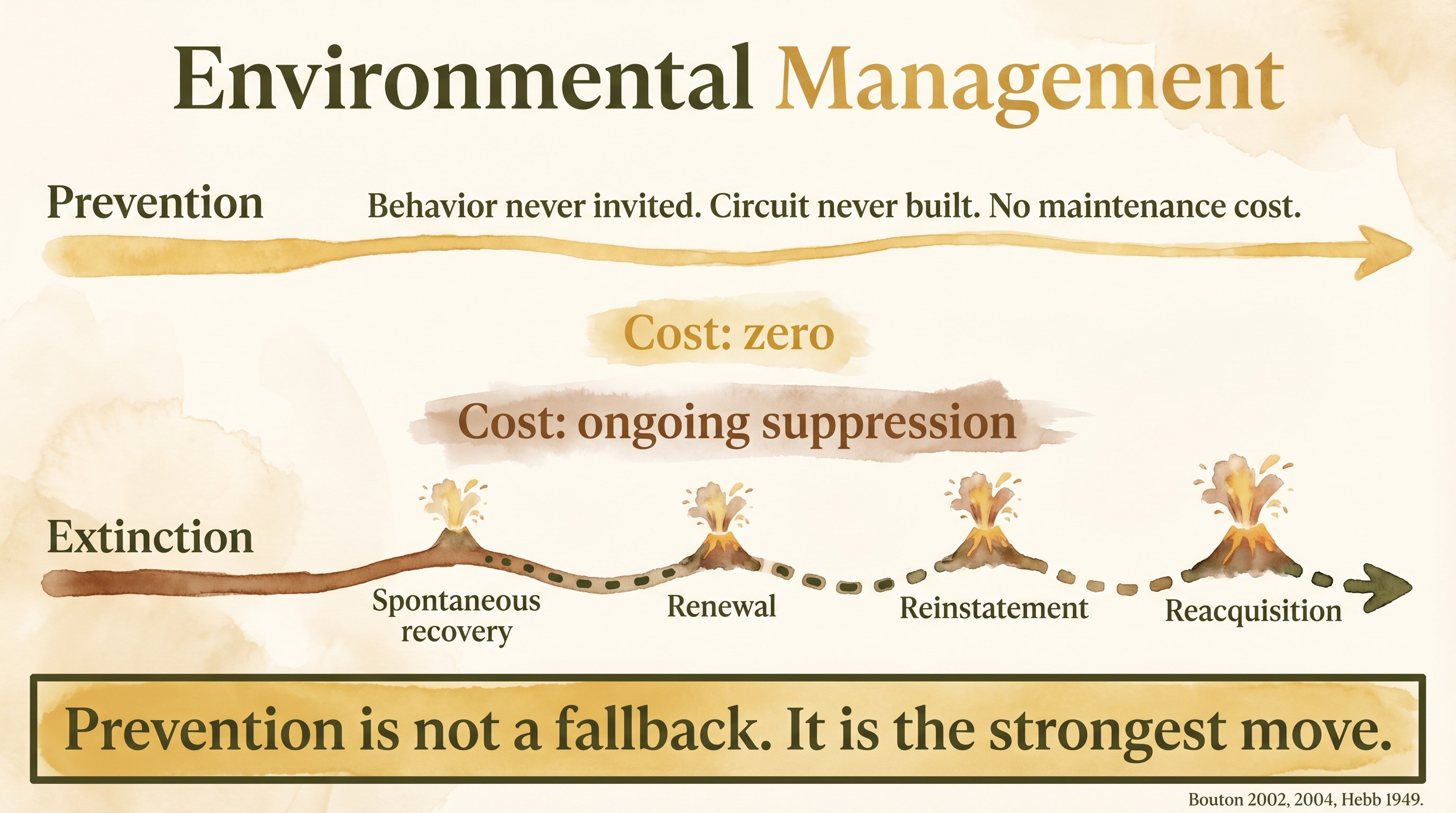
Prevention through environmental setup is the strongest move - a behavior never invited has no neural pathway to suppress later.
Key Takeaways
- Environmental management is primary strategy in JB because repeated behavior strengthens pathways, while later suppression does not erase them cleanly.
- Gates, leashes, controlled access, and supervised interaction are not fallback tools. They are ways of deciding what behavior gets to form.
- Prevention also lowers the need for punishment-heavy responses, which matters because punitive handling carries its own downstream risks.
- A well-set environment is often the most powerful teaching system in the house.
The Evidence
This entry uses heuristic claim-level tags beyond the dedicated EvidenceBlocks below. These tags mark JB interpretive application rather than direct study findings.
This entry uses mixed-evidence claim-level tags beyond the dedicated EvidenceBlocks below. These tags mark claims that combine documented findings with observed practice, heuristic application, or unresolved gaps.
- Hebb, D. O. (1949)broader neuroscience framework
Established the principle that repeated co-activation strengthens pathways, providing the neural logic beneath rehearsal effects. - Bouton, M. E. (2002, 2004)multiple species
Showed that extinction suppresses rather than erases original learning, which makes prevention more powerful than later attempted deletion. - Rescorla, R. A. (2004)multiple species
Documented spontaneous recovery, reinforcing that previously learned patterns can reappear even after suppression.
- Dale, F. C. et al. (2024)domestic dogs
Found that punishment or aversive owner responses in puppyhood predicted increased odds of later separation-related behavior. - Predictability-and-control literature summarized in SCR-020multiple species and domestic dogs
Stable, predictable environments support controllability and resilience more reliably than reactive intervention after the fact.
- JB prevention observationfamily-raised Golden Retrievers
JB consistently observes that behaviors never invited in early puppyhood create less later management burden than behaviors that are permitted first and corrected later.
No randomized family-dog trial has directly compared a strongly prevention-based household setup against a more correction-reliant household while tracking later adult behavior outcomes.
The neuroscience strongly favors prevention logic, but the field has not yet quantified which ordinary household rehearsals carry the highest downstream cost when left unmanaged in puppyhood.
SCR References
Sources
Bouton, M. E. (2002). Context, ambiguity, and unlearning: Sources of relapse after behavioral extinction. Biological Psychiatry, 52(10), 976-986.
Bouton, M. E. (2004). Context and behavioral processes in extinction. Learning & Behavior, 32(4), 485-494.
Dale, F. C., Burn, C. C., Murray, J., & Casey, R. (2024). Canine separation-related behaviour at six months of age: Dog, owner and early-life risk factors identified using the Generation Pup longitudinal study. Animal Welfare, 33, e60.
Hebb, D. O. (1949). The Organization of Behavior. Wiley.
Rescorla, R. A. (2004). Spontaneous recovery. Learning & Memory, 11(5), 501-509.