The Soft Landing
The breeder-to-family transition is not only a logistical handoff. It is a physiological event. The puppy is leaving a familiar regulation system, entering a new one, and trying to decide whether the new adults feel like continuity or collapse. JB calls the best version of that handoff a soft landing. The framework itself is heuristic, but the stress, attachment, and transition science underneath it is strong enough to make the principle much more than a slogan. Documented
What It Means
The phrase matters because the default cultural script is a crash landing. The puppy leaves the breeder, rides home in a state of separation stress and novelty, arrives to a high-energy welcome, and is immediately exposed to new rooms, new voices, new smells, and often a family that is using excitement to soothe itself. Observed-JB Humans experience that as celebration. The puppy often experiences it as collapse of continuity.
The science does not yet give JB a randomized breeder-to-family trial comparing soft landing and crash landing directly. Documented What it does give is a converging stress picture. Nagasawa et al. (2021) showed that puppies have a reactive HPA axis by the age they are usually rehomed. Shelter and foster transition work shows that moving dogs into novel contexts raises cortisol and that stable home environments reduce that load over time. Attachment research also shows that caregiver quality matters quickly. The puppy is not arriving as a blank organism waiting for commands. The puppy is arriving with a live stress system looking for a regulating social center.
That is why the soft landing should be understood as continuity rather than indulgence. The goal is not to be extra loving in a dramatic way. The goal is to preserve the same developmental language the puppy already knew: calm handling, low verbal density, protected rest, limited novelty, readable routines, and adults who make the world feel legible. The puppy does not need a celebration event to feel welcomed. The puppy needs the new adults to feel usable.
There is also an honest hormonal gap. The oxytocin-gaze loop is documented in adult dogs, but it has not been directly demonstrated in newly rehomed eight-to-ten-week-old puppies. Documented Gnanadesikan et al. (2024) showed that oxytocin and cortisol differences are measurable at that age, which means the systems are active. What remains unknown is exactly how quickly the full affiliative loop takes shape in a new puppy-owner bond. That gap does not weaken the soft landing. It simply keeps the rhetoric clean.
Why It Matters for Your Dog
For a JB family, the soft landing protects the twelve weeks of developmental work that came before the ride home. Heuristic The puppy is not beginning from zero. The puppy is arriving with a nervous system that has already been reading calm, structure, adult-dog mentorship, and environmental prevention. The family's job is not to overwrite that language on day one.
The soft landing is what calmness looks like at the moment of highest leverage. The family is teaching the puppy what state belongs in this new home before it teaches anything else.
This is why JB's transition guidance sounds so different from mainstream puppy culture. It is not primarily asking, "How do we make the puppy happy right now?" It is asking, "How do we keep the puppy regulated enough to keep learning the right baseline?" That is a deeper and ultimately kinder question.
The practical consequence is simple. Lower stimulation on the ride home. Lower stimulation at the front door. Fewer people, fewer rooms, fewer novelty demands, more protected sleep, more quiet observation, and rules that begin immediately but without drama. Mixed Evidence That is what continuity looks like when translated into family life.
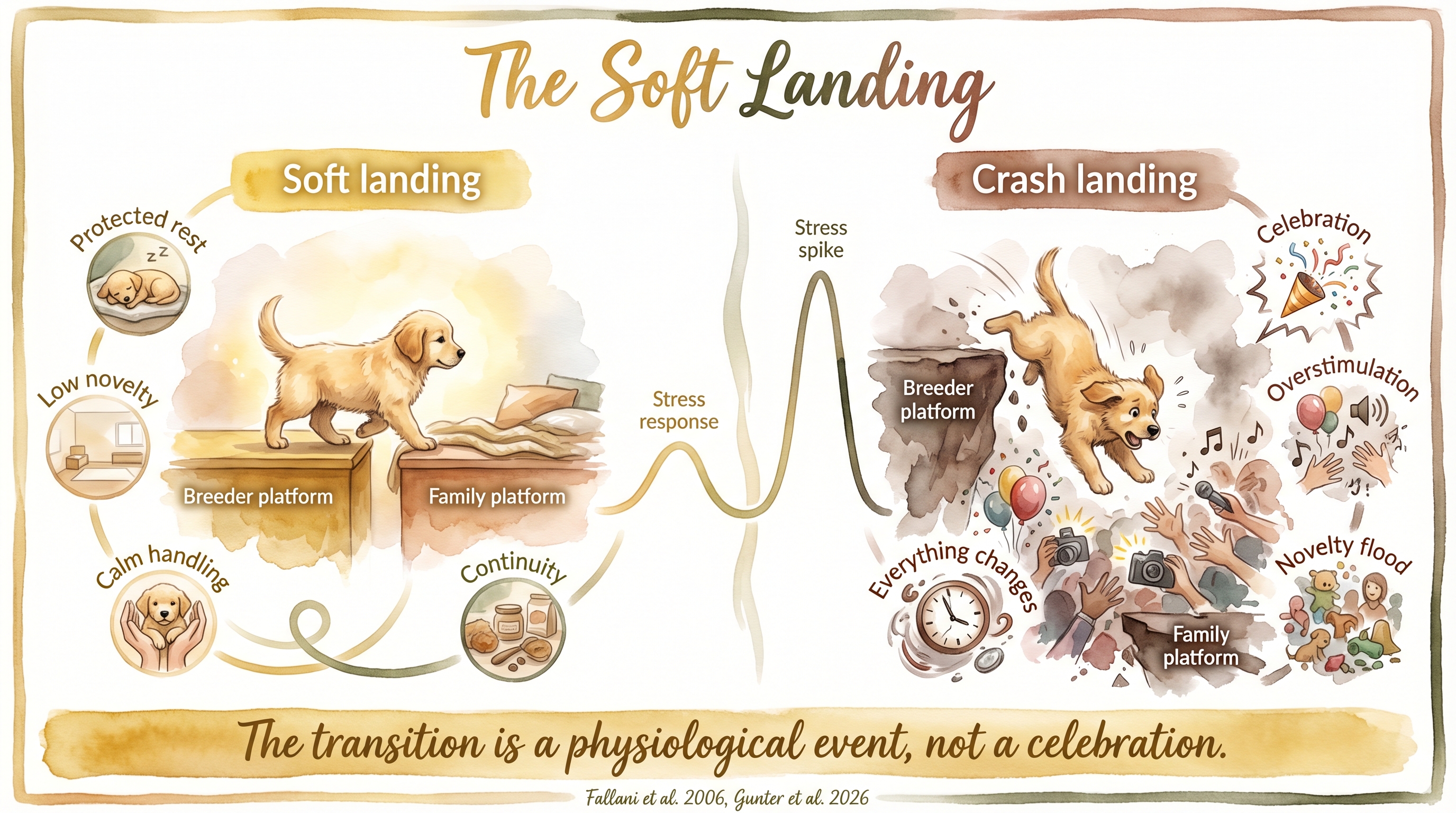
The breeder-to-family transition is a physiological event - a soft landing preserves the developmental language the puppy already knows through continuity, not celebration.
Key Takeaways
- The soft landing is a JB framework for preserving continuity during the breeder-to-family handoff.
- The framework itself is heuristic, but the transition-stress and attachment science supporting it is substantial.
- A new puppy is not a blank slate on go-home day. The puppy arrives with a live stress system and an already developing social baseline.
- Families help most when they lower novelty and emotional pressure rather than turning arrival into a celebration event.
The Evidence
This entry uses observed claim-level tags beyond the dedicated EvidenceBlocks below. These tags mark JB program observation or practice-derived claims that need dedicated EvidenceBlock coverage in a later content pass.
This entry uses mixed-evidence claim-level tags beyond the dedicated EvidenceBlocks below. These tags mark claims that combine documented findings with observed practice, heuristic application, or unresolved gaps.
- Fallani, G. et al. (2006)domestic dogs
Showed that attachment discrimination sharpens over developmental transitions in guide dogs, reinforcing that caregiver continuity matters over time. - Gunter, L. M. et al. (2026)domestic dogs
Found that stable foster-home conditions reduced stress and increased restful behavior relative to shelter conditions. - SCR-060 synthesisdomestic dogs
Supports the claim that novel intake and rehoming contexts raise stress load while stable home environments reduce it over time.
- SCR-357family-raised puppies
Defines the soft landing as a heuristic breeder-to-family framework grounded in attachment, caregiving, and transition-stress science. - SCR-359family-raised puppies
Supports the ride-home portion of the framework as a low-stimulation recovery window rather than a celebration event. - Gnanadesikan, G. E. et al. (2024)dog puppies
Shows that oxytocin and cortisol systems are active and individually variable in two-month-old puppies while leaving the new-dyad oxytocin-gaze timing unresolved.
No published study directly compares a JB-style soft landing to a more conventional excited family reception in breeder-to-home puppy transitions. The central practical claim remains a well-grounded framework rather than a directly trialed protocol.
SCR References
Sources
Fallani, G., Previde, E. P., & Valsecchi, P. (2006). Do disrupted early attachments affect the relationship between guide dogs and blind owners? Applied Animal Behaviour Science, 100(3-4), 241-257. https://doi.org/10.1016/j.applanim.2005.12.005
Gnanadesikan, G. E., et al. (2024). Basal plasma oxytocin and fecal cortisol concentrations are highly heritable and associated with individual differences in behavior and cognition in dog puppies. Hormones and Behavior, 165, 105612. https://doi.org/10.1016/j.yhbeh.2024.105612
Gunter, L. M., et al. (2026). The effects of temporary fostering on shelter dog welfare. PeerJ.
Horn, L., Huber, L., & Range, F. (2013). The importance of the secure base effect for domestic dogs. PLoS ONE, 8(1), e65296. https://doi.org/10.1371/journal.pone.0065296