Body Handling, Grooming, and Veterinary Cooperation
Compound evidence detail1 SCR / 3 parts
- Documentedthe Baumrind authoritative-parenting literature in human child development
- Documentedthe canine correlational evidence linking dog-directed caregiving styles to attachment, attention, sociability, and problem-solving outcomes (van Herwijnen 2018/2020, Brubaker and Udell 2023)
- Heuristicthe JB inference that one specific caregiving style experimentally produces the best long-term developmental outcomes in dogs
In the JB methodology, body handling is everyday continuity, not training event. Heuristic The dog who has been touched, examined, brushed, lifted, and handled across years of ordinary moments arrives at the veterinary visit with the procedure already inside the band of the familiar. The dog who has not is being asked to integrate touch, restraint, novel environment, novel people, novel smells, novel handling, and a clinical procedure simultaneously, in a single high-arousal event. The cooperative-care literature (Edwards et al. 2019; Stellato et al.; Cobb et al. 2016) and the broader stress-reduction findings on veterinary visits (Mariti et al.; Csoltova et al.; Lloyd 2017) all converge on the operational claim that the handling-as-continuity arrangement produces dramatically different outcomes than the handling-as-event arrangement, and the methodology's position is that the continuity is the operation worth doing, not the event-day intervention.
For Families
A dog who tolerates body handling, grooming, and veterinary care does so because the household built that tolerance early, not because the dog was forced into it later. The puppy who has hands gently on its paws, ears, and mouth from the breeder period onward grows into a dog for whom body handling is normal. The puppy who is left alone until the first vet visit grows into a dog who has to be wrestled into cooperation.
The Just Behaving pattern is to make body handling part of normal life from the start. Brief, calm contact with paws, ears, mouth, and tail. Brushing as a quiet ritual rather than as a stressful event. Cooperative posture practiced before it is needed clinically.
The payoff is a dog who can be groomed, examined, and treated medically without sedation, without struggle, and without the trauma a forced handling event creates.
What It Means
Handling is one of the engagement channels with the strongest documented support. Feuerbacher and Wynne (2015) demonstrated that dogs prefer physical contact over verbal praise as a reinforcer (SCR-052), and that the contact channel does not show the rapid habituation that the verbal channel does. Documented The implication for everyday handling is that the touch channel is doing more work than the family typically credits it with: it is one of the primary channels through which engagement, attention, regulation, and the relational signal are being delivered. The methodology's position is that this channel is being used continuously in the JB cohort by design, and the result is a dog whose body is fluent in being touched.
The cooperative-care literature has documented operational protocols for husbandry-related handling. Edwards et al. (2019) reviewed cooperative-care procedures in canine veterinary contexts and established that systematic desensitization, choice-based handling protocols, and predictable handling sequences reduced procedure-related stress measures. Documented Stellato et al. and Csoltova et al. have extended the findings into specific veterinary-procedure contexts (vaccination, blood draw, nail trim, ear handling). Cobb et al. (2016) demonstrated that low-stress handling protocols reduced cortisol responses in dogs during veterinary procedures. Lloyd (2017) provided operational protocols for minimising stress during veterinary visits in clinical settings. The methodology's reading of this literature is that cooperative-care techniques work, and that the techniques work even better when they are not techniques deployed on event-day but the everyday operational mode of the household's handling.
The continuity-vs-event distinction is operationally critical. Heuristic The methodology's observation across the JB cohort is that families who treat the first veterinary visit as a discrete event to prepare the dog for, with cooperative-care training delivered in the weeks leading up to the visit, produce dogs who are less stressed at the visit than dogs whose families did nothing, but more stressed than dogs whose families never treated handling as a separate category from ordinary life. The dog who has been brushed daily for six months while sitting on the couch with the family does not need to be prepared for being brushed; the brushing is already inside the band. The dog who has had its paws touched in the doorway, in the kitchen, on the porch, across hundreds of unremarkable moments, does not need paw-handling desensitization; the paw-handling has been desensitized through accumulation. The cooperative-care literature is documenting what a structured event-day protocol can achieve. The methodology's claim is that the household-continuity arrangement achieves more, with less, by being everywhere rather than being scheduled.
The handler-state coupling channels operate during handling too. The Sundman 2019 (SCR-105), Koskela 2024 (SCR-106), Parr-Cortes 2024 (SCR-107), and Wilson 2022 (SCR-058) findings establish that the dog is reading the handler's physiological state in real time and across months through cortisol, HRV, and olfactory channels. Documented Handling delivered by a regulated handler transmits a different signal than the same handling delivered by a dysregulated handler. The veterinary-visit failure mode is often a compound failure: the dog is anxious because the handler is anxious, and the chemical-channel transmission of the handler's anxiety (Parr-Cortes 2024 demonstrated stressed-human odor impairs canine cognition) is operating during the very moment the dog is being asked to integrate the procedure. The methodology's position is that the family's own regulation during handling is the upstream variable, and that the handling-as-continuity arrangement gives the family fluency in regulated handling that the event-day arrangement cannot match.
The Hebbian wiring at the handling channel is cumulative. The dog who has been touched, lifted, and examined inside a regulated channel across years has approximately the same number of repetitions of the regulated-handling pattern wired into the handling-channel circuit as the number of times those handling moments have happened. The mechanism is conserved-mechanism inference; the application to the handling channel is straightforward. The dog whose handling-channel circuit has been wired by hundreds of regulated repetitions reads the next handling moment through that circuit; the dog whose handling-channel circuit has been wired by a small number of high-stakes high-arousal events reads the next handling moment through that circuit. The neural pattern the dog brings to the veterinary visit was written across years.
The signal-precision principle applies to handling sequences. Documented A handling sequence delivered with precise signaling (the brief contact announcement before the touch, the calm vocal acknowledgment that names the moment, the predictable pause structure between sub-steps) is teaching the dog to read the handling sequence as a communicative event. A handling sequence delivered with surplus emotional content (high-pitched cooing, excessive verbal praise, over-eager body language) is teaching the dog that handling is a high-arousal event, and the high-arousal frame is the frame the dog will bring to the next handling moment. The signal-precision discipline is the same one operating in correction-in-real-time, in play, and in departures: the channel preserves precision when the family is not flooding it.
Why It Matters for Your Dog
The practical starting position is that the family treats the dog's body as something the family has continuous, comfortable access to from day one. The puppy is touched on the paws, ears, mouth, and tail across ordinary moments, not in dedicated handling sessions. The brushing happens during television-watching, not as a separate scheduled activity. The bath is an extension of the daily presence in the bathroom, not a dramatic event. The nail trim happens because the family's hands are routinely on the paws, not because the family is preparing for a procedure. The handling is woven into the texture of the day, and the dog absorbs it as part of what living with humans normally involves.
The cooperative-care techniques are still useful inside the methodology. The methodology's preference for continuity does not mean that the structured cooperative-care techniques (the chin rest as a consent signal, the bucket-game protocol, the cooperative-care station) are wrong; they are not. They are operationally compatible with the methodology and add precision to specific high-stakes procedures (blood draw, ultrasound, dental examination). The methodology's claim is that the structured techniques work better when they are layered on top of the everyday handling continuity than when they are deployed in its absence. The continuity is the substrate; the techniques are the precision layer.
The first veterinary visit is the test. The methodology's read of the first veterinary visit is that it is the diagnostic for whether the handling-as-continuity arrangement has been operating. A puppy whose handling has been everyday continuity walks into the veterinary clinic at eight or nine weeks, is examined by an unfamiliar person, has its body handled, and exits the visit at approximately the regulatory baseline it entered with. A puppy whose handling has not been everyday continuity walks into the same clinic, is examined, and exhibits the cluster of stress responses (panting, lip-licking, whale-eye, tucked tail, attempted withdrawal, leg-trembling) the veterinary literature has documented as the standard high-stress profile (Mariti et al.; Lloyd 2017). The first visit is not the event the family is preparing the dog for; it is the read of how the family has been operating for the preceding weeks.
The grooming dimension. Brushing, ear-cleaning, eye-wiping, tooth-brushing, paw-wiping, and bathing are the ordinary grooming operations a Golden Retriever family will perform across the dog's lifetime. The methodology's preference is that each of these operations is integrated into the household's everyday rhythm rather than scheduled as periodic events. The brushing during television is the operational frame; the dedicated weekly grooming session is the failure mode. The dog whose body is brushed every day briefly is a dog whose coat is in better condition, whose body is more familiar with the brush, and whose grooming-channel circuit is wired into the calm relational channel rather than into the discrete-event channel.
Body Handling, Grooming, and Veterinary Cooperation is a Mentorship operation continued from the breeder. The JB puppy has been handled by Dan and family from the first days of life: paws touched, ears handled, body lifted, mouth examined, all inside a regulated channel with calm adult dogs modeling the cooperative posture. The family\u0027s job at pickup is continuity (Continuity: Continue, Don\u0027t Start, OP8): the human takes over the canine language of calm handling the breeder began, rather than starting a new system at pickup. The handling continuity the family delivers across the dog\u0027s lifetime is the operational form of the mentorship that began at three weeks old.
The most common handling failure modes are specific. First, handling-as-event: the family treats the brushing or the bath as a discrete scheduled event with elaborate ritual around it, and the dog absorbs the frame. Second, handling-only-when-necessary: the family touches the dog's body primarily when something needs to be done (a knot brushed out, a nail trimmed, a procedure prepared for), and the dog learns that touch in those regions is a signal that something significant is about to happen. Third, the dysregulated-handler problem: the family handles the dog while the family is anxious about the handling, and the dog reads the anxiety in the chemical and HRV channels even when the surface behavior is gentle. Fourth, the grooming-shop substitution: the family outsources all grooming to a professional groomer, and the dog never builds the household-handling fluency the methodology depends on. Fifth, the late-start problem: the family does no handling continuity in the early months and tries to install it at six months or older, by which point the handling-channel circuit has been wired in the absence of the discipline.
A note on the limit of the inference. The documented evidence supports the praise-versus-contact preference (Feuerbacher & Wynne 2015; SCR-052), the cooperative-care literature on procedure-related stress reduction (Edwards et al. 2019; Cobb et al. 2016; Lloyd 2017), the handler-state coupling channels (SCR-105, SCR-106, SCR-107; SCR-058), Hebbian circuit-level plasticity (SCR-022), and the owner-managed variables literature (SCR-485, SCR-486). The methodology's specific claim that handling-as-continuity outperforms handling-as-event-day-protocol on matched outcomes has not been tested in a controlled canine cohort. The convergent claim rests on the documented channels and the JB cohort observation.
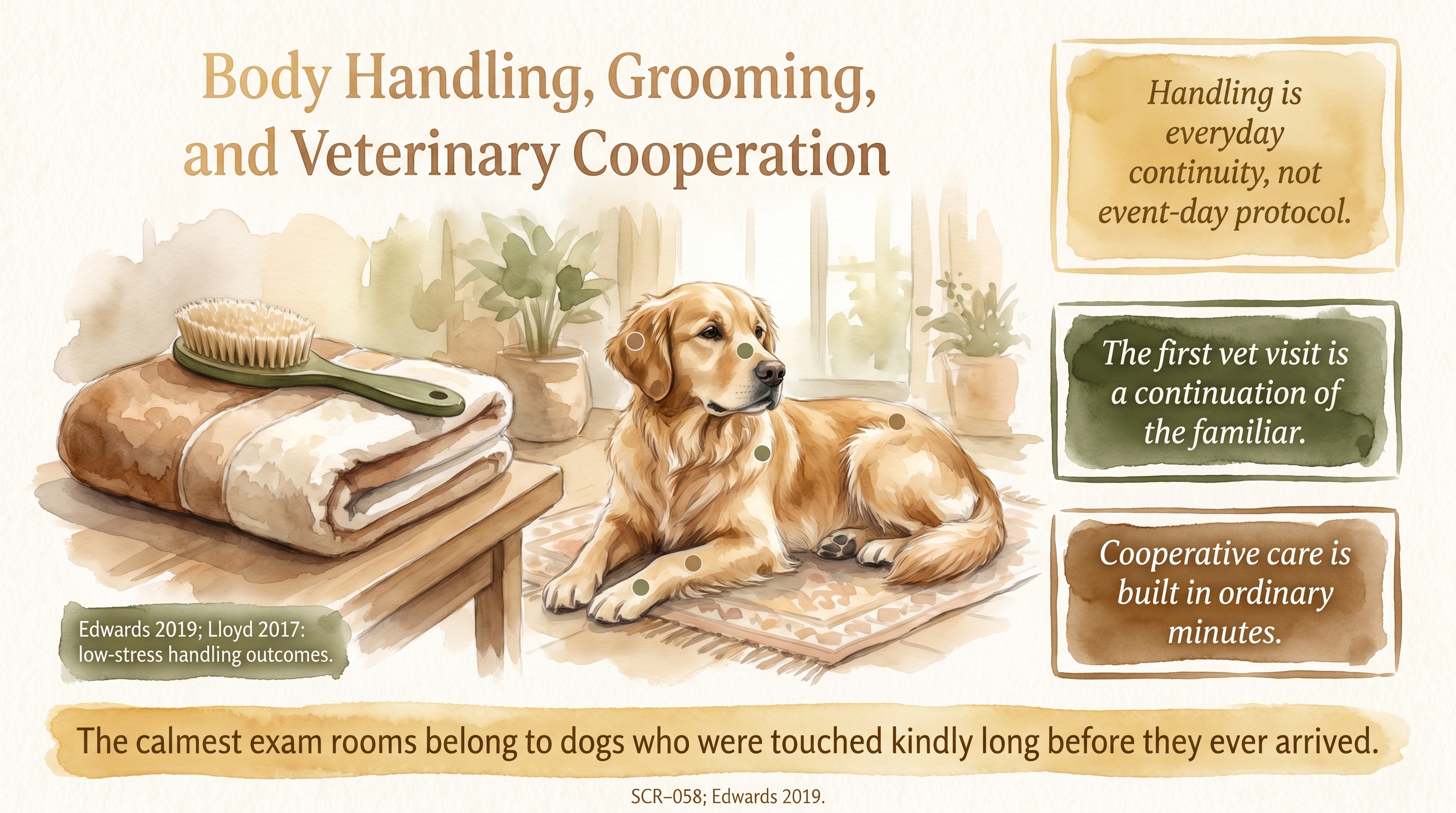
The first vet visit should feel like the hundredth touch, not the first.
Key Takeaways
- Body handling is everyday continuity, not training event. The dog who has been touched, brushed, lifted, and examined across years of ordinary moments arrives at the first veterinary visit with the procedure already inside the band of the familiar. The continuity is the operation; the event-day protocol is the precision layer.
- The contact channel has the strongest documented engagement support (Feuerbacher & Wynne 2015; SCR-052) and does not habituate the way the verbal-praise channel does. Daily brief handling moments are wiring a channel; periodic ritualized handling is wiring a different channel.
- The handler's regulated state is the carrier wave the handling is delivered through. Sundman 2019 cortisol synchrony, Koskela 2024 HRV coupling, Parr-Cortes 2024 olfactory chemosignaling, and Wilson 2022 olfactory stress detection establish that the dog is reading the handler's physiology during the handling moment.
- The cooperative-care literature (Edwards 2019; Cobb 2016; Lloyd 2017) documents that structured techniques reduce procedure-related stress; the methodology's position is that those techniques work better layered on top of the everyday continuity than deployed in its absence.
The Evidence
- Feuerbacher, E. N., & Wynne, C. D. L. (2015), Journal of the Experimental Analysis of Behaviordomestic dogs
Dogs preferred physical contact over verbal praise as a reinforcer in operant choice procedures. Verbal praise lost functional reinforcement value rapidly across successive lab sessions; contact did not show the same habituation. The implication for handling is that touch is one of the primary engagement channels and is doing more work than families typically credit. Daily brief handling moments are wiring a channel; periodic ritualized handling sessions are wiring a different channel.
- Edwards, P. T. et al. (2019), Animalsdomestic dogs (review of cooperative-care literature)
Reviewed cooperative-care procedures in canine veterinary contexts. Systematic desensitization, choice-based handling protocols, and predictable handling sequences reduced procedure-related stress measures. The structured techniques work; the methodology's claim is that they work better layered on top of everyday handling continuity than deployed in its absence. - Cobb, M. L. et al. (2016), Frontiers in Veterinary Sciencedomestic dogs (kennel and clinical contexts)
Low-stress handling protocols reduced cortisol responses in dogs during veterinary procedures. The cortisol channel is responsive to handling-protocol differences in the moment. - Lloyd, J. K. F. (2017), Veterinary Sciencesdomestic dogs (clinical settings)
Operational protocols for minimising stress during veterinary visits. The protocols document specific handling techniques (slow approach, predictable sequence, choice-based examination, low-arousal vocalization) that reduce stress measures and improve cooperative behavior at the visit.
- Mariti, C. et al. (2015), Journal of Veterinary Behaviordomestic dogs (veterinary clinic context)
Documented behavioral and physiological stress responses in dogs at veterinary visits: panting, lip-licking, whale-eye, tucked tail, attempted withdrawal, body trembling. The stress profile is the standard read of the dog encountering a high-arousal handling context without the prior handling continuity. - Csoltova, E. et al. (2017), Physiology & Behaviordomestic dogs (veterinary procedure context)
Positive interaction with the handler before and during veterinary procedures reduced behavioral and physiological stress responses. The handler-state coupling channels (cortisol, HRV) are operational during the procedure; the handler's engagement modulates the dog's response.
- Sundman, A.-S. et al. (2019); Koskela, A. et al. (2024)domestic dogs and their owners
Long-term hair-cortisol synchrony (Sundman 2019) and dyad-specific HRV coupling (Koskela 2024). The dog reads the handler's physiology continuously, including during handling moments. A regulated handler delivers a regulated handling channel; a dysregulated handler delivers a dysregulated one even when the surface behavior of the handling is identical. - Parr-Cortes, Z. et al. (2024); Wilson, C. et al. (2022)domestic dogs
Stressed-human odor impairs canine cognitive performance (Parr-Cortes 2024); dogs discriminate human stress-related odor at well-above-chance accuracy (Wilson 2022). The chemical channel is operational during the handling moment. Surplus handler arousal during a veterinary visit or grooming session is being transmitted through the olfactory channel in addition to the visible behavioral channel.
- Hebb, D. O. (1949); Bliss & Lømo (1973); Bi & Poo (1998)foundational neuroscience principle (rabbit, rat); cross-species
Neurons that fire together wire together. Application to the handling channel is conserved-mechanism inference. The dog's handling-channel circuit reflects the cumulative pattern of prior handling moments; the regulated channel is wired by regulated repetitions, the dysregulated channel by dysregulated ones. The neural pattern the dog brings to the veterinary visit was written across the preceding weeks and months.
- JB cohort observationfamily-raised Golden Retrievers
JB cohort observation across families raising Golden Retrievers is that puppies whose handling was integrated into everyday household rhythm (paws, ears, mouth, body touched in unremarkable moments across daily life) exit the first veterinary visit at approximately the regulatory baseline they entered with. Puppies whose handling was scheduled or event-based exhibit the documented high-stress veterinary profile to a greater degree, even when the families used cooperative-care techniques in the weeks leading up to the visit. The observation is consistent with Hebbian channel-wiring; it has not been tested in a controlled canine cohort. Reported at observed confidence.
- Smith, B. P. et al. (2025), Preventive Veterinary Medicinedomestic dogs (N=3,044 Golden Retrievers, Golden Retriever Lifetime Study)
Household management variables are significant predictors of behavioral trajectory across the first three years of life. Handling-arrangement type is one variable in the cluster. The cohort finding does not partition handling-arrangement type at the precision the methodology operates inside.
- JB Methodology synthesisfamily-raised Golden Retrievers
The methodology's claim that handling integrated into everyday household rhythm produces veterinary-visit outcomes the event-day cooperative-care protocols cannot match, and that the structured cooperative-care techniques work better layered on top of the continuity than deployed in its absence, is JB's synthesis of the contact-channel preference, the cooperative-care literature, the handler-state coupling channels, Hebbian plasticity, and the owner-managed variables literature. Each component is documented; the operational synthesis is heuristic.
No controlled canine cohort study has tested handling-as-continuity versus handling-as-event-day-protocol on matched first-veterinary-visit and lifetime-husbandry outcomes.
The minimum-frequency threshold for everyday handling that produces the cohort-observed outcomes has not been quantified in a published study; the methodology's practical guidance is observation, not measurement.
The interaction between handling continuity and downstream attachment-classification stability has not been partitioned in a published canine cohort.
The household-handling fluency claim has not been benchmarked against professional-groomer-only handling arrangements in a published comparison.
SCR References
Sources
Bi, G.-Q., \u0026 Poo, M.-M. (1998). Synaptic modifications in cultured hippocampal neurons: Dependence on spike timing, synaptic strength, and postsynaptic cell type. Journal of Neuroscience, 18(24), 10464-10472.
Bliss, T. V. P., \u0026 Lømo, T. (1973). Long-lasting potentiation of synaptic transmission in the dentate area of the anaesthetized rabbit following stimulation of the perforant path. Journal of Physiology, 232(2), 331-356.
Cobb, M. L., Iskandarani, K., Chinchilli, V. M., \u0026 Dreschel, N. A. (2016). A systematic review and meta-analysis of salivary cortisol measurement in domestic canines. Domestic Animal Endocrinology, 57, 31-42.
Csoltova, E., Martineau, M., Boissy, A., \u0026 Gilbert, C. (2017). Behavioral and physiological reactions in dogs to a veterinary examination: Owner-dog interactions improve canine well-being. Physiology \u0026 Behavior, 177, 270-281.
Edwards, P. T., Smith, B. P., McArthur, M. L., \u0026 Hazel, S. J. (2019). Fearful Fido: Investigating dog experience in the veterinary context in an effort to reduce distress. Applied Animal Behaviour Science, 213, 14-25.
Feuerbacher, E. N., \u0026 Wynne, C. D. L. (2015). Shut up and pet me! Domestic dogs (Canis lupus familiaris) prefer petting to vocal praise in concurrent and single-alternative choice procedures. Journal of the Experimental Analysis of Behavior, 103(2), 261-271.
Hebb, D. O. (1949). The Organization of Behavior: A Neuropsychological Theory. New York: Wiley.
Koskela, A., Kareinen, I., Somppi, S., Törnqvist, H., Vainio, O., Kujala, M. V. (2024). Heart rate variability coupling in dog-human dyads. Scientific Reports, 14, 8213.
Lloyd, J. K. F. (2017). Minimising stress for patients in the veterinary hospital: Why it is important and what can be done about it. Veterinary Sciences, 4(2), 22.
Mariti, C., Raspanti, E., Zilocchi, M., Carlone, B., \u0026 Gazzano, A. (2015). The assessment of dog welfare in the waiting room of a veterinary clinic. Animal Welfare, 24(3), 299-305.
Parr-Cortes, Z., Müller, C. T., Talas, L., Mendl, M., Guest, C., \u0026 Rooney, N. J. (2024). The odour of an unfamiliar stressed or relaxed person affects dogs' responses on a cognitive bias test. Scientific Reports, 14, 15843.
Smith, B. P., Browne, M., Mack, J., Kontou, T. G., \u0026 Tomkins, L. M. (2025). Predictors of behavioral outcomes in 3,044 Golden Retrievers across the first three years of life. Preventive Veterinary Medicine, 234, 106101.
Stellato, A. C., Hoffman, H., Gowland, S., Dewey, C. E., Widowski, T. M., \u0026 Niel, L. (2019). Effect of high levels of background noise on dog responses to a routine physical examination in a veterinary setting. Applied Animal Behaviour Science, 214, 64-71.
Sundman, A.-S., Van Poucke, E., Svensson Holm, A.-C., Faresjö, Å., Theodorsson, E., Jensen, P., \u0026 Roth, L. S. V. (2019). Long-term stress levels are synchronized in dogs and their owners. Scientific Reports, 9, 7391.
Wilson, C., Campbell, K., Petzel, Z., \u0026 Reeve, C. (2022). Dogs can discriminate between human baseline and psycholog