The Consequence
Compound evidence detail1 SCR / 2 parts
- Documentedthe commensal pathway model of canine domestication established as the dominant framework in evolutionary biology, supported by Bergstrom 2020 genomics, Thalmann 2013 mtDNA, Larson and Bradley 2014, and Freedman 2014
- Heuristicthe JB interpretive bridge mapping the Five Pillars onto the selection pressures inferred to have operated during commensal domestication, a synthesis without direct genomic or archaeological support
The Consequence is JB's claim that many modern pet dogs are social puppies in adult bodies: physically mature, but still organized around juvenile patterns of dependency, demand, and poor self-regulation. The observation that many pet dogs show these traits is familiar. The stronger causal claim about why is JB's philosophical interpretation. Heuristic
What It Means
JB argues that the playmate model and the method-heavy training model can both fail in the same direction. One keeps the dog emotionally young by overparticipating in childish social rhythms. Heuristic The other manages behavior without fully developing the organism underneath it.
The result, in JB's language, is an adult dog that may be:
- highly dependent on stimulation
- poor at settling
- chronically attention-seeking
- boundary-testing as a lifestyle
- socially immature under stress
This page is deliberately provocative, but the underlying question is serious. What does maturity actually look like in a companion dog? If adulthood means more than physical size, then many common pet-dog patterns start to look less like personality and more like unfinished development. Heuristic
JB sees that unfinished development as the downstream cost of historical divergence. When the adult never truly becomes parent, mentor, and regulator, the young organism has less to grow upward into. The dog may become highly managed, highly entertained, or highly trained in specific tasks while remaining socially juvenile in other important ways. Heuristic
The page must stay disciplined. There is no definitive experiment proving that contemporary raising styles cause a broad syndrome of developmental arrest. That is why the claim remains heuristic. The role of attachment systems and social learning makes the idea coherent. Heuristic It does not make the matter settled.
Why It Matters for Your Dog
This page matters because it changes what success looks like. Heuristic The goal is not a dog that can perform on cue while remaining emotionally chaotic the rest of the day. The goal is a dog that has been raised into a more stable, competent, socially adult way of being.
JB's argument is that modern people often manage juvenile behavior instead of raising the dog beyond it.
That is why the five pillars are developmental rather than merely tactical. They are meant to produce a different organism, not just better symptom management.
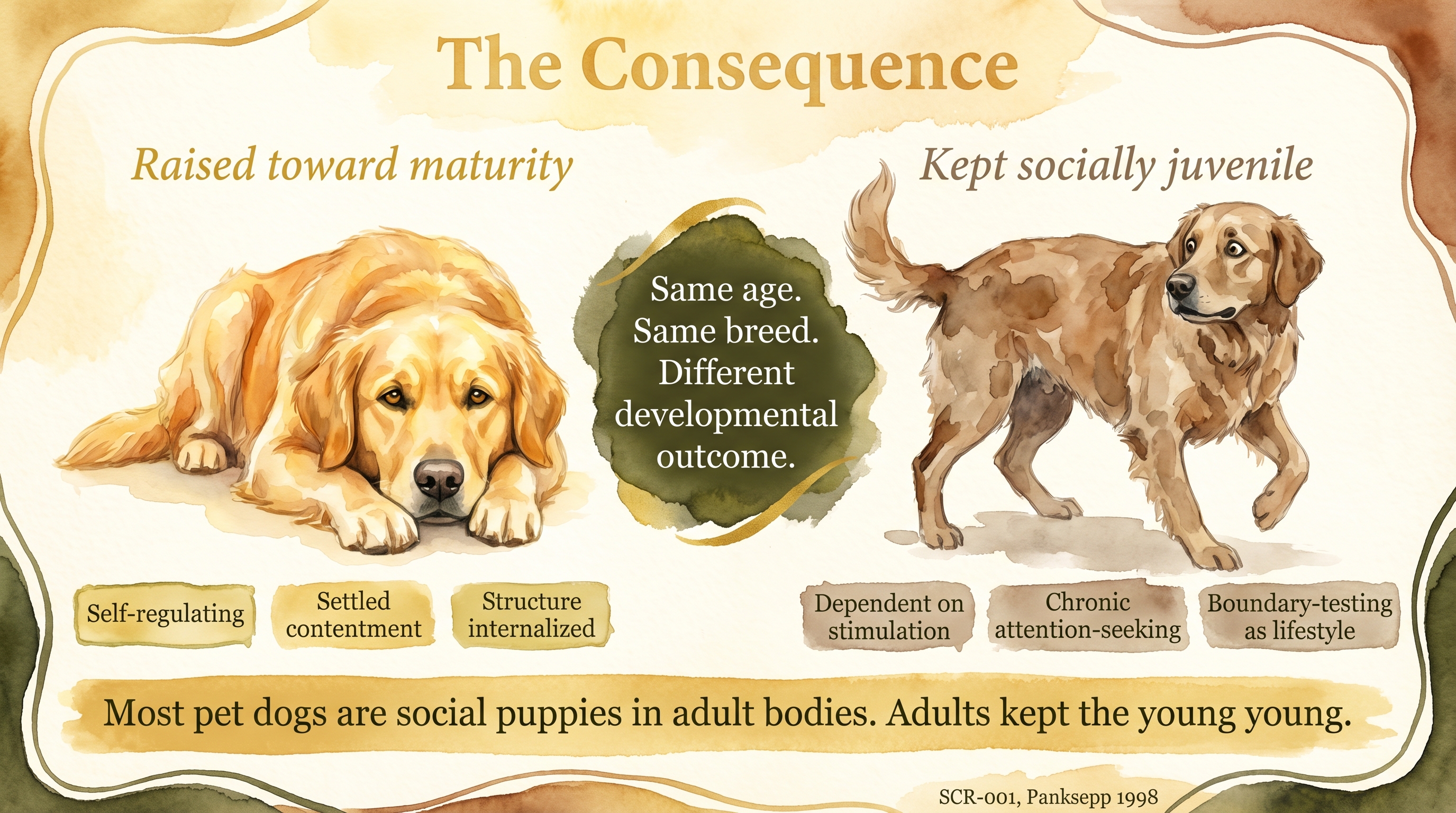
Same age, same breed, different developmental outcome - most pet dogs are social puppies in adult bodies.
Key Takeaways
- Many pet dogs show juvenile social patterns well into adulthood - poor settling, chronic attention-seeking, boundary-testing as a lifestyle.
- JB argues this happens because neither the playmate model nor the training model pulls the young organism toward genuine adult function.
- No other mammalian parenting relationship routinely keeps the young developmentally young instead of raising them toward maturity.
- The Five Pillars are designed as developmental scaffolding, not symptom management - the goal is a genuinely mature adult dog.
The Evidence
- Domestication literature summarized in SCR-001dogs and wolves
Supports the deep evolutionary backdrop of dog-human cohabitation and the expectation that development unfolded inside social human environments. - Huber, L. et al. and related work summarized in SCR-010domestic dogs
Dogs show strong social fidelity and copy demonstrated actions even when simpler alternatives are available, reinforcing the developmental importance of what adults model. - Panksepp-based affective systems summarized in SCR-014mammals, with canine application
CARE and PANIC-GRIEF systems are relevant to attachment, social regulation, and the consequences of how dependency is organized.
- domestic dogs and JB synthesis
The claim that many modern pet dogs remain socially juvenile because current raising and training patterns fail to pull them toward adult function is a philosophical synthesis, not a directly tested intervention result.
No published study directly tests the specific claims or protocols described in this entry within a controlled canine trial.
SCR References
Sources
- Huber, L., et al. (2018). Would dogs copy irrelevant actions from their human caregiver? Learning and Behavior, 46(4), 387-397.
- Panksepp, J. (1998). Affective Neuroscience. Oxford University Press.
- Salomons, H., Smith, K. C. M., Callahan-Beckel, M., Callahan, M., Levy, K., Kennedy, B. S., Bray, E. E., Gnanadesikan, G. E., Horschler, D. J., Gruen, M., Tan, J., White, P., vonHoldt, B. M., MacLean, E. L., & Hare, B. (2021). Cooperative communication with humans evolved to emerge early in domestic dogs. Current Biology, 31(14), 3137-3144.e11. https://doi.org/10.1016/j.cub.2021.06.051
- Domestication literature summarized in SCR-001. Documents domestication evidence and Panksepp affective-systems framework. The social-puppy-in-adult-body conclusion is JB synthesis [Heuristic] (anchors: SCR-001, SCR-014).
- Panksepp-based affective systems summarized in SCR-014. Documents domestication evidence and Panksepp affective-systems framework. The social-puppy-in-adult-body conclusion is JB synthesis [Heuristic] (anchors: SCR-001, SCR-014).