Historical Divergence
Compound evidence detail2 SCRs / 4 parts
- Documentedthe commensal pathway model of canine domestication established as the dominant framework in evolutionary biology, supported by Bergstrom 2020 genomics, Thalmann 2013 mtDNA, Larson and Bradley 2014, and Freedman 2014
- Heuristicthe JB interpretive bridge mapping the Five Pillars onto the selection pressures inferred to have operated during commensal domestication, a synthesis without direct genomic or archaeological support
- Documentedthe historical components: long dog-human cohabitation before formal obedience systems, military-era codification in Most 1910, and village-dog evidence showing social competence outside professional training structures
- Heuristicthe JB formalization thesis that institutional demands, rather than a demonstrated collapse of relational learning, best explain the rise of formal training, with modern pet-context limits kept explicit
Historical Divergence is JB's claim that the relationship with dogs changed when formalized training became the center of the bond. The documented background is that dogs lived successfully with humans for millennia before modern training systems were codified. The stronger causal reading of that history is JB's interpretive contribution. Heuristic
What It Means
The page begins with a contrast between two worlds.
In the older world, dogs lived in and around human households, camps, farms, and settlements. They learned through participation, exposure, and functional cohabitation. Human beings did not need modern professional dog training doctrine in order to live with dogs at all. Heuristic
In the later world, dog-human life increasingly became mediated by method:
- formal obedience systems
- specialist instruction
- command architecture
- codified protocols
- professionalized intervention
JB calls the shift between those worlds the historical divergence.
This is not a claim that all skill teaching is wrong or that no one in earlier periods ever intentionally shaped dog behavior. Heuristic The narrower claim is that systematic codification became a new center of gravity. A relational and environmental process was increasingly reframed as a technical one.
SCR-158 is important here because it keeps the rhetoric disciplined. It allows JB to say the documented sequence matters: long cohabitation came first, systematic training codification came much later, and major formalization is historically linked to institutional needs such as military and working contexts. It does not allow JB to say that every downstream causal implication is proven history. Heuristic
JB's thesis is that once method became central, the dog increasingly came to be viewed as a subject of behavioral production rather than a developing social organism. Heuristic The relationship itself began to bend around technique. That shift, in JB's reading, helps explain why modern dog life can feel so intervention-heavy.
Why It Matters for Your Dog
This page matters because it changes the starting question. Instead of beginning with "Which training system should I use?" JB asks, "Why am I assuming a system of formal training is the center of life with this dog in the first place?" Heuristic
Historical Divergence is JB's argument that the relationship changed when method became primary and ordinary relational raising stopped being treated as enough.
That reframe does not outlaw teaching. It relocates it. The center becomes calm structure, parental guidance, mentorship, prevention, and subtle correction rather than protocol management.
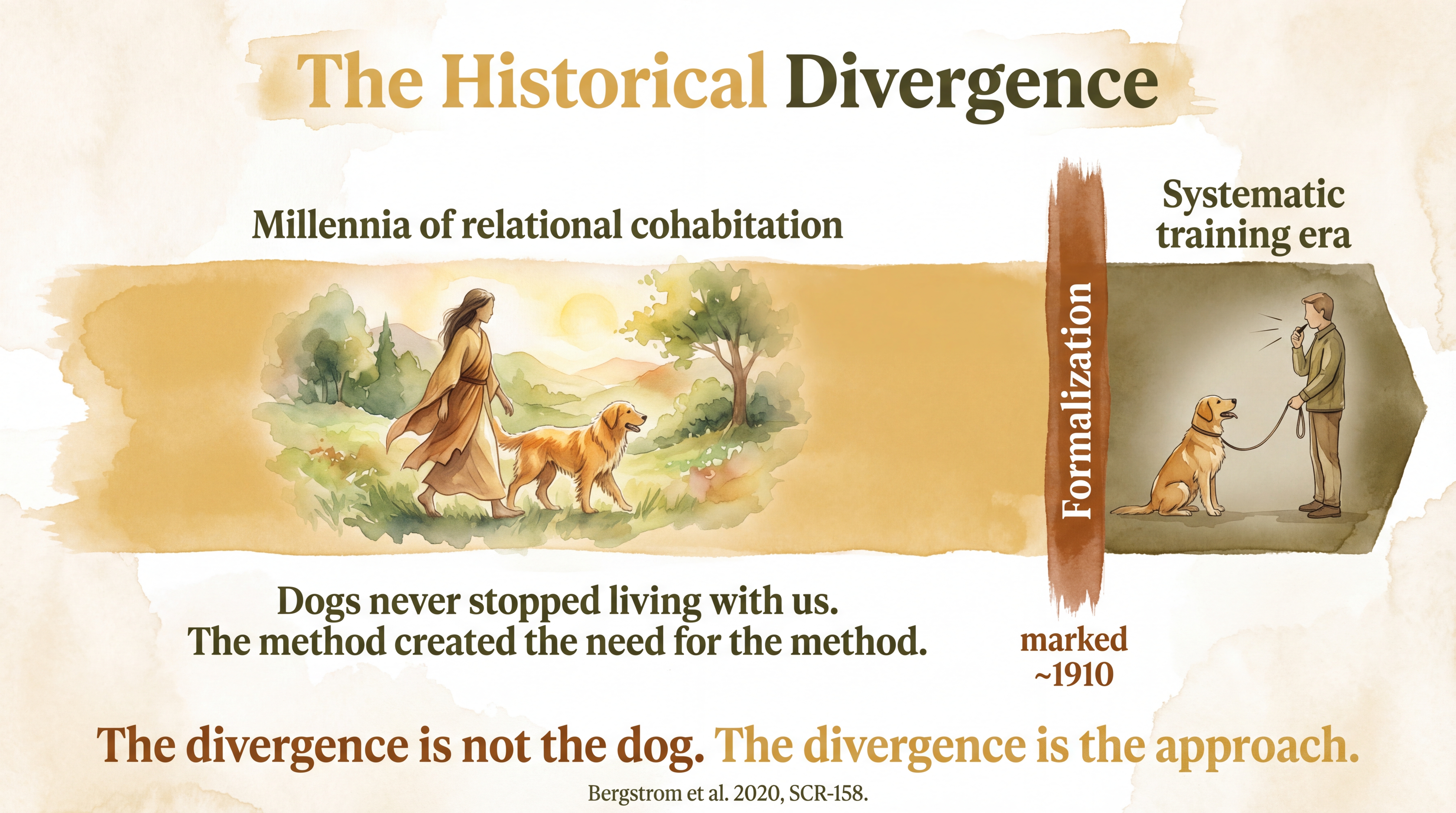
Dogs never stopped living with us - the divergence is the approach, not the dog.
Key Takeaways
- Dogs lived successfully with humans for thousands of years before modern training systems were codified.
- JB argues the divergence happened when method became the center of the bond, replacing ordinary relational raising.
- The historical timeline is documented. The causal claim that formalization created a self-reinforcing cycle of intervention is JB's interpretive contribution.
- The reframe changes the starting question: not 'which system?' but 'why am I assuming a system is the center of life with this dog?'
The Evidence
- Domestication literature summarized in SCR-001ancient dogs and wolves
Supports a long pre-modern history of dog-human cohabitation that predates modern formal training systems by many thousands of years. - Training-history sources summarized in SCR-158domestic dog, historical literature
Places major codification of modern dog training in later institutional contexts rather than at the origin of dog-human coexistence.
- domestic dogs and JB synthesis
The claim that formalization changed the relationship and created a self-reinforcing demand for more formalization is an interpretive historical synthesis, not a settled historical result.
No published study directly tests the specific claims or protocols described in this entry within a controlled canine trial.
SCR References
Sources
- Bergstrom, A., et al. (2020). Origins and genetic legacy of prehistoric dogs. Science, 370(6516), 557-564.
- Hare, B., & Woods, V. (2013). The Genius of Dogs.
- Domestication literature summarized in SCR-001. Documents commensal-pathway evidence and training-history timeline. The causal reading that formalization itself produced modern dog-behavior pathology is JB synthesis [Heuristic] (anchors: SCR-001, SCR-158).
- Training-history sources summarized in SCR-158. Documents commensal-pathway evidence and training-history timeline. The causal reading that formalization itself produced modern dog-behavior pathology is JB synthesis [Heuristic] (anchors: SCR-001, SCR-158).