Raising vs. Training
Compound evidence detail3 SCRs / 6 parts
- Documentedthe commensal pathway model of canine domestication established as the dominant framework in evolutionary biology, supported by Bergstrom 2020 genomics, Thalmann 2013 mtDNA, Larson and Bradley 2014, and Freedman 2014
- Heuristicthe JB interpretive bridge mapping the Five Pillars onto the selection pressures inferred to have operated during commensal domestication, a synthesis without direct genomic or archaeological support
- Observed-JBthe ethological evidence that adult dogs deploy specific social signals with situational selectivity and brief contextual deployment (Abrantes, Bekoff, Mech) together with the Bray, MacLean et al. 2021 retriever puppy demonstration that canine attention to human gestural cues is biologically pre-loaded
- Heuristicthe JB application generalizing the dog signal-precision pattern into a universal social-signaling principle and the corollary claim that high-frequency human verbal praise categorically degrades communicative information in household contexts
- Documentedthe historical components: long dog-human cohabitation before formal obedience systems, military-era codification in Most 1910, and village-dog evidence showing social competence outside professional training structures
- Heuristicthe JB formalization thesis that institutional demands, rather than a demonstrated collapse of relational learning, best explain the rise of formal training, with modern pet-context limits kept explicit
Raising vs. Training is the philosophical distinction underneath almost everything JB says. The basic argument is that puppies are meant to develop into functional adults through social life, environmental structure, and guided maturation. Training, by contrast, is a formal process for producing specific behaviors through arranged contingencies. JB is not claiming that training can never produce results. JB is claiming that producing results is not the same thing as raising an organism. That argument is largely heuristic, even where it draws support from documented observations. Heuristic
What It Means
To raise a puppy is to build a developmental environment. To train a puppy is to engineer behavioral outcomes.
Those two projects can overlap in places, but they are not identical. Raising asks:
- What kind of adult is this puppy becoming?
- What social models surround the puppy?
- What emotional floor does the household provide?
- What behaviors are prevented from taking root in the first place?
Training asks a different set of questions:
- What behavior do we want right now?
- What cue will produce it?
- What consequence will increase or decrease it?
- How reliably can we reproduce it across repetitions?
JB's criticism is not that the second set of questions is always illegitimate. It is that the second set has become so culturally dominant that people now mistake it for the whole task of bringing up a young dog. Heuristic
The historical layer matters here. The commensal pathway is a leading working model in evolutionary biology for how dogs came into human life. JB then adds its interpretive claim: if dogs entered human social worlds through long cohabitation and selection for proximity, then a modern raising framework that emphasizes social orientation, calm adult guidance, and environmental structure may be more continuous with that relationship than a highly formalized training paradigm. Heuristic
That is a carefully hedged claim. JB cannot say the Five Pillars were scientifically proven to be the selection pressures of domestication. Heuristic They were not. SCR-001 is explicit about that boundary. What JB can say is that the developmental logic of social mammals and the historical dog-human relationship make the raising frame more coherent than the modern assumption that a puppy is primarily an obedience project.
Signal Precision helps sharpen the contrast. Natural social life works through timing, context, and relational legibility. Mixed Evidence Formalized training systems often replace that legibility with explicit cues, markers, and reinforcement schedules. Again, JB is not denying that those systems can be effective at behavior production. The point is that they represent a different architecture of adult-young relationship.
This is why JB often says the method creates the need for the method. That phrase must be handled with great care. It is one of the highest slippage risks in the whole knowledge base. SCR-158 does not license the claim as settled historical science. It licenses it as a heuristic thesis about what happens when living with dogs is reorganized into formalized instruction. The more life is chopped into cue-reward-management cycles, the more the adult may need those cycles to keep the dog organized.
The practical distinction becomes:
- raising develops internal organization
- training manages displayed behavior
JB's argument is that most families actually want the first outcome, even when the industry keeps selling them the second process.
Why It Matters for Your Dog
This distinction changes what success looks like.
If the goal is training, success is usually measured by performance: the puppy sits, stays, comes, waits, lies down, or stops doing something when told.
If the goal is raising, success looks broader:
- the puppy settles more easily
- the puppy reads household rhythm
- the puppy handles frustration with more maturity
- the puppy needs less active management over time
JB is not trying to replace one training method with another. It is trying to move the center of gravity from behavior management to developmental raising.
This also explains why JB does not accept the industry's favorite false binary: reward versus punishment. That framing assumes the main question is which behavior-control technology the adult will use. JB says there is a prior question. Why are we treating the whole relationship as a behavior-control problem to begin with?
That does not eliminate the value of skill teaching. Families still need practical behaviors. Heuristic But inside JB, specific skills are meant to sit downstream of the developmental environment, not replace it.
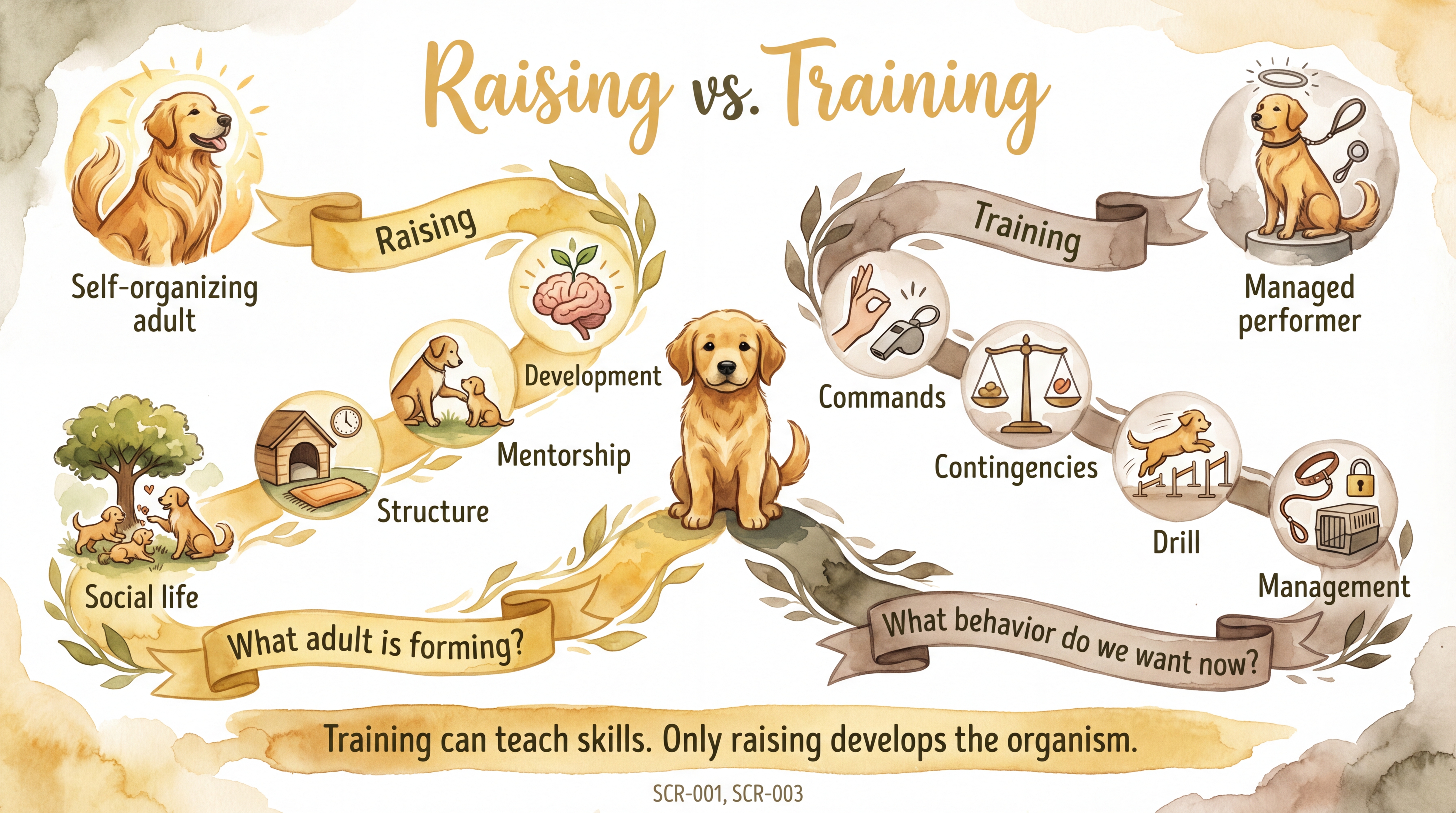
Training can teach skills. Only raising develops the organism.
Key Takeaways
- Raising a puppy is about building a developmental environment and a self-regulating adult dog - training is about producing specific behaviors on cue.
- These two goals can overlap but they are not the same; raising asks what kind of adult the puppy is becoming, while training asks what behavior you want right now.
- Most families actually want a well-developed dog who can live naturally in the family, but the industry keeps selling them training techniques for behavior management.
- Internal organization (raising) develops naturally through social life, mentorship, and structure - managed behavior (training) depends on the adult continuing to arrange contingencies.
The Evidence
This entry uses mixed-evidence claim-level tags beyond the dedicated EvidenceBlocks below. These tags mark claims that combine documented findings with observed practice, heuristic application, or unresolved gaps.
- Hare, Woods, Bergstrom, and related domestication literature summarized in SCR-001wolves, dogs, fox analog literature
The commensal pathway is currently the dominant model of dog domestication. That supports continuity between dogs and human social environments, but it does not directly prove the Five Pillars or the full JB framework. - Canine communication literature summarized in SCR-003domestic dogs and canids
Dogs operate in a social world shaped by contextual signals and relational timing, supporting JB's contrast between natural social legibility and heavily engineered instruction systems.
The claim that 'raising' is developmentally primary while 'training' is a later formalization that can create dependence on its own management architecture is a heuristic philosophical thesis. SCR-158 specifically flags this as a high-slippage area that must not be presented as settled science.
No published study directly tests the specific claims or protocols described in this entry within a controlled canine trial.
SCR References
Sources
- Hare, B. & Woods, V. (2013). The Genius of Dogs. Dutton.
- Coppinger, R. & Coppinger, L. (2001). Dogs: A New Understanding of Canine Origin, Behavior, and Evolution. University of Chicago Press.
- Horowitz, A. (2009). Inside of a Dog: What Dogs See, Smell, and Know.: What Do
- Canine communication literature summarized in SCR-003. Documents canine signal-precision literature as ethological background. The raising-versus-training thesis is JB synthesis [Heuristic, high-slippage] (anchor: SCR-003); the source literature does not test or compare raising frameworks against training frameworks.